TCAN1051HVDQ1 - ±58V CAN FD Transceiver 2Mbps | TI
MPN: TCAN1051HVDQ1 ✓ Active| Qty | Unit Price | Extended |
|---|---|---|
| 1 | $1 | $1.00 |
| 10 | $1 | $10.00 |
| 100 | $1 | $100.00 |
| 500 | $1 | $500.00 |
| 1,000 | $1 | $1,000.00 |
TCAN1051HVDQ1 Overview
A CAN transceiver is the physical layer interface between a CAN protocol controller and the differential bus lines CANH and CANL. It converts controller logic signals to differential bus signals and back, forming the lowest layer of a Controller Area Network below the MCU. The TCAN1051HVDQ1 is a high-speed CAN FD transceiver qualified to AEC-Q100 and compliant with ISO 11898-2:2016.
Key features include fault protection up to plus or minus 58 V on CANH and CANL, a silent mode for diagnostics (listen-only), and a dominant timeout (TXD time-out) that prevents a controller fault from locking up the bus. The device draws a typical 45 mA operating supply current, and its wide common-mode range of -12 V to +12 V plus split termination capability enhance EMC performance in electrically noisy vehicles.
Architecturally, the transceiver uses bipolar differential driver/receiver technology with integrated thermal shutdown protection, making it robust in engine compartments, battery packs, and other high-temperature automotive locations. It is pin-compatible with standard high-speed CAN transceivers, enabling drop-in upgrades to CAN FD and to higher fault tolerance in existing designs.
Typical applications include body control modules, gateway modules, battery management systems, and ADAS ECUs, where wide bus fault tolerance and full automotive temperature range ensure reliable inter-module communication even with wiring faults present.
Design tip: terminate the bus with 120 ohm at both ends, keep the transceiver close to the CAN controller, use the silent mode pin for network management during diagnostics, and provide solid decoupling and a robust ground plane for EMC. Pricing per unit is approximately as of 2026-08-30 per distributor listings.
Drop-in alternatives for TCAN1051HVDQ1 — same package, pin-to-pin compatible. Different-package parts requiring PCB rework are excluded.
Variants in this series
Same-series models that are drop-in compatible with TCAN1051HVDQ1 (same form factor and footprint) — differing in Package, Data Rate.
Quick Comparison Tool — Select alternative parts for side-by-side comparison:
TCAN1051GVDRQ1
✓ In Stock
$1.28 / Unit
View Datasheet →TCAN1042GVDRQ1
✓ In Stock
$0.349 / Unit
View Datasheet →TCAN4550RGYRQ1
✓ In Stock
$3.1 / Unit
View Datasheet →TJA1051T/3/1
✓ In Stock
$0.4102 / Unit
View Datasheet →TCAN1051HQ1
📋 Reference alternative (not in catalog)
NCV7342
📋 Reference alternative (not in catalog)
TCAN1051HVDQ1 Specifications
| Function | High-speed CAN FD transceiver |
| Data Rate | 2 Mbps |
| Bus Fault Protection | ±58 V on CANH and CANL |
| Supply Voltage Range | 4.5 V to 5.5 V |
| Operating Supply Current | 45 mA (typical) |
| Common-Mode Voltage Range | -12 V to +12 V |
| Protocol Standard | ISO 11898-2:2016 |
| Modes | Normal, Silent (listen-only) |
| TXD Dominant Timeout | Yes |
| Thermal Shutdown | Yes |
| Operating Temperature | -55C to +125C |
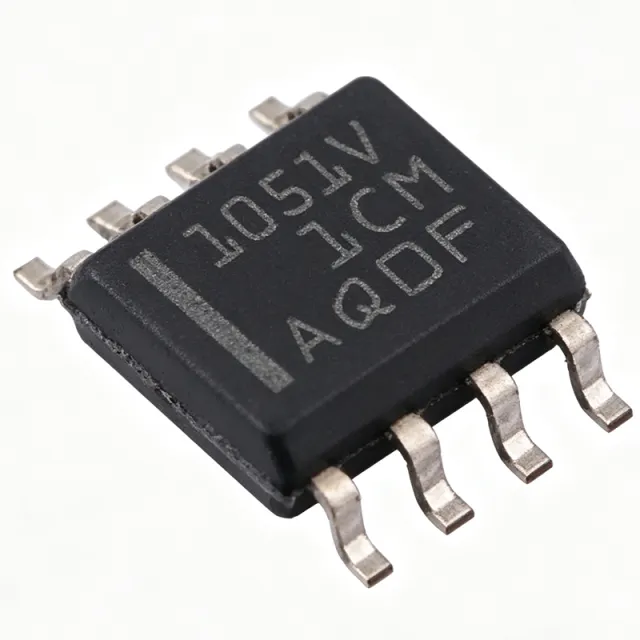
| Package | SOIC-8 (D) |
| Mounting Type | Surface Mount |
| Automotive Qualification | AEC-Q100 |
| RoHS Status | Compliant |
TCAN1051HVDQ1 Pin Configuration
| Pin 1 | TXD — Transmit data input from CAN controller (dominant = low) |
| Pin 2 | GND — Ground |
| Pin 3 | VCC — 4.5 V to 5.5 V supply |
| Pin 4 | RXD — Receive data output to CAN controller |
| Pin 5 | VIO — [DATA_NEEDED: pin function for D-package variant - VIO only on V-suffix parts; may be STB or NC] |
| Pin 6 | CANL — CAN low bus line (±58 V fault protected) |
| Pin 7 | CANH — CAN high bus line (±58 V fault protected) |
| Pin 8 | [DATA_NEEDED: pin 8 name - STB/EN or S] — Mode control / standby input |
Typical Applications
TCAN1051HVDQ1 is suitable for 6 applications: Body Control Module (BCM), Battery Management System (BMS), Automotive Gateway Module, ADAS ECU, Industrial CAN / CANopen Networks, Electric Powertrain and OBC Communication.
Body Control Module (BCM)
In a body control module, the TCAN1051HVDQ1 bridges the MCU CAN controller to the vehicle CAN bus handling lighting, door, and access functions. Its ±58 V fault protection survives wiring-harness shorts to battery or load-dump events common in door and lamp circuits, while the -55C to +125C range covers engine-bay-mounted BCMs. Silent mode lets the module listen during diagnostics without disturbing bus traffic. Per ISO 11898-2:2016, the transceiver drives 2 Mbps CAN FD frames reliably with split termination for EMC.
Recommended
Battery Management System (BMS)
Battery management systems in EVs place CAN transceivers near high-voltage contactors and switch loads, where transient faults are frequent. The TCAN1051HVDQ1 withstands ±58 V faults on CANH/CANL and integrates thermal shutdown, making it well suited to BMS communication between cell-monitoring MCUs and the vehicle gateway. Operating from a 4.5 V to 5.5 V rail at 45 mA typical, it supports 2 Mbps CAN FD traffic for cell-voltage and temperature telemetry, and the dominant timeout prevents a latched controller from blocking fault broadcasts.
Recommended
Automotive Gateway Module
Gateway modules aggregate multiple CAN, CAN FD, and Ethernet domains, so transceiver fault robustness directly affects vehicle availability. The TCAN1051HVDQ1 tolerates ±58 V bus faults and -12 V to +12 V common-mode voltage, keeping a gateway node alive during harness faults while other nodes recover. Its 2 Mbps CAN FD rate matches modern gateways, and AEC-Q100 qualification plus the SOIC-8 footprint permit dense multi-channel layouts with split termination filtering on each port for EMC.
Recommended
ADAS ECU
ADAS ECUs exchange sensor and actuator data over low-latency CAN FD links where frame integrity is safety-critical. The TCAN1051HVDQ1 provides deterministic 2 Mbps CAN FD signaling compliant with ISO 11898-2:2016, ±58 V fault tolerance against power-domain faults from radar/camera actuators, and -55C to +125C operation for windshield- or radiator-adjacent mounting. Silent mode supports diagnostic sniffing of the ADAS bus during calibration without injecting traffic, and thermal shutdown protects the module in hot engine-bay enclosures.
Recommended
Industrial CAN / CANopen Networks
In factory automation, CANopen and DeviceNet-style nodes benefit from the TCAN1051HVDQ1 although it is automotive-qualified; the AEC-Q100 margin exceeds industrial requirements. The transceiver tolerates ±58 V bus faults caused by miswired 24 V or 48 V lines, works from a standard 5 V supply at 45 mA, and drives 2 Mbps CAN FD segments up to 40 m. Split termination and -12 V to +12 V common-mode range suppress motor-drive noise, and its SOIC-8 footprint drops into legacy 82C251-style layouts after pin check.
Recommended
Electric Powertrain and OBC Communication
Onboard chargers and traction-inverter controllers sit in high-EMI, high-temperature zones where CAN links must survive transient coupling. The TCAN1051HVDQ1s ±58 V fault tolerance, thermal shutdown, and -55C to +125C rating keep the charger-to-VCU CAN FD link alive during load dump and ignition transients. Operating from 4.5 V to 5.5 V with 45 mA typical draw, it transmits 2 Mbps frames per ISO 11898-2:2016, and the TXD dominant timeout stops a hung controller from broadcasting dominant state onto the shared powertrain bus.
Recommended
Recommended Products Summary
Engineering reference data for TCAN1051HVDQ1 — comparison, design guidance, and compliance information.
Selection Guide
Comparison with Alternatives
| Parameter | This Product | TCAN1051HQ1 | TCAN1051GVDRQ1 | TJA1051T/3 |
|---|---|---|---|---|
| Package | SOIC-8 (D) | SOIC-8 (D) - same | SOIC-8 (D) - same | SOIC-8 - same footprint |
| Brand | Texas Instruments | Texas Instruments | Texas Instruments | NXP Semiconductors |
| Supply Voltage | 4.5 V to 5.5 V | 4.5 V to 5.5 V | 4.5 V to 5.5 V | 4.75 V to 5.25 V (typical) |
| Operating Temperature | -55C to +125C | -55C to +125C | -55C to +125C | -40C to +125C |
| CAN FD Support | Yes | Yes | Yes | Verify variant |
| AEC-Q100 | Qualified | Qualified | Qualified | AEC-Q100 (TJA1051T/3 automotive) |
| Protocol Standard | ISO 11898-2:2016 | ISO 11898-2:2016 | ISO 11898-2:2016 | ISO 11898-2 |
Key Differentiators
- ±58 V bus fault protection (vs TCAN1051HQ1)
- Automotive full temperature range (vs TJA1051T/3)
- CAN FD native support (vs TCAN1051HQ1)
Design Notes
Place the TCAN1051HVDQ1 as close as possible to the CAN connector and the MCU CAN controller. Decouple VCC with 0.1 uF plus 4.7 uF ceramic capacitors within 2 mm of pin 3. Route CANH/CANL as a matched differential pair; keep TXD/RXD traces short to preserve 2 Mbps timing margins.
Terminate the bus with 120 ohm at both physical ends only - stub termination causes reflections that corrupt CAN FD data-phase bits. If silent mode is unused, tie the mode pin to its inactive level rather than leaving it floating. Do not rely on the transceiver to survive sustained battery shorts indefinitely; the ±58 V rating covers transients and faults, but verify fuse coordination in the harness.
Use split termination (two 60 ohm resistors with a 4.7 nF to 10 nF center capacitor to ground) to filter common-mode noise in electrically noisy vehicles. A common-mode choke between transceiver and connector further suppresses RF emissions per vehicle EMC requirements. Keep the ground plane unbroken under the bus lines.
The transceiver dissipates power mainly during dominant-state bus driving. At 45 mA typical supply current and a 45 ohm effective bus load, dissipation stays well within SOIC-8 limits, but verify junction temperature at +125C ambient with worst-case bus load and sustained dominant traffic; enable thermal shutdown margin by minimizing nearby hot components.
Compliance Information
AEC-Q100 qualified per TI product page. RoHS compliant per distributor listings; REACH/halogen status [DATA_NEEDED].