The TPS536C9RSLR is a Texas Instruments dual-channel, up to 12-phase step-down digital multiphase D-CAP+ controller with Intel VR14 SVID and PMBus interfaces, packaged in a thermally enhanced 48-pin VQFN (RSL) measuring 6x6 mm and rated -40C to +125C. It integrates non-volatile memory (NVM) for standalone configuration, supports undershoot reduction (USR) and overshoot reduction (OSR) for fast transients with low output capacitance, and is fully compatible with TI NexFET power stages. The part is in stock at XAIPART with 99999 units, MOQ 1, priced from $24.5455 at single quantity down to $14.3182 at 1000+ pieces as of 2026-08-30, and its lifecycle status is active. It is purpose-built for Intel VR14 server CPU core rails, AI accelerator and GPU power, and high-current FPGA/ASIC point-of-load conversion.
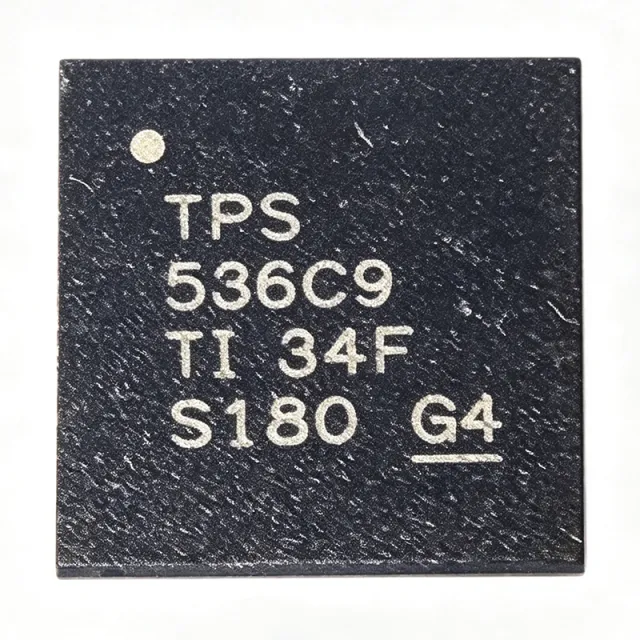
What Is the TPS536C9RSLR and Why Does It Matter for Server Power Design?
A multiphase buck controller interleaves multiple power stages, sharing current across phases to distribute thermal load, reduce input and output ripple, and enable very fast transient response. The TPS536C9RSLR sits at the top of this hierarchy: it orchestrates TI NexFET power stages — each integrating driver and FET functions — across two channels with a combined phase count of up to 12 (N + M <= 12).
Its defining feature set, verified from the TI datasheet and XAIPART product database:
| Parameter | Verified Value |
|---|---|
| Topology | Step-down multiphase buck controller |
| Control architecture | D-CAP+ with undershoot reduction (USR) and overshoot reduction (OSR) |
| Channels | 2 |
| Total phases | Up to 12 (N + M <= 12) |
| Interfaces | PMBus, Intel VR14 SVID |
| Non-volatile memory | Yes (integrated NVM) |
| Power stage compatibility | TI NexFET power stages |
| Package | 48-VQFN (RSL), 6x6 mm |
| Operating temperature | -40C to +125C |
| Remote sensing | Differential remote voltage sense |
| Current sharing | Multiphase current balance |
| RoHS status | Compliant |
| Lifecycle status | Active |
For Intel VR14 server platforms, SVID protocol version matters: SVID versions are not backward compatible between VR generations, so the controller must match the processor VR specification. The TPS536C9RSLR is explicitly VR14 SVID compliant per the TI datasheet, which is why it wins over older family members for VR14 sockets.
How Do You Select and Design In the TPS536C9RSLR?
Designing in this controller is a digital-first process. Unlike analog VR controllers that need external compensation networks, the TPS536C9RSLR's digital loop control provides programmable transient behavior and startup sequencing without external compensation components — but it requires configuration through its integrated NVM.
Step-by-step design flow:
- Define phase allocation. Split the N + M <= 12 phases across the two channels to match your load profile. A typical VR14 design assigns more phases to VCORE and fewer to a secondary rail (for example, 8 phases for VCORE and 4 for a secondary high-current rail).
- Select TI NexFET power stages. The controller is fully compatible with TI NexFET power stages (such as the CSD and TPS power-stage families). Size each stage for the per-phase current, with per-phase current sensing fed back to the controller for current balancing. Consult the TI datasheet recommended power stage table for validated pairings.
- Configure via NVM. Use TI's Fusion Digital Power Designer GUI over PMBus to define phase assignment, output voltage ranges, SVID behavior, fault limits, and transient response settings, then program the NVM. Budget a one-time programming step in production.
- Route sense and current-sense lines carefully. Follow the TI datasheet layout guidelines for SW, VOSNS, and CS pins to achieve specified transient accuracy. Differential remote sense lines must route as Kelvin connections to the load points to compensate for PCB voltage drop at high current.
- Leverage USR/OSR to shrink the output capacitor bank. The D-CAP+ architecture with USR and OSR limits excursions during heavy load steps, allowing lower output capacitance and reduced BOM cost per server board. [VERIFY_NEEDED: exact output capacitance calculation procedure per the TI datasheet design equations]
One caution for production: because configuration lives in NVM, unprogrammed parts will not start correctly. Plan your programming flow (in-circuit programming over PMBus or pre-programmed reels) before volume build.
What Are the Best Alternatives to the TPS536C9RSLR?
There is no cross-brand pin-compatible drop-in verified for this controller. The closest options are family members and a VR14-class cross-brand part, compared below using only verified data:
| Parameter | TPS536C9RSLR | TPS53679RSBR | TPS53681RSBR | NCP81174 |
|---|---|---|---|---|
| VR interface | Intel VR14 SVID | VR13/VR13.HC | VR13 platforms | VR14-class [VERIFY_NEEDED: exact interface spec] |
| Architecture | Dual-channel D-CAP+ with USR/OSR | Similar dual-channel D-CAP+ | Dual-channel D-CAP+ | Multiphase controller [VERIFY_NEEDED: architecture details] |
| Footprint relationship | Reference part | Same footprint family | Same footprint family | Not pin-compatible |
| Board impact | — | Firmware/config redesign required | Firmware/config redesign required | Board redesign required |
| Best for | New Intel VR14 designs | Legacy VR13/VR13.HC platforms | VR13 platforms | VR14-class designs accepting a redesign |
Selection guidance: choose the TPS536C9RSLR for VR14 CPUs. The TPS53679 targets earlier VR13/VR13.HC platforms, and the TPS53681 serves VR13 designs — both within the same 48-pin VQFN footprint family, but VR interface compliance, phase-count mapping, and NVM configuration differ between family members, so firmware/config redesign is required when swapping. The onsemi NCP81174 serves similar VR14 applications but requires a board redesign. Always verify SVID protocol compatibility first.
What Is the Market Position, Lifecycle, and Supply Situation of the TPS536C9RSLR?
The lifecycle status of the TPS536C9RSLR is active per the XAIPART product database, and it is RoHS compliant in a lead-free 48-pin VQFN (RSL) package. Note that automotive AEC-Q100 qualification is not claimed for this controller; it is intended for server, datacenter, and industrial applications rather than automotive.
Supply snapshot as of 2026-08-30:
| Quantity Tier | Unit Price (USD) |
|---|---|
| 1+ | $24.5455 |
| 10+ | $17.7273 |
| 100+ | $15.6818 |
| 500+ | $15.00 |
| 1000+ | $14.3182 |
XAIPART lists 99999 units in stock with MOQ 1. DigiKey also lists the part in stock with same-day shipping as of 2026-08-29, and Octopart currently shows one distributor carrying stock. For large reel quantities (3000 per reel), lead time may extend to factory scheduling — check TI.com or your TI authorized distributor for real-time inventory before committing to a production build. Secondary sources such as Win Source and Xecor also list the part; verify authenticity and date codes when using non-franchise distributors. [DATA_NEEDED: manufacturer forecast, demand trend, and lifecycle forecast data]
What Should Buyers Watch Next for the TPS536C9RSLR?
Anchor your sourcing and design decisions to these verified facts:
- Match the VR generation. Because SVID protocol versions are not backward compatible, any Intel platform migration to a new VR specification forces a controller change. For VR14 today, the TPS536C9RSLR is the verified-compliant TI choice; its PMBus interface also future-proofs it for non-Intel dual-rail uses such as GPU and AI accelerator power.
- Plan for the digital configuration flow. NVM programming via Fusion Digital Power Designer is mandatory. Teams moving from analog VR controllers should budget tooling and production programming steps.
- Buy at tier to cut unit cost ~42%. Moving from qty 1 ($24.5455) to qty 1000+ ($14.3182) as of 2026-08-30 reduces unit cost substantially; XAIPART's deep stock (99999 units) covers prototyping through pilot production.
- Design for low output capacitance early. USR/OSR is the headline economic benefit — fewer output capacitors per board — but it depends on correct configuration and clean SW, VOSNS, and CS layout per the TI datasheet.
- Watch platform transitions. The related VR13-class parts (TPS53679RSBR, TPS53681RSBR) serve legacy platforms; as VR14 and successors dominate new server designs, align new designs with VR14-compliant silicon and keep legacy controllers only for service builds. [VERIFY_NEEDED: future Intel VR specification roadmap details]
Ready to source? Visit the TPS536C9RSLR product page for live stock and pricing, browse the DC-DC Converters category for complementary parts, and explore more multiphase controller technical guides. The authoritative datasheet is always the latest revision at TI.com.
Comments
Be the first to comment.
🔐 Please sign in to post a comment.
Don't have an account? Sign up