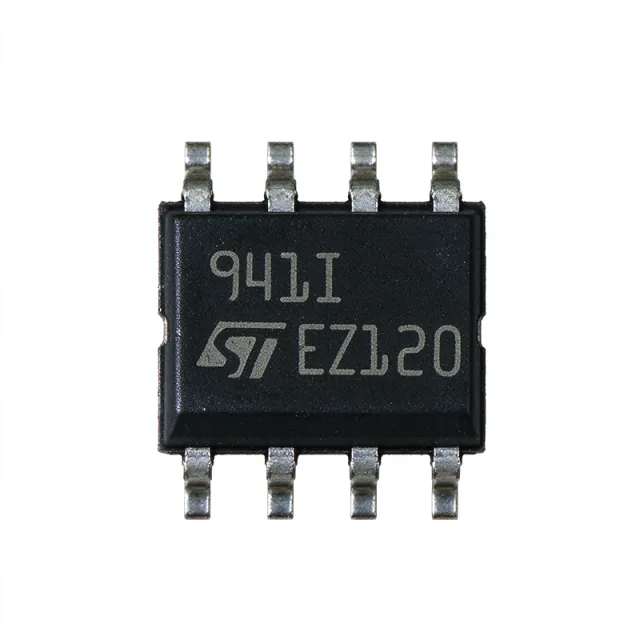
TS941ID
TS941ID - 2.5-10V Rail-to-Rail Op Amp | STMicroelectronics
STMicroelectronics TS941ID is a single-circuit, general-purpose operational amplifier featuring a rail-to-rail output, 2.5 V to 10 V supply operation, and an 8-pin SOIC package. The device belongs to the TS94x micropower operational-amplifier family and is designed for instrumentation, signal buffering, and other low-voltage analog signal-chain applications. Its low-noise operation, high input impedance, and approximately 1 pA input-bias current support accurate handling of high-impedance sources while its rail-to-rail output improves dynamic range near the positive and negative supply rails.
An operational amplifier, or op amp, is a high-gain differential amplifier used to amplify, buffer, compare, and filter analog signals. The TS941ID sits within the operational-amplifier hierarchy and operates from a 2.5 V to 10 V supply, making it suitable for battery-powered, industrial-control, test-and-measurement, and portable equipment. Its rail-to-rail output stage allows the output voltage to approach the supply limits more closely than a conventional output stage, although the exact output swing and input common-mode behavior must be checked in the manufacturer datasheet for the selected supply voltage.
Key features include a single amplifier configuration, rail-to-rail output, low-noise operation, high input impedance, and very low input-bias current of approximately 1 pA. The 2.5 V minimum supply voltage supports compact, low-energy systems, while the 10 V maximum provides compatibility with common industrial and laboratory supply rails. The manufacturer specifies operation over -40 °C to +85 °C, covering industrial temperature requirements without requiring an automotive-qualified variant.
The TS941ID is intended for general-purpose precision signal conditioning rather than as a high-speed communications amplifier. Its micropower-oriented design is valuable when battery current is important, but the precise quiescent-current value should be taken from the manufacturer datasheet. The approximately 1 pA input-bias current is particularly useful with high-impedance sensors because it limits the DC current drawn through the source resistance and helps reduce input-offset errors.
Typical applications include sensor-signal conditioning, low-current transimpedance buffering, portable instrumentation, industrial measurement, and general analog signal conditioning. In a transimpedance stage, the TS941ID can be paired with a suitable feedback resistor and compensation capacitor while its low input-bias current reduces bias-current-induced error. In instrumentation, it can buffer inputs before a higher-precision converter or provide gain around sensors whose output range does not use the complete supply span.
When designing around the TS941ID, verify input common-mode range, output swing, unity-gain stability, noise, slew rate, and quiescent current against the actual load and supply conditions. Place input, feedback, and decoupling connections for low noise and stable feedback operation, and include adequate output-current margin for capacitive or resistive loads. The 8-pin SOIC footprint is convenient for conventional surface-mount assembly but is not as compact as the smallest QFN packages.
This product page consolidates the verified manufacturer information, distributor availability references, family-level alternatives, parameter comparisons, and practical design guidance. It distinguishes confirmed TS941ID data from specifications that still require confirmation from the manufacturer datasheet, helping engineers identify the part faster without presenting unverified values as established facts.
USD $0.82
স্টক অনুপস্থিত