উপশ্রেণী

পণ্য (44,000+)

TS952ID - Dual 3MHz Rail-to-Rail Op Amp | STMicroelectronics
TS952ID

TS952ID - Dual 3MHz Rail-to-Rail Op Amp | STMicroelectronics

STMicroelectronics TS952ID is a dual, input/output rail-to-rail BiCMOS operational amplifier with a 3 MHz gain-bandwidth product, 1 V/us slew rate, and operation from 2.7 V to 12 V in an 8-pin SOIC package. It is optimized and specified for both 3 V and 5 V supply rails, making it suitable for low-voltage analog systems that require an amplifier to approach its supply limits at the input and output. An operational amplifier, or op amp, is a high-gain analog building block used in amplification, buffering, filtering, sensing, and feedback-control circuits. The TS952 belongs to the rail-to-rail op-amp category within the broader amplifier IC and signal-chain hierarchy. Rail-to-rail input and output behavior allows signals near either supply rail to be processed with less conventional headroom loss than a fixed-input amplifier. The TS952ID provides two amplifier circuits, a 3 MHz bandwidth, and a 1 V/us slew rate. According to the STMicroelectronics TS952 product-page data, the device is optimized for 3 V and 5 V operation. Other identified features include an 80 dB supply-voltage rejection ratio, 2 kV ESD protection, and low-power operation. These characteristics make the part applicable to low-voltage sensor conditioning, portable instrumentation, audio input stages, and general-purpose analog signal processing. The BiCMOS architecture combines bipolar input-stage behavior with CMOS output circuitry and is intended to balance low-voltage operation, amplifier performance, and power efficiency. Because the TS952 is a dual device, two independent amplifier channels can share one package. The 8-pin SOIC outline also supports conventional surface-mount assembly, although final stability, bandwidth, and output-current behavior must be evaluated at the intended supply voltage and load. Typical uses include battery-powered sensor interfaces, buffered analog inputs, portable measurement systems, audio preamplification, and low-voltage control loops. At 3 V, the device is aligned with compact battery-operated systems; at 5 V, it provides additional signal range for industrial and consumer analog circuits. The 3 MHz bandwidth is sufficient for many general-purpose conditioning stages but is not intended for high-speed video or precision wideband instrumentation without further analysis. When designing around the TS952ID, verify input and output common-mode limits, output swing, load capability, noise, offset, and stability for the selected supply voltage. Decoupling capacitors should be placed close to the supply pins, and sensitive input traces should remain short and away from switching nodes. Feedback components should follow the manufacturer recommendations because gain-bandwidth, input capacitance, and capacitive loading can affect closed-loop behavior. This product record combines the verified STMicroelectronics family description, distributor package information, operating range, bandwidth, slew rate, rejection, and ESD information with practical selection guidance. It also distinguishes verified facts from specifications that still require confirmation from the complete manufacturer datasheet, avoiding unsupported claims about electrical limits or replacement parts.

RFQ যোগাযোগ
TS952IN - Dual 3MHz Rail-to-Rail Op Amp | STMicroelectronics
TS952IN

TS952IN - Dual 3MHz Rail-to-Rail Op Amp | STMicroelectronics

The STMicroelectronics TS952IN is a dual, low-power operational amplifier with input and output rail-to-rail capability, a 3 MHz gain-bandwidth product, and a 1 V/us slew rate. It operates from 2.7 V to 12 V and is packaged in an 8-pin Mini DIP. The device belongs to the TS95x family, whose BiCMOS architecture is optimized and fully specified for 3 V and 5 V operation. An operational amplifier is a voltage-controlled differential amplifier that can amplify the difference between two input voltages while providing high open-loop gain. The TS952IN contains two independent amplifier channels in one package. Rail-to-rail input operation lets each channel accept signals close to the positive or negative supply rail, while rail-to-rail output operation allows the output voltage to approach either supply limit. These characteristics make the device useful for portable instrumentation, sensor interfaces, audio paths, and low-voltage control systems. The 3 MHz gain-bandwidth product supports useful bandwidth in low-voltage signal chains without requiring a high-speed amplifier operating from a larger supply. The 1 V/us slew rate helps limit large-signal distortion when signals change quickly. Because the TS95x family is designed for low-power operation, the TS952IN is also appropriate for battery-powered equipment where a pair of independent amplifiers is useful without using two separate packages. The device is specified for a 2.7 V to 12 V supply range, with its family optimized for 3 V and 5 V systems. At low supply voltages, rail-to-rail behavior becomes especially valuable because it increases the usable input and output range relative to conventional fixed-output amplifiers. Designers should still verify the actual output swing, input common-mode range, noise, input bias current, output-current capability, and stability requirements against the manufacturer datasheet for the operating point of interest. Typical applications include buffering sensor outputs, amplifying low-level analog signals, active filtering, audio preamplification, and general-purpose signal conditioning. In a sensor interface, one channel can amplify the sensor signal while the other can provide buffering, gain, or a reference-related function. Supply bypassing, output-load compatibility, and stability with the selected feedback network are important implementation considerations for this general-purpose dual amplifier. This product page combines the verified TS952IN operating characteristics, package information, drop-in replacement findings, application guidance, and practical design notes. It is intended to help engineers identify the correct amplifier quickly, compare pin-compatible choices, and plan PCB and signal-chain changes before releasing a new design.

RFQ যোগাযোগ
TS952IPT - Dual Low-Power Rail-to-Rail Amplifier | ST
TS952IPT

TS952IPT - Dual Low-Power Rail-to-Rail Amplifier | ST

The STMicroelectronics TS952IPT is a dual, low-power operational amplifier with rail-to-rail input and rail-to-rail output capability, 35 nA input bias current, 1 V/us slew rate, 3 MHz gain-bandwidth product, and 6 mV input offset voltage in an 8-pin TSSOP package. Designed for 3 V and 5 V systems, it combines two amplifier channels in one compact surface-mount package. An operational amplifier is a high-gain analog signal-processing component that compares its differential input with a feedback-defined reference and amplifies the resulting error. The TS952IPT belongs to the rail-to-rail input/output amplifier class, allowing its input and output stages to operate close to the supply rails. This makes it useful in portable instruments, sensor interfaces, battery-powered equipment, and low-voltage industrial control systems where signal headroom is limited. Key characteristics include a low 35 nA input bias current, which reduces loading on high-impedance sources, and a 3 MHz gain-bandwidth product that supports moderate-speed signal paths. Its 1 V/us slew rate improves large-signal response, while rail-to-rail input and output stages increase usable signal range in single-supply systems. The dual configuration also reduces board area by integrating two amplifiers into one package. The TS952IPT uses a low-power BiCMOS operational-amplifier architecture. The architecture combines bipolar input behavior with CMOS-compatible output drive and low-power operation. In practical circuits, input common-mode range, output swing, output-current capability, noise, and stability with the selected feedback network determine whether it is suitable for a particular precision or signal-conditioning stage. Typical applications include low-voltage sensor amplification, photodiode-biased readout stages, portable measurement equipment, audio signal conditioning, general-purpose buffer circuits, and industrial control interfaces. The 3 V and 5 V operating environments align the device with battery-powered products, data-acquisition modules, embedded systems, and compact instrumentation. When designing a PCB around the TS952IPT, follow the manufacturer datasheet for decoupling, exposed pad or thermal guidance, input capacitance, and output-load limitations. Place the input and output bypass capacitors close to their associated pins, maintain short feedback paths, and verify stability with the actual source impedance and capacitive load. This product page combines the TS952IPT technical characteristics, sourcing information, package guidance, practical application notes, and replacement analysis. It is designed to help engineers identify the correct low-power amplifier and plan a robust implementation without changing the established 8-pin TSSOP footprint.

RFQ যোগাযোগ
TS952IYD - Dual Rail-to-Rail Low-Power Op Amp | STMicroelectronics
TS952IYD

TS952IYD - Dual Rail-to-Rail Low-Power Op Amp | STMicroelectronics

The STMicroelectronics TS952IYD is a dual-amplifier operational amplifier optimized for low-power operation at 3 V and 5 V. It provides input and output rail-to-rail capability in an 8-pin SOIC package, making it suitable for portable equipment, sensor interfaces, and low-voltage signal-conditioning systems. The TS95x family combines two amplifiers per package to improve board utilization while retaining compact, surface-mount construction. An operational amplifier is an analog signal-conditioning device that uses external feedback to amplify voltage differences between its differential inputs. A rail-to-rail input stage accepts signals extending close to the positive or negative supply rail, while a rail-to-rail output stage can swing its output toward those rails. This capability is useful when signal levels occupy much of the available supply-voltage range and conventional input or output stages would otherwise introduce avoidable clipping. The TS952IYD is identified as a standard general-purpose, input/output rail-to-rail, low-power amplifier. Its two-circuit configuration supports independent signal paths within one package. The manufacturer describes the TS95x family as optimized and fully specified for 3 V and 5 V operation, giving designers a clear basis for portable and embedded applications that operate from low-voltage rails. The SOIC-8 package also supports conventional surface-mount assembly and inspection. The family's low-power orientation is significant because analog performance depends on more than nominal gain. Supply current, input bias behavior, output swing, noise, and the usable common-mode range determine whether an amplifier can process small sensor signals without consuming excessive energy or clipping near the rails. Exact electrical limits should be selected against the manufacturer's operating tables for the intended supply voltage and temperature range. Typical uses include battery-powered sensor conditioning, portable audio and communication interfaces, current measurement, low-voltage data acquisition, and embedded control systems. Two amplifiers can also implement independent gain stages, buffer functions, or active filtering when each channel requires its own feedback network. When both channels operate close to the supply rails, decoupling and grounding become especially important for preserving signal integrity. For implementation, place the bypass capacitor adjacent to the supply pins and connect the two ground pins to a low-impedance ground plane. Avoid long feedback traces and route sensitive input and output nets away from switching nodes. Confirm that the required input range, output swing, gain-bandwidth behavior, and load current remain within the manufacturer's limits at the actual supply voltage. This product page combines the TS952IYD device identity, package information, sourcing guidance, application context, and practical layout considerations. It also distinguishes directly documented characteristics from parameters that must be confirmed in the manufacturer datasheet, helping engineers plan a reliable low-voltage analog design without relying on generic operational-amplifier assumptions.

RFQ যোগাযোগ
TS954ID - Quad 3MHz R-to-R Op Amp | STMicroelectronics
TS954ID

TS954ID - Quad 3MHz R-to-R Op Amp | STMicroelectronics

The STMicroelectronics TS954ID is a quad rail-to-rail BiCMOS operational amplifier optimized for 3 V and 5 V operation, with a 3 MHz gain-bandwidth product and 1 V/µs slew rate in a 14-pin SOIC package. The four amplifiers support supply voltages from 2.7 V to 12 V and combine low-power operation with low input bias current. An operational amplifier is an analog integrated circuit that amplifies the voltage difference between its non-inverting and inverting inputs. A rail-to-rail output amplifier can approach the supply rails at its output, making it useful when the available signal range is small. The TS954 belongs to the amplifier IC hierarchy, where operational amplifiers are used for signal conditioning, buffering, active filtering, comparisons, and analog sensor interfaces. The TS954 family provides four amplifiers per package, a 3 MHz gain-bandwidth product, and a 1 V/µs slew rate. Its input bias current is 35 nA, while the listed supply current is 950 µA per channel. These characteristics make it suitable for general-purpose signal conditioning operating from 2.7 V to 12 V, including low-voltage analog systems and battery-powered equipment. The device uses a BiCMOS input architecture combining bipolar and CMOS process characteristics. Its rail-to-rail output stage allows useful output swing near the supply limits, while the low 35 nA input bias current reduces current errors when driving high-impedance sources. The 3 MHz bandwidth is adequate for audio-frequency and general instrumentation tasks, whereas applications requiring substantially faster closed-loop settling should use a higher-bandwidth amplifier. Typical uses include low-level sensor amplification, active analog filters, audio signal conditioning, instrumentation, and four-channel buffering. The SOIC-14 package permits conventional surface-mount assembly and provides one amplifier per two package pins. Its quad configuration can also reduce board area compared with four separate single or dual amplifier packages when all four channels are required. Designers should verify the required output swing, load impedance, input common-mode range, noise performance, and stability against the manufacturer datasheet before finalizing a circuit. Decoupling capacitors should be placed close to the supply pins, and unused amplifier inputs should be biased according to the manufacturer recommendations so that input and output stages remain in their intended operating regions. This page consolidates verified manufacturer and distributor information for the TS954ID, including the 3 MHz bandwidth, 1 V/µs slew rate, 2.7 V to 12 V supply range, 14-pin SOIC format, sourcing links, and the engineering trade-offs that distinguish a low-power quad amplifier from faster or more specialized alternatives.

RFQ যোগাযোগ
TS954IDT - Quad Rail-to-Rail Low-Power Op Amp | STMicroelectronics
TS954IDT

TS954IDT - Quad Rail-to-Rail Low-Power Op Amp | STMicroelectronics

The STMicroelectronics TS954IDT is a quad input/output rail-to-rail BiCMOS operational amplifier optimized for 3 V and 5 V operation, with a 2.7 V to 12 V supply-voltage range and four amplifiers in a 14-pin SOIC package. Its rail-to-rail input and output stages support operation close to the supply rails, making the device suitable for portable, industrial, and instrumentation systems that require low-voltage signal conditioning. An operational amplifier is an analog signal-conditioning semiconductor that compares two input voltages and amplifies the difference between them. A quad operational amplifier contains four independent amplifier channels in one package. The rail-to-rail BiCMOS category combines complementary bipolar input characteristics with CMOS output stages, while the low-power design targets portable and space-constrained applications. The TS954IDT provides four rail-to-rail amplifier channels, low-noise input behavior, low distortion, and operation from 2.7 V to 12 V. The manufacturer describes the family as optimized and fully specified for 3 V and 5 V systems. Rail-to-rail input operation improves usable input range, while rail-to-rail output capability allows output voltage to approach the available supply voltage more closely than a conventional non-rail-to-rail output amplifier. The TS954 family combines four general-purpose amplifiers with a 14-pin SO package. It is intended for applications where several independent analog channels are required, including sensor conditioning, buffer amplification, active filtering, low-level signal processing, and embedded control systems. The shared package consolidates four channels without requiring four separate amplifier packages, reducing board-area requirements. Typical uses include portable measurement equipment, industrial sensor interfaces, audio and communications signal conditioning, battery-powered instruments, and general-purpose analog subsystems. The 2.7 V minimum supply supports 3 V systems, while the 12 V maximum provides flexibility for 5 V and higher-voltage designs when the applied operating point remains within the device ratings. When designing around the TS954IDT, verify input and output common-mode limits, output-current demand, capacitive-load stability, and supply voltage for every channel. Decoupling capacitors should be placed close to the supply pins, and sensitive analog traces should be routed away from switching nodes and high-current return paths to preserve low-noise operation. This product page combines the manufacturer datasheet information with practical application guidance, package details, technical comparisons, and drop-in replacement options. It is intended to help engineers select the correct amplifier, plan the PCB, and assess whether a same-package alternative can simplify an existing design without unnecessary board changes.

RFQ যোগাযোগ
TS954IN - 3MHz Quad Rail-to-Rail Op Amp | STMicroelectronics
TS954IN

TS954IN - 3MHz Quad Rail-to-Rail Op Amp | STMicroelectronics

The STMicroelectronics TS954IN is a quad input/output rail-to-rail low-power BiCMOS operational amplifier optimized for 3V and 5V operation. Its four amplifiers, 3 MHz gain-bandwidth product, 1 V/us slew rate, and 14-DIP package make it suitable for compact analog signal-conditioning systems requiring low-voltage supply operation. The input and output stages support rail-to-rail signal handling, while the 80 dB supply-voltage rejection specification helps suppress supply-related signal distortion. An operational amplifier is an active semiconductor device that amplifies the voltage difference between its differential inputs. Rail-to-rail input capability means the input common-mode range can extend toward both supply rails, while rail-to-rail output capability allows the output voltage to approach the operating limits more closely than a conventional non-rail-to-rail amplifier. The TS954IN belongs to the TS95x family of low-power BiCMOS operational amplifiers optimized for single-supply systems. Key characteristics include four amplifier channels in one package, a 3 MHz gain-bandwidth product, and a 1 V/us slew rate. These specifications support applications such as sensor interfaces, buffered analog signals, low-voltage instrumentation, audio paths, and general-purpose analog conditioning. The TS954IN is also identified as ESD protected to 2 kV and includes latch-up protection according to the manufacturer datasheet information. The BiCMOS architecture combines bipolar input characteristics with CMOS power-handling behavior. This implementation supports low-power operation while maintaining a useful small-signal bandwidth for sensor, filtering, and signal-buffer circuits. At a 3V supply, the family is specifically optimized for low-power consumption, which makes it relevant to portable equipment and embedded analog systems that cannot justify a higher-power precision amplifier. Typical uses include buffering sensor outputs, amplifying low-level analog signals, active filtering, level shifting, audio preamplification, and instrumentation. The quad organization reduces package count when several independent analog channels are required. Designers should still evaluate input offset voltage, input bias current, output-current capability, noise, and stability for the exact gain, load, and supply conditions before finalizing a circuit. The principal design consideration is operating margin. Rail-to-rail inputs and outputs do not remove the requirement to maintain adequate input and output voltage limits, especially under load. Decoupling capacitors should be placed close to the supply pins, and feedback networks should be designed to preserve the intended closed-loop gain while avoiding output saturation. This product page combines the manufacturer family description with practical application guidance, parameter comparison, and pin-package considerations. It is intended to help engineers determine whether the TS954IN's four-channel 3V/5V rail-to-rail architecture fits a board-level design before consulting the complete manufacturer datasheet for limit values and test conditions.

RFQ যোগাযোগ
TS971ID - 12MHz Low-Noise Rail-to-Rail Op Amp | STMicroelectronics
TS971ID

TS971ID - 12MHz Low-Noise Rail-to-Rail Op Amp | STMicroelectronics

The STMicroelectronics TS971ID is a single, rail-to-rail output operational amplifier with 12 MHz gain-bandwidth product, 4 V/µs slew rate, 4 nV/√Hz input-noise density, and 0.003% ultra-low distortion. The device operates from 2.7 V to 10 V and is supplied in an 8-pin SOIC package. Its combination of low noise, high gain bandwidth, rail-to-rail output swing, and wide supply range makes it suitable for portable audio, instrumentation, sensor conditioning, and general-purpose signal-processing circuits. An operational amplifier is an analog integrated circuit that amplifies the difference between two input voltages. The TS971ID belongs to the operational-amplifier hierarchy within analog and mixed-signal ICs. Rail-to-rail output means the output can swing close to either supply rail, improving usable output range in low-voltage systems. The single-amplifier configuration also keeps the package compact for cost-sensitive designs requiring one precision analog channel. The principal performance features include 12 MHz gain bandwidth and a 4 V/µs slew rate, allowing the amplifier to process relatively fast signals without excessive settling limitations. Input-noise density is specified at 4 nV/√Hz, and the listed distortion is 0.003%. According to the STMicroelectronics product family information, TS97x devices can operate with supply voltages as low as ±1.35 V and are intended for portable and battery-powered equipment. The TS971ID combines rail-to-rail output operation with low-noise and low-distortion behavior. ESD protection is listed at 2 kV, while latch-up immunity is identified as Class A. These characteristics are particularly useful when a circuit must preserve small-signal information while operating from a constrained supply. The amplifier's 2.7 V to 10 V operating range supports conventional 3.3 V, 5 V, and up-to-10 V system rails. Typical uses include microphone and line-level audio preamplification, portable measurement equipment, low-level sensor interfaces, active filters, and buffered sensor outputs. In an audio preamplifier, the 4 nV/√Hz noise density helps limit the amplifier's contribution to the system noise floor. In instrumentation, the 12 MHz bandwidth provides useful signal range, while the 0.003% distortion specification supports high-fidelity signal paths. When designing a TS971ID circuit, verify the input and output common-mode limits, operating-voltage range, output-current capability, and stability requirements against the manufacturer datasheet. Place input, output, and compensation-network components close to the device, and use a suitable output-load arrangement. Because the verified search results do not provide a public price or a complete manufacturer pin table, those details are not inferred here.

RFQ যোগাযোগ
TS971IDT - 12 MHz Rail-to-Rail Low-Noise Op Amp, SOIC-8 | STMicroelectronics
TS971IDT

TS971IDT - 12 MHz Rail-to-Rail Low-Noise Op Amp, SOIC-8 | STMicroelectronics

The STMicroelectronics TS971IDT is a single rail-to-rail output, very low-noise operational amplifier with a 12 MHz gain-bandwidth product and a 4 V/us slew rate, operating from 2.7 V to 10 V in an 8-pin SOIC package. It is a standard general-purpose amplifier in the TS9xx family, built for single-supply and dual-supply analog signal chains where the output must swing close to both rails. An operational amplifier, commonly shortened to op amp, is an analog differential-input amplifier whose closed-loop behavior is set by external feedback components. Within the electronic component hierarchy an op amp sits in the analog amplifier class, alongside instrumentation and buffer amplifiers, all of which fall under the broader category of amplifier integrated circuits used for conditioning, scaling and buffering low-level signals. The TS971IDT occupies the high-speed end of that spectrum, offering enough bandwidth for video, filter and fast sensor interfaces rather than the slow precision of micropower parts. Key characteristics of this device include a single amplifier per package, rail-to-rail output operation, and a very low-noise architecture. Because the output stage swings to the positive and negative supply rails, the amplifier can drive downstream circuitry without leaving a headroom-limited region, which matters in single 3.3 V or 5 V systems where the usable signal range is already narrow. The 12 MHz gain-bandwidth product pairs with the 4 V/us slew rate so that full-scale swings are reproduced without the soft edges typical of low-bandwidth amplifiers. The TS97x family is offered in several packages to suit different board constraints. As noted in the manufacturer documentation, space-critical designs can use the SOT23-5 (2.8 x 2.9 mm) or DFN8 (3 x 3 mm) versions of the TS97x devices, while the TS971IDT itself ships in the industry-standard 8-pin SOIC outline that most assembly houses and prototype boards already support. Supply options run from 2.7 V to 10 V in total, or from 1.35 V to 5 V for single-supply operation. Typical uses include sensor signal conditioning in industrial and IoT equipment, active filtering and audio path amplification, and general-purpose buffering ahead of analog-to-digital converters. In these roles the rail-to-rail output recovers maximum signal swing from a low supply, while the wide bandwidth preserves fast transients rather than rounding them off. When laying out a design around the TS971IDT, place the bypass capacitors close to the supply pins and keep the feedback network short, since long traces add parasitic capacitance that can affect stability in high-gain configurations. Confirm that the required output swing, load current and supply noise budget match the application before fixing the gain structure in place. This page consolidates manufacturer documentation, distributor availability information, drop-in alternatives drawn from the TS9xx family, and practical design guidance that a single distributor listing does not provide on its own, giving engineers the context needed to select and land the part correctly.

RFQ যোগাযোগ
TS971ILT - 12 MHz Low-Noise R-R Operational Amplifier | STMicroelectronics
TS971ILT

TS971ILT - 12 MHz Low-Noise R-R Operational Amplifier | STMicroelectronics

The STMicroelectronics TS971ILT is a single, very low-noise operational amplifier with rail-to-rail output swing, 12 MHz gain-bandwidth product, and 4 V/us slew rate, supplied in a 5-pin SOT-23 package. It operates from 2.7 V to 10 V and is intended for compact battery-powered and portable signal-conditioning circuits. An operational amplifier is an analog active component that uses high-gain feedback to amplify voltage differences. The TS971 belongs to the operational-amplifier hierarchy, which includes general-purpose amplifiers, rail-to-rail input/output amplifiers, low-noise amplifiers, and precision signal-chain devices. Its rail-to-rail output allows the output voltage to approach the supply rails, improving utilization of available supply voltage in portable equipment. The TS971ILT combines low-noise operation with a 12 MHz gain-bandwidth product and 4 V/us slew rate. These characteristics make it useful for audio preamplification, sensor conditioning, active filtering, and low-level signal amplification where bandwidth and noise must be balanced. The single-amplifier configuration also reduces board area compared with dual or quad devices. The device supports supply voltages as low as 2.7 V and is characterized for operation up to 10 V. Its SOT-23-5 package is suitable for surface-mount construction, although the exposed thermal limitations of the small package require attention when driving capacitive loads or operating continuously at high output swing. The input common-mode behavior and output swing should be checked against the system supply rails in the manufacturer datasheet. Typical uses include portable audio signal paths, microphone and sensor interfaces, low-frequency filters, and general instrumentation. For battery-powered systems, the low-voltage operation can simplify power architecture and reduce the need for a higher-voltage analog rail. In signal-chain designs, the low-noise characteristics help preserve weak signals before conversion or measurement. Place input and output decoupling capacitors close to the device pins, keep analog traces short, and provide adequate return-current paths. Verify stability with the source and load impedances used in the final circuit, especially when driving long capacitive loads. This page combines manufacturer-family details, package information, pricing structure, replacement guidance, and practical design notes for faster component selection.

RFQ যোগাযোগ
TS972ID - 12 MHz Dual Rail-to-Rail Low-Noise Op Amp | STMicroelectronics
TS972ID

TS972ID - 12 MHz Dual Rail-to-Rail Low-Noise Op Amp | STMicroelectronics

STMicroelectronics TS972ID is a dual, output rail-to-rail, very-low-noise operational amplifier with 12 MHz gain-bandwidth product, 4 V/us slew rate, and operation from 2.7 V to 10 V in an 8-pin SOIC package. Its principal characteristics are 4 nV/Hz noise density, 0.003% distortion, and the ability to operate with supply voltages as low as ±1.35 V. These ratings position the TS972ID as a precision amplifier for portable, battery-powered, audio-preamplifier, and low-noise signal-conditioning systems. An operational amplifier, or op amp, is a high-gain differential amplifier whose feedback network determines its closed-loop behavior. Within the integrated-circuit hierarchy, the TS972ID belongs to the operational-amplifier class, amplifier IC category, and broader analog and mixed-signal semiconductor family. Rail-to-rail output capability lets its output approach the supply rails more closely than a conventional amplifier, improving usable output swing in compact low-voltage systems. The TS972ID combines three defining benefits: 12 MHz gain-bandwidth product for moderate-frequency amplification, 4 V/us slew rate for faster signal transitions, and 4 nV/Hz input-voltage noise for low-noise operation. A 0.003% distortion figure further supports high-fidelity signal paths. The dual configuration provides two amplifiers in one 8-pin SOIC, reducing board area compared with two separate single-channel packages. Its low-voltage operating range and rail-to-rail output architecture suit systems that cannot tolerate the headroom required by conventional amplifiers. The 2.7 V to 10 V supply specification permits operation from a single 3.3 V rail, dual ±2.5 V rails, or other compatible supplies. The manufacturer description specifically identifies portable and battery-powered equipment as suitable markets, while the noise and distortion specifications make audio preamplification a natural fit. Typical uses include portable audio preamplifiers, low-noise sensor conditioning, microphone stages, active filters, and buffered sensor outputs. Two amplifiers in one package can implement dual signal channels, instrumentation front ends, or complementary gain stages when their independent inputs and outputs are required. Care is still necessary when driving capacitive loads, observing output-current limits, and controlling stability around the amplifier and feedback network. The primary design consideration is stable implementation of the intended gain. Input and feedback resistances should be selected consistently with the 12 MHz bandwidth and noise target, while board layout should minimize parasitic capacitance and feedback-loop coupling. Decoupling capacitors should be placed close to the supply pins, and unused amplifier channels should be configured according to the manufacturer guidance rather than left floating. This page consolidates the verified TS972ID operating limits, source references, and same-family alternatives with practical selection and layout guidance. It distinguishes documented facts from parameters requiring confirmation, making the result more useful for PCB compatibility reviews, sourcing, and amplifier design decisions.

RFQ যোগাযোগ
TS972IN - Dual Low-Noise R2R Op Amp | STMicroelectronics
TS972IN

TS972IN - Dual Low-Noise R2R Op Amp | STMicroelectronics

STMicroelectronics TS972IN is a dual operational amplifier with rail-to-rail output swing, very low noise of 4 nV/Hz, 12 MHz gain-bandwidth product, and 4 V/us slew rate. The device operates from dual supplies as low as ±1.35 V and is packaged for through-hole assembly in an 8-DIP package with 7.62 mm pin spacing. It is designed for signal conditioning applications where low-noise amplification, low distortion, and rail-to-rail output swing are important. An operational amplifier is an analog semiconductor that amplifies the voltage difference between its two inputs while using negative feedback to establish gain and bandwidth. The TS972IN belongs to the operational-amplifier hierarchy within analog ICs and interface signal-conditioning components. Its dual-circuit configuration provides two independent amplifiers in one package, reducing board area in audio, instrumentation, sensor, and portable-equipment designs. The TS972IN combines several performance characteristics suited to precision signal chains. Its 4 nV/Hz noise density supports low-noise preamplification, while its maximum distortion of 0.003% is useful in audio and measurement paths. A 12 MHz gain-bandwidth product supports wider-band signal amplification, and the 4 V/us slew rate improves large-signal response. Rail-to-rail output swing allows the output to approach the supply rails more closely than a conventional non-rail-to-rail amplifier. The TS97x family supports operation from voltages as low as ±1.35 V, making the TS972IN suitable for battery-powered and portable systems. Its specified operating range extends to 10 V. The device also includes 2 kV ESD protection and Class A latch-up immunity, helping improve interface robustness in sensitive applications. The dual amplifier uses an 8-DIP package for conventional PCB through-hole assembly. Typical uses include audio preamplification, portable instrumentation, low-level sensor conditioning, active filtering, and general-purpose analog signal conditioning. Two amplifiers in one package are especially useful for balanced differential stages, buffer stages, or paired gain blocks where matching and board-space efficiency are beneficial. Its rail-to-rail output also makes it suitable for systems whose signal range approaches the available supply voltage. When designing a circuit, verify input and output common-mode limits, output-current demand, output swing, and stability with the selected feedback network. Place input and output decoupling close to the relevant pins, route sensitive input traces away from switching nodes, and use short ground paths to minimize parasitic feedback. The 8-DIP package is convenient for prototype and legacy through-hole assemblies but requires more board area than an equivalent surface-mount package. This product page combines the TS972IN electrical characteristics, application guidance, drop-in alternatives, and design considerations needed to evaluate the amplifier for a new analog circuit. It also highlights the trade-offs among verified same-footprint alternatives without confusing package compatibility with merely similar functionality.

RFQ যোগাযোগ
TS972IPT - Dual Low-Noise Rail-to-Rail Op Amp | STMicroelectronics
TS972IPT

TS972IPT - Dual Low-Noise Rail-to-Rail Op Amp | STMicroelectronics

STMicroelectronics TS972IPT is a dual general-purpose operational amplifier with rail-to-rail output swing, 12 MHz gain-bandwidth product, 4 V/us slew rate, and operation from ±1.35 V, making it suitable for portable and battery-powered equipment. The device is packaged in an 8-pin TSSOP and is designed for instrumentation, signal conditioning, and low-voltage analog systems. Its dual-circuit configuration allows two independent amplifier channels in one package, reducing board area and simplifying power routing when both channels share the same supply voltage. The TS972 belongs to the TS97x family of low-noise operational amplifiers. An operational amplifier is an analog signal-processing IC that uses high open-loop gain to amplify differences between two input voltages. The TS97x family is designed for low-voltage operation, rail-to-rail output signal swing, and portable applications where supply voltage, power consumption, and signal headroom are important design constraints. Key characteristics include a 12 MHz gain-bandwidth product, 4 V/us slew rate, dual amplifier channels, and an 8-pin TSSOP package. The rail-to-rail output stage allows the output to approach the supply rails more closely than a conventional non-rail-to-rail output stage. This is valuable in low-voltage systems where usable output range is limited and improves the effective signal range available to downstream analog and digital circuits. The TS97x family operates with voltages as low as ±1.35 V, according to STMicroelectronics product information, and the TS972IPT is identified as a 2.7 V to 10 V supply-range device in the listed technical data. The combination of low-noise operation and moderate bandwidth supports applications such as sensor interfaces, buffer stages, audio signal paths, and general-purpose analog amplification. The dual package is particularly useful when a design requires two similar channels with matching supply and ground connections. Typical uses include battery-powered instrumentation, portable measurement systems, active filtering, signal conditioning, and low-voltage sensor interfaces. The 12 MHz bandwidth provides useful speed for signals beyond static or very-low-frequency operation, while the 4 V/us slew rate helps preserve large-signal response. In designs using the rail-to-rail output, the output still requires adequate output-current capability and suitable load conditions for the selected operating point. When laying out a TS972IPT circuit, place input and output components close to their associated pins and keep sensitive input traces short and away from switching-current paths. Check the required common-mode input range, output swing, load, supply voltage, and stability conditions against the manufacturer datasheet before finalizing the application. The TSSOP package also requires careful thermal planning when both amplifier channels dissipate significant power.

RFQ যোগাযোগ
TS972IQT - Dual 12MHz Low-Noise Op Amp | STMicroelectronics
TS972IQT

TS972IQT - Dual 12MHz Low-Noise Op Amp | STMicroelectronics

The STMicroelectronics TS972IQT is a dual, general-purpose operational amplifier designed for low-noise, rail-to-rail signal processing. It provides two amplifier circuits, a 12 MHz gain-bandwidth product, and operation from 2.7 V to 10 V in an 8-pin DFN package measuring 3 x 3 mm. Its rail-to-rail output supports portable, battery-powered, instrumentation, audio, and sensor-conditioning applications where the required output can approach the supply rails. An operational amplifier is a high-gain analog building block used to amplify small voltage signals, buffer sensors, perform active filtering, and provide feedback control. The TS972 belongs to the operational-amplifier hierarchy, which includes general-purpose amplifiers, rail-to-rail input/output amplifiers, and low-noise instrumentation amplifiers. Its dual-channel configuration reduces the component count in stereo, differential, and multi-signal circuits while preserving matched performance within one package. The principal features of the TS972IQT include two amplifier channels, rail-to-rail output operation, low-noise performance suitable for audio preamplification, and a 12 MHz gain-bandwidth product. The 2.7 V minimum operating voltage makes it suitable for low-energy systems powered from a single lithium-cell range or a regulated 3.3 V rail. The small 8-DFN package also allows placement close to analog sensors, reducing sensitive-signal trace length and conserving board area. Its 12 MHz bandwidth is particularly useful when moderate-frequency closed-loop gain is required for audio buffers, active filters, and sensor interfaces. Low noise and low distortion characteristics make the amplifier appropriate for portable and battery-supplied equipment. Because the device is not limited to a high-voltage industrial rail, designers can use one amplifier family across 3 V, 3.3 V, and 5 V systems without changing the package footprint. Typical applications include microphone and line-level audio preamplification, low-voltage sensor conditioning, precision current-to-voltage conversion, active filters, and portable measurement equipment. Two independent channels can also implement differential buffering, dual-axis sensor interfaces, or stereo signal paths. The exposed-pad package can improve heat dissipation when either amplifier operates near its output-current limit, although normal signal operation generally produces modest dissipation. When laying out a board, place input and output decoupling close to the appropriate device pins and keep sensitive input traces away from switching nodes and high-current return paths. Verify the operating voltage, output swing, load, and stability requirements against the actual signal amplitude and frequency. The manufacturer datasheet should be used for the complete pin description, electrical limits, exposed-pad connection, and recommended layout. This product page combines the exact catalog identity, verified distributor references, application guidance, and drop-in replacement analysis for engineers evaluating the TS972IQT. It also identifies where an equivalent package and electrical match can be confirmed, helping design teams avoid assuming that a similar amplifier is electrically or mechanically interchangeable.

RFQ যোগাযোগ
TS972IYD - Dual 12MHz Rail-to-Rail Op Amp | STMicroelectronics
TS972IYD

TS972IYD - Dual 12MHz Rail-to-Rail Op Amp | STMicroelectronics

The STMicroelectronics TS972IYD is a dual-circuit, general-purpose operational amplifier with rail-to-rail output swing, very low noise, and a 12 MHz gain-bandwidth product in an 8-pin SOIC package. The device supports operation from voltages as low as ±1.35 V, making it suitable for portable, battery-powered, audio, sensor, and low-voltage signal-processing equipment. An operational amplifier, or op amp, is a voltage-gain building block within analog and mixed-signal electronics. Its feedback network can create stable gain, filtering, buffering, summing, and current-control functions. The TS972IYD belongs to the operational-amplifier hierarchy, which includes rail-to-rail amplifiers, low-noise amplifiers, and low-voltage general-purpose devices used in analog signal chains. Key features of the TS972IYD include two amplifiers per package, rail-to-rail output operation, a 12 MHz gain-bandwidth product, and very low-noise characteristics. Rail-to-rail output allows the output stage to approach the supply limits, which helps maximize signal range in low-voltage systems. The dual configuration reduces board area by integrating two amplifier channels into one 8-pin SOIC package. The TS97x family operates from voltages as low as ±1.35 V and is designed for portable and battery-supplied equipment. Its combination of low-noise, low-distortion behavior, wide output swing, and moderate bandwidth supports audio preamplification, sensor conditioning, active filtering, and general analog signal processing. Engineers should account for input common-mode range, output swing, capacitive-load stability, and supply-voltage limits when selecting operating points. Typical uses include audio preamplifiers, microphone and sensor interfaces, battery-powered instrumentation, active filters, buffer stages, and low-voltage control systems. In each case, the dual channel arrangement can support paired signal paths or provide an unused amplifier for filtering, level shifting, or test functions while keeping the footprint compact. For a new layout, route the bypass capacitor directly to the supply and ground pins, keep feedback traces short, and verify stability with the intended source impedance and load. Component substitutions require confirmation of the SOIC footprint, pin functions, supply range, common-mode behavior, output swing, bandwidth, and noise performance rather than package similarity alone. This product page combines the device identity, package information, documented operating characteristics, sourcing workflow, and engineering guidance. It also distinguishes confirmed TS97x-family options from unsupported substitute claims and focuses replacement analysis on genuine pin-compatible, same-package possibilities rather than merely similar amplifier functions.

RFQ যোগাযোগ
TS974ID - 12 MHz Low-Noise Rail-to-Rail Op Amp | STMicroelectronics
TS974ID

TS974ID - 12 MHz Low-Noise Rail-to-Rail Op Amp | STMicroelectronics

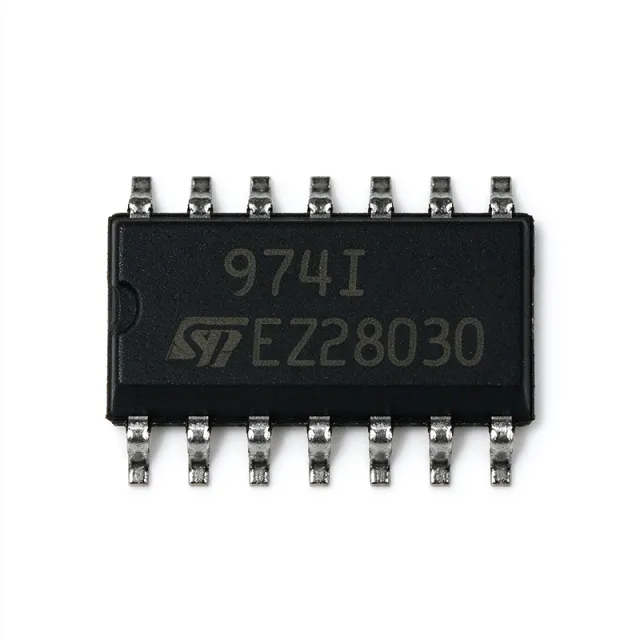
The STMicroelectronics TS974ID is a quad operational amplifier with four rail-to-rail output stages, 12 MHz gain-bandwidth product, 4 V/µs slew rate, and 4 nV/√Hz noise density in a 14-pin SOIC package. It operates from 2.7 V to 10 V, including split-supply operation as low as ±1.35 V, and is intended for portable, battery-powered, audio, sensor, and general-purpose signal-conditioning systems. An operational amplifier is an analog integrated circuit that uses high-gain differential feedback to amplify small voltage signals. The TS974ID belongs to the TS97x family of low-noise, low-distortion amplifiers. Within the broader semiconductor hierarchy, an operational amplifier is an analog amplifier IC, a linear signal-processing component, and ultimately part of a power-management and signal-chain ecosystem. Its four amplifiers combine rail-to-rail output swing with a 12 MHz bandwidth and 4 V/µs slew rate. The stated 4 nV/√Hz noise density supports low-noise signal acquisition, while the specified 0.003% distortion improves linearity in audio and precision analog circuits. A supply range of 2.7 V to 10 V permits operation from a single 3.3 V or 5 V rail or from a split supply as low as ±1.35 V. The TS97x architecture is designed for low-noise and low-distortion performance, with particular suitability for portable and battery-supplied equipment. The quad configuration provides four amplifiers in one 14-pin SOIC package, reducing board area when multiple analog channels require similar electrical performance. Its 12 MHz bandwidth is substantially higher than that required for many slow sensor-conditioning channels, allowing designers to preserve signal fidelity over a wider frequency range. Typical applications include audio preamplification, microphone and sensor conditioning, portable instrumentation, active filtering, data acquisition, and low-voltage embedded systems. The TS974ID is especially useful when several channels must process signals without adding a separate amplifier package for every stage. In audio systems, its low noise and low distortion support cleaner preamplifier operation; in sensors, the rail-to-rail output can improve usable dynamic range on low-voltage supplies. When designing around the TS974ID, account for input common-mode range, output swing, stability with the selected feedback network, and noise bandwidth. Decoupling capacitors should be placed close to the supply pins, while analog input and feedback paths should be kept short and away from switching nodes. Stable feedback components and suitable output loading are important when exploiting the device's 12 MHz bandwidth. This product record consolidates verified manufacturer-family characteristics, distributor availability, package information, and practical application guidance. It also identifies the missing pricing, pin-level, environmental, and qualification details explicitly rather than estimating them, allowing engineers to compare the TS974ID against other low-noise rail-to-rail quad amplifiers before committing to a design.

USD $1.23 স্টক অনুপস্থিত
TS974IDT - 12 MHz Quad Rail-to-Rail Op Amp | ST
TS974IDT

TS974IDT - 12 MHz Quad Rail-to-Rail Op Amp | ST

The STMicroelectronics TS974IDT is a four-circuit rail-to-rail operational amplifier featuring a 12 MHz gain-bandwidth product, 4 V/us slew rate, and 4 nV/Hz noise density in a 14-pin SO package. Its rail-to-rail output swing and operating capability from voltages as low as ±1.35 V make it suitable for compact analog signal chains that require low noise, high dynamic performance, and flexible supply-voltage operation. An operational amplifier is an analog integrated circuit that uses high-gain feedback to amplify voltage differences. The TS974 belongs to the operational-amplifier hierarchy, which sits within amplifier ICs and analog signal-processing semiconductors. Rail-to-rail output operation allows the output to approach the available supply rails, while low-noise amplification preserves small signals in audio, instrumentation, sensor, and control systems. The TS974IDT combines four amplifiers in one package. Key characteristics include 4 nV/Hz noise density, 0.003% distortion, 12 MHz bandwidth, and 4 V/us slew rate. These figures support high-frequency signal amplification with relatively low added noise. The device also includes 2 kV ESD protection and Class A latch-up immunity, improving practical robustness in sensitive analog applications. Its architecture is optimized for low-noise and low-distortion operation. The 12 MHz bandwidth provides adequate response for audio preamplification and general instrumentation, while the 4 V/us slew rate helps preserve large-signal fidelity. The rail-to-rail output topology reduces output-voltage headroom concerns, although designers must still evaluate input common-mode range, output swing, supply voltage, stability, and output loading against the manufacturer specifications. Typical uses include low-noise audio preamplification, portable and battery-powered instrumentation, sensor signal conditioning, industrial measurement systems, and general-purpose analog signal processing. The four-amplifier configuration reduces board area when several independent channels are required. It is particularly useful where four similar low-noise channels must operate within one compact package. Designers should place input and output compensation or decoupling components according to the recommended application circuit, maintain the required input and output common-mode range, and verify stability with the intended source and load impedances. The low-noise performance does not remove the need for careful grounding, short PCB traces, and clean supply routing. This page combines the principal TS974IDT operating characteristics, practical application guidance, package information, and verified replacement relationships. It also highlights design constraints and selection trade-offs that help engineers determine whether the device is appropriate before committing it to a new PCB layout.

RFQ যোগাযোগ
TS974IN - 4-Channel Low-Noise Rail-to-Rail Op Amp | STMicroelectronics
TS974IN

TS974IN - 4-Channel Low-Noise Rail-to-Rail Op Amp | STMicroelectronics

The STMicroelectronics TS974IN is a four-circuit, rail-to-rail operational amplifier with a very low noise density of 4 nV/Hz, a 12 MHz gain-bandwidth product, and a 4 V/us slew rate, packaged in a 14-pin DIP. It is designed for applications that require low-noise signal amplification across multiple independent channels. An operational amplifier is an analog integrated circuit that amplifies the voltage difference between its non-inverting and inverting inputs. Within the amplifier hierarchy, the TS974IN is a general-purpose precision operational amplifier and a member of the rail-to-rail low-noise amplifier family. Rail-to-rail input and output operation allows the signal to approach the supply rails, improving usable dynamic range in low-voltage and single-supply systems. The TS974IN provides four amplifier channels in one package, reducing board area and simplifying multi-channel signal-conditioning layouts. Its 4 nV/Hz noise density supports high-resolution analog measurement, while the 12 MHz gain-bandwidth product and 4 V/us slew rate preserve signal fidelity in faster signal paths. The listed ultra-low distortion of 0.003% makes the device suitable for audio preamplification, filtering, buffering, and instrumentation. The device operates over a supply range extending to 10 V and includes ESD protection rated at 2 kV. The listed latch-up immunity is Class A. Each amplifier is configured as a standard voltage-feedback operational amplifier, allowing the same component to implement inverting, non-inverting, summing, comparator-style, and active-filter circuits. Operating and electrical limits should always be confirmed in the manufacturer datasheet. Typical uses include four-channel audio preamplification, sensor signal conditioning, active audio filters, low-level instrumentation, data acquisition front ends, and general-purpose analog buffering. Because all four channels share one package, matching and thermal tracking are convenient when several related analog signals are processed under similar conditions. For low-noise layouts, keep the input and feedback resistors short, place input compensation and decoupling capacitors close to the relevant pins, and avoid routing high-impedance input traces beside digital clock or switching nodes. Select the bypass capacitance and compensation values with the datasheet's stability and noise guidance in mind, particularly when driving capacitive loads. This page combines the verified TS974IN product characteristics with application guidance, drop-in replacement analysis, and engineering design notes. It is intended to help designers evaluate the TS974IN quickly while completing the mandatory signal-integrity, noise, and stability checks against the full manufacturer documentation.

RFQ যোগাযোগ
TS974IYD - 12MHz Quad Rail-to-Rail Op Amp | STMicroelectronics
TS974IYD

TS974IYD - 12MHz Quad Rail-to-Rail Op Amp | STMicroelectronics

The STMicroelectronics TS974IYD is a four-circuit, general-purpose operational amplifier with rail-to-rail output swing, 12 MHz gain-bandwidth product, 60 dB common-mode rejection, and a 14-SOIC package. It accepts a 2.7 V to 10 V single-supply range or dual-supply operation from ±1.35 V to ±5 V, with a nominal 5 V single-supply configuration identified for the device. An operational amplifier is an analog signal-conditioning IC that compares an input voltage with a feedback-defined reference and amplifies the resulting error voltage. The TS974 belongs to the rail-to-rail operational amplifier hierarchy, where the output can approach the supply rails. This characteristic is useful when the available signal range is small, while its low-noise and low-distortion behavior make the TS97x family suitable for audio preamplification and portable instrumentation. The TS974IYD combines four amplifiers in one 14-SOIC package. Each channel has a gain-bandwidth product of 12 MHz and supports up to 100 mA of output current. Its 60 dB common-mode rejection ratio improves immunity to common-mode voltage on the input pair, while the 200 nA input bias current and 1 µA quiescent current per channel suit low-power circuitry. These characteristics support portable and battery-powered equipment operating from low supply voltages. The device supports both single- and dual-supply arrangements. In a single-supply system, the input and output signal range requires attention near the rails even though the output stage has rail-to-rail swing. In a dual-supply circuit, the stated operating range extends from ±1.35 V to ±5 V. Because the TS974 is intended for low-noise amplification, resistor selection, decoupling, grounding, and output-load compatibility remain central to achieving the intended signal quality. Typical uses include portable audio preamplification, low-level sensor conditioning, battery-powered measurement equipment, active filters, and general-purpose analog signal processing. Four channels in one package also reduce board area when a system needs several similar gain stages. The package pin arrangement and electrical characteristics must be checked against the manufacturer datasheet before applying it to a new board or using it as a replacement. For a new design, begin with the required signal bandwidth, output swing, supply voltage, and load current. Place the bypass capacitor near the power pins, keep feedback loops compact, and verify that input common-mode and output swing requirements remain valid at the chosen gain. For an existing PCB, confirm the 14-SOIC footprint, pin functions, and electrical limits before substituting another amplifier. This page consolidates the available manufacturer-family information, distributor listing details, ordering guidance, and drop-in comparison considerations. It is designed to help engineers identify whether the TS974IYD fits a low-voltage, low-noise quad-op-amp design before moving to detailed circuit review and datasheet verification.

RFQ যোগাযোগ
TS982IDW - Dual 200mA R-R Op Amp | STMicroelectronics
TS982IDW

TS982IDW - Dual 200mA R-R Op Amp | STMicroelectronics

STMicroelectronics TS982IDW is a dual operational amplifier with rail-to-rail output capability, 200 mA output-current drive, and operation from voltages as low as 2.7 V. The device is housed in an 8-pin SO package and is stable at unity gain. Its combination of low supply voltage, broad output-current capability, and dual-channel integration makes it suitable for industrial and automotive signal-conditioning systems. An operational amplifier is an analog integrated circuit that amplifies the voltage difference between its inverting and non-inverting inputs. The TS982 belongs to the operational-amplifier hierarchy within analog and mixed-signal semiconductors. Its dual architecture provides two amplifier channels in one package, reducing component count when a board needs matched signal conditioning, buffering, or gain stages. The TS982's rail-to-rail output stage can approach the supply rails, increasing usable output-voltage range in low-voltage systems. Its ability to drive 200 mA makes it stronger than many general-purpose dual amplifiers and allows the device to feed higher-capacitance loads or drive downstream stages. Operation down to 2.7 V supports modern low-power electronics, while unity-gain stability simplifies buffer and fixed-gain implementations. The SO-8 package provides a compact footprint for industrial, automotive, and embedded systems. The exposed-pad construction supports heat transfer when the amplifier operates at elevated output current, although board layout and thermal design remain important. Two amplifiers in one package also simplify dual-channel designs where both channels perform related functions. Typical uses include sensor-signal conditioning, active filtering, audio and communications interfaces, data acquisition, and general-purpose analog buffers. The 200 mA drive capability is particularly useful when the op-amp must charge a downstream capacitance, interface with another analog circuit, or support a load beyond the range of a lightweight low-power amplifier. Designers should verify the exact input common-mode range, output swing, bandwidth, slew rate, noise, offset, and thermal limits for the operating conditions. Input and output stability must be evaluated with the intended feedback network and load because capacitive loading can affect op-amp behavior even when unity-gain stable. This page combines manufacturer-device facts, package details, sourcing guidance, and practical analog-design considerations to help engineers evaluate TS982IDW for low-voltage, dual-channel signal-processing designs.

RFQ যোগাযোগ
TSA1005-40IFT - 10-Bit 40MSPS Dual ADC | STMicroelectronics
TSA1005-40IFT

TSA1005-40IFT - 10-Bit 40MSPS Dual ADC | STMicroelectronics

The STMicroelectronics TSA1005-40IFT is a dual-channel, 10-bit resolution analog-to-digital converter (ADC) based on a pipelined architecture, sampling up to 40 MSPS in a 48-pin TQFP (7x7 mm) package. It uses a 0.25 µm deep sub-micron CMOS process, operates from a single 2.5 V analog supply, and supports an independent 2.5 V or 3.3 V CMOS output supply. A pipelined ADC is a high-speed converter architecture that resolves an analog input across multiple cascaded low-resolution stages, each driving a sample-and-hold amplifier and a flash sub-ADC. The pipeline allows new conversions to begin every clock cycle, achieving sample rates well above 100 MSPS while keeping per-stage hardware compact. Pipelined ADCs sit within the broader taxonomy: data converter -> ADC -> high-speed ADC -> pipelined ADC -> integrated circuit -> semiconductor. The TSA1005 belongs to a category often called "baseband IF sampling ADCs," used when analog signals need to be digitized near the antenna or sensor for downstream DSP. Key specifications include 1 GHz analog input bandwidth, an integrated track-and-hold amplifier per channel, common clocking for synchronous dual-channel sampling, and a multiplexed digital output mode. The device targets applications needing a low noise floor and high SFDR; SFDR (Spurious-Free Dynamic Range) measures how far the largest spurious tone sits below the fundamental when digitizing a pure sine wave, with higher values meaning cleaner spectra. The TSA1005 is engineered for very low noise floor, high SFDR, and good channel-to-channel isolation. Typical applications include medical ultrasound imaging, professional video processing, IF (intermediate frequency) sampling for communications receivers, instrumentation, and industrial non-destructive testing. Each application relies on the part's combination of 10-bit resolution at video-grade sample rates and dual-channel synchronous capture. When designing with this part, decouple both the 2.5 V analog and 2.5/3.3 V digital rails with 100 nF ceramic capacitors placed as close as possible to each supply pin. Route the analog inputs as 50 Ω controlled-impedance traces with the analog ground plane isolated from the digital return to minimize coupling. This page synthesizes distributor pricing, drop-in same-package alternatives, and practical PCB layout notes not found in the manufacturer datasheet alone. Information current as of 2026-10-15.

RFQ যোগাযোগ
TSA1203IF - Dual 12-bit 40MSPS ADC | STMicroelectronics
TSA1203IF

TSA1203IF - Dual 12-bit 40MSPS ADC | STMicroelectronics

The STMicroelectronics TSA1203IF is a dual-channel, 12-bit, 40 MSPS analog-to-digital converter fabricated in a mainstream 0.25 µm CMOS process, housed in a 48-pin TQFP (7x7 mm) package. It integrates two simultaneous sample-and-hold amplifiers, a 1 GHz analog input bandwidth, and a built-in reference voltage, dissipating 230 mW at 40 Msps from a single 2.5 V supply. The CMOS output stage can be driven from an independent 2.5 V or 3.3 V rail, simplifying interfacing to both legacy and modern FPGA/ASIC logic families. An analog-to-digital converter (ADC) is a mixed-signal integrated circuit that converts a continuous-time, continuous-amplitude analog input into a discrete-time, discrete-amplitude digital code. Pipeline ADCs such as the TSA1203IF use a multi-stage switched-capacitor architecture to achieve high sampling rates while keeping per-stage power and die area modest, sitting within the broader hierarchy of data converters -> ADC -> high-speed pipeline ADC -> semiconductor. Dual-channel variants like this one are favored for diversity receivers, I/Q baseband sampling, and simultaneous multi-antenna digital beamforming because the two channels are sampled on a common clock edge, eliminating channel-to-channel skew. Key features include 1 GHz analog input bandwidth, SFDR of -68.3 dBc at 10 MHz input, multiplexed outputs for reduced pin count, common clocking between channels, and pin-to-pin compatibility with the dual 10-bit 20/40 MSPS TSA1005-20/40 and the dual 12-bit 20 MSPS TSA1204. The pipelined architecture combined with digital error correction yields clean 12-bit outputs at full clock rate without requiring complex external calibration at room temperature. Typical applications include cellular base station receivers, IF sampling for software-defined radio, medical imaging front-ends, and industrial ultrasound beamformers. The integrated reference and dual independent input channels also suit multi-channel data-acquisition cards for test and measurement instrumentation. When designing with this part, ensure the analog and digital grounds are joined only at a single point near the exposed pad, and that the analog supply is decoupled with both 0.1 µF ceramic and 10 µF bulk capacitance within 5 mm of the supply pins.

RFQ যোগাযোগ
TSA1204IFT - 12-Bit 20MSPS Dual-Channel ADC | STMicroelectronics
TSA1204IFT

TSA1204IFT - 12-Bit 20MSPS Dual-Channel ADC | STMicroelectronics

The STMicroelectronics TSA1204IFT is a 12-bit resolution, dual-channel pipelined Analog-to-Digital Converter sampling up to 20 MSPS, packaged in a 48-pin TQFP (7x7 mm). The device operates from a single 2.5 V analog supply with an independent 2.5 V/3.3 V CMOS output stage supply, consuming only 95 mW per channel at 20 MSPS and scaling down adaptively at lower sampling rates. An Analog-to-Digital Converter (ADC) is a mixed-signal integrated circuit that converts continuous-time analog voltages into discrete digital codes at a specified sampling rate. Dual-channel pipelined ADCs belong to the broader hierarchy of data converter IC -> mixed-signal IC -> semiconductor, and they occupy the performance tier between successive-approximation (SAR) converters (slow, low-power, <5 MSPS) and high-speed flash converters (very fast, very high power). The TSA1204IFT targets moderate-bandwidth multi-channel systems where engineers need two synchronized channels without the cost of two discrete ADCs. Key features include a 1 GHz analog input bandwidth, an integrated Track-and-Hold amplifier, 11.2-bit effective number of bits (ENOB) at the Nyquist input frequency, and -81.5 dBc spurious-free dynamic range (SFDR) at Nyquist. The 0.25 micrometer CMOS process enables adaptive power consumption scaling from 0.5 MSPS to 20 MSPS, allowing the part to drop to lower power in standby. The CMOS outputs are pin-selectable between 2.5 V and 3.3 V logic levels, simplifying interface to FPGAs, ASICs, or microcontrollers in mixed-voltage systems. Typical applications include dual-channel digital oscilloscopes, intermediate-frequency (IF) signal processing in communications receivers, ultrasound imaging front-ends, and high-speed industrial data acquisition. The dual channel allows simultaneous sampling of in-phase and quadrature (I/Q) baseband signals, or two channels of a multi-channel instrumentation system. When designing with the TSA1204IFT, place the analog and digital ground returns on a split ground plane joined under the ADC, use wide PCB traces for the analog supply pins, and decouple each supply pin with 100 nF and 10 uF capacitors placed as close as possible to the device. The exposed pad of the TQFP should be soldered to a ground plane for thermal and electrical performance. This page synthesizes distributor pricing, drop-in same-family alternatives, and practical design notes not collected in any single manufacturer datasheet revision, giving engineers a one-stop reference for sourcing and second-sourcing the TSA1204IFT.

RFQ যোগাযোগ
TSA1401IF - 14-bit 20MSPS 85mW ADC | STMicroelectronics
TSA1401IF

TSA1401IF - 14-bit 20MSPS 85mW ADC | STMicroelectronics

The STMicroelectronics TSA1401IF is a 14-bit, 20 MSPS pipelined analog-to-digital converter that consumes only 85 mW at full sampling rate. Housed in a 48-pin TQFP (7x7 mm) package, the part targets low-power imaging and instrumentation applications where conventional 14-bit ADCs exceed the system thermal budget. According to the STMicroelectronics datasheet, the TSA1401IF implements ST's OPTIMWATT architecture to dynamically scale internal bias currents with clock rate, enabling designers to lower the sampling clock for slower channels and reduce overall system power. An ADC (analog-to-digital converter) is a mixed-signal integrated circuit that quantizes a continuous-time analog input into a discrete N-bit binary code at a programmable sample rate. TSA1401IF sits in the high-speed, mid-resolution segment of the ADC taxonomy (ADC -> pipelined ADC -> high-speed ADC -> data converter -> mixed-signal IC). Pipelined ADCs use multiple low-resolution flash stages interleaved with residue gain and digital correction to achieve both high conversion rate and moderate resolution; this architecture dominates the 10-100 MSPS / 10-14 bit space used in CCD imaging, ultrasound front ends, and digital oscilloscope channels. Key specifications include 14-bit resolution, 20 MSPS maximum sample rate, 85 mW typical power dissipation at full speed, single 5 V analog supply, single +3 V to +5 V digital supply, 48-pin TQFP (7x7 mm) package, industrial temperature range (-40 C to +85 C), and an external reference input. The pipelined converter includes self-calibrated digital error correction that typically holds DNL within 0.5 LSB and INL within 1.0 LSB across the industrial temperature range. Differential analog inputs are AC-coupled through on-chip clamp protection, supporting full-scale ranges from 1 Vp-p to 2 Vp-p driven by op-amp or transformer front ends. Typical applications include high-end infrared imaging for surveillance and thermography, X-ray medical imaging front ends, professional CCD camera front ends for broadcast and industrial vision, document scanners and digital copiers, and test instrumentation including digital storage oscilloscopes and arbitrary waveform recorders. Designers value the TSA1401IF in battery-powered portable imaging systems where total BOM power directly limits field runtime. When designing with the TSA1401IF, the analog input must be driven from a low-impedance differential source; designers typically use a transformer (for single-ended to differential conversion) or a fully-differential op-amp such as the THS4503. Decoupling must include 10 uF tantalum plus 100 nF ceramic on each supply pin, placed within 5 mm of the package. The clock line should be routed with 50 ohm controlled impedance and kept away from analog signal traces. This page synthesizes distributor pricing, identical-footprint drop-in alternatives from the same STMicroelectronics family, and practical layout notes that complement the official datasheet.

RFQ যোগাযোগ