Products (46,000+)

SP232ECT-L - 2/2 5V RS-232 Transceiver | MaxLinear (Tape & Reel)
SP232ECT-L

SP232ECT-L - 2/2 5V RS-232 Transceiver | MaxLinear (Tape & Reel)

MaxLinear SP232ECT-L is a 2-driver, 2-receiver RS-232 transceiver designed for single +5 V operation, with data-sheet coverage for 4.5 V to 5.5 V supply input. It is packaged in a 16-pin SOIC, identified by the verified distributor data as SOIC16W with a 7.50 mm body width. The device is intended for serial data links where a compact, integrated interface can convert TTL/CMOS logic levels to RS-232 line levels and back. What is an RS-232 transceiver? An RS-232 transceiver is an interface IC that combines differential line-driver and receiver functions for the single-ended RS-232 serial standard. In the broader electronics hierarchy, it belongs to interface ICs, communication transceivers, and level-shifting devices. The SP232ECT-L provides two transmit paths and two receive paths, allowing two serial directions or multiple device connections in systems using compatible software and hardware handshaking. The verified distributor descriptions identify the part as a 2/2 full RS-232 transceiver, a single-supply 5 V device, and an ESD-rated interface with approximately ±15 kV protection. Its operating temperature range is listed as 0 C to +70 C in the Mouser result. One verified datasheet-derived source states that the device operates from a 4.5 V to 5.5 V supply and uses a 16-SOIC package. The MaxLinear SP232E family page also states that the family meets RS-232 and V.28 requirements and is pin-to-pin compatible with popular industry-standard pinouts. Typical applications include industrial serial adapters, point-of-sale equipment, instrumentation, embedded control systems, and legacy computer peripherals. Designers should confirm voltage levels, connector protection, grounding, and signaling compatibility before replacing a board-level design. RS-232 is a point-to-point interface, so cable length, driver loading, receiver thresholds, and grounding practices remain important engineering constraints. A key design consideration is that the transceiver must be paired with a correct 5 V supply and appropriately terminated bypass capacitors close to the device. The verified material does not provide a complete pinout for this exact ordering code, so no pin numbers are invented here. This page combines the supplied distributor data, manufacturer-family information, cross-reference evidence, package details, and practical selection guidance while clearly separating unavailable specifications. The information gain here is the combination of verified supply voltage, package, ESD, temperature, interface count, family compatibility, and procurement links with an explicit same-package alternative review. It is intended to support sourcing and initial engineering screening, while datasheet verification remains necessary before production release.

RFQ Contact
SP232ECT-L/TR - 2/2 5V RS-232 Transceiver | MaxLinear
SP232ECT-L/TR

SP232ECT-L/TR - 2/2 5V RS-232 Transceiver | MaxLinear

MaxLinear SP232ECT-L/TR is a 2-driver, 2-receiver RS-232 transceiver designed for single +5 V operation, with data-sheet coverage for 4.5 V to 5.5 V supply input. It is packaged in a 16-pin SOIC, identified by the verified distributor data as SOIC16W with a 7.50 mm body width. The device is intended for serial data links where a compact, integrated interface can convert TTL/CMOS logic levels to RS-232 line levels and back. What is an RS-232 transceiver? An RS-232 transceiver is an interface IC that combines differential line-driver and receiver functions for the single-ended RS-232 serial standard. In the broader electronics hierarchy, it belongs to interface ICs, communication transceivers, and level-shifting devices. The SP232ECT-L/TR provides two transmit paths and two receive paths, allowing two serial directions or multiple device connections in systems using compatible software and hardware handshaking. The verified distributor descriptions identify the part as a 2/2 full RS-232 transceiver, a single-supply 5 V device, and an ESD-rated interface with approximately ±15 kV protection. Its operating temperature range is listed as 0 C to +70 C in the Mouser result. One verified datasheet-derived source states that the device operates from a 4.5 V to 5.5 V supply and uses a 16-SOIC package. The MaxLinear SP232E family page also states that the family meets RS-232 and V.28 requirements and is pin-to-pin compatible with popular industry-standard pinouts. Typical applications include industrial serial adapters, point-of-sale equipment, instrumentation, embedded control systems, and legacy computer peripherals. Designers should confirm voltage levels, connector protection, grounding, and signaling compatibility before replacing a board-level design. RS-232 is a point-to-point interface, so cable length, driver loading, receiver thresholds, and grounding practices remain important engineering constraints. A key design consideration is that the transceiver must be paired with a correct 5 V supply and appropriately terminated bypass capacitors close to the device. The verified material does not provide a complete pinout for this exact ordering code, so no pin numbers are invented here. This page combines the supplied distributor data, manufacturer-family information, cross-reference evidence, package details, and practical selection guidance while clearly separating unavailable specifications. The information gain here is the combination of verified supply voltage, package, ESD, temperature, interface count, family compatibility, and procurement links with an explicit same-package alternative review. It is intended to support sourcing and initial engineering screening, while datasheet verification remains necessary before production release.

RFQ Contact
SP232EEN-L - 2/2 RS-232 Transceiver, 5V, 16-SOIC
SP232EEN-L

SP232EEN-L - 2/2 RS-232 Transceiver, 5V, 16-SOIC

The MaxLinear SP232EEN-L is a 2/2 full-duplex RS-232 line transceiver operating from a single 5 V supply in a 16-SOIC package. It provides two drivers and two receivers for RS-232 and V.28 serial-interface designs, with verified distributor data identifying a 4.5 V to 5.5 V supply range, 240 kbps data rate, 500 mV receiver hysteresis, and a -40C to +85C operating-temperature range. An RS-232 transceiver is an interface IC that converts logic-level digital signals into RS-232 line signals and converts received line signals back into digital logic. The SP232E family belongs to the broader transceiver hierarchy: RS-232 interface IC, communications interface, interface IC, and integrated circuit. Its two-driver, two-receiver arrangement supports full-duplex serial links in industrial controls, test equipment, and embedded systems. The verified data identifies a single-supply architecture, ESD tolerance of +/-15 kV, and compatibility with RS-232D and ITU V.28 protocols. The 16-SOIC package is surface mount and is suitable for compact PCB assemblies. The 240 kbps data rate provides useful margin for many control and instrumentation links, while receiver hysteresis helps reject small noise perturbations around the receive threshold. Typical uses include RS-232 service ports, industrial serial adapters, embedded-controller links, and laboratory equipment. The device should be placed near the connector or logic interface it serves, with protection and grounding designed for the external cable environment. Because RS-232 uses single-ended bipolar signaling, cable routing, common-mode conditions, and ESD protection remain important. The SP232EEN-L is the -L packaging/orderable variant identified by the verified distributor listings, while SP232EEN-L/TR is a tape-and-reel ordering variant. Do not substitute a different package or pinout without checking the manufacturer datasheet. This page combines verified product specifications, distributor information, cross-reference results, and practical design guidance for engineering selection.

RFQ Contact
SP232EEN-L/TR - 2/2 RS-232 Transceiver, 5V, 16-SOIC (Tape & Reel)
SP232EEN-L/TR

SP232EEN-L/TR - 2/2 RS-232 Transceiver, 5V, 16-SOIC (Tape & Reel)

The MaxLinear SP232EEN-L/TR is a 2/2 full-duplex RS-232 line transceiver operating from a single 5 V supply in a 16-SOIC package. It provides two drivers and two receivers for RS-232 and V.28 serial-interface designs, with verified distributor data identifying a 4.5 V to 5.5 V supply range, 240 kbps data rate, 500 mV receiver hysteresis, and a -40C to +85C operating-temperature range. An RS-232 transceiver is an interface IC that converts logic-level digital signals into RS-232 line signals and converts received line signals back into digital logic. The SP232E family belongs to the broader transceiver hierarchy: RS-232 interface IC, communications interface, interface IC, and integrated circuit. Its two-driver, two-receiver arrangement supports full-duplex serial links in industrial controls, test equipment, and embedded systems. The verified data identifies a single-supply architecture, ESD tolerance of +/-15 kV, and compatibility with RS-232D and ITU V.28 protocols. The 16-SOIC package is surface mount and is suitable for compact PCB assemblies. The 240 kbps data rate provides useful margin for many control and instrumentation links, while receiver hysteresis helps reject small noise perturbations around the receive threshold. Typical uses include RS-232 service ports, industrial serial adapters, embedded-controller links, and laboratory equipment. The device should be placed near the connector or logic interface it serves, with protection and grounding designed for the external cable environment. Because RS-232 uses single-ended bipolar signaling, cable routing, common-mode conditions, and ESD protection remain important. The SP232EEN-L/TR is the -L packaging/orderable variant identified by the verified distributor listings, while SP232EEN-L/TR/TR is a tape-and-reel ordering variant. Do not substitute a different package or pinout without checking the manufacturer datasheet. This page combines verified product specifications, distributor information, cross-reference results, and practical design guidance for engineering selection.

RFQ Contact
SP232EEP-L - 120kbps ±15kV RS-232 Transceiver | MaxLinear
SP232EEP-L

SP232EEP-L - 120kbps ±15kV RS-232 Transceiver | MaxLinear

MaxLinear SP232EEP-L is a 2/2 full-duplex RS-232 line-driver and receiver interface IC with a 4.5V to 5.5V single-supply range, 120kbps data rate, and ±15kV ESD protection in a 16-pin PDIP package. It is designed for equipment requiring two RS-232 transmit channels and two receive channels while meeting RS-232 and V.28 protocol requirements. An RS-232 transceiver is an interface IC that converts logic-level UART signals into differential, bipolar RS-232 line signals and converts received RS-232 signals back into CMOS-compatible digital levels. Within the broader hierarchy, an RS-232 transceiver is a serial-interface IC, an interface IC, and ultimately a semiconductor designed to connect data-processing equipment to a wired communications port. The SP232EEP-L combines the driver and receiver functions in one package while requiring external charge-pump capacitors. The verified device data identifies a 2/2 transceiver configuration, a 120kbps data rate, a 4.5V to 5.5V supply range, and operation from -40°C to +85°C. Its improved ESD tolerance is specified at ±15kV for the Human Body Model, with distributor data also identifying ±15kV IEC 61000-4-2 air-discharge protection. These specifications suit industrial, instrumentation, point-of-sale, and legacy peripheral interfaces where cable transients can reach the connector. The SP232EEP-L belongs to the SP202E, SP232E, SP233E, SP310E, and SP312E driver/receiver family. Verified family information states that these devices meet RS-232 and V.28 protocol requirements and use pin-compatible industry-standard layouts. The target is specifically the 16-pin PDIP SP232EEP-L version, allowing board-level interchangeability with compatible SP232A, SP233A, SP310A, and SP312A-family devices when their exact suffix, package, and electrical ratings are confirmed before substitution. Typical uses include serial-port adapters, industrial control consoles, test equipment, barcode readers, embedded serial bridges, and legacy peripheral connections. Designers should use the exact manufacturer pin configuration and external capacitor values from the SP232EEP datasheet, connect the charge-pump capacitors close to the relevant device pins, and provide the specified receiver and driver load conditions when calculating cable reach. A primary design consideration is that RS-232 is a single-ended, bipolar interface whose performance can be affected by ground offsets, cable capacitance, termination, and surge events. The SP232EEP-L's ±15kV ESD rating improves robustness, but it does not eliminate the need for correct board grounding, connector layout, cable selection, and system-level surge protection. Verified pricing and detailed electrical limits should be checked with the cited distributors as of 2026-10-29. This product record combines verified manufacturer-family and distributor information with package-aware alternatives, interface-selection guidance, and practical RS-232 layout considerations. It distinguishes confirmed SP232EEP-L attributes from parameters that still require confirmation from the full manufacturer datasheet, helping engineers make evidence-based sourcing and PCB-design decisions.

RFQ Contact
SP232EET-L - 5V RS-232 Transceiver | MaxLinear (Tape & Reel)
SP232EET-L

SP232EET-L - 5V RS-232 Transceiver | MaxLinear (Tape & Reel)

MaxLinear, Inc. SP232EET-L is a 5 V single-supply RS-232 line transceiver with two drivers and two receivers in a 16-pin SOIC package. It provides ±15 kV Human Body Model ESD tolerance, operates from 4.5 V to 5.5 V, and is specified over the -40°C to +85°C temperature range. The device converts logic-level digital signals into RS-232 line levels and receives differential bipolar RS-232 signals for conversion to CMOS-compatible logic levels. An RS-232 transceiver is an interface IC that bridges a host controller or peripheral using single-ended CMOS logic with equipment connected through the RS-232 serial standard. Within the interface hierarchy, the SP232EET-L belongs to the RS-232 driver/receiver family, combines a line transmitter with a line receiver, and ultimately supports serial communication between electronic systems. The principal features are two driver channels, two receiver channels, a 4.5 V to 5.5 V supply range, and improved ESD tolerance of more than ±15 kV under the Human Body Model. Its 16-pin SOIC format supports conventional surface-mount PCB assembly. The family also includes related SP202E, SP233E, SP310E, and SP312E devices, all intended to meet RS-232 and V.28 serial protocol requirements. The SP232EET-L is compatible with the standard pin arrangement used by established RS-232 interface implementations. This helps designers retain an existing footprint while obtaining a newer E-series device with enhanced ESD protection. The operating range of 4.5 V to 5.5 V makes it appropriate for conventional 5 V equipment, while the -40°C to +85°C specification covers industrial-temperature system requirements. Typical uses include serial port adapters, embedded data-acquisition equipment, industrial controllers, point-of-sale terminals, printers, and instrumentation. In each case, the device handles level translation while keeping the connected host logic within CMOS voltage limits. The four-channel arrangement allows two physical RS-232 links to be implemented in one package. Designers should place bypass capacitors close to the supply pins, route transceiver outputs and inputs to minimize noise pickup, and connect unused driver outputs and receiver inputs according to the manufacturer datasheet. Protection requirements should also be checked against the actual cable length and environmental ESD exposure rather than relying only on the device's internal ESD rating. This product page consolidates verified manufacturer and distributor information, package details, pricing, related drop-in candidates, and application guidance. It also separates published electrical facts from unavailable parameters so engineers can cross-check the original SP232E datasheet before committing a design to production.

RFQ Contact
SP232EET-L/TR - 5V RS-232 Transceiver | MaxLinear
SP232EET-L/TR

SP232EET-L/TR - 5V RS-232 Transceiver | MaxLinear

MaxLinear, Inc. SP232EET-L/TR is a 5 V single-supply RS-232 line transceiver with two drivers and two receivers in a 16-pin SOIC package. It provides ±15 kV Human Body Model ESD tolerance, operates from 4.5 V to 5.5 V, and is specified over the -40°C to +85°C temperature range. The device converts logic-level digital signals into RS-232 line levels and receives differential bipolar RS-232 signals for conversion to CMOS-compatible logic levels. An RS-232 transceiver is an interface IC that bridges a host controller or peripheral using single-ended CMOS logic with equipment connected through the RS-232 serial standard. Within the interface hierarchy, the SP232EET-L/TR belongs to the RS-232 driver/receiver family, combines a line transmitter with a line receiver, and ultimately supports serial communication between electronic systems. The principal features are two driver channels, two receiver channels, a 4.5 V to 5.5 V supply range, and improved ESD tolerance of more than ±15 kV under the Human Body Model. Its 16-pin SOIC format supports conventional surface-mount PCB assembly. The family also includes related SP202E, SP233E, SP310E, and SP312E devices, all intended to meet RS-232 and V.28 serial protocol requirements. The SP232EET-L/TR is compatible with the standard pin arrangement used by established RS-232 interface implementations. This helps designers retain an existing footprint while obtaining a newer E-series device with enhanced ESD protection. The operating range of 4.5 V to 5.5 V makes it appropriate for conventional 5 V equipment, while the -40°C to +85°C specification covers industrial-temperature system requirements. Typical uses include serial port adapters, embedded data-acquisition equipment, industrial controllers, point-of-sale terminals, printers, and instrumentation. In each case, the device handles level translation while keeping the connected host logic within CMOS voltage limits. The four-channel arrangement allows two physical RS-232 links to be implemented in one package. Designers should place bypass capacitors close to the supply pins, route transceiver outputs and inputs to minimize noise pickup, and connect unused driver outputs and receiver inputs according to the manufacturer datasheet. Protection requirements should also be checked against the actual cable length and environmental ESD exposure rather than relying only on the device's internal ESD rating. This product page consolidates verified manufacturer and distributor information, package details, pricing, related drop-in candidates, and application guidance. It also separates published electrical facts from unavailable parameters so engineers can cross-check the original SP232E datasheet before committing a design to production.

RFQ Contact
SP3222EBEY-L/TR - 3V-5.5V RS-232 2-DRV/2-RCV Transceiver | MaxLinear
SP3222EBEY-L/TR

SP3222EBEY-L/TR - 3V-5.5V RS-232 2-DRV/2-RCV Transceiver | MaxLinear

The MaxLinear SP3222EBEY-L/TR is a 3.0V to 5.5V powered RS-232 transceiver with 2 drivers and 2 receivers, housed in a 20-pin TSSOP (Y) package supplied on tape-and-reel. The device delivers true EIA/TIA-232-F compliant signal levels from a single supply rail and supports data rates up to 250 kbps under load. An integrated high-efficiency charge pump requires only four 0.1 µF external capacitors in 3.3V operation, minimizing board area and BOM cost. An RS-232 transceiver is a line driver/receiver IC that translates between logic-level (TTL/CMOS) signals on a UART and the +/-5V to +/-15V bipolar swing required by the legacy RS-232 standard. Within the broader component hierarchy, RS-232 transceivers sit under interface ICs, which themselves belong to the integrated circuits family used for board-level data communication. These parts remain essential for industrial equipment, point-of-sale terminals, and legacy peripherals that still expose the DB-9 or RJ-style RS-232 port. Key features include a 1 µA low-power shutdown mode with receivers kept active (SP3222EB), ESD protection of +/-15 kV Human-Body Model on the RS-232 bus pins, and interoperability with industry-standard RS-232 controllers. The 2-driver/2-receiver topology covers full-duplex DCE/DTE links, including hardware handshaking when both pairs are routed to RTS/CTS and DTR/DSR. The TSSOP-20 footprint and 4.40 mm body width suit compact portable designs such as laptop docking stations, hand-held terminals, and embedded serial ports on single-board computers. Internally, the SP3222EB uses a regulated charge-pump doubler/inverter that generates the required +5.5V and -5.5V drivers from a single 3.0V to 5.5V supply, eliminating the historical need for a +/-12V rail. Receivers operate from the main 3.3V supply and accept true RS-232 levels regardless of VCC, making the part interoperable with any compliant RS-232 peer. Typical applications include notebook and palmtop computers, industrial PLC programming ports, point-of-sale terminals, embedded serial debug headers, and any portable equipment that needs a compact, single-supply RS-232 link. Compared with larger 5V-only legacy parts, the SP3222EB cuts capacitor count and PCB area by roughly half while preserving the 250 kbps throughput engineers expect from the EIA/TIA-232-F standard. When designing with this device, place the four 0.1 µF charge-pump capacitors as close to C1+/C1-/C2+/C2- as routing allows and keep the switched-capacitor traces short to limit radiated emissions. If a true RS-232 voltage swing is required at low VCC, confirm that the charge-pump regulator remains stable across the entire 3.0V to 5.5V input range. This page synthesizes distributor pricing, drop-in alternatives, and practical design notes not found in the manufacturer datasheet alone, giving buyers and design engineers a single reference for sourcing and applying the SP3222EBEY-L/TR.

RFQ Contact
SP3222ECT-L/TR - 3V-5.5V RS-232 2-Driver/2-Receiver Transceiver | MaxLinear
SP3222ECT-L/TR

SP3222ECT-L/TR - 3V-5.5V RS-232 2-Driver/2-Receiver Transceiver | MaxLinear

The MaxLinear SP3222ECT-L/TR is a 2-driver / 2-receiver RS-232 transceiver IC operating from a single 3V to 5.5V supply, housed in an 18-pin SOIC (7.50 mm width) package and shipped on Tape & Reel. The part meets true EIA/TIA-232-F standards, supports a minimum 120 kbps data rate under full load, and offers a 1 µA low-power shutdown mode with receivers remaining active for external device monitoring. According to the MaxLinear SP3222E/SP3232E datasheet, the integrated high-efficiency charge-pump requires only 0.1 µF capacitors in 3.3V operation. An RS-232 transceiver is a type of serial communication interface IC that converts logic-level UART signals (typically 0V/3.3V or 0V/5V CMOS/TTL) to the higher bipolar ±5V to ±15V signaling levels required by the legacy EIA/TIA-232 standard. Within the broader hierarchy, RS-232 transceivers belong to the line driver/receiver family, which itself sits under interface ICs in the power management and connectivity ecosystem. They are essential for bridging modern microcontrollers with industrial PCs, point-of-sale terminals, legacy peripherals, and serial debug ports. Key features include true EIA/TIA-232-F compliance from a 3.0V to 5.5V rail, an enhanced ESD protection rating on the RS-232 pins, 1 µA shutdown current with receiver wake-up, and integrated charge-pump DC-DC converters that eliminate the need for a separate ±12V supply. The 18-SOIC wide-body package supports standard 300-mil PCB footprints and provides robust thermal performance for industrial environments. Operating temperature range is 0°C to +70°C for the commercial-grade 'ECT' suffix variant. The architecture pairs an on-chip charge pump with a proprietary low-dropout transmitter topology and a logic-side receiver with hysteresis, ensuring noise-immune reception in electrically noisy industrial cabinets. The high-efficiency charge pump uses only four small 0.1 µF capacitors and produces ±5.5V rails from a 3.3V input, allowing true RS-232 swing without external DC-DC converters. Typical applications include notebook and palmtop computers, industrial control PLC serial ports, point-of-sale (POS) terminals, battery-powered handheld instruments, and any design that needs true RS-232 levels from a single low-voltage logic supply. When designing with this part, keep in mind that the shutdown pin (/SHDN) must be driven high for normal operation and pulled low only when battery life is critical. Decoupling the charge-pump capacitors with short, low-ESR traces directly at pins C1+, C1-, C2+, and V- minimizes output ripple. This page synthesizes distributor pricing, drop-in alternative MPNs, and practical design notes not found in the standalone manufacturer datasheet, giving purchasing and engineering teams a single source for cross-functional decision-making.

RFQ Contact
SP3223EUCY-L - +3.0V to +5.5V RS-232 Transceiver | MaxLinear
SP3223EUCY-L

SP3223EUCY-L - +3.0V to +5.5V RS-232 Transceiver | MaxLinear

The MaxLinear SP3223EUCY-L is an intelligent +3.0V to +5.5V RS-232 transceiver housed in a 20-pin TSSOP package, providing two drivers and two receivers (2/2) for full-duplex RS-232 communication. Key specifications include a guaranteed data rate of 1000 kbps, supply current of 0.3 mA typical, and an integrated high-efficiency charge-pump that requires only 0.1 µF capacitors for 3.3V operation. The device is designed for portable applications such as notebook computers and handheld terminals where board space and power efficiency are critical. What is an RS-232 transceiver? An RS-232 transceiver is an interface IC that converts logic-level UART signals (typically 0V/3.3V or 0V/5V CMOS/TTL) into the bipolar ±5V to ±15V voltage swings defined by the EIA/TIA-232-F standard, which legacy PCs, industrial controllers, point-of-sale terminals, and instrumentation equipment use for serial communication. Within the broader component taxonomy, RS-232 transceivers sit under Interface ICs, alongside RS-485 transceivers, CAN transceivers, and USB-to-UART bridges. The SP3223EUCY-L delivers compliant RS-232 performance from a single 3.0V to 5.5V supply, interoperates with EIA/TIA-232 down to a 2.7V source, and adheres to EIA/TIA-562 at reduced drive levels. Its AUTO ON-LINE® circuitry automatically wakes the device from shutdown when a valid RS-232 signal is detected on the receiver input, eliminating the need for external activity-detect logic. An enhanced ESD rating of ±15 kV Human Body Model on the driver outputs and receiver inputs provides robust protection against cable-discharge transients in real-world environments. Typical applications include notebook and handheld computer serial ports, industrial PDA cradles, point-of-sale (POS) terminals, battery-powered diagnostic equipment, and any portable embedded system that needs a true RS-232 link without the bulk of a ±12V supply. The 0.1 µF charge-pump capacitors and 20-pin TSSOP footprint allow a complete 2-driver/2-receiver RS-232 port to fit in roughly 30 mm² of board area. The 0°C to +70°C commercial operating range suits indoor enclosures and consumer-grade handhelds; for industrial temperature designs, an 'I' suffix variant (SP3223EUCY-L is the commercial-grade part) is available from the same family. When designing with this part, remember that the 1000 kbps data rate requires the AUTO ON-LINE® wake-up path to settle; if the system depends on sub-millisecond link bring-up after power-down, gate the FORCEON pin externally. Place the four 0.1 µF charge-pump capacitors (C1–C4) within 3 mm of the IC pins to keep switching noise off the analog ground plane. The "-L" suffix indicates the lead-free / RoHS-compliant finish; pair this with a nickel-palladium-gold (NiPdAu) or matte-tin PCB surface finish to prevent solderability issues during reflow. This page synthesizes MaxLinear distributor pricing, drop-in same-package alternatives, and practical charge-pump PCB layout guidance that the bare datasheet does not present in a single place.

RFQ Contact
SP3232EA-L - 16-SSOP 120kbps RS-232 Transceiver | Sipex
SP3232EA-L

SP3232EA-L - 16-SSOP 120kbps RS-232 Transceiver | Sipex

The Sipex SP3232EA-L is a true RS-232 transceiver IC designed for portable and handheld equipment, with one transmitter and one receiver integrated in a 16-SSOP package. According to the retrieved manufacturer-family documentation, it supports a +3.0 V to +5.5 V supply, true EIA/TIA-232-F operation, and a minimum data rate of 120 kbps under full load. The device also includes low-power shutdown with receivers active, making it useful for battery-operated systems where the transmitter can be disabled while incoming data remains monitored. An RS-232 transceiver is an interface IC that combines a differential line driver and receiver with the voltage-level conversion required by the RS-232 standard. In the broader electronics hierarchy, it belongs to communication interfaces, then interface ICs, and finally semiconductor signal-conditioning devices. The SP3232EA series was designed for notebook, palmtop, and other portable applications where a compact interface must translate low-voltage logic signals to and from RS-232 levels. Key documented features include a +3.0 V to +5.5 V operating supply range, operation down to +2.7 V power-source conditions according to the retrieved technical listing, minimum 120 kbps data rate under full load, and enhanced ESD specifications of ±15 kV. The SP3232E family uses a high-efficiency charge-pump power supply with 0.1 µF capacitors in 3.3 V operation, helping the interface generate the bipolar RS-232 voltage levels required by the standard while reducing external capacitor count. The retrieved datasheet material identifies the SP3222E/SP3232E family as an RS-232 transceiver solution for portable or hand-held equipment. The SP3232EA-L designation identifies the specific -L ordering variant, while the underlying family documentation supplies the electrical operating information. Exact pin names, package dimensions, receiver propagation delay, transmitter output levels, and absolute maximum ratings should be confirmed against the applicable Sipex or MaxLinear datasheet before layout release. Typical applications include RS-232 links in portable computers, serial adapters, embedded serial consoles, battery-powered instruments, and industrial equipment requiring a low-voltage logic interface to a legacy RS-232 port. In a portable design, the receiver can remain active during shutdown if the system must detect a remote signal while reducing transmitter power. In a cable-connected instrument, the charge pump and external capacitors should be placed close to the device to minimize switching noise and maintain signal integrity. The main design consideration is confirming that the selected SSOP footprint, pinout, supply voltage, and logic levels match the PCB before substitution. For a production release, verify ESD protection requirements, cable protection, grounding, and the exact electrical limits from the official manufacturer datasheet rather than relying only on distributor summaries. This page combines retrieved manufacturer-family information, distributor links, and engineering guidance while clearly identifying data that still requires datasheet confirmation.

USD $0.27 In Stock
SP3232EBCA-L - 2/2 3V RS-232 Transceiver | MaxLinear (Tape & Reel)
SP3232EBCA-L

SP3232EBCA-L - 2/2 3V RS-232 Transceiver | MaxLinear (Tape & Reel)

The MaxLinear SP3232EBCA-L is a 2-driver, 2-receiver RS-232 transceiver designed for true +3.0 V to +5.5 V operation, with a 250 kbit/s data rate and a 16-SSOP package. It uses an integrated charge-pump power supply for single-supply RS-232 level translation, making it suitable for portable equipment, data terminals, industrial control systems, and other equipment that requires bidirectional serial communication. An RS-232 transceiver is an interface IC that converts logic-level digital signals into RS-232 voltage levels and receives RS-232 signals for conversion back into logic-compatible levels. Within the interface hierarchy, the SP3232EB belongs to the RS-232 transceiver class of interface ICs and combines line drivers, line receivers, and charge-pump voltage conversion in one integrated device. This integration eliminates the need for a separate external RS-232 voltage source. The SP3232EB series provides two transmit channels and two receive channels, allowing two logic-side signals to leave the system while two RS-232 inputs are received. Its supply range of +3.0 V to +5.5 V allows operation from both 3.3 V and 5 V system rails. The manufacturer identifies a 250 kbit/s transmission rate and 15 kV ESD protection as notable device characteristics for robust interface designs. The charge-pump supply is a core technical feature of the SP3222EB and SP3232EB families. At 3.3 V operation, the manufacturer states that the high-efficiency charge pump requires only 0.1 µF capacitors. This arrangement creates positive and negative RS-232 levels from one positive supply, while reducing the external component count compared with implementations requiring separate charge-pump support components. Typical applications include portable and handheld computers, data terminals, industrial equipment, point-of-sale systems, and embedded serial interfaces. In a portable design, the device can translate low-voltage logic to and from an RS-232 peripheral while operating from the same 3.3 V rail as the system controller. In industrial equipment, the 15 kV ESD protection rating and 250 kbit/s capability support robust communication links where electrical transients and moderate data rates are expected. PCB design should preserve the manufacturer’s recommended charge-pump capacitor connections and keep those components close to the appropriate supply pins. Decoupling and signal-routing practices should also limit switching-current paths from disturbing sensitive logic circuitry. Because the RS-232 interface is single-ended and uses large voltage swings, the connector-side traces should remain short and be arranged to minimize coupling into adjacent signals. This product page combines the verified device characteristics, package information, manufacturer cross-reference results, practical application guidance, and engineering-focused comparison data. It is intended to help engineers identify the correct transceiver, verify footprint and interface compatibility, and plan the charge-pump and layout requirements before releasing an RS-232 design.

RFQ Contact
SP3232EBCA-L/TR - 2/2 3V RS-232 Transceiver | MaxLinear
SP3232EBCA-L/TR

SP3232EBCA-L/TR - 2/2 3V RS-232 Transceiver | MaxLinear

The MaxLinear SP3232EBCA-L/TR is a 2-driver, 2-receiver RS-232 transceiver designed for true +3.0 V to +5.5 V operation, with a 250 kbit/s data rate and a 16-SSOP package. It uses an integrated charge-pump power supply for single-supply RS-232 level translation, making it suitable for portable equipment, data terminals, industrial control systems, and other equipment that requires bidirectional serial communication. An RS-232 transceiver is an interface IC that converts logic-level digital signals into RS-232 voltage levels and receives RS-232 signals for conversion back into logic-compatible levels. Within the interface hierarchy, the SP3232EB belongs to the RS-232 transceiver class of interface ICs and combines line drivers, line receivers, and charge-pump voltage conversion in one integrated device. This integration eliminates the need for a separate external RS-232 voltage source. The SP3232EB series provides two transmit channels and two receive channels, allowing two logic-side signals to leave the system while two RS-232 inputs are received. Its supply range of +3.0 V to +5.5 V allows operation from both 3.3 V and 5 V system rails. The manufacturer identifies a 250 kbit/s transmission rate and 15 kV ESD protection as notable device characteristics for robust interface designs. The charge-pump supply is a core technical feature of the SP3222EB and SP3232EB families. At 3.3 V operation, the manufacturer states that the high-efficiency charge pump requires only 0.1 µF capacitors. This arrangement creates positive and negative RS-232 levels from one positive supply, while reducing the external component count compared with implementations requiring separate charge-pump support components. Typical applications include portable and handheld computers, data terminals, industrial equipment, point-of-sale systems, and embedded serial interfaces. In a portable design, the device can translate low-voltage logic to and from an RS-232 peripheral while operating from the same 3.3 V rail as the system controller. In industrial equipment, the 15 kV ESD protection rating and 250 kbit/s capability support robust communication links where electrical transients and moderate data rates are expected. PCB design should preserve the manufacturer’s recommended charge-pump capacitor connections and keep those components close to the appropriate supply pins. Decoupling and signal-routing practices should also limit switching-current paths from disturbing sensitive logic circuitry. Because the RS-232 interface is single-ended and uses large voltage swings, the connector-side traces should remain short and be arranged to minimize coupling into adjacent signals. This product page combines the verified device characteristics, package information, manufacturer cross-reference results, practical application guidance, and engineering-focused comparison data. It is intended to help engineers identify the correct transceiver, verify footprint and interface compatibility, and plan the charge-pump and layout requirements before releasing an RS-232 design.

RFQ Contact
SP3232EBCN-L - 250kbps RS-232 Transceiver | MaxLinear
SP3232EBCN-L

SP3232EBCN-L - 250kbps RS-232 Transceiver | MaxLinear

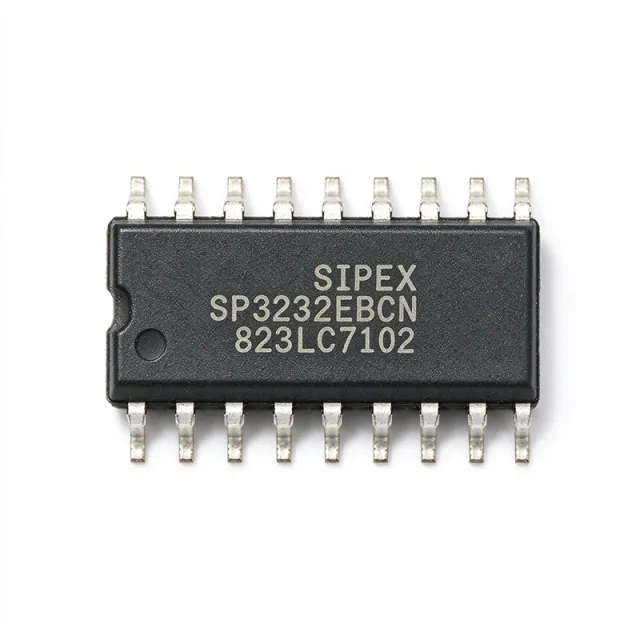
MaxLinear, Inc. SP3232EBCN-L is a two-channel RS-232 transceiver with two drivers and two receivers, a 250 kbps data rate, and a 16-pin SOIC package. It operates from a true +3.0 V to +5.5 V supply and supports commercial-temperature operation from 0 °C to +70 °C. The integrated interface also provides 15 kV ESD protection, making it suitable for equipment that requires robust protection on exposed serial ports. An RS-232 transceiver is an interface IC that converts logic-level signals to and from differential voltage levels used by RS-232 ports. A complete dual transceiver combines transmitter and receiver functions on each channel. The transmitter raises a digital signal to RS-232 voltage levels, while the receiver converts those voltage levels back into logic-compatible signals. This bidirectional level conversion allows a host, controller, or embedded system to connect to a conventional serial port using one compact integrated circuit. The SP3232EBCN-L uses a high-efficiency charge-pump power supply that permits true RS-232 operation from a single supply. According to the manufacturer documentation, only 0.1 µF charge-pump capacitors are required in 3.3 V operation. This integration reduces the external component count compared with discrete RS-232 interface approaches and is valuable in portable and hand-held equipment where board area and power consumption are constrained. With two transmit channels and two receive channels, the device supports simultaneous RS-232 activity on two logical channels. Its listed maximum signaling rate of 250 kbps provides ample margin for common serial links, including point-of-sale terminals, data-acquisition equipment, industrial controls, and service interfaces. The 16-SOIC package also supports conventional surface-mount assembly and is easier to inspect and rework than fine-pitch leadless packages. Typical applications include configuration and service ports in portable instruments, RS-232 links in industrial control equipment, data-logger connections, POS-system peripherals, and legacy communications ports in embedded systems. The 3.0 V to 5.5 V supply range permits use in both 3.3 V and 5 V system architectures, while the 0 °C to +70 °C commercial-temperature range suits indoor commercial and industrial equipment. When laying out the circuit, place the charge-pump capacitors and interface bypass capacitors close to their associated supply and charge-pump pins. Keep the RS-232 driver outputs away from sensitive analog or high-speed digital traces, and connect the device ground to the circuit ground at a low-impedance point. A protection network should be added when the connector is exposed to cables longer than the controlled enclosure boundary. This product page combines the manufacturer specifications, verified RS-232 interface characteristics, cross-reference data, package guidance, and practical design considerations. It is intended to help engineers confirm supply compatibility, channel count, signaling rate, temperature range, ESD protection, and replacement suitability before placing the SP3232EBCN-L into a new or existing design.

RFQ Contact
SP3232EBCN-L/TR - 250 kbps True RS-232 Transceiver, 2/2, 16-SOIC | MaxLinear
SP3232EBCN-L/TR

SP3232EBCN-L/TR - 250 kbps True RS-232 Transceiver, 2/2, 16-SOIC | MaxLinear

The MaxLinear SP3232EBCN-L/TR is a true RS-232 transceiver integrating two drivers and two receivers in a 16-pin narrow SOIC package, operating from a single 3.0 V to 5.5 V supply at data rates up to 250 kbps with 15 kV ESD protection on the RS-232 pins. An RS-232 transceiver is the physical-layer bridge between a logic-level UART and a differential, bipolar RS-232 port. RS-232 is a point-to-point, single-ended-plus-ground signalling standard defined in EIA/TIA-232-F; the transceiver's job is to convert TTL/CMOS logic levels into RS-232 levels on transmit and back again on receive. In the signal-chain hierarchy, an RS-232 transceiver sits below the UART controller and above the connector, inside the broader class of interface ICs and line-driver/receiver devices. Key features include a high-efficiency on-chip charge-pump supply that needs only 0.1 uF capacitors, true EIA/TIA-232-F compliance down to 3.0 V, 250 kbps transmission rate under load, 15 kV ESD protection on all bus pins, and a low-power shutdown mode drawing about 1 uA with the receivers still active. A single charge-pump and dual-pump topology eliminates the need for an external -12 V supply. The SP3232EB series is built for portable and hand-held equipment, where a single 3.3 V or 5 V rail must drive a legacy RS-232 port. The device also suits industrial data acquisition, instrumentation, point-of-sale terminals and USB-to-RS-232 bridging designs. Its 16-pin narrow SOIC body and standard pinout allow direct placement on existing RS-232 interface boards. A typical implementation places the transceiver between a microcontroller UART and a DB9 or RJ45-style RS-232 connector, with 0.1 uF charge-pump capacitors close to the V+ and V- pins and 100 nF decoupling on the supply. Pay attention to RS-232 ground referencing in long cable runs: the receiver tolerates a common-mode range, but ground loops in industrial cabinets remain the dominant source of data errors. This page consolidates parametric detail, drop-in alternatives in the same SOIC-16 footprint, and practical layout guidance that a datasheet alone does not present side by side.

USD $0.77 In Stock
SP3232EBCP-L - 250kbps Dual RS-232 Transceiver | MaxLinear
SP3232EBCP-L

SP3232EBCP-L - 250kbps Dual RS-232 Transceiver | MaxLinear

The MaxLinear SP3232EBCP-L is a dual RS-232 transceiver integrated circuit with two transmitters, two receivers, a 250 kbps data rate, and a single-supply operating range of 3.0 V to 5.5 V. It is packaged in a 28-pin LQFP. The device provides true EIA/TIA-232-F operation and uses a charge-pump power supply with four external 0.1 µF capacitors. An RS-232 transceiver is an interface IC that converts logic-level signals into RS-232 bipolar levels and converts incoming RS-232 signals back into digital logic. RS-232 belongs to the interface-IC hierarchy and is commonly used for point-to-point serial links in computer, industrial-control, instrumentation, and embedded systems. Its differential bipolar signaling provides noise immunity and voltage margins suited to cable-based communication. The SP3232EBCP-L offers two transmit channels and two receive channels, allowing one integrated component to handle bidirectional serial communication. Its 250 kbps rated transmission rate supports substantially faster data transfer than legacy limited-rate serial interfaces. Operation from a single 3.0 V to 5.5 V supply also allows the same circuit to work with 3.3 V and 5 V system rails. Its charge-pump circuitry generates the positive and negative voltage levels required by true RS-232 operation. Four external 0.1 µF capacitors support the charge pump and associated voltage generation. According to the MaxLinear SP3232EB family information, the charge-pump architecture requires only 0.1 µF capacitors for 3.3 V operation, helping reduce board area while preserving compliant line-driver levels. Typical applications include industrial serial controllers, portable data-acquisition equipment, computer peripherals, instrument interfaces, and embedded systems that exchange RS-232 commands or data. The two transmitters and two receivers are useful where a device must support more than one serial channel or provide separate transmit and receive connections on each port. PCB design should place the four charge-pump capacitors close to their associated pins, preserve the recommended routing geometry, and provide uninterrupted ground-plane continuity beneath the device. Check that the host interface uses the correct RS-232 logic levels and cable connection because the SP3232EBCP-L does not directly accept TTL signals without the transceiver’s level translation. This product record combines the SP3232EB family specifications with practical interface-selection guidance, including same-footprint alternatives, charge-pump layout considerations, application fit, and a parameter-by-parameter comparison for engineering review.

RFQ Contact
SP3232EBCT-L - 2/2 RS-232 Transceiver, 3-5.5V | MaxLinear (Tape & Reel)
SP3232EBCT-L

SP3232EBCT-L - 2/2 RS-232 Transceiver, 3-5.5V | MaxLinear (Tape & Reel)

MaxLinear SP3232EBCT-L is a dual line RS-232 transceiver with two drivers and two receivers, operating from a single +3.0 V to +5.5 V supply and packaged in a 16-pin SOIC. It supports transmission rates up to 250 kbps under load and is designed for portable and hand-held equipment requiring a complete bidirectional RS-232 interface. An RS-232 transceiver is a physical-layer interface IC that converts between digital logic levels and the voltage-defined RS-232 interface used for serial communications. The SP3232EB family combines two transmit channels, two receive channels, on-chip level translation, and a charge-pump voltage source for the bipolar RS-232 signal. This places it in the hierarchy of interface ICs, transceiver ICs, serial-interface ICs, and semiconductor devices. The SP3232EBCT-L operates from +3.0 V to +5.5 V and can therefore be powered from common 3.3 V or 5 V system rails. Its stated 250 kbps transmission rate under load is suitable for moderate-speed data links, configuration interfaces, instrumentation, and embedded control links. The 16-SOIC package allows direct use of a familiar surface-mount footprint and simplifies assembly where a larger quad-channel RS-232 device is unnecessary. The internal charge-pump supply generates the positive and negative voltages required by true RS-232 drivers. According to the MaxLinear product page, the SP3222EB/SP3232EB series uses only 0.1 uF charge-pump capacitors in 3.3 V operation. A dual-channel architecture can also reduce the number of external interface ICs compared with a quad transceiver, although signal-routing and channel-count requirements still determine the final choice. Typical applications include portable data terminals, hand-held test equipment, industrial control modules, point-of-sale equipment, and embedded serial adapters. The integrated level translation allows a low-voltage controller to communicate with a conventional RS-232 host while keeping the external power-supply design relatively simple. Designers should follow the manufacturer’s recommended charge-pump capacitor values, place them close to the associated pins, and observe the external capacitor requirements of the transmitter and receiver network. PCB layout should keep the RS-232 connector and interface traces away from sensitive analog or high-speed digital paths. The maximum cable length, termination, grounding, and protection arrangement should be selected for the intended communication standard and operating environment. This product summary combines the manufacturer family specifications with practical application, package, and replacement guidance. It also highlights the distinctions that matter when evaluating the SP3232EBCT-L against other dual RS-232 transceivers.

RFQ Contact
SP3232EBCT-L/TR - 2/2 RS-232 Transceiver, 3-5.5V | MaxLinear
SP3232EBCT-L/TR

SP3232EBCT-L/TR - 2/2 RS-232 Transceiver, 3-5.5V | MaxLinear

MaxLinear SP3232EBCT-L/TR is a dual line RS-232 transceiver with two drivers and two receivers, operating from a single +3.0 V to +5.5 V supply and packaged in a 16-pin SOIC. It supports transmission rates up to 250 kbps under load and is designed for portable and hand-held equipment requiring a complete bidirectional RS-232 interface. An RS-232 transceiver is a physical-layer interface IC that converts between digital logic levels and the voltage-defined RS-232 interface used for serial communications. The SP3232EB family combines two transmit channels, two receive channels, on-chip level translation, and a charge-pump voltage source for the bipolar RS-232 signal. This places it in the hierarchy of interface ICs, transceiver ICs, serial-interface ICs, and semiconductor devices. The SP3232EBCT-L/TR operates from +3.0 V to +5.5 V and can therefore be powered from common 3.3 V or 5 V system rails. Its stated 250 kbps transmission rate under load is suitable for moderate-speed data links, configuration interfaces, instrumentation, and embedded control links. The 16-SOIC package allows direct use of a familiar surface-mount footprint and simplifies assembly where a larger quad-channel RS-232 device is unnecessary. The internal charge-pump supply generates the positive and negative voltages required by true RS-232 drivers. According to the MaxLinear product page, the SP3222EB/SP3232EB series uses only 0.1 uF charge-pump capacitors in 3.3 V operation. A dual-channel architecture can also reduce the number of external interface ICs compared with a quad transceiver, although signal-routing and channel-count requirements still determine the final choice. Typical applications include portable data terminals, hand-held test equipment, industrial control modules, point-of-sale equipment, and embedded serial adapters. The integrated level translation allows a low-voltage controller to communicate with a conventional RS-232 host while keeping the external power-supply design relatively simple. Designers should follow the manufacturer’s recommended charge-pump capacitor values, place them close to the associated pins, and observe the external capacitor requirements of the transmitter and receiver network. PCB layout should keep the RS-232 connector and interface traces away from sensitive analog or high-speed digital paths. The maximum cable length, termination, grounding, and protection arrangement should be selected for the intended communication standard and operating environment. This product summary combines the manufacturer family specifications with practical application, package, and replacement guidance. It also highlights the distinctions that matter when evaluating the SP3232EBCT-L/TR against other dual RS-232 transceivers.

RFQ Contact
SP3232EBCY-L - 250kbps RS-232 Transceiver | MaxLinear (Tape & Reel)
SP3232EBCY-L

SP3232EBCY-L - 250kbps RS-232 Transceiver | MaxLinear (Tape & Reel)

MaxLinear SP3232EBCY-L is a 2/2 full RS-232 transceiver rated for 250 kbps, 3 V to 5.5 V operation, and 0°C to +70°C commercial temperature range in a 16-pin TSSOP package. The integrated interface includes one driver and one receiver, providing bidirectional point-to-point RS-232 communication from a single low-voltage supply. An RS-232 transceiver is an interface IC that converts between logic-level signals and RS-232 differential voltage levels. It belongs to the serial-interface hierarchy, combining a line driver, line receiver, and charge-pump voltage converter. The SP3232EB family targets portable and handheld equipment where true RS-232 performance is required from a compact 3.3 V or 5 V supply rather than a conventional ±12 V source. The SP3232EBCY-L supports data rates up to 250 kbps and a 3 V to 5.5 V supply range. Its high-efficiency charge-pump supply requires only 0.1 µF capacitors during 3.3 V operation, reducing external capacitor count compared with conventional RS-232 implementations. The manufacturer cross-reference identifies the SP3232EB family as providing 15 kV ESD protection. Two interface directions are available through the transceiver arrangement. The driver converts TTL or CMOS logic levels into RS-232 levels, while the receiver converts incoming RS-232 signals back into logic-compatible levels. This makes the device suitable for data links between portable computers, embedded controllers, industrial equipment, and other systems using the RS-232 standard. Typical applications include portable serial adapters, point-of-sale terminals, diagnostic interfaces, industrial control equipment, and embedded serial links. The 16-TSSOP package supports compact surface-mount construction, while the single-supply architecture simplifies system power design. The 250 kbps rating provides useful margin for common asynchronous serial links operating well below the device’s maximum signaling rate. When laying out the circuit, use the charge-pump capacitor values specified by the manufacturer and place them close to their associated pins. Keep the RS-232 driver and receiver traces away from sensitive analog or high-speed digital paths, and provide the connector interface with appropriate surge and ESD protection. This page combines the SP3232EB family electrical characteristics, package information, manufacturer cross-reference data, and practical guidance for selecting a pin-compatible RS-232 replacement or planning a compact single-supply serial interface.

RFQ Contact
SP3232EBCY-L/TR - 250kbps RS-232 Transceiver | MaxLinear
SP3232EBCY-L/TR

SP3232EBCY-L/TR - 250kbps RS-232 Transceiver | MaxLinear

MaxLinear SP3232EBCY-L/TR is a 2/2 full RS-232 transceiver rated for 250 kbps, 3 V to 5.5 V operation, and 0°C to +70°C commercial temperature range in a 16-pin TSSOP package. The integrated interface includes one driver and one receiver, providing bidirectional point-to-point RS-232 communication from a single low-voltage supply. An RS-232 transceiver is an interface IC that converts between logic-level signals and RS-232 differential voltage levels. It belongs to the serial-interface hierarchy, combining a line driver, line receiver, and charge-pump voltage converter. The SP3232EB family targets portable and handheld equipment where true RS-232 performance is required from a compact 3.3 V or 5 V supply rather than a conventional ±12 V source. The SP3232EBCY-L/TR supports data rates up to 250 kbps and a 3 V to 5.5 V supply range. Its high-efficiency charge-pump supply requires only 0.1 µF capacitors during 3.3 V operation, reducing external capacitor count compared with conventional RS-232 implementations. The manufacturer cross-reference identifies the SP3232EB family as providing 15 kV ESD protection. Two interface directions are available through the transceiver arrangement. The driver converts TTL or CMOS logic levels into RS-232 levels, while the receiver converts incoming RS-232 signals back into logic-compatible levels. This makes the device suitable for data links between portable computers, embedded controllers, industrial equipment, and other systems using the RS-232 standard. Typical applications include portable serial adapters, point-of-sale terminals, diagnostic interfaces, industrial control equipment, and embedded serial links. The 16-TSSOP package supports compact surface-mount construction, while the single-supply architecture simplifies system power design. The 250 kbps rating provides useful margin for common asynchronous serial links operating well below the device’s maximum signaling rate. When laying out the circuit, use the charge-pump capacitor values specified by the manufacturer and place them close to their associated pins. Keep the RS-232 driver and receiver traces away from sensitive analog or high-speed digital paths, and provide the connector interface with appropriate surge and ESD protection. This page combines the SP3232EB family electrical characteristics, package information, manufacturer cross-reference data, and practical guidance for selecting a pin-compatible RS-232 replacement or planning a compact single-supply serial interface.

RFQ Contact
SP3232EBEA-L/TR - 2/2 RS-232 Transceiver | MaxLinear
SP3232EBEA-L/TR

SP3232EBEA-L/TR - 2/2 RS-232 Transceiver | MaxLinear

The MaxLinear SP3232EBEA-L/TR is a 2-driver, 2-receiver RS-232 transceiver operating from a 3 V to 5.5 V supply in a 16-SSOP package. It supports transmission rates up to 250 kbps under load, supports true EIA/TIA-232-F operation, and includes an integrated charge-pump supply that requires only 0.1 µF capacitors in 3.3 V operation. An RS-232 transceiver is an interface IC that converts logic-level signals into RS-232 voltage levels and converts incoming RS-232 signals back into logic levels. It belongs to the interface IC hierarchy, which includes serial interface transceivers, line drivers, receivers, and multi-protocol interface controllers. Such devices provide electrical conversion and level translation between modern digital systems and older RS-232 equipment. The SP3232EB series combines two transmit channels and two receive channels in one package. Its 3 V to 5.5 V operating range permits use with both 3.3 V and 5 V systems. The integrated high-efficiency charge pump eliminates the need for an external RS-232 line-power supply, while 0.1 µF charge-pump capacitors simplify PCB implementation. The series also provides 15 kV ESD protection according to the manufacturer cross-reference information. Operationally, the transmitters drive RS-232 signals onto cable or connector networks, while the receivers provide thresholded inputs for the host UART or logic interface. This division of functions allows a compact port to support both command output and status or data input. The 250 kbps under-load capability is suitable for conventional RS-232 links, including point-of-sale equipment, industrial controllers, data-acquisition systems, and portable or handheld equipment. Typical implementations place the transceiver between a host controller and an external DB9 or other RS-232 connector. Signal routing should account for the logical relationship between driver outputs and receiver inputs, as well as the protection network required by the target connector and cable environment. The device can also be used where a legacy RS-232 interface must coexist with a modern low-voltage embedded processor. The principal design consideration is the relationship between supply voltage, charge-pump capacitors, UART logic levels, and connector protection. Place the required capacitors close to their associated pins and keep the high-voltage RS-232 node physically separated from sensitive logic traces. Confirm the exact pin assignment and recommended external components in the manufacturer datasheet before releasing a PCB layout. This product page combines the verified electrical and package attributes with pin-compatible family options, application guidance, comparison parameters, and practical PCB considerations. It is intended to help engineers identify the correct 16-SSOP RS-232 transceiver and plan the surrounding interface circuit efficiently.

RFQ Contact
SP3232EBEN-L/TR - 250kbps RS-232 Transceiver | MaxLinear
SP3232EBEN-L/TR

SP3232EBEN-L/TR - 250kbps RS-232 Transceiver | MaxLinear

The MaxLinear SP3232EBEN-L/TR is a two-channel, two-transceiver full RS-232 interface IC operating from a single 3.0V to 5.5V supply at rates up to 250kbps. The device is packaged in a 16-pin SOIC for surface-mount assembly and is specified over a -40°C to +85°C temperature range. An RS-232 transceiver is an interface IC that converts logic-level digital signals into RS-232 levels and converts received RS-232 levels back into digital logic signals. The SP3232EB family combines receiver and transmitter functions with an integrated charge-pump supply, making it suitable for portable and hand-held equipment that requires true RS-232 performance from a low-voltage system supply. The SP3232EBEN-L/TR supports two transmit and two receive channels. Its single-supply operating range of 3.0V to 5.5V permits use in both 3.3V and 5V systems. The manufacturer states that its high-efficiency charge-pump power supply requires only 0.1µF capacitors during 3.3V operation, reducing the external support-component count for compact serial-interface designs. The family is specified for operation at up to 250kbps and has a quiescent supply current of 0.3mA. The low-power architecture is useful for battery-powered equipment, portable test instruments, and embedded systems where an RS-232 connection is required but continuous current consumption must remain controlled. The 16-SOIC package supports standard surface-mount production and PCB rework procedures. Typical applications include serial service ports on portable computers, industrial diagnostic equipment, point-of-sale systems, data-acquisition instruments, and embedded controllers that communicate with RS-232 peripherals. The two-channel configuration allows one port to connect to a host adapter while another handles a local serial accessory or test fixture. Designers should preserve the required charge-pump capacitor connections and place the associated capacitors close to the device. Input and output signal paths should be routed away from switching nodes and noisy digital return currents to reduce the possibility of communications errors in electrically noisy industrial equipment. This product page combines the manufacturer family specifications with package details, practical application guidance, and a focused drop-in replacement comparison. It is intended to help engineers select an RS-232 interface, plan a PCB layout, and evaluate compatible replacements without reducing the component to a generic transceiver description.

RFQ Contact
SP3232EBEP-L - 250kbps RS-232 Transceiver | MaxLinear
SP3232EBEP-L

SP3232EBEP-L - 250kbps RS-232 Transceiver | MaxLinear

The MaxLinear SP3232EBEP-L is a true +3.0V to +5.5V RS-232 transceiver IC with two transmitters and two receivers, data rates up to 250kbps, and a 16-pin PDIP package. Its integrated charge-pump supply generates the bipolar voltage levels required by RS-232 from a single supply, while 0.1uF charge-pump capacitors support operation from a 3.3V rail. An RS-232 transceiver is an interface IC that translates between complementary logic-level signals used by digital equipment and the positive and negative voltage levels used by RS-232 links. The SP3232EB belongs to the broader interface IC hierarchy, where it sits between a host controller or UART and an external serial connector. This integration reduces the number of external level-shifting and charge-pump components required in compact portable equipment. Key features include a 2/2 transceiver arrangement, true RS-232 operation from +3.0V to +5.5V, and a maximum data rate of 250kbps when fully loaded. The high-efficiency on-board charge pump produces approximately ±5.5V from one supply. This makes the device applicable to 3.3V-only, mixed 3.3V-to-5.5V, and 5.0V-only systems. The device is intended specifically for portable and hand-held equipment such as notebook and laptop computers. The SP3232EB family combines charge-pump generation, RS-232 drivers, and RS-232 receivers in one package. Its dual-channel architecture allows two serial data paths to be implemented without duplicating the interface circuitry. The 16-pin PDIP package also supports conventional through-hole PCB assembly and prototyping. Because RS-232 is a single-ended, bipolar interface, correct grounding, cable routing, and protection remain important in systems exposed to electrostatic discharge or long cables. Typical uses include portable computer serial ports, industrial control links, embedded equipment, point-of-sale terminals, and service interfaces. The device is particularly useful when the system logic operates at 3.3V but the attached peripheral requires true RS-232 signal levels. Its 250kbps capability is suitable for moderate-speed data transfer while consuming less board area than a discrete driver and receiver implementation. Designers should place the required charge-pump capacitors close to their associated pins and provide the input and output bypassing specified by the manufacturer datasheet. Keep protected RS-232 traces away from sensitive clock, audio, and sensor paths. Confirm connector pin assignments and logic polarity during system integration, since transmitter and receiver signal inversions can differ from UART logic conventions. This product page combines manufacturer specifications, application guidance, package details, and verified drop-in replacement information to support faster component selection. It also distinguishes electrically similar devices from replacements that are truly pin-compatible, helping engineers preserve the existing 16-pin PDIP footprint and validate interface behavior before releasing a new board.

RFQ Contact
SP3232EBER-L/TR - 250kbps RS-232 Transceiver | MaxLinear
SP3232EBER-L/TR

SP3232EBER-L/TR - 250kbps RS-232 Transceiver | MaxLinear

The MaxLinear, Inc. SP3232EBER-L/TR is a 2/2 (two driver, two receiver) full-duplex RS-232 transceiver IC designed for portable and hand-held serial interfaces, operating from a single 3V to 5V supply and packaged in a 16-QFN (5x5 mm) surface-mount package supplied on tape and reel. It is specified for data rates up to 250 kbaud and features on-chip ESD protection rated to 15 kV. An RS-232 transceiver is a level-shifting interface IC that converts between logic-level CMOS/TTL signals and the bipolar +/- voltage swings defined by the RS-232 (EIA-232) standard. The SP3232EB/SP3222EB family belongs to the interface IC hierarchy: transceiver -> RS-232 interface -> serial transceiver -> integrated circuit. Because RS-232 uses inverting logic and elevated voltages, a transceiver is required between a host UART and a cable-attached peripheral, and the chip also supplies the biasing voltages the standard demands. Key features of this device include an integrated high-efficiency charge-pump power supply that needs only 0.1 uF capacitors when operated from 3.3V, true RS-232 levels from a single low-voltage supply, low-power operation suited to battery-powered equipment, integrated charge-pump capacitors in most qualified variants, and 15 kV ESD protection on the driver and receiver pins. The receiver hysteresis of 300 mV gives noise immunity against slow-moving bus edges in industrial cables. Technically the part replaces the older MAX232-style architecture by combining the charge-pump inverter, the dual driver bank and the dual receiver bank into one 16-QFN device. Because the on-chip charge pump operates continuously, the internal supply rails move only slightly with input voltage, so the transceiver behaves as a true single-supply RS-232 solution from 3V to 5V. The exposed pad under the QFN provides a low-impedance thermal and ground path, which matters when the package is used in compact handheld enclosures. Typical applications include point-of-sale terminals, barcode scanners, handheld test and measurement instruments, industrial serial cables, USB-to-serial adapters, medical and diagnostic equipment, and notebook or palmtop computer serial ports. The 250 kbaud data rate comfortably covers legacy RS-232 peripherals, while the 5x5 mm footprint suits space-constrained handheld and portable designs. When designing with the SP3232EBER-L/TR, place the charge-pump capacitors and the RS-232 line-side protection network close to the pins, route the driver outputs and receiver inputs as a matched, tightly coupled pair, and keep the analog ground return continuous under the device. Pay attention to the exposed-pad solder and thermal requirements, and confirm the cable-side ESD margin when connecting to externally accessible ports.

RFQ Contact