Products (46,000+)

SP3232EHEP-L - 3.3V 460kbps RS-232 Transceiver | MaxLinear
SP3232EHEP-L

SP3232EHEP-L - 3.3V 460kbps RS-232 Transceiver | MaxLinear

The MaxLinear SP3232EHEP-L is a 3.3 V RS-232 transceiver with two drivers, two receivers, and a maximum data rate of 460 kbps. The device is associated with a 16-pin TSSOP package and is intended for portable and hand-held equipment requiring a compact, low-power interface between TTL/CMOS logic and RS-232 lines. An RS-232 transceiver is an interface IC that combines differential line drivers and receivers with the voltage conversion required to communicate with RS-232 equipment. In the broader semiconductor hierarchy, it belongs to interface ICs and serves as the physical communication layer between a low-voltage digital controller and an RS-232 port. The SP3232EH family targets portable and hand-held applications such as notebook and laptop computers. The principal operating characteristics are a 3.3 V supply, two driver channels, two receiver channels, and throughput up to 460 kbps. These four features make the SP3232EHEP-L appropriate for point-to-point serial links, configuration ports, service interfaces, and embedded equipment that must exchange RS-232 signals without employing a larger multi-channel transceiver. MaxLinear describes the SP3232EH as a 2-driver/2-receiver RS-232 solution using a high-efficiency charge-pump power supply. According to the manufacturer data sheet, the charge-pump arrangement requires only 0.1 µF capacitors for 3.3 V operation. This architecture supports a compact external component set while maintaining the elevated and inverted voltage levels required by RS-232 driver outputs. Typical uses include portable data-acquisition equipment, industrial serial adapters, test fixtures, and controller boards with a legacy RS-232 service port. The 460 kbps rate supports substantially faster communication than conventional low-speed serial links while retaining the simple point-to-point interface of RS-232. System designers should still account for cable length, ground reference, transient protection, and protocol timing. When laying out the circuit, place the charge-pump capacitors and receiver bypass capacitors close to their associated device pins. Keep the RS-232 driver and receiver routes away from sensitive analog or high-speed digital paths, and provide the protection appropriate to the exposed connector environment. Follow the manufacturer data sheet for capacitor selection, pin assignments, and maximum operating conditions. This page consolidates the manufacturer specifications, package information, sourcing guidance, comparison points, and practical integration considerations for the SP3232EHEP-L. It is intended to help engineers identify a genuine same-footprint alternative, evaluate the 3.3 V and 460 kbps operating envelope, and plan a robust RS-232 interface before releasing the circuit to production.

RFQ Contact
SP3232EHET-L - 3.3V 460kbps RS-232 Transceiver | MaxLinear
SP3232EHET-L

SP3232EHET-L - 3.3V 460kbps RS-232 Transceiver | MaxLinear

MaxLinear SP3232EHET-L is a 3.3 V dual RS-232 transceiver with two drivers and two receivers, supporting data rates up to 460 kbps in a 16-pin SOIC package. It combines bidirectional serial-interface conversion with low-voltage operation for portable and embedded systems. The -L suffix identifies the lead-free ordering configuration, while the -TR portion is used by tape-and-reel order codes. An RS-232 transceiver is a level-shifting interface IC that converts logic-level signals from a host or controller into RS-232-compatible levels, while converting incoming RS-232 signals back into digital logic levels. In the interface hierarchy, SP3232EHET-L is a serial transceiver, an RS-232 transceiver, a line-driver and receiver pair, and ultimately a semiconductor interface device used between digital equipment and a cable-based serial port. The SP3232EH is designed around a compact 2/2 transceiver arrangement. Its 3.3 V supply operation reduces the logic-side voltage required by portable electronics, and its 460 kbps maximum signaling rate is suitable for moderate-speed serial links. The 16-SOIC format supports conventional surface-mount assembly while keeping the interface small enough for embedded control boards. Charge-pump circuitry and internal voltage levels allow the device to implement RS-232 signaling from a low-voltage supply. This transceiver architecture is intended for portable or hand-held equipment, including computers, terminals, and embedded serial-port systems. Two driver channels support two outgoing RS-232 signals, while two receiver channels accept two incoming signals. This arrangement suits equipment that needs more than one serial direction but does not require the channel count of larger multi-driver RS-232 families. Typical uses include point-of-sale terminals, portable diagnostic equipment, industrial controllers, and peripheral connection systems. In these applications, the key design considerations are the 3.3 V supply requirement, the 460 kbps data-rate ceiling, the 16-pin SOIC footprint, and the proper implementation of RS-232 cable protection. External protection may be required when a connected cable is exposed to electrostatic discharge or other industrial transients. Place bypass capacitors close to the supply and ground pins, route transceiver outputs and inputs away from sensitive clock or reference nets, and confirm that the host-side logic levels match the 3.3 V interface. Review the manufacturer pin-description and connection tables before assigning PCB tracks. Use the Request a Quote form on this page for current commercial availability, quantity requirements, and lead-time confirmation. This product page combines the manufacturer family description with distributor package and interface information, a pin-compatible replacement comparison, and practical PCB and protection guidance. It is intended to help engineers qualify the SP3232EHET-L quickly while still checking the exact ordering suffix against their mechanical and production requirements.

RFQ Contact
SP3232EHET-L/TR - 3.3V 460kbps RS-232 | MaxLinear
SP3232EHET-L/TR

SP3232EHET-L/TR - 3.3V 460kbps RS-232 | MaxLinear

MaxLinear SP3232EHET-L/TR is a 3.3V, 460kbps RS-232 transceiver containing two drivers and two receivers in a 16-SOIC package. The device operates from a 3V to 5.5V supply and supports RS-232 interoperability down to a 2.7V source. Enhanced human-body-model ESD protection of 15kV helps protect the serial interface when cables are connected to portable or hand-held equipment. The target is identified as a full RS-232, 2/2 transceiver and is packaged in the 16-SOIC format identified as 16-SOIC (0.295, 7.50mm width). An RS-232 transceiver is an interface IC that converts logic-level digital signals into RS-232 line levels and converts incoming RS-232 signals back into logic-compatible receiver outputs. The RS-232 transceiver category sits within serial interface ICs, interface ICs, and integrated circuits. It is commonly used to connect a host controller, embedded processor, test instrument, or industrial terminal to a longer-distance serial port where ground-referenced logic levels cannot drive the cable interface directly. The SP3232EH family provides two transmit drivers and two receive channels, allowing one port to support bidirectional RS-232 communication. Operation from a 3V to 5.5V supply is useful in portable systems operating from a 3.3V rail, while the 460kbps signaling capability supports higher-speed serial links than legacy low-speed RS-232 implementations. Its enhanced 15kV human-body-model ESD rating is a notable protection feature for connector-facing circuits. The architecture is optimized for portable and hand-held applications such as notebook and palmtop computers, where low supply voltage, compact packaging, and protection from electrostatic discharge are important. Because the device includes both directions of conversion, it can support two RS-232 lines without requiring separate driver and receiver ICs. The 16-SOIC package also provides a conventional surface-mount footprint compatible with automated assembly, although the exact pin assignment must be taken from the manufacturer pin-description table. Typical applications include portable data-collection equipment, serial adapters, industrial service interfaces, diagnostic equipment, and embedded control systems that retain an RS-232 port. When one side of a cable is exposed to user contact or poorly controlled external wiring, the 15kV human-body-model ESD rating is especially relevant. Designers should still provide appropriate protection-network coordination and verify that the selected connector, cable, and grounding arrangement meet the system-level interface requirements. The primary design consideration is power and signal integrity. Place the device close to the RS-232 connector so that board-trace exposure is minimized, connect the transceiver ground to the interface reference ground, and avoid long unprotected traces between the connector and IC. Confirm the 460kbps requirement against the actual cable length and noise environment because data rate, transmission distance, and capacitive loading are strongly related. This product page consolidates the core electrical ratings, package information, interface use cases, verified drop-in candidates, comparison parameters, and practical layout guidance for faster component selection and PCB planning. Use the MaxLinear SP3232EH product page and manufacturer datasheet for the authoritative electrical characteristics, recommended application circuit, and exact pin configuration.

RFQ Contact
SP3232EHEY-L - 460 kbps RS-232 Transceiver | MaxLinear (Tape & Reel)
SP3232EHEY-L

SP3232EHEY-L - 460 kbps RS-232 Transceiver | MaxLinear (Tape & Reel)

The MaxLinear SP3232EHEY-L is a 2-driver, 2-receiver RS-232 transceiver operating from a 3 V to 5.5 V single supply, supporting data rates up to 460 kbps in a 16-pin TSSOP package. The device includes a high-efficiency charge-pump supply and enhanced ESD protection rated to ±15 kV under the IEC human-body-model condition. Its integrated level conversion converts TTL/CMOS logic levels to and from RS-232 levels without requiring a separate supply for the interface rails. An RS-232 transceiver is a semiconductor interface device that bridges a digital logic system and a serial communications link using RS-232 voltage signaling. Each transceiver channel combines a line driver, which converts logic signals into RS-232 output levels, with a receiver, which converts incoming RS-232 signals into logic-compatible levels. In the broader hierarchy, the SP3232EHEY-L belongs to the interface-controller class, specifically the RS-232 driver/receiver and transceiver family within integrated interface ICs. The SP3232E series supports operation from a single 3.3 V supply while producing the positive and negative voltage levels required for conventional RS-232 communication. According to the MaxLinear manufacturer datasheet, its charge-pump supply requires only 0.1 µF capacitors in 3.3 V operation. The 2/2 driver and receiver arrangement provides two independent communications channels, while the 460 kbps maximum signaling rate supports common point-to-point serial links, embedded equipment, and legacy peripheral interfaces. The enhanced protection is particularly valuable in industrial and instrumentation environments where cables can be longer and more exposed than in a protected desktop enclosure. The device is specified for true EIA/TIA-232-F operation from a supply as high as 5.5 V and can interoperate with RS-232 equipment powered from a source as low as 2.7 V. Its internal charge-pump architecture reduces the number of external bulk capacitors while preserving bipolar RS-232 output levels. Typical applications include data acquisition equipment, industrial controllers, portable test instruments, point-of-sale terminals, and embedded systems that retain an RS-232 service or communications port. The device can also pair with a host UART or microcontroller to provide a standards-compliant physical interface for legacy equipment. Designers should treat the cable, ground reference, connector, and logic levels as parts of the complete communication path rather than relying only on the IC specification. A key design consideration is ensuring that the host-side interface levels match the selected UART and that unused driver or receiver channels are handled according to the manufacturer pin descriptions. Power-supply decoupling, charge-pump capacitor placement, and signal routing should follow the recommended layout in the manufacturer datasheet. ESD protection helps manage cable transients, but it does not replace proper grounding, shielding, or external surge protection in severe industrial environments. This product page combines the exact electrical ratings, package information, pin-location guidance, verified drop-in candidates, and practical interface-layout considerations for SP3232EHEY-L. It also distinguishes genuine same-footprint replacements from functionally similar devices that use different packages, allowing engineers to evaluate compatibility before modifying an existing RS-232 design.

USD $0.22 In Stock
SP3232EHEY-L/TR - 460 kbps RS-232 Transceiver | MaxLinear
SP3232EHEY-L/TR

SP3232EHEY-L/TR - 460 kbps RS-232 Transceiver | MaxLinear

The MaxLinear SP3232EHEY-L/TR is a 2-driver, 2-receiver RS-232 transceiver operating from a 3 V to 5.5 V single supply, supporting data rates up to 460 kbps in a 16-pin TSSOP package. The device includes a high-efficiency charge-pump supply and enhanced ESD protection rated to ±15 kV under the IEC human-body-model condition. Its integrated level conversion converts TTL/CMOS logic levels to and from RS-232 levels without requiring a separate supply for the interface rails. An RS-232 transceiver is a semiconductor interface device that bridges a digital logic system and a serial communications link using RS-232 voltage signaling. Each transceiver channel combines a line driver, which converts logic signals into RS-232 output levels, with a receiver, which converts incoming RS-232 signals into logic-compatible levels. In the broader hierarchy, the SP3232EHEY-L/TR belongs to the interface-controller class, specifically the RS-232 driver/receiver and transceiver family within integrated interface ICs. The SP3232E series supports operation from a single 3.3 V supply while producing the positive and negative voltage levels required for conventional RS-232 communication. According to the MaxLinear manufacturer datasheet, its charge-pump supply requires only 0.1 µF capacitors in 3.3 V operation. The 2/2 driver and receiver arrangement provides two independent communications channels, while the 460 kbps maximum signaling rate supports common point-to-point serial links, embedded equipment, and legacy peripheral interfaces. The enhanced protection is particularly valuable in industrial and instrumentation environments where cables can be longer and more exposed than in a protected desktop enclosure. The device is specified for true EIA/TIA-232-F operation from a supply as high as 5.5 V and can interoperate with RS-232 equipment powered from a source as low as 2.7 V. Its internal charge-pump architecture reduces the number of external bulk capacitors while preserving bipolar RS-232 output levels. Typical applications include data acquisition equipment, industrial controllers, portable test instruments, point-of-sale terminals, and embedded systems that retain an RS-232 service or communications port. The device can also pair with a host UART or microcontroller to provide a standards-compliant physical interface for legacy equipment. Designers should treat the cable, ground reference, connector, and logic levels as parts of the complete communication path rather than relying only on the IC specification. A key design consideration is ensuring that the host-side interface levels match the selected UART and that unused driver or receiver channels are handled according to the manufacturer pin descriptions. Power-supply decoupling, charge-pump capacitor placement, and signal routing should follow the recommended layout in the manufacturer datasheet. ESD protection helps manage cable transients, but it does not replace proper grounding, shielding, or external surge protection in severe industrial environments. This product page combines the exact electrical ratings, package information, pin-location guidance, verified drop-in candidates, and practical interface-layout considerations for SP3232EHEY-L/TR. It also distinguishes genuine same-footprint replacements from functionally similar devices that use different packages, allowing engineers to evaluate compatibility before modifying an existing RS-232 design.

USD $0.22 In Stock
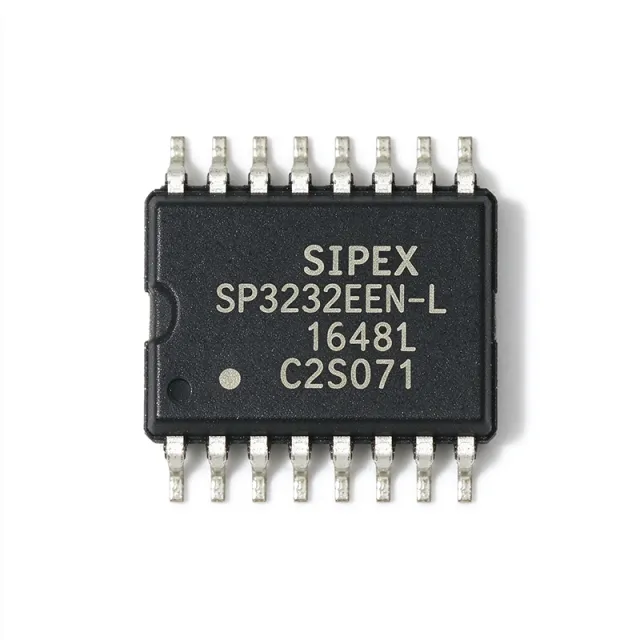
SP3232EN-L - 3V RS-232 Transceiver | MaxLinear | Serial Interface
SP3232EN-L

SP3232EN-L - 3V RS-232 Transceiver | MaxLinear | Serial Interface

The MaxLinear SP3232EN-L is a 2-transceiver, full-duplex RS-232 interface IC designed for portable and hand-held equipment. According to the supplied distributor and manufacturer-linked data, it operates from a true +3.0 V to +5.5 V supply, supports data rates up to 120 kbps under full load, and is available in a 16-pin SOIC package. The -L suffix identifies the lead-free ordering option, while the verified listings distinguish this MPN from SP3232EEN-L and other orderable variants. An RS-232 transceiver is an interface IC that converts between logic-level TTL/CMOS signals and the voltage-defined, single-ended differential signaling used by RS-232 equipment. This device integrates transmit and receive channels, allowing two serial directions to share one physical interface. It is commonly selected for battery-powered, portable, industrial-control, and legacy equipment connections where a compact, low-voltage serial interface is required. The SP3232EN-L is specified for a 3.0 V to 5.5 V operating supply range and a maximum data rate of 120 kbps under full load. The supplied specifications also identify approximately 1 mA supply current, low-power shutdown capability with receivers active for the relevant SP3222E family description, and operation from -40 C to +85 C. Its RS-232 interface is intended for portable or hand-held applications such as notebook and palmtop computers. The 16-pin SOIC package provides a conventional surface-mount footprint suitable for compact PCB assemblies. Because this is an interface transceiver rather than a power semiconductor, the safe-operating-area field is not applicable. Exact pin names, pinout details, receiver and transmitter electrical limits, and some lifecycle and compliance fields were not present in the supplied verified snippets; those values should be checked against the manufacturer datasheet before production release. Typical applications include RS-232 links in portable data-acquisition equipment, handheld test instruments, embedded controllers with legacy serial ports, and battery-operated peripherals. The 120 kbps rate is suitable for moderate-speed serial communication rather than high-bandwidth protocols. When designing the interface, account for the RS-232 voltage levels, cable capacitance, grounding strategy, protection requirements, and the difference between logic-level and RS-232-side pins. This page consolidates the verified SP3232EN-L distributor records, identified technical specifications, application guidance, and design cautions into one engineering reference. It is intended to support part selection and preliminary design work; final component validation should use the current manufacturer datasheet and approved sourcing channels.

RFQ Contact
SP3232EP-L - 3.0V RS-232 Transceiver | Sipex
SP3232EP-L

SP3232EP-L - 3.0V RS-232 Transceiver | Sipex

The Sipex SP3232EP-L is a +3.0V to +5.5V RS-232 transceiver designed for low-voltage serial interfaces. The verified manufacturer material identifies a minimum data rate of 120 kbps under full load, operation from a true +3.0V to +5.5V supply, compatibility with RS-232 down to +2.7V, and enhanced ESD protection rated at ±15 kV. The available SP3232EP family is offered in a 16-pin SSOP package, matching the selected SSOP-16 footprint and supporting PCB-level drop-in evaluation for compatible RS-232 designs. What is an RS-232 transceiver? An RS-232 transceiver is an interface IC that combines a driver and receiver for point-to-point serial communication. In the wider hierarchy, it is a transceiver, then an interface IC, then an integrated circuit and semiconductor. The driver converts logic-level signals into RS-232 levels, while the receiver converts incoming RS-232 levels back into digital logic levels. This device is intended for systems that need standards-based serial connectivity at low supply voltage. Key features include the 3.0V minimum operating supply, 5.5V maximum supply, 120 kbps minimum data rate under full load, and ±15 kV enhanced ESD protection. The verified snippets also identify true EIA/TIA-232-F compliance from a +3.0V to +5.5V supply and interoperability with RS-232 down to +2.7V. These characteristics make the transceiver suitable for embedded systems, industrial control links, test equipment, and peripheral connections where a standard RS-232 interface is required. The SP3232EP uses a +3.0V-to-+5.5V supply architecture to support low-voltage digital systems without requiring a higher-voltage RS-232 transceiver supply. The 120 kbps minimum rate under full load provides a defined data-rate target for moderate-speed serial links. Its ESD rating is particularly important because RS-232 connector inputs can be exposed to external cables and user-contact transients. Typical applications include USB-to-RS-232 adapters, embedded instrumentation, point-of-sale equipment, industrial controllers, data-acquisition systems, and legacy peripheral connections. In each case, the transceiver provides the physical-layer interface between logic-level UART hardware and an external RS-232 port. The application must still observe the datasheet's electrical limits, pin connections, decoupling requirements, and cable-routing guidance. For PCB design, place the transceiver close to the RS-232 connector and provide the required local supply bypassing. Keep the logic-side traces away from the connector-side signals, use an appropriate ground reference, and verify the external UART voltage levels. The 16-pin SSOP footprint requires careful solder-paste and land-pattern review before manufacturing. This page combines verified manufacturer and distributor information, pricing context, package identification, and application-focused engineering guidance. Because the supplied web results do not provide a complete pin-by-pin pinout or verified same-package substitute list, missing engineering data is explicitly marked rather than inferred. Confirm final placement and production quantities against the manufacturer datasheet and current distributor inventory.

RFQ Contact
SP3232EUCA-L - 3.3V 1Mbps RS-232 IC | MaxLinear
SP3232EUCA-L

SP3232EUCA-L - 3.3V 1Mbps RS-232 IC | MaxLinear

The MaxLinear SP3232EUCA-L is a 3.3 V RS-232 interface IC containing two drivers and two receivers, supporting data rates up to 1000 kbps in a 16-SSOP package. Its integrated charge-pump supply supports low-capacitance operation with 0.1 µF capacitors in 3.3 V applications, reducing the external support-component count for compact serial-interface designs. An RS-232 transceiver is an interface IC that converts logic-level digital signals into RS-232 line levels and converts received RS-232 signals back into digital logic. The SP3232EU belongs to the broader line-driver and line-receiver hierarchy, where the line driver transmits, the line receiver detects, and the transceiver combines both functions. It is particularly relevant to portable and handheld equipment requiring bidirectional asynchronous serial communication. The principal features include two transmit drivers, two receive receivers, full RS-232 operation, a 3.3 V supply, and a maximum data transmission rate of 1000 kbps. The 1000 kbps rating supports high-speed RS-232 links, while the two-driver and two-receiver arrangement allows two serial channels or a combination of independent transmit and receive paths. The 16-SSOP package also supports compact board layouts where a larger SOIC footprint would be undesirable. The internal high-efficiency charge pump generates the bipolar voltage required by the RS-232 drivers without requiring an external negative supply. According to the MaxLinear SP3232EU product information, 3.3 V operation requires only 0.1 µF charge-pump capacitors. This architecture simplifies system partitioning, although the external capacitor selection, placement, and tolerance still influence driver amplitude and signal integrity. Typical uses include portable data terminals, handheld test equipment, industrial serial adapters, embedded serial consoles, and compact peripheral interfaces. The two transmitters and two receivers are useful when a design needs more than one RS-232 direction, while the 1000 kbps capability can accommodate short-distance high-speed links when the connected equipment, cable, and protocol support that rate. PCB design should follow the manufacturer pin and capacitor-placement guidance, keep charge-pump and receiver-network components close to the device, and provide adequate return paths for both supply rails. The RS-232 interface must also be evaluated for ground offset, cable length, connector protection, and transient immunity; a high logic data rate does not guarantee reliable communication on every cable or grounding arrangement.

RFQ Contact
SP3232EUCA-L/TR - 3.3V 1Mbps RS-232 IC | MaxLinear
SP3232EUCA-L/TR

SP3232EUCA-L/TR - 3.3V 1Mbps RS-232 IC | MaxLinear

The MaxLinear SP3232EUCA-L/TR is a 3.3 V RS-232 transceiver IC with two drivers, two receivers, and a maximum data rate of 1000 kbps, packaged in a 16-pin SSOP. The device provides the electrical interface between a low-voltage digital system and an RS-232 port, combining bidirectional line-driver and line-receiver functions in one package. According to the MaxLinear product page, the SP3232EU is intended for portable and handheld equipment while also supporting high-speed RS-232 data transmission. An RS-232 transceiver is an interface IC that translates digital logic levels into RS-232 line levels and converts received RS-232 signals back into logic-compatible levels. It belongs to the interface IC hierarchy alongside serial transceivers, line drivers, and line receivers. These devices simplify serial-port design by combining the active driver circuitry, receiver circuitry, and the required charge-pump voltage conversion in a single IC. The SP3232EU operates from a 3 V to 5.5 V supply and supports data rates up to 1000 kbps. Its two-driver and two-receiver arrangement can serve two communication channels or provide additional driver and receiver channels for handshake and control signals. The 3.3 V operating capability makes the device suitable for systems based on modern low-voltage microcontrollers, embedded processors, and portable equipment. MaxLinear identifies true EIA/TIA-232-F operation from a supply as high as 5.5 V. Its internal high-efficiency charge-pump supply generates the voltage required by the RS-232 drivers while allowing operation with only 0.1 uF external capacitors in 3.3 V designs. This approach reduces external component count compared with implementations that require additional bulk capacitance. The SP3232EU therefore combines a compact SSOP-16 footprint with a high data rate and low-voltage operation. Typical uses include portable-computer accessories, handheld equipment, industrial serial interfaces, point-of-sale terminals, instrument connections, and embedded-control systems. In an embedded design, the transceiver can connect a 3.3 V controller UART to an external RS-232 connector while preserving the logic-level translation required by the RS-232 standard. Layout should keep the charge-pump capacitors and communication-line protection close to their associated pins, while separating the transceiver from sensitive analog or high-speed digital circuits. Confirm the package pin assignments and connector signal mapping in the manufacturer datasheet before PCB release. This product page combines the MaxLinear family specifications, verified distributor listings, package details, and practical selection guidance. It also distinguishes same-family alternatives by verified electrical ratings and package information so engineers can assess replacement suitability without treating merely similar components as drop-in replacements.

RFQ Contact
SP3232EUCN-L - 1 Mbps Dual RS-232 Transceiver | MaxLinear
SP3232EUCN-L

SP3232EUCN-L - 1 Mbps Dual RS-232 Transceiver | MaxLinear

The MaxLinear SP3232EUCN-L is a 3.3 V RS-232 transceiver with two drivers and two receivers, a 1000 kbps data rate, and a 16-pin SOIC package. Designed for portable and handheld equipment, it combines bidirectional RS-232 interface conversion with an integrated charge-pump power supply. The 0C to 70C commercial temperature range supports industrial, consumer, and point-of-use equipment where a compact, low-voltage serial interface is required. An RS-232 transceiver is an interface IC that converts logic-level UART signals into RS-232 voltage levels and converts received RS-232 signals back into logic-compatible levels. The SP3232EUCN-L belongs to the RS-232 transceiver hierarchy, where transceiver ICs sit between host processors or microcontrollers and external D-sub or other RS-232 connectors. Its two driver and two receiver channels permit simultaneous bidirectional communication while reducing the external component count required for level conversion. The device supports data transmission at up to 1000 kbps and operates from a 3.3 V supply. According to the manufacturer datasheet, its high-efficiency charge-pump supply requires only 0.1 uF capacitors for 3.3 V operation. This compact charge-pump arrangement supports compact portable designs while producing the bipolar voltage levels required by RS-232. The package also reduces board area compared with discrete driver and receiver implementations. The SP3232EU family provides separate transmit and receive channels, allowing a system to send and receive RS-232 data through one interface IC. The receiver channels support integration with UART-based controllers, while the drivers connect to external RS-232 ports. Its 1000 kbps capability is suitable for moderate-speed diagnostic, configuration, control, and point-of-service interfaces rather than long-distance continuous high-bandwidth data links. Typical uses include handheld test equipment, portable computers, serial adapters, point-of-sale terminals, industrial service interfaces, and embedded control systems that exchange configuration or diagnostic data through RS-232. The 16-pin SOIC package is particularly useful where a conventional through-hole or larger surface-mount footprint would be inconvenient. When designing around the SP3232EUCN-L, place the charge-pump capacitors close to their designated pins and route the RS-232 driver outputs directly toward the connector. Keep logic-side traces away from the high-voltage transmit nets, provide the connector's normal ESD and surge-protection path, and verify that the connected UART baud rate and cable loading are compatible with 1000 kbps operation. This page combines the manufacturer interface characteristics, package details, application guidance, verified drop-in alternatives, and practical PCB considerations to support faster component selection and implementation planning.

RFQ Contact
SP3232EUCN-L/TR - 1 Mbps 3.3V RS-232 | MaxLinear
SP3232EUCN-L/TR

SP3232EUCN-L/TR - 1 Mbps 3.3V RS-232 | MaxLinear

MaxLinear SP3232EUCN-L/TR is a 3.3 V RS-232 transceiver IC with two drivers, two receivers, a maximum data rate of 1000 kbps, and a 16-pin SOIC package. It supports portable and hand-held equipment that requires bidirectional serial communication using the RS-232 interface. The integrated high-efficiency charge-pump supply supports 3.3 V operation with only 0.1 µF capacitors. An RS-232 transceiver is an interface IC that converts logic-level UART signals into RS-232 voltage levels and converts received RS-232 signals back into logic-compatible levels. Within the interface hierarchy, it is a serial transceiver, a line-driver and line-receiver component, and ultimately a semiconductor designed for data communication and industrial-control equipment. The SP3232E has two transmit channels and two receive channels, allowing two serial links or bidirectional operation on one device. Its 1000 kbps signaling rate supports relatively high-speed RS-232 communication compared with slower legacy transceivers. Operation from a single 3.3 V supply also simplifies power design in portable systems, while the charge-pump topology generates the bipolar voltage required by RS-232 without a separate negative supply. MaxLinear describes the SP3232E series as a solution for portable or hand-held computers, including notebook and palmtop platforms. The same architecture is useful for instrument control, point-of-sale equipment, industrial serial adapters, and embedded systems that exchange data with a host over RS-232. The charge-pump network requires small 0.1 µF capacitors for 3.3 V operation. Place these capacitors close to their associated pins and keep the RS-232 driver and receiver traces away from sensitive analog or high-speed digital paths. Confirm the exact pin names and exposed functions against the MaxLinear datasheet before assigning PCB nets. This product page combines the SP3232E family electrical characteristics, package information, drop-in replacement guidance, comparison data, and practical PCB design notes to support faster component selection and implementation.

RFQ Contact
SP3232EUCT-L - 1 Mbps Dual RS-232 Transceiver | MaxLinear
SP3232EUCT-L

SP3232EUCT-L - 1 Mbps Dual RS-232 Transceiver | MaxLinear

The MaxLinear SP3232EUCT-L is a dual-driver, dual-receiver RS-232 transceiver designed for high-speed serial communication from a single 3.0 V to 5.5 V supply. It supports a maximum data rate of 1000 kbps and is packaged in a 16-pin SOIC for compact industrial, communications, and embedded equipment. An RS-232 transceiver is an interface IC that converts logic-level UART signals into RS-232 line levels and converts incoming RS-232 signals back into CMOS-compatible levels. The SP3232E family integrates two line drivers, two line receivers, and a charge-pump supply, placing it within the hierarchy of interface ICs, communications transceivers, and RS-232 interface silicon. The SP3232EUCT-L provides two transmit channels and two receive channels, allowing one RS-232 port to handle two data directions. Its single-supply operation supports both 3.3 V and 5 V system environments. The manufacturer's charge-pump design requires only 0.1 uF capacitors in 3.3 V operation, reducing external component count while preserving full RS-232 signal levels. Its 1000 kbps capability is suitable for moderate-speed serial links, including embedded control ports and industrial peripherals. The integrated charge pump generates the positive and negative voltages needed by RS-232 drivers from the single supply. This architecture avoids a separate bipolar power source and allows the device to operate from a 3.0 V to 5.5 V source. Because the interface performs level translation at the physical layer, the connected host or target UART still handles data framing, baud-rate agreement, parity, flow control, and protocol behavior. Typical uses include industrial control equipment, portable data-acquisition systems, service interfaces, POS terminals, and embedded debug or configuration ports. The 16-pin SOIC package supports conventional surface-mount assembly and remains practical for boards where component height is more constrained than the size of a dual-inline package. Confirm the exact pin assignment, charge-pump capacitor values, and decoupling requirements in the manufacturer datasheet before PCB release. Preserve short, direct paths for the charge-pump nodes and place the required capacitors close to their associated pins to reduce switching noise and unstable driver behavior. This product page combines the SP3232EUCT-L electrical characteristics, same-package replacement options, application guidance, and design notes to help engineers evaluate the transceiver quickly and implement a reliable RS-232 interface.

RFQ Contact
SP3232EUCT-L/TR - 2/2 RS-232 Transceiver | MaxLinear
SP3232EUCT-L/TR

SP3232EUCT-L/TR - 2/2 RS-232 Transceiver | MaxLinear

The MaxLinear SP3232EUCT-L/TR is a 2-driver, 2-receiver RS-232 transceiver designed for portable and high-speed serial-interface equipment. It operates from a single 3 V to 5.5 V supply, supports data rates up to 1000 kbps, and uses an efficient charge-pump power supply that requires only 0.1 µF capacitors in 3.3 V operation. The device is packaged in a 16-pin SOIC for surface-mount assembly. An RS-232 transceiver is an interface IC that combines voltage-level conversion, drivers, and receivers to connect modern low-voltage digital logic with legacy RS-232 equipment. The SP3232EU family provides a practical bridge between UART controllers and serial peripherals, printers, industrial instruments, and point-of-sale terminals. Its compact surface-mount package supports automated assembly while avoiding a separate external RS-232 line-driver circuit. Principal features include two transmit drivers and two receive receivers, operation from one 3 V to 5.5 V supply, and a maximum data transmission rate of 1000 kbps. The internal charge-pump design supplies the bipolar voltage levels required by RS-232 without a separate negative supply. At 3.3 V, the charge pump requires only 0.1 µF capacitors, reducing external component count and helping conserve board space in portable equipment. The SP3232EUCT-L/TR is the tape-and-reel ordering form of the SP3232EUCT-L device. Its 16-SOIC package is suitable for reflow assembly and volume manufacturing. The suffix /TR identifies tape-and-reel packing, while U identifies the electrical and temperature configuration and L identifies the lead-free ordering option. Design engineers should use the manufacturer pin-description table when assigning connector-side and logic-side nets. Typical applications include notebook and palmtop computer serial ports, portable data-collection equipment, industrial serial adapters, barcode scanners, point-of-sale terminals, and embedded diagnostic interfaces. The device is especially useful where a low-voltage UART must connect to an RS-232 port using one compact transceiver rather than discrete level-shifting circuitry. The principal design considerations are external capacitor selection, signal grounding, and RS-232 protection. Place the charge-pump capacitors and interface bypass capacitors close to their specified pins, and route the RS-232 traces away from sensitive analog or high-speed digital nets. The receive path should also be evaluated for system-level ESD protection where cables leave the enclosure. This page combines the manufacturer device information, practical package and application guidance, drop-in replacement considerations, and design notes intended to shorten component-selection and PCB-integration time.

RFQ Contact
SP3232EUCY-L/TR - 1Mbps Dual RS-232 Transceiver | MaxLinear
SP3232EUCY-L/TR

SP3232EUCY-L/TR - 1Mbps Dual RS-232 Transceiver | MaxLinear

MaxLinear SP3232EUCY-L/TR is a 2-driver, 2-receiver RS-232 interface transceiver capable of transmitting at 1000 kbps. It operates from a single 3 V to 5.5 V supply, supports 3.3 V operation, and is packaged in a 16-pin TSSOP. The -L designation identifies the low-power variant, while the /TR suffix denotes tape-and-reel shipping. An RS-232 transceiver is a semiconductor interface device that converts logic-level signals into RS-232 voltage levels and converts incoming RS-232 signals back into digital logic. It belongs to the line-transceiver hierarchy within interface ICs and provides the physical signaling layer required to connect a data-processing system to a serial peripheral over RS-232. The SP3232EUCY-L/TR provides two transmit channels and two receive channels, allowing two full-duplex serial links on one device. Its maximum data rate of 1000 kbps supports high-speed RS-232 communication, while the 3 V to 5.5 V supply range accommodates both 3.3 V and 5 V system rails. The internal charge-pump supply supports true RS-232 operation without a separate bipolar supply when the device operates from 3.3 V. MaxLinear describes the SP3232EU family as a high-efficiency charge-pump solution for portable and hand-held equipment. The charge-pump topology raises and inverts the supply used by the line drivers, while the receiver and driver channels implement the voltage translation required by RS-232. The family is intended for equipment where compact implementation, low component count, and reliable serial connectivity are important. Typical uses include notebook and palmtop computer serial interfaces, portable data-collection equipment, industrial control systems, instrument interfaces, and embedded serial links. A design can place the transceiver between a host UART and an external DB9 or other RS-232 connector, adding the required logic-to-RS-232 level conversion while preserving a compact surface-mount footprint. PCB layout is important around this interface. Keep charge-pump capacitors and supply bypass components close to their associated pins, route the RS-232 driver outputs away from sensitive logic, and use an appropriate protection scheme for cables connected to external equipment. The 16-pin TSSOP package is pin-compatible with the closely related SP3232ECY-L/TR member of the same device family. This page combines the manufacturer specifications, interface-family context, replacement guidance, and practical layout considerations into a focused engineering reference. It also distinguishes exact package compatibility from broader RS-232 functionality so that designers can assess a replacement without assuming that every similar transceiver has the same footprint or signaling performance.

RFQ Contact
SP3232EUEY-L - 1Mbps RS-232 Transceiver | MaxLinear (Tape & Reel)
SP3232EUEY-L

SP3232EUEY-L - 1Mbps RS-232 Transceiver | MaxLinear (Tape & Reel)

The MaxLinear SP3232EUEY-L is a 2/2 RS-232 transceiver designed for portable and handheld equipment, with two drivers, two receivers, a 3.3 V to 5.5 V supply range, and a maximum data rate of 1000 kbps in a 16-pin TSSOP package. Its integrated charge-pump supply supports low-noise RS-232 operation from a single system supply while reducing the external capacitor count. An RS-232 transceiver is an interface IC that converts logic-level signals from a host or embedded controller into RS-232 levels and converts incoming RS-232 signals back into digital logic levels. RS-232 belongs to the broader interface-IC hierarchy, where transceivers connect embedded systems, instrumentation, industrial equipment, and communications equipment through established serial-interface standards. The SP3232EUEY-L provides two transmit channels and two receive channels, enabling bidirectional serial communication over two RS-232 data paths. Its 1000 kbps data rate supports higher-throughput links than many legacy RS-232 implementations. The 3 V to 5.5 V operating range accommodates systems powered from either 3.3 V or 5 V rails, and the charge-pump architecture requires only 0.1 µF capacitors for 3.3 V operation. The charge pump generates the positive and negative voltage rails required by true RS-232 signaling from a single low-voltage supply. This topology avoids a separate negative power supply in portable equipment. The internal design targets RS-232 standards compliance and interoperability while preserving a conventional transceiver interface for host UART connections and embedded serial ports. Typical applications include notebook and palmtop computer serial ports, portable data-acquisition equipment, diagnostic interfaces, industrial control panels, and embedded systems that need bidirectional RS-232 communication. The 16-TSSOP package also supports compact layouts where board area is more constrained than the number of I/O channels. For a new layout, place the charge-pump capacitors close to their associated pins and maintain short return paths for transceiver currents. Verify the connector-side protection strategy and grounding arrangement for the actual cable length because external cables can introduce ESD and EMI events that are not present at the IC pins. This page combines manufacturer electrical characteristics, package and sourcing information, pin-comparable family options, and implementation guidance to support faster component selection, PCB planning, and RS-232 interface design.

RFQ Contact
SP3232EUEY-L/TR - 1Mbps RS-232 Transceiver | MaxLinear
SP3232EUEY-L/TR

SP3232EUEY-L/TR - 1Mbps RS-232 Transceiver | MaxLinear

The MaxLinear SP3232EUEY-L/TR is a 2/2 RS-232 transceiver designed for portable and handheld equipment, with two drivers, two receivers, a 3.3 V to 5.5 V supply range, and a maximum data rate of 1000 kbps in a 16-pin TSSOP package. Its integrated charge-pump supply supports low-noise RS-232 operation from a single system supply while reducing the external capacitor count. An RS-232 transceiver is an interface IC that converts logic-level signals from a host or embedded controller into RS-232 levels and converts incoming RS-232 signals back into digital logic levels. RS-232 belongs to the broader interface-IC hierarchy, where transceivers connect embedded systems, instrumentation, industrial equipment, and communications equipment through established serial-interface standards. The SP3232EUEY-L/TR provides two transmit channels and two receive channels, enabling bidirectional serial communication over two RS-232 data paths. Its 1000 kbps data rate supports higher-throughput links than many legacy RS-232 implementations. The 3 V to 5.5 V operating range accommodates systems powered from either 3.3 V or 5 V rails, and the charge-pump architecture requires only 0.1 µF capacitors for 3.3 V operation. The charge pump generates the positive and negative voltage rails required by true RS-232 signaling from a single low-voltage supply. This topology avoids a separate negative power supply in portable equipment. The internal design targets RS-232 standards compliance and interoperability while preserving a conventional transceiver interface for host UART connections and embedded serial ports. Typical applications include notebook and palmtop computer serial ports, portable data-acquisition equipment, diagnostic interfaces, industrial control panels, and embedded systems that need bidirectional RS-232 communication. The 16-TSSOP package also supports compact layouts where board area is more constrained than the number of I/O channels. For a new layout, place the charge-pump capacitors close to their associated pins and maintain short return paths for transceiver currents. Verify the connector-side protection strategy and grounding arrangement for the actual cable length because external cables can introduce ESD and EMI events that are not present at the IC pins. This page combines manufacturer electrical characteristics, package and sourcing information, pin-comparable family options, and implementation guidance to support faster component selection, PCB planning, and RS-232 interface design.

RFQ Contact
SP3232EY-L - 2/2 RS-232 Transceiver | MaxLinear
SP3232EY-L

SP3232EY-L - 2/2 RS-232 Transceiver | MaxLinear

The MaxLinear SP3232EY-L is a true RS-232 transceiver IC with two drivers and two receivers, a 3.0 V to 5.5 V operating supply range, and data-rate capability up to 120 kbps in the supplied manufacturer-family data. The verified distributor result identifies the device as a 16-TSSOP RS-232 interface component. It is designed for portable and hand-held equipment where a compact, low-voltage RS-232 interface is required. An RS-232 transceiver is an interface IC that combines line drivers and receivers with the electrical characteristics required by RS-232 communication links. The driver converts low-voltage logic signals into RS-232-compatible levels, while the receiver converts incoming RS-232 signals back into logic levels. In the broader electronics hierarchy, the SP3232EY-L belongs to interface ICs, communication interfaces, and RS-232 transceivers. The verified data identifies the SP3222E/SP3232E family as using a high-efficiency charge-pump power supply that requires only 0.1 μF capacitors in 3.3 V operation. It also specifies true +3.0 V to +5.5 V RS-232 operation, minimum 120 kbps data-rate capability under full load, and 1 μA low-power shutdown with receivers active. These features make the device relevant to portable computers, embedded serial links, instrumentation, and industrial control equipment. The SP3232EY-L combines transmit and receive functions in one package, reducing the number of discrete interface ICs required for a dual-channel RS-232 port. Its 16-TSSOP package supports compact surface-mount layouts, while the specified 3.0 V to 5.5 V supply range allows operation from both 3.3 V and 5 V system rails. The device is appropriate where RS-232 compliance and low-voltage integration are more important than the higher data rates of newer serial standards. Designers should pay attention to the external charge-pump capacitors, supply decoupling, and the distinction between logic-side and RS-232-side signals. The 0.1 μF capacitor requirement applies to 3.3 V operation according to the supplied family description; capacitor voltage rating and layout should follow the manufacturer guidance. Because the verified results do not provide a complete public pinout or detailed absolute-maximum table for this exact suffix, pin-level and stress-limit decisions require confirmation from the exact manufacturer datasheet before release to production. This product page combines the supplied distributor and manufacturer-family data with application guidance, design cautions, and clearly marked information gaps. It is intended to support initial component selection and board planning rather than replace the exact datasheet, qualification process, or application-specific validation.

RFQ Contact
SP3238EEY-L - 5/3 RS-232 Transceiver, 250 kbps, 28-SSOP | MaxLinear
SP3238EEY-L

SP3238EEY-L - 5/3 RS-232 Transceiver, 250 kbps, 28-SSOP | MaxLinear

The MaxLinear SP3238EEY-L is a 5-driver / 3-receiver RS-232 transceiver that operates from a single +3.0V to +5.5V supply and delivers true EIA/TIA-232-F compliant signal levels. Housed in a 28-pin SSOP (TSSOP-equivalent) package, it supports data rates up to 250 kbps and operates from -40C to +85C. Key features include an internal high-efficiency charge-pump power supply that requires only 0.1uF capacitors at 3.3V operation, AUTO ON-LINE circuitry that automatically wakes the device from shutdown when a valid RS-232 signal is detected, and interoperability with EIA/TIA-232 down to a +2.7V power source. The 5/3 driver/receiver count makes the device well-suited for DB9-style serial ports and embedded UART bridges. The SP3238E device is an RS-232 transceiver solution intended for portable or hand-held applications such as notebook and palmtop computers. Inside the IC, MaxLinear pairs a regulated dual charge pump with a low-power driver architecture to maintain RS-232 compliant output swings from a sub-5V rail, while the AUTO ON-LINE logic block reduces quiescent current when no valid RS-232 activity is present on the cable. Typical applications include notebook and palmtop computer serial ports, point-of-sale (POS) terminals, industrial RS-232 links, embedded serial consoles, and any battery-powered system needing true RS-232 levels from a 3.3V logic rail. Designers regularly pair it with a DB9 connector and 0.1uF X5R ceramic bypass caps for a compact interface. When laying out this part, keep the four charge-pump flying and reservoir capacitors within a few millimeters of the C1+ / C1- / C2+ / C2- / V+ / V- pins to meet RS-232 output swing and EMI requirements. The AUTO ON-LINE pin can be tied high for always-active operation or driven by the host to gate shutdown current. This page synthesizes distributor pricing, drop-in alternatives, and practical design notes not found in the manufacturer datasheet.

RFQ Contact
SP3238EEY-L-TR - 5/3 RS-232 Transceiver, 3-5.5V, 28-TSSOP
SP3238EEY-L-TR

SP3238EEY-L-TR - 5/3 RS-232 Transceiver, 3-5.5V, 28-TSSOP

The MaxLinear (formerly Exar) SP3238EEY-L/TR is an intelligent +3.0V to +5.5V RS-232 transceiver in a 28-pin TSSOP package, integrating five drivers and three receivers with a charge-pump DC-DC converter on-chip. It operates from a single 3.0V to 5.5V supply, supports data rates up to 250 kbps, and meets the EIA/TIA-232-F and ITU-T V.28/V.24 specifications over the industrial -40C to +85C temperature range. The device is supplied on a 2,500-unit tape-and-reel and is targeted at portable and hand-held applications such as notebook, palmtop, PDA, and battery-powered equipment. A RS-232 transceiver is a line driver/receiver pair that converts logic-level UART signals to and from the +/-5V to +/-15V swing required by the legacy RS-232 standard, enabling reliable point-to-point serial communication between data terminal equipment (DTE) and data communication equipment (DCE). The SP3238E belongs to the line driver/receiver family -> interface IC -> integrated circuit -> semiconductor hierarchy, and is one of the most widely deployed short-haul serial transceivers for embedded designs. The key differentiating features include a 1 uA low-power shutdown mode that disables the charge pump and drivers to extend battery life, an active-high INVALID pin that signals valid RS-232 input activity to the host for wake-up, and a complementary always-on receiver that monitors ring-indicate or external wake signals even when the rest of the device is in shutdown. Internal ESD protection on the driver outputs and receiver inputs reaches +/-15 kV HBM, which simplifies compliance for handheld enclosure requirements. Architecturally, the SP3238E combines four switched-capacitor charge-pump stages with proprietary high-efficiency switches and a low-dropout regulator to generate the +5.5V and -5.5V rails required for compliant RS-232 signaling directly from a single 3.0V or 5.0V system rail. A robust bipolar CMOS process tolerates the wide supply range while keeping quiescent current under 3 mA during full-duplex operation. Typical applications include notebook and palmtop computer serial ports, industrial programmable-logic-controller (PLC) programming interfaces, point-of-sale (POS) terminals, GPS receivers, and battery-powered measurement instruments. Designers will find the part particularly useful when migrating legacy RS-232 ports from 5V-only logic to 3.3V microcontrollers without external charge pumps. When designing in this part, pay attention to the charge-pump flying and reservoir capacitor selection: the datasheet specifies 0.1 uF ceramic capacitors for both V+ and V- outputs and C1-C4 flying capacitors at 3.3V operation, switching to 0.047 uF at 5.0V. Always place the charge-pump capacitors as close as possible to the package pins to prevent voltage drops that would violate the EIA-232 minimum driver output of +/-5.0V at maximum load. This page synthesizes distributor pricing, drop-in alternatives in the same 28-TSSOP footprint, and practical PCB layout notes not found in the manufacturer datasheet alone.

RFQ Contact
SP3244EER1-L - 3V-5.5V RS-232 Transceiver with Auto On-Line Plus | MaxLinear
SP3244EER1-L

SP3244EER1-L - 3V-5.5V RS-232 Transceiver with Auto On-Line Plus | MaxLinear

The MaxLinear SP3244EER1-L is a 3.0V to 5.5V powered RS-232 transceiver containing 3 drivers and 5 receivers in a 32-pin QFN (5x5 mm) package, designed for DTE (PC or terminal) serial port applications. It delivers a slew-limited 250 kbps data rate and integrates MaxLinear's Auto On-Line Plus power-saving circuitry, which automatically shuts down the on-board charge pump and drivers when no valid RS-232 signal is present at the receiver inputs. The single-chip solution operates from a single +3.0V to +5.5V supply, eliminating the bipolar +/-12V rails historically required for EIA/TIA-232 interfaces. The device is pin-compatible with the legacy SP3243E/SP3243EB family, providing an upgrade path with enhanced power savings. An RS-232 transceiver is a type of line driver/receiver IC that converts logic-level UART signals (typically 0V to VCC) into bipolar RS-232 voltage levels (typically +/-5V to +/-8V) required by the legacy EIA/TIA-232-F standard. Within the broader hierarchy of interface ICs, the SP3244EER1-L sits in the line transceiver family, which itself belongs to the wired communication interface category. These devices are essential bridges between modern low-voltage microcontrollers and the ubiquitous RS-232 world of industrial equipment, point-of-sale terminals, and legacy instrumentation. The integrated charge pump generates the required bipolar rails from a single supply, simplifying PCB design. Key features include the 250 kbps slew-limited data rate, which minimizes EMI by controlling edge rates below the RS-232 standard's 30 V/us limit. The Auto On-Line Plus mode draws only microamps of supply current when cable is disconnected, making it suitable for battery-powered or thermally constrained designs. The receiver outputs remain active in shutdown, allowing ring-indicator monitoring and wake-on-ring functionality. ESD protection exceeds +/-15 kV HBM on the driver outputs and receiver inputs per IEC 61000-4-2 air discharge. Logic inputs include 5V-tolerant design when operating from a 3.3V supply, simplifying connection to 5V MCUs without level shifters. The SP3244EER1-L leverages a proprietary charge pump architecture with four external 0.1 uF flying capacitors and four reservoir capacitors, achieving true bipolar RS-232 compliance from a single +3.3V rail. This eliminates bulky dual-rail DC-DC converters or boost topologies. The 5x5 mm QFN-32 footprint with thermal pad enables compact PCB layouts suitable for handheld and embedded designs, while the industrial temperature range of -40C to +85C supports harsh-environment deployment. Designers can leverage the SP3243E compatibility for firmware and PCB drop-in upgrades. Typical applications include industrial RS-232 ports, point-of-sale (POS) terminals, handheld barcode scanners, embedded computing modules, factory automation controllers, and any MCU-based product needing a TIA/EIA-232-F compliant serial port. Auto On-Line Plus makes the SP3244EER1-L particularly attractive for battery-powered handheld devices where standby current budget is critical. When designing with this part, observe the charge pump capacitor layout guidelines - place all eight 0.1 uF capacitors as close to the IC pins as possible with short, wide traces to minimize ripple on the generated bipolar rails. Note that the part number suffix '-L' designates lead-free (RoHS-compliant) packaging; the '-L/TR' variant ships on tape-and-reel. Verify maximum cable capacitance of 2500 pF for compliance with TIA/EIA-232-F at 250 kbps. This page synthesizes distributor pricing, drop-in alternatives, and practical design notes not found in the manufacturer datasheet.

RFQ Contact
SP331CT-L - RS232/485 Programmable 4/4 Transceiver | MaxLinear
SP331CT-L

SP331CT-L - RS232/485 Programmable 4/4 Transceiver | MaxLinear

The MaxLinear SP331CT-L is a programmable 4-driver/4-receiver multi-protocol transceiver that supports RS-232, RS-422, and RS-485 interfaces from a single 5V supply, housed in a 28-pin SOIC package. It integrates four drivers and four receivers in a 28-SOIC footprint with on-board charge-pump capacitors required only on the RS-232 drivers, and supports data rates up to 10 Mbps in RS-485 mode. A multi-protocol transceiver is a single-chip device that consolidates several serial-communication physical layers (RS-232, RS-422, RS-485) into one IC so a design can reconfigure its port via pin straps or firmware to operate on different buses without changing the PCB. In the broader taxonomy, the SP331CT-L belongs to the line driver/receiver family, which sits inside interface ICs, which are a sub-class of integrated circuits (semiconductors). This consolidation reduces BOM count, simplifies qualification, and lets one hardware platform address multiple end-customer protocols such as Modbus RTU (RS-485), EIA-232 point-to-point links, and EIA-422 multi-drop networks. Key features include 4 drivers / 4 receivers, RS-232 charge pump integrated on-chip (no external capacitors for the RS-232 drivers), RS-485 data rate up to 10 Mbps, a self-test loopback mode that internally routes driver outputs back to the receiver inputs for board-level diagnostics, and a commercial 0°C to +70°C operating temperature range. The 28-SOIC (JEDEC MS-013) wide-body package simplifies hand-prototyping and rework compared to finer-pitch QFN alternatives. Technically, the SP331CT-L pairs a charge-pump doubler/inverter (using four small external capacitors) with bipolar RS-485/RS-422 transceivers; the protocol select pins program each channel pair for the appropriate slew rate and load. Enhanced ESD protection of ±15 kV per IEC 61000-4-2 (air discharge) is implemented on the bus pins, removing the need for external TVS arrays in many industrial enclosures. Typical applications include multi-protocol industrial serial ports, factory-automation PLCs, point-of-sale terminals, and instrumentation that must support both legacy RS-232 equipment and modern RS-485 multi-drop fieldbus networks. The loopback mode is particularly useful for production test and field diagnostics. When designing with this device, route the RS-485 bus traces as a 100 Ω differential pair with characteristic impedance matching and place the four charge-pump capacitors (typically 0.1 µF) as close as possible to the charge-pump pins to reduce radiated EMI and ensure the ±15 kV ESD rating is preserved. This page synthesizes distributor pricing, drop-in same-package alternatives, and practical design notes (charge-pump layout, protocol-pin programming, IEC 61000-4-2 ESD handling) that complement but go beyond what the manufacturer datasheet alone provides.

RFQ Contact
SP334CT-L - Programmable RS-232/RS-485 Transceiver 28-SOIC | MaxLinear
SP334CT-L

SP334CT-L - Programmable RS-232/RS-485 Transceiver 28-SOIC | MaxLinear

The MaxLinear SP334CT-L is a programmable RS-232 and RS-485 transceiver IC integrating three drivers and five receivers in RS-232 mode and two drivers and two receivers in RS-485 mode, packaged in a 28-pin SOIC with single 4.75 V to 5.25 V supply. The device supports data rates up to 230 kbps in RS-232 mode and up to 5 Mbps (driver) in RS-485 mode, with slew-rate-limited drivers to minimize EMI on shared multipoint buses. A multi-protocol transceiver IC combines a UART/serial-port line interface that bridges an MCU's asynchronous logic-level serial port to industry-standard differential or single-ended physical-layer signaling used in industrial, point-of-sale, and embedded-networking equipment. The SP334 family sits in the broader Interface IC hierarchy (line transceiver > multiprotocol transceiver > serial interface > wired connectivity IC) and is commonly used to consolidate RS-232 and RS-485 ports onto one PCB footprint when both legacy and industrial buses must coexist. Key features include on-board charge-pump DC-DC converters that generate the +/- 5 V to +/- 10 V RS-232 levels from a single 5 V supply, true fail-safe receiver inputs on the RS-485 path (guaranteed logic-high output with open or shorted inputs), thermal-shutdown protection, and a hardware strap (pin 28 / SLP) that selects between RS-232 and RS-485 modes. The internal drivers use slew-rate control on the RS-485 side to limit harmonic content and reduce reflections on unterminated stubs. Driver and receiver enable pins allow half-duplex RS-485 direction control while preserving RS-232 simplex operation. The SP334 architecture uses a BiCMOS process that integrates charge-pump capacitors externally but keeps the charge-pump switching nodes, drivers, and receivers on the same die. This minimizes external component count to typically six 0.1 uF pump capacitors plus standard bypass. The RS-485 drivers meet the TIA/EIA-485-A differential output swing of at least 1.5 V across a 27 ohm load and the receiver thresholds follow the +/- 200 mV standard with the additional fail-safe bias. Typical applications include multi-drop RS-485 industrial fieldbus nodes, point-of-sale terminals that require RS-232 for legacy peripherals, factory automation controllers, and HVAC or building-automation gateways. Designers choose the SP334 when a single BOM line item must cover both a maintenance-port RS-232 connection and an RS-485 trunk to neighboring equipment. A key design consideration is the charge-pump capacitor selection: 0.1 uF ceramics with low ESR and at least 16 V rating are recommended. Pump frequency is typically 1 MHz; bypassing the V+ and V- pins with 0.1 uF plus 10 uF bulk capacitors improves RS-232 output symmetry under heavy load. The mode-select pin must be tied high or low and not left floating during operation. This page synthesizes distributor pricing, parametric drop-in alternatives, and application-level design notes not consolidated in the manufacturer datasheet, giving engineers a faster sourcing decision path for the SP334CT-L.

RFQ Contact
SP335EER1-L/TR - Multiprotocol RS-232/RS-485/RS-422 Transceiver | MaxLinear
SP335EER1-L/TR

SP335EER1-L/TR - Multiprotocol RS-232/RS-485/RS-422 Transceiver | MaxLinear

The MaxLinear SP335EER1-L/TR is an advanced multiprotocol serial transceiver supporting RS-232, RS-422, and RS-485 standards in a single 32-pin QFN (5x5 mm) package with exposed thermal pad. The device integrates 1 driver / 1 receiver pair for RS-232 mode and 2 driver / 2 receiver pairs for RS-485/RS-422 mode, supporting data rates up to 1 Mbps in RS-232 and up to 20 Mbps in RS-485/422. It operates from a 3.0 V to 5.5 V single supply and requires only four external charge-pump capacitors. A multiprotocol transceiver is a single-chip interface IC that allows a UART, MCU, or FPGA to communicate over multiple serial standards (RS-232 single-ended, RS-422 differential, RS-485 half/full duplex) through one connector. Compared with dedicated transceivers, it eliminates external mode-switching FETs or relays, reduces BOM count, and enables a single PCB layout to serve multiple cable protocols. Multiprotocol transceivers belong to the broader category of line drivers / receivers within the wired-communication interface family. Key features include integrated 120 ohm cable termination (selectable via the TERM pin), a half/full duplex mode pin, mode selection between RS-485 and RS-232, internal charge pump for RS-232 driver voltage generation, and an exposed thermal pad for enhanced power dissipation. The device supports up to 32 transceivers on a single RS-485 bus and is offered in industrial -40 C to +85 C operating temperature range. The SP335EER1-L/TR uses a BiCMOS process with on-chip charge-pump regulators to generate the RS-232 +/-5 V output swing from a single 3.3 V or 5 V rail. The differential drivers in RS-485/RS-422 mode deliver a 1.5 V minimum differential output across 27 ohm load, supporting the TIA/EIA-485 standard. ESD protection on the bus pins exceeds +/-15 kV HBM (per the manufacturer datasheet, SP335E revision 1.02, 2017). Typical applications include multiprotocol industrial serial ports, point-of-sale terminals, building automation controllers, RS-232 to RS-485 protocol converters, and embedded communication modules that must interoperate with legacy and modern fieldbus equipment. The integrated termination and flexible mode control make it well suited for mixed-protocol field service equipment. When designing with this part, place the four charge-pump capacitors (typically 0.1 uF or 1 uF) as close to the C1+ / C1- / C2+ / C2- pins as possible. Use a solid ground plane beneath the exposed pad and stitch vias around the perimeter for thermal relief. Mode pin logic transitions should occur only when the drivers are disabled to avoid bus contention. This page synthesizes distributor pricing, drop-in alternatives, design notes, and parametric comparisons drawn from MaxLinear datasheets and DigiKey/Mouser/Octopart listings as of 2026-10-10.

RFQ Contact
SP3485CN-L - 10Mbps 3.3V RS-485 Transceiver | MaxLinear
SP3485CN-L

SP3485CN-L - 10Mbps 3.3V RS-485 Transceiver | MaxLinear

The MaxLinear SP3485CN-L is a 3.3V low-power half-duplex RS-422/RS-485 transceiver with a 10 Mbit/s data rate, supplied in an 8-pin SOIC package. It combines one driver and one receiver, making it suitable for two-wire multidrop buses as well as point-to-point RS-422 links. The verified operating supply range is 3.135V to 3.465V, and the commercial temperature range is 0C to 70C. A transceiver integrates differential driver and receiver functions into one physical interface IC. An RS-485 transceiver converts logic-level TXD and control signals into balanced bus signals, then converts differential bus voltage back into RXD logic. Half-duplex operation means the bus transmits and receives at different times, while an enable or driver-control input determines when the driver is active. The SP3485 supports the electrical requirements of both RS-422 and RS-485 serial-interface protocols. Its 10,000 kbit/s capability supports industrial control, instrumentation, building automation, and general-purpose serial buses. Low 3.3V operation reduces supply requirements, while the half-duplex architecture limits the number of interface devices required at each node. The manufacturer identifies SP3485 devices as pin-compatible with SP481, SP483, and SP485 families. In a multidrop network, the transceiver converts the differential bus into a logic-level receiver output at each connected node. Designers must still verify network topology, termination, biasing, cable length, grounding, and protocol timing for the complete system. Bus direction control requires coordination in software or hardware so multiple nodes do not transmit simultaneously. Typical uses include RS-485 industrial links, RS-422 point-to-point communications, factory equipment, remote sensors, and embedded serial bridges. Its 8-SOIC package supports conventional surface-mount assembly and makes the device practical for compact communication interfaces where a low-voltage transceiver is preferred. PCB implementation should place the transceiver close to the connector, route the differential pair as a controlled-impedance pair, provide a continuous ground reference, and keep external protection components close to the bus entry. Verify all voltage, temperature, ESD, cable, and termination requirements against the manufacturer datasheet before releasing the production design. This page consolidates the verified distributor specifications, sourcing links, protocol context, and replacement considerations into one engineering reference while identifying parameters that still require manufacturer-datasheet confirmation.

RFQ Contact