Motor Drivers
Products (104)

L9976 - Automotive Dual H-Bridge Motor Driver | STMicroelectronics
The STMicroelectronics L9976 is an automotive-grade dual H-bridge motor driver designed for DC motor control in body and chassis applications. It integrates two full H-bridges capable of driving two DC motors or one stepper motor, with a supply voltage range of 5.5V to 36V and a continuous output current of up to 1.2A per channel. The device is housed in a 28-pin PowerSO-28 package with an exposed pad for enhanced thermal performance. A motor driver is an integrated circuit that translates low-power control signals from a microcontroller into the higher-current, higher-voltage signals needed to drive electric motors. In automotive systems, motor drivers are essential for functions such as window lifts, mirror adjustment, seat positioning, and HVAC actuators. The L9976 sits within the power management and actuation hierarchy, bridging the digital control domain (MCU) and the electromechanical domain (motors). Key features of the L9976 include a low RDS(on) of 0.5 ohm per switch, which minimizes power dissipation and improves efficiency. It provides overcurrent, overtemperature, and undervoltage protection, ensuring robust operation in harsh automotive environments. The device also features a serial peripheral interface (SPI) for advanced diagnostics and control, allowing the microcontroller to read fault status and configure operating modes. The PowerSO-28 package offers a thermal resistance of 35 C/W, enabling reliable operation at high ambient temperatures. The L9976 utilizes a standard H-bridge topology with integrated freewheeling diodes, eliminating the need for external clamping components. The SPI interface supports daisy-chaining of multiple devices, simplifying PCB layout in multi-motor systems. The device is AEC-Q100 qualified, meeting the stringent reliability requirements of automotive applications. Typical applications include automotive body control modules, power window lift systems, mirror adjustment units, and HVAC actuator control. The wide supply voltage range accommodates both 12V and 24V automotive electrical systems, and the low quiescent current of 10 uA in standby mode helps reduce battery drain when the vehicle is off. When designing with the L9976, ensure adequate PCB copper area for thermal dissipation, especially when driving motors at high currents. The SPI interface should be properly configured for fault monitoring, and the supply pins must be decoupled with a 100nF ceramic capacitor close to the device to suppress switching noise.

L9976-TR - Automotive Dual H-Bridge Motor Driver | STMicroelectronics
The L9976-TR is an automotive-grade dual H-bridge motor driver IC from STMicroelectronics, designed for driving DC motors and stepper motors in automotive applications. It integrates two full H-bridges capable of delivering continuous output current up to 1.2 A per channel, with a supply voltage range of 5.5 V to 36 V. The device is housed in a PowerSO-20 package, providing excellent thermal performance for demanding automotive environments. A motor driver is an integrated circuit that translates low-power control signals from a microcontroller into the higher-current, higher-voltage signals needed to drive electric motors. Motor drivers sit between the logic domain and the power domain in a system, often including protection features such as overcurrent, overtemperature, and undervoltage lockout. In automotive systems, motor drivers are essential for controlling actuators such as window lifts, mirror adjusters, and HVAC flaps, where reliability and robustness are critical. Key features of the L9976-TR include a wide operating voltage range from 5.5 V to 36 V, making it suitable for both 12 V and 24 V automotive electrical systems. Each H-bridge can deliver up to 1.2 A continuous current, with peak current capability of 2 A. The device includes integrated protection features such as overcurrent protection, overtemperature shutdown, and undervoltage lockout, ensuring safe operation under fault conditions. The SPI interface allows for advanced diagnostics and configuration, enabling precise control and monitoring of the motor driver. The L9976-TR utilizes a robust power MOSFET H-bridge architecture with low RDS(on) to minimize power dissipation and improve efficiency. The device is designed to operate over the full automotive temperature range of -40°C to +150°C, meeting the stringent requirements of AEC-Q100 qualification. The PowerSO-20 package provides a low thermal resistance path to the PCB, allowing for efficient heat dissipation in high-current applications. Typical applications include automotive DC motor control for window lifts, mirror adjustment, and HVAC actuators, as well as stepper motor control for instrument clusters and headlamp leveling systems. The device's SPI interface enables real-time diagnostics and fault reporting, making it ideal for safety-critical automotive systems. When designing with the L9976-TR, ensure adequate PCB copper area for thermal management, especially when operating at high currents. The SPI interface should be properly configured for the desired operating mode, and external flyback diodes are recommended when driving inductive loads to protect the H-bridge from voltage spikes.

L9977 - Automotive Dual H-Bridge Driver | STMicroelectronics
The L9977 is an automotive-grade dual H-bridge driver IC from STMicroelectronics, designed for controlling DC motors and inductive loads in automotive body applications. It integrates two full H-bridges capable of driving up to 5.5 A continuous current per channel, with a wide operating supply voltage range of 5.5 V to 36 V. The device is housed in a PowerSO-36 package, providing excellent thermal performance for high-current applications. An H-bridge motor driver is a power management IC that allows bidirectional control of a DC motor by selectively switching four transistors in an 'H' configuration. It is a fundamental building block in automotive electronics, enabling functions such as window lift, seat adjustment, and mirror positioning. The L9977 belongs to the family of motor drivers, which are part of the broader power management IC category, and it is specifically optimized for the harsh automotive environment. Key features of the L9977 include a low quiescent current of 50 µA in standby mode, making it suitable for always-on automotive modules. It offers overcurrent, overtemperature, and short-circuit protection, ensuring robust operation in fault conditions. The device also features a serial peripheral interface (SPI) for advanced diagnostics and control, allowing the microcontroller to monitor and configure the driver in real time. The PowerSO-36 package with exposed pad ensures efficient heat dissipation, enabling continuous operation at high currents. From a technical perspective, the L9977 utilizes a smart power technology that integrates logic, protection, and power stages on a single die. This reduces external component count and improves reliability. The SPI interface supports daisy-chaining of multiple devices, simplifying PCB layout in multi-motor systems. The device is AEC-Q100 qualified, meeting the stringent quality and reliability standards required for automotive applications. Typical applications include automotive body control modules, power window lift systems, seat position adjustment, and mirror folding. The L9977's ability to handle high currents and its robust protection features make it ideal for driving DC motors in these systems. Additionally, its low standby current is critical for battery-powered vehicles to minimize parasitic drain. When designing with the L9977, ensure proper PCB layout with adequate copper area for thermal management, especially when driving high currents continuously. The SPI interface should be configured correctly to enable fault reporting and diagnostic functions. Also, consider adding external flyback diodes or using the integrated freewheeling diodes to protect against inductive load transients.

L9977-TR - Dual Half Bridge Driver, 1.2A, 7-16.5V | STMicroelectronics
The L9977-TR is a monolithic integrated dual half bridge driver from STMicroelectronics, designed in BCD technology to drive various loads including DC motors. It is optimized for automotive electronics environmental conditions, delivering robust performance in harsh operating environments. The device provides two half-bridge outputs with a typical ON-resistance of 0.7 ohm and an output current capability of ±1.2 A, operating from a supply voltage range of 7 V to 16.5 V. The L9977-TR is available in a 20-pin SOIC (SO-20) package, suitable for surface-mount assembly. A dual half bridge driver is a power management IC that contains two independent half-bridge output stages, each capable of sourcing and sinking current to drive inductive or resistive loads such as DC motors, solenoids, and relays. In the system hierarchy, a dual half bridge driver falls under motor drivers, which are a subset of power management ICs, ultimately part of the broader semiconductor category. This component type is essential in automotive body control modules, where it controls actuators like window lifts, mirror adjustments, and seat positioning. Key features of the L9977-TR include half-bridge outputs with typical RON of 0.7 ohm, output current capability of ±1.2 A, operating supply voltage from 7 V to 16.5 V, and supply overvoltage protection for VVS up to 40 V. The device also features very low quiescent current, making it suitable for always-on automotive applications. The BCD (Bipolar-CMOS-DMOS) technology combines the advantages of bipolar, CMOS, and DMOS processes, enabling high-voltage capability, low power consumption, and high current drive in a single monolithic IC. The L9977-TR is designed for automotive electronics, withstanding the demanding environmental conditions such as wide temperature ranges, supply transients, and electromagnetic interference. The overvoltage protection up to 40 V ensures the device can survive load dump and other supply transients common in automotive power systems. The low ON-resistance minimizes power dissipation, improving thermal performance and system efficiency. Typical applications include automotive body control modules, DC motor drivers for window lifts and mirror adjustment, and relay drivers. The device's ability to drive inductive loads makes it suitable for solenoid and actuator control. In a typical automotive body control module, the L9977-TR interfaces directly with a microcontroller, receiving logic-level control signals and driving the load with the required current and voltage. When designing with the L9977-TR, ensure adequate PCB copper area for thermal dissipation, especially when driving loads near the maximum current rating. The supply voltage must be decoupled with a capacitor close to the VCC pin to handle transient currents. The logic inputs are compatible with 5V microcontrollers, but verify the input thresholds against the specific microcontroller's output levels.
L9979-TR - Automotive Dual H-Bridge Driver | STMicroelectronics
The L9979-TR is an automotive-grade dual H-bridge driver IC from STMicroelectronics, designed for controlling DC motors and inductive loads in 12V automotive systems. It integrates two independent H-bridge outputs capable of driving continuous currents up to 1.2A per channel, with a peak current capability of 2A. The device operates from a supply voltage range of 5.5V to 36V, making it suitable for a wide range of automotive power rails. It is available in a PowerSO-20 package, which provides excellent thermal performance for high-current applications. A dual H-bridge driver is a power management IC that contains two full H-bridge circuits, each capable of driving a DC motor bidirectionally or controlling two separate loads. It is a type of motor driver, which falls under the broader category of power management ICs. The L9979-TR integrates the power stage, control logic, and protection features, simplifying the design of motor control systems in vehicles. Key features of the L9979-TR include a low quiescent current of 10 µA in standby mode, which is critical for battery-powered automotive applications. It also features overcurrent protection, thermal shutdown, and undervoltage lockout, ensuring robust operation in harsh environments. The device is AEC-Q100 qualified, meeting the stringent reliability requirements of the automotive industry. Its SPI interface allows for advanced diagnostics and control, enabling real-time monitoring of load conditions and fault status. The L9979-TR uses a standard CMOS process technology, which balances performance and cost. The integrated protection features reduce the need for external components, saving board space and improving system reliability. The device's ability to operate at high temperatures (up to 150°C junction) makes it suitable for under-hood applications where ambient temperatures can be extreme. Typical applications include automotive HVAC actuators, mirror adjustment, seat positioning, and other DC motor control functions. The L9979-TR's dual H-bridge configuration allows it to control two motors independently, making it ideal for applications requiring multiple actuators. Its SPI interface enables precise control and diagnostics, which is essential for advanced automotive systems. When designing with the L9979-TR, it is important to ensure proper PCB layout to minimize parasitic inductance and resistance in the power path. Adequate decoupling capacitors should be placed close to the supply pins to handle transient currents. The thermal pad should be connected to a large copper area to dissipate heat effectively, especially when driving high currents continuously.

L99ASC03TR - 3-Phase BLDC Motor Pre-Driver | STMicroelectronics
The STMicroelectronics L99ASC03TR is a multifunctional system IC designed for three-phase brushless DC (BLDC) motor control applications, primarily targeting automotive systems. It integrates a flexible gate driver unit (GDU), a 5V low-dropout voltage regulator (LDO) capable of delivering up to 200 mA, and a 3.3V/5V reference voltage, all in a 48-pin LQFP-EP (7x7) package. The device operates from a wide input voltage range of 5.5V to 28V, making it suitable for both 12V and 24V automotive electrical systems. A brushless DC (BLDC) motor pre-driver is a specialized motor control IC that sits between a microcontroller (MCU) and the external power stage (MOSFETs or IGBTs). It translates low-voltage logic-level signals from the MCU into high-current gate drive signals that control the commutation and speed of a BLDC motor. In the system hierarchy, a BLDC motor pre-driver is a type of motor driver IC, which falls under power management ICs, ultimately part of the broader semiconductor category. The L99ASC03TR integrates the gate driver, voltage regulation, and protection features, reducing external component count and simplifying PCB design. Key features include a wide operating voltage range from 5.5V to 28V, a programmable gate drive current for optimized switching performance, and a built-in 5V LDO with 200 mA output capability. The device also provides a 3.3V/5V reference voltage with ±1% accuracy, SPI interface for configuration and diagnostics, and comprehensive protection features such as overcurrent, overvoltage, undervoltage, and thermal shutdown. These features ensure robust operation in harsh automotive environments. The L99ASC03TR employs a flexible architecture that supports both sensored and sensorless BLDC motor control. The gate driver unit can be configured for different external MOSFET/IGBT combinations, and the SPI interface allows real-time adjustment of gate drive strength and protection thresholds. The integrated LDO and reference voltage eliminate the need for separate power management components, reducing system cost and board space. Typical applications include automotive engine cooling fans, oil pumps, water pumps, HVAC blowers, and industrial BLDC motor drives. The wide input voltage range and automotive-grade robustness make it suitable for 12V and 24V systems. The device is AEC-Q100 qualified, ensuring reliability for automotive use. When designing with the L99ASC03TR, ensure proper PCB layout with adequate copper area for thermal dissipation, and place decoupling capacitors close to the VCC and LDO output pins. The SPI interface should be configured correctly to set the desired gate drive current and protection thresholds for the specific motor application.
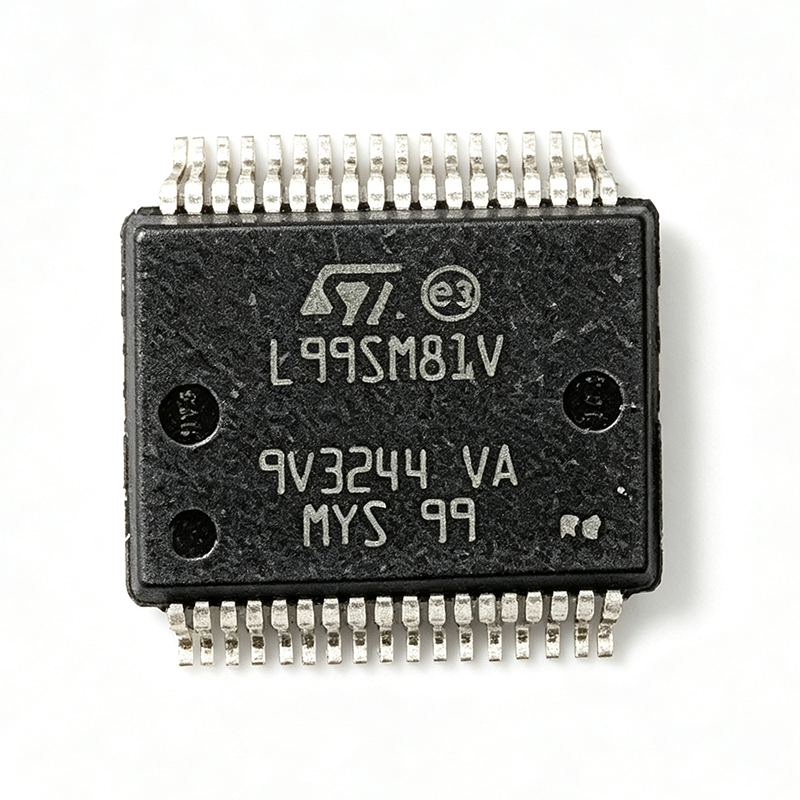
L99SM81V - Automotive Stepper Motor Driver | STMicroelectronics
The L99SM81V is an automotive-grade integrated driver for bipolar two-phase stepper motors, designed by STMicroelectronics for precise current-controlled micro-stepping with programmable amplitude. It integrates a microstepping controller with a power stage capable of driving up to 1.2 A per phase, and operates from a supply voltage range of 6 V to 28 V, making it suitable for direct connection to automotive battery rails. The device is available in a 40-pin QFN (6x6 mm) package and is AEC-Q100 qualified for automotive applications. A stepper motor driver is a power management IC that converts digital step and direction commands into the precise current sequences needed to rotate a stepper motor in controlled increments. It sits between a microcontroller and the motor, translating low-power logic signals into high-current drive signals. In the system hierarchy, a stepper motor driver is a type of motor driver, which falls under power management ICs, which are part of the broader category of analog and mixed-signal semiconductors. Key features of the L99SM81V include a programmable microstepping resolution up to 1/16 step, integrated current sensing with no external sense resistors, and a SPI interface for configuration and diagnostics. It also features overcurrent, overtemperature, and undervoltage protection, along with a low quiescent current in standby mode, which is critical for automotive battery conservation. The device is AEC-Q100 qualified, ensuring reliability across the -40°C to +150°C junction temperature range. The L99SM81V uses a proprietary current-control architecture that combines a constant-current chopper with a programmable decay mode, enabling smooth and quiet motor operation. The integrated current sensing eliminates the need for external sense resistors, reducing BOM cost and PCB area. The SPI interface allows real-time monitoring of fault conditions and precise adjustment of motor parameters, making it a flexible solution for complex automotive motion control. Typical applications include headlamp leveling systems, where precise positioning is required for optimal beam alignment, HVAC flap control for cabin comfort, and instrument cluster stepper motors for gauge indication. The wide supply voltage range and robust protection features make it ideal for direct battery connection in 12 V automotive systems. When designing with the L99SM81V, ensure adequate PCB copper area for thermal dissipation, especially when driving high currents continuously. The SPI interface should be isolated from high-current traces to minimize noise coupling. Proper decoupling capacitors on the supply pins are essential to maintain stable operation during motor transients.

MCT8316A - 40V, 8A Sensorless BLDC Motor Driver | Texas Instruments
The Texas Instruments MCT8316A is a 40-V max, 8-A peak, sensorless trapezoidal control integrated FET 3-phase BLDC motor driver supplied in a 40-pin VQFN (7x5 mm) package with exposed thermal pad. It delivers a single-chip, code-free solution for 12- to 24-V brushless-DC motors requiring high-speed operation up to 3 kHz electrical frequency or very fast startup times below 50 ms. A sensorless trapezoidal control BLDC driver is a motor driver that uses back-EMF sensing to determine rotor position, eliminating Hall-effect sensors and reducing system cost, wiring complexity, and failure points in harsh environments. The MCT8316A belongs to the integrated FET motor driver family within the broader power management and motor control IC hierarchy, combining gate drivers, power FETs, and control logic in one package. Key features include three integrated NMOS half-bridges with very low on-resistance (95 mOhm high-side + low-side per the MCT8316A-Q1 product data), support for both I2C (MCT8316AV) and hardware-interface (MCT8316AT) versions, configurable startup and stop options, active demagnetization, and optional closed-loop speed control. An integrated adjustable buck regulator and LDO generate 3.3-V or 5.0-V rails that can also power external circuitry. The architecture implements code-free trapezoidal commutation with internal back-EMF sensing, so no firmware development is required for basic operation. Two 12-bit DACs output analog voltages proportional to internal digital variables on DACOUT1 and DACOUT2 pins, enabling real-time tuning and diagnostics. Protection features include undervoltage lockout (UVLO), overcurrent protection (OCP), overtemperature warning and shutdown (OTW/OTSD), and abnormal voltage suppression (AVS). Typical applications include power tools, vacuum robots, drones, fans, and pumps, where the <50 ms startup and 3 kHz electrical capability support rapid acceleration and high rotational speed. The I2C variant adds advanced configuration and monitoring for smart appliances and industrial equipment. Design consideration: provide adequate bulk capacitance on the motor supply to absorb 8-A peak transients, and use short, low-inductance traces to the motor terminals to limit EMI; the exposed thermal pad needs a solid copper pour for heat dissipation at high continuous loads. This page synthesizes distributor pricing, drop-in alternatives, comparison data, and practical design notes not found in the manufacturer datasheet.

TLE42062GXUMA2 - 1.4A H-Bridge Motor Driver 8-18V | Infineon
The Infineon TLE42062GXUMA2 is a fully integrated bipolar H-bridge DC motor driver delivering up to 1.4 A continuous output current, housed in a 14-pin PG-DSO-14 surface-mount package. Designed for automotive and industrial motion control, it operates from a single 8 V to 18 V supply and integrates the four power DMOS half-bridge transistors, charge pump, control logic, and protection circuitry on a single die. Key features include a parallel (TTL-compatible) logic interface, integrated free-wheeling diodes, PWM capability up to 25 kHz, low quiescent current, and full protection against short-circuit, over-temperature, over-voltage, and under-voltage conditions. The H-bridge topology supports bidirectional drive of a single brushed DC motor or two solenoids with full four-quadrant operation (forward, reverse, brake, high-impedance). Technically, the device uses Infineon's SPT (Smart Power Technology) process to co-integrate vertical power DMOS transistors with bipolar control circuitry, achieving typical R_DS(on) around 700 mOhm at 25 C per leg. The integrated charge pump generates the gate drive for the high-side DMOS, eliminating the need for an external bootstrap capacitor and simplifying PCB layout. Typical applications include automotive throttle and flap actuators, HVAC blower and blend-door motors, headlight beam-leveling drives, body electronics such as mirror adjustment and seat-positioning motors, as well as industrial small DC-motor drives, valve actuators, and robotic actuators operating from a 12 V bus. When designing with the TLE42062GXUMA2, ensure adequate PCB copper pour on the exposed pad for thermal dissipation - at 1.4 A into a low-impedance motor, continuous dissipation can exceed 1 W. Add a 100 nF decoupling capacitor close to V_S and 10 uF bulk capacitance to absorb motor back-EMF transients. This page synthesizes distributor pricing, drop-in alternatives, and practical design notes not found in the manufacturer datasheet.
TLE82092SAAUMA1 - SPI H-Bridge DC Motor Driver | Infineon
The Infineon TLE82092SAAUMA1 is an SPI-programmable H-bridge DC motor driver housed in a 20-pin PG-DSO-20-65 power package, designed for safety-critical automotive motion control. It integrates two power MOSFET half-bridges delivering up to 5.5 A continuous load current, supports 4 selectable current ranges, and offers 2 configurable slew-rate settings. An SPI interface provides extensive diagnostic readback for fault monitoring in ASIL-rated systems. An H-bridge motor driver is a power IC that uses four switching transistors arranged in an "H" topology to drive a DC motor or solenoid in both forward and reverse directions from a single supply rail. The TLE82092SAAUMA1 belongs to the broader category of motor drivers and motor controllers within the power management IC family, sitting between microcontrollers and the mechanical actuator. By integrating the power stage, current sensing, and a digital SPI control interface, it replaces discrete MOSFET half-bridges plus op-amp sense circuitry, reducing PCB area and improving reliability in safety-critical applications. Key features include a wide operating supply range of 5 V to 28 V (transient tolerant to 40 V), four programmable current-limit thresholds, two programmable slew rates for EMI tuning, and comprehensive SPI diagnostics including open-load, short-to-ground, short-to-battery, and thermal shutdown flags. The PG-DSO-20-65 exposed-pad package achieves a junction-to-ambient thermal resistance of approximately 36 C/W with proper PCB copper area, enabling sustained 5 A operation without external heatsinking. The device is built on Infineon's SMART7 automotive process technology, combining low-Rds(on) N-channel power MOSFETs with on-chip charge pump gate drivers and a precision current-sense amplifier. The SPI interface operates up to 5 MHz and supports daisy-chaining for multi-device ECU architectures. Internal protection blocks include over-temperature warning, over-current shutdown, under-voltage lockout, and cross-current prevention with programmable dead time. Typical applications include throttle body control, exhaust gas recirculation valves, variable-geometry turbocharger actuators, electric park brake systems, transmission shift valves, and HVAC damper controls. The H-bridge topology and integrated diagnostics make the part especially suitable for systems requiring ASIL-B or ASIL-C functional safety compliance per ISO 26262. When designing with this part, observe the SPI programming sequence during initialization - the device must be configured before the output stages are enabled. Place the bootstrap capacitors close to pins 8/14 (high-side drivers) and use at least 100 nF ceramic decoupling on VCC. Refer to the Infineon application note for PCB layout guidance on thermal copper spreading under the exposed pad. This page synthesizes distributor pricing from DigiKey, LCSC, and Octopart, together with SPI-programmable H-bridge alternatives and practical design notes not consolidated in the manufacturer datasheet.

TLE82422LXUMA2 - 8-Ch Low-Side Constant Current Pre-Driver | Infineon
The Infineon TLE82422LXUMA2 (die name TLE8242-2L) is an eight-channel low-side constant-current control pre-driver IC housed in a 64-pin PG-LQFP-64-4 package, designed for solenoid, valve, and LED driver applications in automotive and industrial systems. Each of the eight channels is independently configurable through the SPI interface and can operate in either direct PWM mode or closed-loop constant current mode by setting the appropriate CM bit in SPI message #1. The device operates from a supply range of 5.5 V to 42 V and is rated for junction temperatures from -40 °C to +150 °C, enabling use in harsh automotive underhood environments. What is a low-side constant-current pre-driver? A low-side pre-driver sits between a microcontroller and external low-side N-channel MOSFET switches, controlling the gate of each MOSFET to regulate current through grounded loads such as solenoids, valves, relay coils, or LED strings. By sensing drain current through an external shunt and modulating the external MOSFET gate, the pre-driver achieves tightly regulated load current independent of supply voltage or temperature variations. The "pre-driver" classification means the IC does not contain the power MOSFETs themselves - this architecture lets designers select external MOSFETs sized for the application's load current and thermal budget. Key features of the TLE82422LXUMA2 include eight independently controlled channels, integrated SPI for diagnostics and configuration, fixed-frequency constant-current control, per-channel current setpoints, comprehensive fault diagnostics (open load, short circuit, overtemperature), and a wide 5.5 V to 42 V supply range. The PG-LQFP-64-4 package provides a low-thermal-resistance surface-mount footprint compatible with standard reflow assembly. Each channel supports a configurable PWM frequency and duty cycle, allowing the same IC to drive mixed load types (e.g., proportional valves and on-off solenoids) from a single device. Architecture-wise, the TLE82422-2L integrates a precision current-sense amplifier per channel, an SPI slave controller with global and per-channel status registers, an internal 5 V logic regulator for digital supply, and gate drivers capable of sourcing and sinking the gate charge of standard logic-level N-channel MOSFETs. The constant-current regulation loop operates at a fixed switching frequency to minimize EMI by placing harmonics at predictable frequencies, simplifying input-filter and EMC compliance design. Typical applications include automotive transmission solenoids, electronic throttle and EGR valves, diesel injection valves, LED driver modules, industrial process control valves, and printer/plotter stepper motor drivers. The eight-channel density is particularly suited to mechatronic modules that require multiple coordinated actuators. When designing with this device, follow Infineon's reference layout for the PG-LQFP-64-4 exposed pad: solder the e-pad to a continuous ground copper pour to achieve the rated thermal resistance and to provide the low-impedance return path required for accurate current sensing. Decouple VS and VCC with low-ESR ceramic capacitors placed within 5 mm of the supply pins. This page synthesizes distributor pricing, drop-in alternative analysis, and practical design notes - including a same-family Infineon alternative - that go beyond the manufacturer datasheet's specification tables to help engineers rapidly evaluate the TLE82422LXUMA2 for their multi-channel actuator and constant-current applications.

TLE8444SLXUMA1 - Quad Half-Bridge Motor Driver, 24V, AEC-Q100 | Infineon
The Infineon TLE8444SLXUMA1 is a protected quad half-bridge motor driver in a 24-pin PG-SSOP-24-7 package, designed for automotive and industrial motion-control applications. Built on Infineon's SPT (Smart Power Technology) BiCDMOS process, the device combines bipolar and CMOS control circuitry with DMOS power stages and integrates four independent half-bridge outputs capable of driving DC motors, stepper motors, bipolar and unipolar loads in parallel interface mode. Key headline parameters include a 24 V supply voltage rating, 0.9 A overcurrent shutdown threshold per channel, and 1.3 Ohm typical on-resistance (RDS(on)) per switch. What is a half-bridge motor driver? A half-bridge driver is a power semiconductor topology containing two switches (high-side and low-side) that together drive one terminal of a load. A quad half-bridge IC integrates four such bridges on a single die, enabling flexible load configurations: two DC motors, one stepper motor (as two full H-bridges), four solenoids, four LEDs, or any combination. These ICs belong to the broader motor driver family, which sits under power management ICs in the system hierarchy (motor driver -> power management IC -> semiconductor). The half-bridge topology is the foundational building block of all H-bridge and 3-phase motor drivers. Key differentiating features include an SPI/parallel control interface, integrated freewheeling diodes, overcurrent shutdown with diagnostics, overtemperature protection, undervoltage lockout, and open-load detection. The BiCDMOS architecture allows logic-level inputs (3.3 V/5 V CMOS compatible) to directly drive the high-current DMOS outputs, eliminating external gate drivers and level shifters. Each half-bridge can deliver continuous load current up to its rated RDS(on) limit, and parallel-mode operation enables higher per-channel current. The TLE8444SL is targeted primarily at automotive body electronics and industrial motion control, where it controls small DC motors, stepper motors, relays, and solenoids. Its AEC-Q100 qualification makes it suitable for under-hood and body modules, while the parallel interface simplifies integration with microcontrollers that lack SPI peripherals. The SSOP-24 package with exposed pad provides low thermal resistance for sustained high-current operation. Typical applications include throttle and flap actuators in HVAC systems, headlight beam-leveling motors, DC and stepper motor control in industrial automation, and solenoid/valve drivers. The integrated diagnostics (open load, short to ground/battery, overtemperature) significantly reduce external protection circuitry. When designing with this device, ensure the supply voltage stays within the rated range and place a 100 nF decoupling capacitor close to the VBB pin. The exposed thermal pad must be soldered to a sufficient copper pour to handle the worst-case dissipation across all four channels. This page consolidates distributor pricing, parametric drop-in alternatives, and practical PCB-level design guidance not found in the manufacturer datasheet, making it a complete sourcing and engineering reference for the TLE8444SLXUMA1.
TLE9166EQXUMA1 - 6 Half-Bridge SPI Motor Driver | Infineon
The Infineon TLE9166EQXUMA1 is a multi half-bridge motor driver IC integrating 6 half-bridges with NMOS output stages, a 25 kHz PWM engine, and an SPI configuration interface, housed in a PG-TSDSO-32-1 surface-mount package. It supports PWM-controlled DC motor commutation and is targeted at automotive door lock and other small brushed-motor body electronics applications. A half-bridge motor driver is a type of motor driver IC that uses multiple half-bridge output stages to switch current through motor windings in response to logic-level control signals. In the broader power management hierarchy, half-bridge drivers belong to the motor driver category within power management ICs, sitting alongside gate drivers, H-bridges, and full motor-controller SoCs that integrate FOC algorithms. Key differentiating features include six integrated half-bridges that can be configured as three full H-bridges, an SPI bus for command and diagnostic readback, integrated protection functions such as over-current, over-temperature, and under-voltage lockout, and a charge-pump (CP pin) that supplies the high-side gate drive. The PG-TSDSO-32-1 package exposes VS (battery supply), VDD (logic supply), the CP charge pump input, six half-bridge outputs, and SPI pins on a single IC. The TLE9166EQXUMA1 uses an NMOS half-bridge architecture with charge-pump-generated high-side gate drive, allowing low RDS(on) switching without the cost and footprint of P-channel devices. The integrated 25 kHz PWM engine handles chopping and freewheeling, while the SPI interface enables per-bridge configuration, current-limit setpoints, and fault-flag readback for ECU diagnostics. Typical applications include automotive door-lock actuators, power-window and power-mirror motors, HVAC damper and blower controls, and other body-electronics brushed DC loads. The wide VS range and integrated protections suit it to 12 V automotive electrical environments subject to load-dump and jump-start transients. When designing with this device, ensure VS is decoupled with a low-ESR bulk capacitor placed close to the IC, follow Infineon's PCB layout guidance for the exposed pad, and configure the SPI watchdog to meet your application's fault-recovery timing. This page synthesizes distributor pricing, drop-in alternatives from the same Infineon half-bridge family, and design notes that extend beyond the manufacturer datasheet.

TLE9180D31QKXUMA1 - 6-Ch Half-Bridge Gate Driver | Infineon
The Infineon TLE9180D31QKXUMA1 is an advanced half-bridge gate driver IC engineered to control six external N-channel MOSFETs forming a three-phase inverter for high-current BLDC motor drives in automotive 12V, 24V and 48V systems. Packaged in a PG-LQFP-64-27 (LQFP-64-EP, 10x10 mm) with exposed thermal pad, it provides non-inverting outputs, integrated current-sense amplifier, and ISO 26262 functional-safety support. Source/sink capability is 1 A typical with a 5.5 V to 60 V supply range and up to 90 V transient tolerance on bridge/motor/supply pins, suiting 48 V mild-hybrid architectures. A half-bridge gate driver is a power-management IC that translates low-power PWM logic signals from a microcontroller into high-current gate-drive voltages capable of rapidly switching large power MOSFETs. It sits between the MCU (control domain) and the inverter power stage (power domain), forming one of the cornerstones of every modern motor-drive or DC-DC converter. The TLE9180 family extends this concept with built-in protection, current sensing and ASIL-aware diagnostics, removing many external components. Key features include six half-bridge channels, programmable dead-time control, integrated charge-pump ready for 100% PWM duty, 5.5 V to 60 V supply range, current-sense amplifier for shunt-based phase-current measurement, and a comprehensive protection set: under-voltage, over-voltage, over-temperature, short-circuit, and cross-conduction prevention. SPI interface provides configurable fault and diagnostic readback. The LQFP-64-EP package exposes a thermal pad that drops theta_JA well below a standard LQFP, easing thermal design at 1 A continuous gate current. Typical applications include 12V/24V/48V BLDC and PMSM motor drives for electric water pumps, oil pumps, fans, HVAC blowers, e-bike traction controllers, and mild-hybrid auxiliary drives. Designers also use it for high-current three-phase solenoid drivers and DC-DC converter synchronous-rectifier control. The 90 V transient tolerance provides headroom for load-dump events in 24 V truck systems. When designing with this IC, ensure the bootstrap capacitors are sized for the maximum PWM period to maintain VGS above the MOSFET Miller plateau. The exposed pad must be soldered to a continuous ground copper pour to keep junction temperature within the -40C to +150C automotive Grade-1 range. Use the SPI window for cyclic diagnostics to meet ASIL requirements. This page consolidates real-time distributor pricing, qualified drop-in alternatives within the TLE9180 family and competing gate drivers, and practical design notes that complement the Infineon datasheet for faster automotive motor-drive design.
TLE9201SGAUMA1 - 6A H-Bridge Motor Driver | Infineon | PG-DSO-12-17
The Infineon TLE9201SGAUMA1 is a 6 A H-bridge driver IC designed for the control of DC motors and other inductive loads in automotive applications, housed in a PG-DSO-12-17 (12-pin exposed-pad SOIC) package. It integrates two half-bridge MOSFET outputs with RDS(on) < 100 mOhm per switch, supports an operating voltage range of 5.0 V to 28 V, and offers fully 3.3 V / 5.5 V compatible logic inputs. PWM/DIR control reduces the number of PWM-capable pins needed on the microcontroller side, and outputs can be pulse-width modulated at frequencies up to 20 kHz with a current limitation threshold of 8 A. An H-bridge (full bridge) motor driver is a type of integrated power stage that uses four switching elements arranged in an H topology to drive a bidirectional DC load (such as a brushed DC motor) from a single supply rail. H-bridge drivers belong to the broader category of motor drivers and motion-control ICs, which in turn fall under power management semiconductors used to interface low-power microcontrollers with high-current electromechanical actuators. By integrating the power FETs, gate drivers, and protection logic into a single IC, the TLE9201SGAUMA1 replaces discrete MOSFET bridges and significantly reduces PCB area and design complexity. Key features include short-circuit protection, over-temperature shutdown, low standby current, SPI-configurable diagnostics, and AEC-Q100 qualification for automotive use. The device also supports load currents above the current limitation threshold (8 A) by entering a fold-back / hiccup mode rather than latching off, allowing sustained fault handling in harsh environments. The TLE9201SGAUMA1 uses an N-channel MOSFET output stage with charge-pump gate drive, enabling low RDS(on) and high efficiency at low VIN. SPI diagnostics provide real-time feedback on fault conditions such as open load, short to battery, short to ground, and over-temperature. The integrated dead-time generation prevents cross-conduction of the high-side and low-side FETs during switching transitions, a critical reliability feature for H-bridge designs. Typical applications include throttle body control, HVAC flaps, mirror adjustment, headlight leveling, and small DC pumps in vehicles, as well as industrial valves, power tools, building automation, and small medical pumps. Any 12 V or 24 V brushed DC motor up to 6 A continuous current is a suitable load for this driver. When designing with this device, ensure that the exposed thermal pad (pin 12) is soldered to a sufficient copper area (at least 1 square inch on a 2-layer board) to keep junction temperature within SOA limits. Place the supply bypass capacitors (typically 100 nF ceramic plus 10 uF bulk) as close as possible to the VBB pin to suppress the high di/dt transients typical of PWM motor switching. This page synthesizes distributor pricing, drop-in alternatives, and practical design notes not found in the manufacturer datasheet alone, giving engineers a faster path from selection to qualified PCB layout.

TLE9241QUXUMA1 - 7-Channel Solenoid Gate Driver IC | Infineon
The Infineon TLE9241QUXUMA1 is a 7-channel constant-current solenoid gate driver IC designed for automatic transmission control, integrating six low-side and one high-side driver channels with 8 Hall-effect sensor interfaces and an SPI communication port. Housed in a 48-pin PG-TQFP-48-9 package, it operates across a 4.5 V to 5.5 V logic supply range with a separate high-voltage VBAT domain and a peak load current capability of up to 7.5 A per channel, making it purpose-built for hydraulic solenoid valves in modern automatic transmissions. A solenoid driver IC is a specialized mixed-signal semiconductor that translates digital commands from a transmission control unit (TCU) into precisely regulated analog currents flowing through inductive loads such as pressure-control valves, shift valves, and lock-up clutches. As a category, it sits within the broader power-management IC (PMIC) hierarchy: gate driver -> solenoid driver -> motor/actuator driver -> PMIC -> semiconductor. By replacing discrete PWM drive circuitry and analog current-sense op-amps with a single highly integrated IC, the TLE9241 family dramatically reduces PCB area and improves diagnostic coverage in transmission ECUs. Key features of the TLE9241QUXUMA1 include integrated closed-loop current regulation via internal PWM generation, parallel SPI control of multiple devices for multi-valve TCU scaling, comprehensive fault diagnostics (open-load, short-to-ground, short-to-battery, over-temperature), and an operating temperature range of -40 °C to +150 °C suitable for under-hood automotive environments. The 7.5 A peak current capability per channel supports the high forces required by proportional pressure-control valves during gear shifts. Typical end applications are 6-, 7-, 8-, and 9-speed automatic transmissions (DCT, AT, CVT, e-clutch), electro-mechanical power steering (EMPS) actuation where similar proportional solenoid control is used, and dual-clutch module valve bodies. The Infineon TLE9241QU datasheet documents the SPI register map, dither/waveform control, and EMC behavior relevant for these transmission modules. When designing with the TLE9241QUXUMA1, allocate a 100 nF decoupling capacitor directly on each VS pin and a 10 µF bulk reservoir near the package, plus an exposed-pad thermal land for heat spreading during sustained PWM operation. The SPI bus must be pulled up to the logic VIO rail and protected with TVS diodes for harness transients exceeding ISO 7637-2. This page synthesizes current distributor stock levels, parametric drop-in alternatives, SPI register guidance, and EMC layout considerations that go beyond the manufacturer datasheet, giving transmission engineers a single point of reference for sourcing and design-in.
TLE94003EPXUMA1 - Triple Half-Bridge 5.5-20V DC Motor Driver | Infineon
The Infineon TLE94003EPXUMA1 is a protected triple half-bridge DMOS driver IC designed for DC motor control, integrating three independent low-side and high-side power MOSFET half-bridges in a single 14-pin PG-TSDSO package with exposed pad. The IC operates from a 5.5V to 20V supply range and is part of Infineon's TLE94xyz DC motor driver family, delivering integrated multi half-bridge functionality with built-in protection features. According to Infineon datasheet materials, each half-bridge uses DMOS output stages capable of driving brushed DC motors, solenoids, relays, and lamp loads in automotive and industrial environments. A DC motor driver (also called a motor driver IC or half-bridge driver) is a power-management semiconductor that sits between a low-power microcontroller and a high-current motor load. Within the power-management IC hierarchy, the TLE94003EPXUMA1 belongs to the broader category of motor drivers > motion controllers > integrated power switches. By integrating three half-bridges, one chip can drive a single three-phase brushless DC (BLDC) motor, three independent brushed DC motors, or be paralleled into full-bridge configurations for higher-current brushed motors. Key features include 5.5V to 20V supply range, integrated charge pump allowing 100% duty-cycle operation, ultra-low quiescent current in standby, built-in over-current, over-temperature, under-voltage, and short-circuit protection, plus a diagnostic feedback pin. The DMOS output stages are optimized for low on-resistance, which directly minimizes conduction losses and improves thermal performance. The PG-TSDSO-14 package with exposed thermal pad enables efficient heat dissipation in space-constrained automotive modules. Typical applications include automotive body electronics (HVAC flaps, mirror adjustment, seat positioning), industrial automation (small brushed and brushless DC motors, valve control), and consumer appliances. The integrated protection set eliminates the need for many external components, simplifying PCB layout and reducing BOM cost. When designing with this part, observe the exposed-pad PCB layout recommendations: solder the thermal pad to a copper pour of at least 1 cm² for proper heat removal. Use decoupling capacitors rated for the full supply transient range, and configure the SPI/EN/diagnostic pins per the datasheet's typical application circuit to ensure correct fault propagation. This page synthesizes distributor pricing, drop-in alternatives, and practical design notes not found in the manufacturer datasheet alone.
TLE94104EPXUMA1 - Quad Half-Bridge DC Motor Driver | Infineon
The Infineon TLE94104EPXUMA1 is a protected quad half-bridge driver IC designed for automotive DC motor control, integrating four half-bridge output stages with on-board power MOSFETs and 16-bit SPI control in a 14-pin PG-TSDSO-EP (exposed-pad) surface-mount package. The device operates from a 3 V to 5.5 V logic supply and 5.5 V to 20 V motor supply, driving up to four external low-side switches or acting as a fully integrated 4-channel half-bridge driver for DC motors, solenoids, and relays. Each output stage is rated for continuous DC motor current with built-in over-temperature, over-current, and short-circuit protection, and the part is qualified to -40 C to +150 C junction temperature per automotive grade-0 requirements. What is a half-bridge motor driver? A half-bridge driver is a power-conversion building block that switches one terminal of a load (typically a DC motor winding) between a high-side supply rail and a low-side ground rail. Four half-bridges can be paralleled or paired into two full H-bridges, giving flexible bidirectional control of up to four DC motors or two stepper-motor windings. The TLE94104EP belongs to Infineon's TLE94xyz integrated multi half-bridge family, which trades the flexibility of discrete MOSFET gate drivers for the simplicity, diagnostic coverage, and PCB-area savings of an integrated solution. Key features include per-channel current limiting, open-load detection in OFF state, configurable slew-rate control, and global charge-pump generated gate drive for the high-side N-channel MOSFETs. The 16-bit SPI interface provides daisy-chain capability for up to 16 devices on a single bus, allowing scalable actuator counts in body-control modules. Internal thermal shutdown with hysteresis protects the IC from junction over-temperature faults and reports status back to the host MCU through the SPI status register. Typical applications include Heating, Ventilation and Air Conditioning (HVAC) flap control, electronic seat adjustment, mirror folding, sunroof drives, and other low-to-medium current brushed DC loads in 12 V automotive body networks. The wide operating-voltage range also supports industrial 24 V systems with adequate derating, and the small PG-TSDSO-14 package with exposed thermal pad enables compact PCB layouts under the dashboard. When designing with the TLE94104EPXUMA1, ensure the exposed pad is soldered to a copper area of at least 1 cm squared to keep the junction within the safe operating area at maximum motor current. Place the logic supply (VCC) decoupling capacitor as close as possible to the IC pins to prevent logic-level noise from corrupting SPI transactions. This page synthesizes distributor pricing, drop-in alternatives, and practical design notes not found in the manufacturer datasheet, giving component engineers a faster procurement and design-in path.
TLE94110ESXUMA1 - 10x Half-Bridge Motor Driver | Infineon
The Infineon TLE94110ESXUMA1 is a 10-fold half-bridge driver IC for DC motor control, housed in a 24-pin PG-TSDSO-24 exposed-pad package. It supports a supply voltage range of 5.5V to 20V, integrates ten 1.5A (typical) MOSFET half-bridge outputs, and provides a 16-bit SPI plus direct-input (DI) control interface with comprehensive diagnostic feedback. According to the Infineon product page, the device can be configured as 3, 4, 6, 8, 10, or 12 half-bridges by paralleling outputs, giving PCB designers flexibility when driving mixed loads. A half-bridge (H-bridge) motor driver is a power-converter topology that uses MOSFET half-bridges in push-pull configuration to drive DC loads bidirectionally. The TLE94110ES family sits in the motor-driver hierarchy as follows: motor driver -> half-bridge driver -> power management IC -> semiconductor. Compared with discrete MOSFET half-bridges, integrated multi-half-bridge drivers reduce PCB area, simplify thermal design by spreading dissipation across the exposed pad, and embed critical protection features such as overcurrent, open-load, and overtemperature shutdown. Key features include 1.5A continuous output current per channel (up to 2A peak, depending on configuration), integrated PWM generators with adjustable dead time, open-load detection with programmable threshold on two outputs, and full short-circuit, overtemperature, and undervoltage protection. The 16-bit SPI daisy-chain capability allows multiple TLE94110ES devices to be controlled from a single MCU, supporting up to 12 half-bridges per chip and beyond via cascade. The device is built on Infineon's smart power technology, combining DMOS output stages with CMOS logic on a single die. The exposed thermal pad provides a low thermal-resistance path to the PCB copper, enabling sustained 1.5A operation across all ten outputs simultaneously with proper board design. The wide 5.5V-20V input range covers 12V automotive bus systems including cranking transients when the input is buffered. Typical applications include HVAC flap motors in automotive climate control, small DC and brushless DC (BLDC) motor driver stages, LED lighting modules with per-string current control, and generic multi-channel solenoid/relay drivers. Its 10-channel density makes it especially attractive for zonal body-control modules replacing discrete relay boxes. When designing with this part, observe the exposed-pad PCB layout guidelines: use at least 6 cm² of copper on top and bottom layers with thermal vias to spread heat from all 10 channels. Configure unused outputs as open-drain or tie them to the supply through a pull-up, and always enable the open-load detection on critical safety loads. This page synthesizes distributor pricing, drop-in alternatives, and practical design notes not found in the manufacturer datasheet, giving engineers a single, citation-ready reference for automotive multi-motor control designs.
TLE94112ESXUMA1 - 12-Fold Half-Bridge DC Motor Driver | Infineon
The Infineon TLE94112ESXUMA1 is a protected twelve-fold half-bridge driver designed for automotive motion-control applications, packaged in a PG-TSDSO-24 (exposed-pad) surface-mount housing. Each of the twelve half-bridge outputs can source/sink up to approximately 0.9 A continuous, and the outputs are freely configurable into parallel, half-bridge, or full-bridge topologies, making the part a single-chip solution for multi-motor DC loads. A serial peripheral interface (SPI) provides output control, diagnostics, and daisy-chain capability for up to sixteen devices. What is a multi half-bridge driver? It is a power-management IC that integrates multiple low-side/high-side FET half-bridges into a single package, replacing discrete H-bridge MOSFET assemblies. Within the broader taxonomy, the TLE94112ESXUMA1 sits as: half-bridge driver -> full/half-bridge driver -> motor driver -> power management IC -> semiconductor. Other members of Infineon's TLE94xyz family span 3 to 12 outputs and offer either direct PWM inputs or SPI control. Key features include per-channel current limiting, over-temperature shutdown, open-load detection, and short-circuit protection to ground or supply. The wide supply range supports 5.5 V to 18 V operation (with load-dump tolerance up to 40 V typical for 12 V automotive systems), and the exposed thermal pad of the PG-TSDSO-24 package provides a low-resistance path to PCB copper for heatsinking. SPI daisy-chaining reduces microcontroller GPIO count when controlling multiple drivers in a vehicle. Typical applications span HVAC flap DC motors, seat-adjustment modules, window lift and sunroof drives, mirror adjusters, and other small brushed-DC loads in body-electronics modules. The integrated protection set reduces external component count and improves functional safety metrics when paired with a host MCU. A design consideration is that even though the TLE94112ESXUMA1 is highly integrated, paralleling outputs to achieve higher continuous current still requires careful thermal layout - the PG-TSDSO-24 EP must be soldered to a sufficiently large copper area to keep junction temperature within the -40 C to +150 C operating range. Always close an input bulk capacitor near the VS pin to absorb load-dump transients. This page consolidates Infineon datasheet parameters, cross-distributor pricing, drop-in same-brand family variants, and practical PCB layout guidance not found in the manufacturer datasheet alone.

TLE95613QXXUMA1 - 48V BLDC Motor Driver, Half-Bridge, SPI | Infineon
The Infineon TLE95613QXXUMA1 (TLE9561-3QX) is a multifunctional system IC for automotive BLDC motor control that integrates a 5V/3.3V power supply, multiple half-bridges, CAN-FD/LIN transceivers and an SPI interface in a single exposed-pad PG-VQFN-48-31 power package. It delivers integrated half-bridge MOSFET outputs with 18 µA typical quiescent current and supports operating junction temperatures from -40 °C to +150 °C, targeting 12V/24V automotive body and powertrain applications. A BLDC motor driver is a power-management and gate-driver IC that converts low-power logic commands from an MCU into the high-current phase-drive waveforms (PWM, commutation) required by three-phase brushless DC motors. In the broader taxonomy it sits under motor drivers and motion controllers, itself a sub-category of power management ICs and gate drivers. Highly-integrated multi-half-bridge parts such as the TLE9561 family further combine supply generation (LDO, charge pump) and communication transceivers (CAN, LIN, SPI), allowing one IC to replace several discrete blocks on a compact ECU PCB. Key differentiating features of the TLE95613QXXUMA1 include four half-bridge outputs (extendable to six via external drivers), integrated short-circuit and over-temperature protection, an SPI control port for diagnostics and PWM generation, and an exposed thermal pad for direct PCB heat-sinking. The wide 5.5V to 28V supply range suits both 12V and 24V automotive bus rails, while built-in charge-pump support enables 100% duty-cycle drive of the N-channel MOSFET half-bridges. The architecture uses an NMOS output stage with adaptive dead-time control, an internal charge pump for high-side gate drive, and a 5V LDO plus 3.3V tracker to supply the host MCU. Diagnostic features include open-load detection, short-to-battery and short-to-ground reporting per output, and a thermal warning/shutdown chain that protects both the IC and the motor winding. Typical applications include automotive HVAC blowers, engine cooling fans, electric water pumps, seat ventilation, and other 12V/24V BLDC or DC motor loads. Designers frequently pair the TLE95613 with Infineon Aurix or AURIX TC2xx/TC3xx MCUs and TLE925x CAN transceivers to form a complete motor-control ECU. Design considerations include providing adequate PCB copper area beneath the exposed pad for thermal dissipation, respecting the max supply rating of 28V including load-dump transients, and using the SPI watchdog to bring outputs into a safe state on MCU loss-of-clock. The high-side gate drive relies on the integrated charge pump, so the external reservoir capacitor value must follow the datasheet recommendation. This page synthesizes distributor pricing, pin-compatible same-family Infineon alternatives (TLE9561-1QX, TLE9561-2QX, TLE9561-4QX variants), and practical design guidance that goes beyond the datasheet summary, including thermal analysis and EMI considerations specific to the PG-VQFN-48-31 exposed-pad footprint.

TLE9561QXXUMA1 - BLDC Motor Driver IC | Infineon | 48-Pin VQFN
The Infineon TLE9561QXXUMA1 is a multifunctional system IC with integrated power supply, communication interfaces, multiple half-bridges, and support features in an exposed-pad PG-VQFN-48-31 power package, designed for automotive BLDC motor control applications. A motor driver IC is an integrated circuit that combines gate drivers, power MOSFETs, protection circuits, and a digital control interface (typically SPI) into a single package. Motor drivers sit at the bottom of the power-management hierarchy: BLDC driver IC -> motor driver -> power management IC -> semiconductor. By integrating the half-bridge stages and a 5V/3.3V supply, the TLE9561QX eliminates the need for separate gate-driver ICs and external LDO regulators in compact mechatronic modules. Key features include SPI-controlled half-bridges for three-phase BLDC motors, an integrated linear voltage regulator supplying 5V at up to 250 mA, watchdog and fail-safe logic, low quiescent current in stop mode, and AEC-Q100 qualification for automotive environments. The device operates across a wide 5.5V to 28V battery supply range with transient tolerance up to 40V, supporting 12V automotive rails. At the architecture level, the device combines an ARM-compatible embedded power controller with high-side and low-side charge-pump-driven N-channel MOSFET outputs. The SPI interface allows parametrization of current limits, dead times, slew rates, and diagnostic thresholds. Thermal shutdown, overcurrent, open-load, and short-to-ground/battery diagnostics are multiplexed back to the microcontroller through the same SPI bus, enabling predictive maintenance. Typical applications include HVAC blowers, engine cooling fans, water/oil pumps, e-compressors, electric power steering (EPS) auxiliary drives, and any small three-phase BLDC actuator in a 12V automotive board net. The wide Vin range also supports 24V mild-hybrid subsystems. When designing with this device, ensure that the exposed pad is soldered to a sufficient copper area for thermal dissipation. Use the SPI watchdog to detect microcontroller lockups and place the decoupling capacitors as close as possible to the supply pins to suppress switching noise. This page synthesizes distributor pricing, drop-in alternatives, and application design notes that are not consolidated in the manufacturer datasheet, giving engineers a single reference for evaluation, sourcing, and second-source qualification.

TMP816PWR - Single-Phase BLDC Fan-Motor Predriver | TI
The TMP816PWR from Texas Instruments is a variable-speed single-phase full-wave fan-motor predriver designed to drive external PNP-NMOS power transistors for high-efficiency, low-noise motor control. It operates from a 6V to 16V supply and delivers up to 20mA output current, making it ideal for large-scale fan motors requiring high air volume and current. The device is available in a 20-pin TSSOP (PW) package and supports an operating temperature range of -30°C to 95°C. A fan-motor predriver is an integrated circuit that provides the gate/base drive signals for external power transistors in a motor drive circuit. It sits between the microcontroller and the power stage, translating low-current control signals into high-current drive pulses. In the hierarchy of motor control, the predriver is a type of motor driver IC, which falls under power management ICs, essential for converting logic-level commands into the power needed to spin a motor. Key features include a single-phase full-wave drive topology, adjustable current limit threshold, and compatibility with external PWM signals for variable-speed control. The PNP-NMOS external power stage enables low-saturation voltage operation, reducing power loss and improving efficiency. The device also includes protection features such as thermal shutdown and current limiting, ensuring reliable operation in demanding environments. Technically, the TMP816PWR integrates a pre-driver stage that outputs PWM signals to control the external power transistors. Its adjustable current limit threshold allows designers to set the maximum motor current, protecting the motor and power stage. The device's low quiescent current and high-efficiency drive contribute to reduced power consumption, making it suitable for energy-conscious applications. Typical applications include cooling fans in servers, power supplies, and industrial equipment, as well as automotive cabin fans and HVAC blowers. The TMP816PWR's ability to drive large current motors with minimal external components simplifies design and reduces BOM cost. When designing with the TMP816PWR, ensure proper PCB layout to minimize parasitic inductance in the power path and place decoupling capacitors close to the supply pins. The adjustable current limit should be set according to the motor's rated current to prevent overcurrent damage.

VNH3SP30 - 30A Full-Bridge Motor Driver | STMicroelectronics
The VNH3SP30 is a fully integrated H-bridge motor driver from STMicroelectronics, designed for a wide range of automotive and industrial applications. It incorporates a dual monolithic high-side driver (HSD) and two low-side switches, providing a complete bridge driver solution in a MultiPowerSO-30 package. The device is capable of driving DC motors with continuous currents up to 30A, making it suitable for high-power actuation systems. A full-bridge motor driver, also known as an H-bridge, is a power electronics circuit that allows a DC motor to be driven in both directions (forward and reverse) by controlling the polarity of the voltage applied across the motor terminals. It consists of four switching elements (typically MOSFETs or IGBTs) arranged in an 'H' configuration. The VNH3SP30 integrates these switches along with protection and diagnostic features, simplifying the design of motor control systems. In the hierarchy of motor control, the H-bridge driver sits between the microcontroller (which generates PWM signals) and the motor itself, translating low-power logic signals into high-current drive capability. Key features of the VNH3SP30 include a wide operating voltage range (5.5V to 36V), a maximum output current of 30A, and a low on-resistance (RDS(on)) of 0.05 ohms per switch, which minimizes power dissipation. The device supports both parallel and PWM control modes, allowing flexible speed and direction control. It also includes built-in protection features such as undervoltage lockout, overcurrent protection, and thermal shutdown, ensuring reliable operation in harsh environments. The VNH3SP30 is built using ST's proprietary VIPower M0 technology, which integrates the power MOSFETs and control logic on a single chip. This monolithic approach reduces parasitic inductance and improves switching performance compared to discrete solutions. The MultiPowerSO-30 package provides excellent thermal performance, with a thermal resistance of 1.5°C/W, enabling the driver to handle high currents without external heatsinks in many applications. Typical applications include automotive systems such as power windows, seat adjusters, and wiper motors, as well as industrial automation, robotics, and electric vehicles. The device's ability to handle 30A makes it ideal for driving large DC motors in actuators, pumps, and conveyor systems. Its automotive-grade qualification (AEC-Q100) ensures reliability in demanding environments. When designing with the VNH3SP30, it is essential to provide adequate bulk capacitance on the power supply to handle the high inrush currents of DC motors. Additionally, proper PCB layout with wide copper traces and thermal vias is critical to dissipate heat effectively. The device's PWM input allows for speed control, but the PWM frequency should be chosen carefully to balance switching losses and motor noise.