Interface ICs
ژێرپۆلەکان
بەرهەمەکان (5,600+)

TUSB3410RHBR - USB 2.0 UART Bridge | Texas Instruments
The Texas Instruments TUSB3410RHBR is a USB 2.0 full-speed serial-port controller that bridges one enhanced UART channel to USB and supports UART, I2C, and IrDA serial-port operating modes. It integrates an 8052-compatible core with 10 kB of ROM, provides 32 package pins, and is offered in a VQFN RHB package with an exposed thermal pad. Its specified commercial temperature range is 0°C to 70°C. A USB serial bridge is an interface IC that translates between a USB host and an embedded serial device. Within the product hierarchy, the TUSB3410 is a USB interface controller, serial-port bridge, application-specific microcontroller, and power-management-independent semiconductor. This category allows legacy RS-232, RS-485, IrDA, and related serial equipment to connect through a standardized USB port without redesigning the host-side interface. Key features include full-speed USB operation, support for an enhanced UART channel, I2C and IrDA functionality, an 8052 controller core, and 10 kB of ROM. The RHB package exposes a pad for improved heat transfer on compact circuit boards. These features suit equipment that needs a direct USB-to-serial path while retaining control over modem-style UART handshake signals. The TUSB3410 integrates an 8052-compatible microcontroller architecture with USB and serial-port functions rather than behaving as a passive level translator. Its internal ROM supports device operation, while external circuitry handles the selected physical serial interface. For RS-232 designs, an external transceiver is required for voltage conversion and line protection; for RS-485 designs, the appropriate transceiver and termination network must likewise be selected separately. Typical applications include USB-to-RS-232 adapters, industrial serial equipment, configuration and debug ports, infrared data links, USB-to-IrDA adapters, and legacy serial accessories. The device is also suitable for data acquisition and control equipment that uses handshake signals to coordinate transmitter and receiver activity. PCB design should preserve the exposed-pad thermal path and keep USB, crystal, and serial-interface routing away from noisy power stages. Confirm the unused hardware-control-pin states against the manufacturer's pin-description table and interface guidance. Review the exact electrical limits, clock requirements, and transceiver interface details before releasing a production design. This page consolidates package, interface, temperature, lifecycle, compliance, replacement, and application guidance while adding practical PCB and design considerations. It also identifies same-footprint TUSB3410 family options so engineers can distinguish electrical-temperature variants from reel or small-reel ordering codes without changing the PCB land pattern.

TUSB3410RHBT - USB Serial Port Bridge | Texas Instruments
The Texas Instruments TUSB3410RHBT is an application-specific 8052 USB serial port controller with 10 kB of ROM, UART, I2C, and IrDA connectivity, and USB interface support. It is packaged in a 32-pin VQFN RHB package rated for a 0°C to 70°C operating range. The device bridges USB connectivity with legacy serial interfaces while providing four I/O lines for peripheral control. A USB serial port controller is an interface integrated circuit that allows equipment using UART, I2C, or IrDA serial signaling to communicate through a USB host. Within the product hierarchy, it belongs to the USB interface IC and application-specific microcontroller categories, combining firmware-driven control, USB device logic, and serial-port connectivity in one component. The TUSB3410 includes an 8052 core, 10 kB of ROM, four I/O lines, and support for UART, I2C, IrDA, and USB serial functions. Its integrated design reduces the need for separate USB-to-serial interface hardware while retaining the familiar serial connectors and signal levels used by established industrial and embedded equipment. The manufacturer datasheet explains that USB compliance requires the device to become ready to respond to the host within 100 ms. During this interval, the controller must leave reset, load configuration data from an I2C EEPROM when applicable, and transfer execution to application firmware. This startup sequence is important when validating USB enumeration and host-driver compatibility. Typical uses include USB-to-UART adapters, industrial data-collection equipment, IrDA peripherals, legacy serial-console systems, and USB-to-I2C bridges. The TUSB3410 is particularly relevant when an existing serial-port design must become USB-compatible without changing the host-side application software around the serial interface. Design the power, USB, UART, I2C, and optional IrDA sections according to the manufacturer datasheet. Keep USB routing compact and controlled, provide the required input and output capacitance at the device, and account for EEPROM access and firmware startup before expecting the host to communicate successfully. This page combines manufacturer device information, verified commercial references, drop-in cross-reference results, and practical selection guidance. It also distinguishes confirmed drop-in options from functional alternatives that require a different footprint, helping engineers avoid substitutions that cannot be soldered onto the original PCB land pattern.

TUSB3410VF - USB 2.0 UART IrDA Bridge | Texas Instruments
The Texas Instruments TUSB3410VF is a USB 2.0 full-speed serial-port controller that bridges an enhanced UART to a USB host, with additional I2C and IrDA connectivity, in a 32-pin LQFP package. It operates from a 3 V to 3.6 V supply, covers an industrial temperature range of 0°C to 70°C, and includes 10 kB of ROM. The USB 2.0 full-speed interface provides a practical connection path for legacy serial equipment while retaining compatibility with modern host computers. A USB-to-UART bridge is an interface IC that translates USB transactions into a conventional serial-port data stream. In the electronic-component hierarchy, the TUSB3410VF belongs to the USB interface-controller family and combines USB device-controller functionality with UART, I2C, and IrDA serial interfaces. This mixed connectivity allows one device to support USB-to-serial conversion and auxiliary control or infrared communication functions in embedded systems. Key features include USB 2.0 full-speed operation, an enhanced UART serial interface, I2C support, IrDA support, a 3 V to 3.6 V operating supply, and 10 kB of on-chip ROM. The 32-pin LQFP package provides enough pins for the USB data and power connections, UART signals, I2C signals, IrDA functions, clock requirements, and control or configuration pins. Its 0°C to 70°C rating targets commercial and industrial equipment operating without the extended temperature limits of an automotive-grade component. The TUSB3410VF is designed for legacy serial-port migration, where a conventional UART device would otherwise require a computer with a native serial connector. It can also serve as a multi-interface bridge when an installed system needs USB connectivity alongside I2C control or IrDA communication. The dedicated USB interface handles enumeration and data transfer while the UART presents a familiar serial interface to the embedded target. Typical applications include industrial serial adapters, legacy data-acquisition equipment, point-of-sale terminals, test and measurement instruments, embedded control systems, and infrared-capable peripheral interfaces. The component is particularly useful when an existing UART-based product must gain USB connectivity without redesigning its core serial subsystem. Designers should follow the manufacturer datasheet for crystal or clock selection, USB differential-routing requirements, decoupling, pull-up values, and I2C or IrDA implementation. USB signal integrity, connector protection, grounding, and firmware or host-driver compatibility should be verified before production release because the bridge hardware does not eliminate operating-system compatibility constraints. This page combines verified manufacturer and distributor information, package-specific facts, practical application guidance, comparison parameters, and design notes. It also distinguishes verified drop-in candidates from options that require further engineering review, providing useful engineering context beyond a basic distributor listing.
TUSB3410VFG4 - USB to UART Bridge | Texas Instruments
The Texas Instruments TUSB3410VFG4 is a full-speed USB 2.0 serial-port controller that bridges a USB host to an enhanced UART, with I2C and IrDA support, in a 32-pin LQFP package. The device operates from a 3.3 V supply, includes 10 KB of internal ROM and 16 KB of RAM, and provides the hardware and firmware foundation for USB-to-serial peripheral connectivity. Its commercial-grade temperature range is 0 °C to 70 °C. A USB-to-UART bridge is an interface IC that translates USB data transactions into a conventional asynchronous serial stream. It eliminates the need for a separate USB controller when an embedded system needs a PC-compatible RS-232, IrDA, or other UART endpoint. The TUSB3410 occupies the interface-controller level of the hierarchy: USB interface controller, serial bridge, peripheral interface IC, and ultimately an embedded connectivity solution. The TUSB3410VFG4 integrates an 8052-compatible microcontroller core with 10 KB of ROM, 16 KB of RAM, and an I2C interface. Its boot ROM configures the USB connection and contains an I2C bootloader, while application firmware can be loaded from the host or from external onboard memory through I2C. This architecture is useful when a product needs more behavior than a fixed hardware USB-to-serial converter can provide. Important electrical characteristics include a 3.3 V operating supply, full-speed USB 2.0 operation, and a 32-lead gull-wing LQFP package. The G4 suffix identifies a specific ordering configuration, while the VF ordering code identifies the square LQFP package. The package is designed for surface-mount assembly and provides a practical pin count for systems requiring parallel UART control, USB data, I2C, and support signals. Typical uses include legacy RS-232 equipment interfaces, industrial serial adapters, point-of-sale terminals, security equipment, and embedded systems that need a programmable USB serial endpoint. Compared with simple fixed-function USB-to-UART converters, the integrated processor and downloadable firmware allow application-specific behavior, additional GPIO control, and custom boot or configuration sequences. Plan the PCB around the 32-pin LQFP footprint and keep USB D+ and D- routing short and impedance-controlled. Follow the pin-description and layout guidance in the manufacturer datasheet when assigning power, ground, crystal, UART, and I2C nets. This page also organizes package, application, and comparison information to support sourcing and design decisions that are not consolidated in a single manufacturer document.
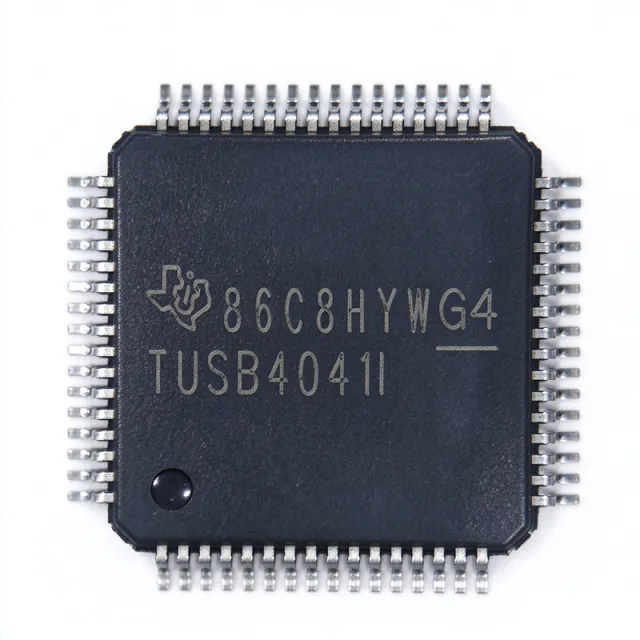
TUSB4041IPAP - 4-Port USB 2.0 480-Mbps Hub | Texas Instruments (Tape & Reel)
The Texas Instruments TUSB4041IPAP is a 4-port high-speed 480-Mbps USB 2.0 hub controller in a 64-pin HTQFP (PAP) 10x10 mm package. It provides USB high-speed (480 Mbps) or full-speed (12 Mbps) connections on the upstream port and supports four downstream ports that operate at high-speed, full-speed, or low-speed. The industrial-grade version operates across -40C to +85C, making it suitable for embedded and industrial designs. A USB 2.0 hub controller is a serial-interface bridge that aggregates one upstream USB port into multiple downstream ports while managing the protocol handshakes, transaction translation, and per-port power control dictated by the USB 2.0 specification. It sits within the broader hierarchy of USB controllers -> interface ICs -> power management and connectivity silicon -> mixed-signal semiconductors. The TUSB4041I family supports both self-powered and bus-powered configurations, with integrated USB transceivers and optional battery-charging detection on downstream ports. Key features include 480-Mbps high-speed upstream operation, per-port over-current protection flags, integrated 1.5-kV ESD on USB signal lines, support for compound devices, and I2C/EEPROM configurability for vendor ID (VID), product ID (PID), and port-remap policy. Per-port power-switch control outputs enable ganged or individual port-power switching without external glue logic. The device integrates a UTMI+ low-pin-interface (ULPI) or integrated transceiver variant, a serial-interface engine, and a protocol layer that handles split transactions for full-/low-speed peripherals attached to high-speed upstream links. The HTQFP-64 footprint provides ample ground and power pins for signal-integrity routing on 2-layer consumer-grade boards. Typical applications include USB port expansion on industrial PCs, docking stations, monitors with built-in USB hubs, embedded HMI panels, and POS terminals. The industrial temperature range and integrated charge-detection features also make it a strong fit for automotive-infotainment accessories and medical USB peripherals. When designing with this part, place 27 ohm series termination resistors close to the USB DP/DM pins and provide adequate bulk capacitance on each downstream VBUS rail managed by the controller's power-switch enables.

TUSB4041IPAPQ1 - 4-Port USB 2.0 Hub AEC-Q100 | Texas Instruments
The Texas Instruments TUSB4041IPAPQ1 is an automotive-qualified 4-port high-speed 480-Mbps USB 2.0 hub controller in a 64-pin HTQFP (PAP) package with exposed pad. It provides four downstream USB 2.0 ports from a single upstream port, full-speed (12 Mbps), high-speed (480 Mbps), and low-speed (1.5 Mbps) signaling, and operates over -40C to +85C with an automotive-grade qualification. A USB 2.0 hub is a critical interface IC that expands a single USB root port into multiple downstream ports, providing downstream device connect/disconnect detection, overcurrent protection coordination, transaction translation between split USB transactions, and configurable port-power switching. The TUSB4041IPAPQ1 sits in the USB hub controller product hierarchy (USB 2.0 hub -> USB hub -> USB interface IC -> interface IC -> semiconductor) and is widely deployed in automotive infotainment, body electronics, and rear-seat entertainment systems. Key features include integrated USB 2.0 high-speed PHY on every port, pin-strap configuration for battery-charging support, customization via OTP ROM, I2C EEPROM, or I2C/SMBus target interface for VID/PID/port/phy settings, optional upstream port indicator, and individual port power control with overcurrent sensing. The device uses a single 3.3 V supply plus an internal 1.1 V core regulator generated by the on-chip LDO. Internal termination, pull-up/pull-down resistors, and a built-in 5 V VBUS load switch controller (external n-MOSFET required) simplify PCB design. Suspend and remote wakeup signaling are managed in hardware, reducing firmware complexity. Typical applications include automotive head-unit USB ports, rear-seat entertainment hubs, body-control module USB service ports, industrial PC USB expansion, and embedded telematics USB interfaces. AEC-Q100 qualification makes the -Q1 device preferred for road-vehicle applications, while the non-Q1 TUSB4041IPAP serves commercial/industrial environments. When designing with this part, place the external 24.576 MHz crystal (or oscillator) within 5 mm of the XI/XO pins and provide a continuous ground reference under the exposed thermal pad for thermal and EMI performance. Per-port 5 V VBUS switches must use a logic-level n-MOSFET driven by the integrated DP1PWR output to share load-current and fault indications with the host. This page synthesizes distributor pricing for automotive-grade USB hubs, pin-compatible drop-in alternatives, and design considerations from the manufacturer datasheet not always highlighted on distributor listings.
TUSB4041IPAPR - 4-Port USB 2.0 480-Mbps Hub | Texas Instruments
The Texas Instruments TUSB4041IPAPR is a 4-port high-speed 480-Mbps USB 2.0 hub controller in a 64-pin HTQFP (PAP) 10x10 mm package. It provides USB high-speed (480 Mbps) or full-speed (12 Mbps) connections on the upstream port and supports four downstream ports that operate at high-speed, full-speed, or low-speed. The industrial-grade version operates across -40C to +85C, making it suitable for embedded and industrial designs. A USB 2.0 hub controller is a serial-interface bridge that aggregates one upstream USB port into multiple downstream ports while managing the protocol handshakes, transaction translation, and per-port power control dictated by the USB 2.0 specification. It sits within the broader hierarchy of USB controllers -> interface ICs -> power management and connectivity silicon -> mixed-signal semiconductors. The TUSB4041I family supports both self-powered and bus-powered configurations, with integrated USB transceivers and optional battery-charging detection on downstream ports. Key features include 480-Mbps high-speed upstream operation, per-port over-current protection flags, integrated 1.5-kV ESD on USB signal lines, support for compound devices, and I2C/EEPROM configurability for vendor ID (VID), product ID (PID), and port-remap policy. Per-port power-switch control outputs enable ganged or individual port-power switching without external glue logic. The device integrates a UTMI+ low-pin-interface (ULPI) or integrated transceiver variant, a serial-interface engine, and a protocol layer that handles split transactions for full-/low-speed peripherals attached to high-speed upstream links. The HTQFP-64 footprint provides ample ground and power pins for signal-integrity routing on 2-layer consumer-grade boards. Typical applications include USB port expansion on industrial PCs, docking stations, monitors with built-in USB hubs, embedded HMI panels, and POS terminals. The industrial temperature range and integrated charge-detection features also make it a strong fit for automotive-infotainment accessories and medical USB peripherals. When designing with this part, place 27 ohm series termination resistors close to the USB DP/DM pins and provide adequate bulk capacitance on each downstream VBUS rail managed by the controller's power-switch enables.

TUSB4041IPAPRQ1 - 4-Port USB 2.0 Hub, AEC-Q100 | Texas Instruments
The Texas Instruments TUSB4041IPAPRQ1 is an automotive-grade 4-port high-speed USB 2.0 hub controller supporting 480-Mbps upstream and downstream signaling in a 64-pin HTQFP (PAP) 10x10 mm package with an exposed thermal pad. The -Q1 suffix denotes AEC-Q100 qualification, making it suitable for in-vehicle USB expansion where reliability across -40C to +85C is mandatory. It integrates USB 2.0 transceivers, a serial-interface engine, hub repeater, and per-port power control with battery-charge support, allowing direct attachment to automotive head units, IVI systems, and telematics modules. A USB 2.0 hub is a compliant USB device class that expands one upstream port into multiple downstream ports while managing enumeration, power distribution, and transaction translation across a tiered-star topology. The hub sits between a host controller (xHCI/eHCI) and downstream peripherals; the hub repeater manages connectivity, while the hub controller handles split transactions and descriptor management. The TUSB4041I-Q1 family is positioned as an automotive TUSB2.0 hub silicon in TI's broader portfolio of USB interface ICs, falling under the Interface ICs > Audio/Video and broader serializer-deserializer hierarchy of signal-conditioning and protocol-bridging devices. Key features include support for downstream battery charging (DCP, CDP, SDP per BC1.2-like behavior), pin-strap configuration, OTP ROM customization, I2C/SMBus configuration interface, integrated 5V-to-3.3V LDO, and per-port overcurrent protection plus power-switch control outputs. Per-port event indicators are available via an interrupt output, and the part provides both full-speed (12 Mbps) and high-speed (480 Mbps) signaling upstream while supporting low-/full-/high-speed downstream traffic. Architecture-wise, the device combines an ULPI-style internal PHY layer with a hardwired hub controller core. Pin-strap pins allow boot-time selection of VID/PID, removable/non-removable port mapping, and battery-charging mode without external EEPROM, while an optional I2C EEPROM, OTP ROM, or SMBus target interface enables field-customizable configuration. The PAP package's exposed pad offers a low-junction-to-board thermal path, important under hood or behind-dash operating conditions. Typical automotive applications include infotainment USB expansion (rear-seat entertainment, smartphone projection), telematics control units, body and cluster controllers that expose diagnostic or media ports, and in-cabin USB charging outlets requiring BC1.2-class behavior. Industrial variants of the same die (TUSB4041I, no -Q1) target factory USB aggregation and USB-isolated medical-cart hubs. When designing with this part, allocate a generous copper pour under the exposed pad, keep the 24 MHz crystal traces short, and use a 5V-tolerant current-limited power switch per downstream port. The -Q1 qualification grade means PPAP and IMDS data are available from TI on request.
TUSB422IYFPR - USB Type-C Port Controller DSBGA-9 | Texas Instruments
The Texas Instruments TUSB422IYFPR is a USB Type-C port controller with integrated USB Power Delivery (USB PD) physical layer, housed in a 9-ball DSBGA (YFP) package measuring approximately 1.6 mm x 1.6 mm. It supports USB Type-C Cable and Connector Specification and USB Power Delivery 2.0, enabling up to 100 W of negotiated power and alternate-mode signaling through a single USB Type-C connection. The device operates from a single 3.3 V supply and communicates with an external Type-C Port Manager (TCPM) over standard I2C interface up to 400 kHz. A USB Type-C port controller is a specialized interface IC that sits between a USB Type-C receptacle and the application processor in devices such as laptops, tablets, monitors, docks, and power adapters. It performs attach/detach detection on the two Configuration Channel (CC) pins, decodes BMC-encoded USB PD messages, and reports cable orientation, role detection, and current-mode advertisement to the host. Compared with discrete USB-C implementations, a dedicated port controller reduces BOM count, simplifies firmware, and accelerates USB-IF compliance. Key features of the TUSB422 include configurable DFP (Downstream Facing Port), UFP (Upstream Facing Port), or DRP (Dual Role Port) operation, integrated Rp/Rd termination for CC1 and CC2, automatic cable-orientation detection, and a low-power standby mode. The internal BMC PHY uses 9-ohm termination (per USB PD spec) so it can be paired with common external load switches and VBUS power-path controllers without external components. The device is qualified to industrial temperature range (-40C to +85C) and is supplied Pb-free and RoHS-compliant. Architecturally, the TUSB422 separates the protocol layer from the physical layer. The PHY handles BMC encoding, preamble, and collision detection on CC1/CC2; the TCPM firmware running on the host MCU handles policy engine, protocol layer, and device policy manager functions. This partitioning lets OEMs keep policy and security logic in trusted firmware and reuse a single TUSB422 across product families. Typical applications include USB-C power adapters and chargers, notebook/dock side-band controller, USB-C monitors and hubs, smartphones and tablets, and Thunderbolt 3 / USB4 accessory adapters. Designers choose the TUSB422 when they need a small-footprint, TI-trusted USB PD PHY with proven USB Type-C compliance. Design note: TI recommends placing the TUSB422 as close as possible to the USB Type-C connector CC pins. Keep CC1/CC2 traces matched within 1 mm to within the receptacle pads to ensure USB-IF compliance testing passes. Decouple VDD 3V3 with at least 0.1 uF plus 1 uF ceramic capacitors. This page synthesizes distributor pricing, drop-in alternatives, and design notes not always consolidated on the manufacturer datasheet, enabling faster component selection and drop-in replacement decisions.
TUSB422IYFPT - USB PD TCPCi Port Controller | Texas Instruments
The Texas Instruments TUSB422IYFPT is a USB Type-C port controller and USB Power Delivery physical-layer interface with Configuration Channel logic, supplied in a 9-DSBGA package. It supports USB Type-C 1.2 and USB Power Delivery specifications, provides 5 V to 24 V sourcing and sinking capability, and includes a 2.5 W VCONN switch for alternate-mode negotiations. The device is designed around the TCPCi architecture, where an external USB Type-C Port Manager communicates with the TUSB422 through an I2C interface. The TUSB422 handles the USB BMC physical layer and the low-level CC signaling while the external controller manages policy, negotiation, and system behavior. The TUSB422IYFPT is optimized for portable applications and can be configured by software as a dedicated host, dedicated device, or dual-role port with dual-role port support. Attach and detach detection, alternate-mode negotiation, power sourcing, power sinking, and USB data-role behavior are supported for compact USB Type-C designs. The 9-DSBGA package supports surface-mount assembly in space-constrained portable equipment. Designers should use the manufacturer datasheet pin-description table and reference application information when assigning PCB tracks, because the exposed-ball package and its power, ground, and signal assignments require exact footprint-level review. The TUSB422 is a physical-layer companion rather than a complete USB Type-C port manager, so firmware and an external TCPM remain necessary for full protocol policy control.
TUSB501DRFR - 5Gbps USB 3.0 Redriver | Texas Instruments
The Texas Instruments TUSB501DRFR is a 3.3 V, single-channel USB 3.0 SuperSpeed redriver with a maximum data rate of 5 Gbps, packaged in an 8-pin WSON package measuring 2 mm by 2 mm. It combines input equalization with high-differential-voltage output drive to recover degraded 5 Gbps signals and extend the practical reach of USB SuperSpeed links across printed-circuit boards, cables, and interconnects. A USB redriver is a signal-conditioning semiconductor placed within a high-speed data path to combat insertion loss, reflections, and intersymbol interference. In the hierarchy of electronic components, the TUSB501 is a USB interface IC, a redriver and repeater, and ultimately a high-speed signal-integrity device. Unlike a protocol controller or hub, it does not interpret USB traffic or create a new bus segment; it conditions an existing differential pair and passes the recovered 5 Gbps signal onward. The TUSB501DRFR supports one USB 3.0 SuperSpeed channel at 5 Gbps and provides equalization for lossy channels. Its 3.3 V supply operation and 2 mm by 2 mm WSON (DRF) package support compact equipment designs. The specified operating-temperature range is -40°C to +85°C, making the device suitable for industrial and temperature-range-controlled consumer, communications, storage, and test-system implementations. Technically, the redriver compensates attenuation encountered by the differential pair and regenerates the output signal at a high differential voltage. This helps the receiving endpoint detect transitions reliably when PCB traces, connectors, and cable segments introduce loss. The manufacturer describes TUSB501 as a third-generation 3.3 V single-channel redriver designed to extend possible channel length while recovering USB 3.0 SuperSpeed data. Typical applications include host-to-device links, peripheral connections, storage controllers, docking systems, external test equipment, and active cable assemblies. The device is particularly useful when loss and intersymbol interference threaten link margin. In an active cable or extended PCB interconnect, placing the redriver near the degradation boundary can restore signal amplitude before the next connector or receiver. Designers should preserve the differential impedance of the USB SuperSpeed pair, use symmetrical routing, minimize stubs and unnecessary vias, and place decoupling close to the supply pin. The device has limited built-in ESD protection, so system-level protection and connector placement remain important. Differential probing and eye-diagram measurements are recommended when validating a new channel. This page combines the exact TUSB501DRFR ordering information with package, application, replacement, and design guidance. It distinguishes confirmed manufacturer characteristics from parameters that still require datasheet verification, helping engineers plan a 5 Gbps USB redriver design without relying on generic interface-IC assumptions.

TUSB5052PZ - 5-Port USB 2.0 Hub Controller with Serial Bridge | Texas Instruments
The Texas Instruments TUSB5052PZ is a USB 2.0 hub controller with an integrated bridge to two serial ports, a maximum hub clock frequency of 6 MHz, and a 1.5 MBps data-transfer rate. The device is supplied in a 100-terminal LQFP package measuring 14 mm by 14 mm. Its commercial temperature grade, gull-wing terminal form, and square package outline support use in conventional embedded USB expansion designs. A USB hub controller is a semiconductor that manages traffic between one upstream USB connection and multiple downstream USB ports. The TUSB5052PZ belongs to the broader USB interface controller hierarchy, where USB interface ICs connect host controllers, peripherals, hubs, bridges, and external serial devices. Its configurable optional hub capability allows designers to combine hub and serial-interface functions in one device instead of allocating separate ICs for those functions. The verified listing identifies the TUSB5052PZ as a five-port USB 2.0 hub controller with a bridge to two serial ports. Its maximum clock frequency is 6 MHz, while its stated data-transfer rate is 1.5 MBps. The nominal operating voltage is 3.3 V, matching the power level commonly used by USB 2.0 interface circuitry. These characteristics make the controller relevant to embedded USB systems requiring multiple USB connections alongside serial-port expansion. The 100-LQFP (14 x 14 mm) package provides 100 external terminals and a square, gull-wing surface-mount form. Compared with a smaller connector-oriented USB interface package, this device exposes a substantially larger pin count to support hub-port and serial-bridge functions. Its specified commercial temperature grade is suitable for ordinary commercial equipment, although manufacturer ordering information and the full datasheet should be checked for detailed electrical limits and qualification requirements. Typical application areas include industrial control panels, multifunction printers, point-of-sale terminals, external storage enclosures, test equipment, and legacy-port expansion systems. In each case, the controller can sit between a USB host and downstream peripherals while presenting serial connectivity to embedded subsystems. System-level performance remains dependent on upstream USB bandwidth, device scheduling, cable quality, enumeration behavior, and the electrical implementation of the connected ports. Designers should verify every signal, supply, and termination connection against the manufacturer datasheet before layout release. The large 100-terminal package demands careful escape routing between fine-pitch leads, while USB differential pairs require controlled impedance and minimized stub length. Decoupling and high-speed return paths should also be planned so that the 3.3 V interface supply and USB data paths are not compromised by adjacent digital or switching circuitry. This product record combines the verified distributor specifications, commercial availability references, package information, and cross-reference findings for the TUSB5052PZ. It also documents where additional engineering data remain necessary, including detailed pin assignments, electrical limits, lifecycle declarations, pricing, and validated drop-in replacements. Those gaps are intentionally marked rather than replaced with unverified datasheet or substitution claims.

TUSB5152PZ - 5-Port USB Hub Controller | Texas Instruments
The Texas Instruments TUSB5152PZ is a USB interface controller that integrates a configurable 5-port hub, two serial ports, and a bridge to the IEEE 1284 parallel port. The device is supplied in a 100-LQFP surface-mount package measuring 14 x 14 mm, as identified by DigiKey and the manufacturer datasheet search results. Its package designation uses the PZ suffix, while the verified distributor information identifies the device as an interface controller in the USB interface IC category. A USB hub controller is a semiconductor that manages traffic between a host USB interface and one or more downstream ports. A configurable USB 2.0 hub can allocate upstream bandwidth according to the activity presented by connected devices. The TUSB5152PZ extends this conventional hub role with two serial interfaces and an IEEE 1284 parallel-port bridge, allowing legacy printer and peripheral connectivity to coexist within a system designed around USB. This integration reduces the need for separate interface components when both USB expansion and legacy peripheral support are required. The verified product descriptions identify an optional five-port hub configuration, two serial ports, and one parallel-port bridge. The parallel interface is specified as IEEE 1284, the legacy printer-port standard supported by the integrated bridge. The two serial ports provide additional data paths for system integration, although individual electrical rates and protocol details are not included in the supplied verified snippets and therefore cannot be stated here as confirmed specifications. The TUSB5152PZ is packaged in a 100-LQFP with 14 x 14 mm body dimensions. This high-pin-count surface-mount package exposes the hub, serial, and parallel functions to a controller-oriented PCB design. A complete design must route the relevant USB, serial, parallel, clock, power, and control signals according to the manufacturer datasheet. Because no verified public pin table was included in the supplied results, no pin-level assignments are asserted on this page. Typical applications include compact USB-to-IEEE-1284 printer adapters, multifunction office peripherals, industrial interface equipment, and legacy computer expansion systems. The device is particularly relevant where one controller must provide USB hub expansion while also maintaining compatibility with serial accessories and an IEEE 1284 printer connection. Product selection should account for the exact USB speed grade, supported serial interface standards, clock requirements, and system power needs found in the complete manufacturer documentation. Supply information identifies TUSB5152PZ as a product replaced by TUSB5052. Verified distributor listings also describe the component as available and provide pricing from $7.2600 at quantity one. This page combines the verified package and lifecycle information, pricing tiers, application guidance, and explicitly documents unresolved technical details rather than inferring unavailable specifications.

TUSB522PRGER - 5Gbps Dual USB Redriver | Texas Instruments
The Texas Instruments TUSB522PRGER is a fourth-generation, dual-channel USB 3.1 Gen 1 redriver and signal conditioner supporting 5 Gbps per channel in a 24-pin VQFN RGE package measuring 4 mm by 4 mm. It operates from a 3.3 V supply and combines two independently processed SuperSpeed data paths on one compact IC. A USB redriver is an interface IC that regenerates a degraded high-speed differential signal, compensates for channel loss, and restores signal amplitude and timing before it reaches the next USB device. It occupies the physical layer between a transmitter and receiver. Within the interface-IC hierarchy, TUSB522PRGER is a dual-lane USB signal conditioner designed for USB 3.1 Gen 1 links operating at 5 Gbps. The principal features include two redriver channels, 5 Gbps data-rate support, a 3.3 V power supply, an ultra-low-power architecture, and support for USB 3.1 low-power modes. The dual-channel arrangement allows one device to condition both Tx and Rx SuperSpeed lanes in systems with separate unidirectional signal paths. The operating-temperature range shown for the RGE ordering option is 0 °C to 70 °C. The TUSB522PRGER is intended to improve margin across PCB traces, connectors, cables, and other interconnect elements whose insertion loss would otherwise prevent reliable USB 3.1 Gen 1 operation. Because each channel processes a single-lane SuperSpeed differential pair, board designers can preserve the standard USB topology while adding programmable signal-conditioning capability between controller and peripheral devices. Its 24-pin VQFN package also supports compact implementation in desktop, peripheral, docking, and embedded computing equipment. Typical applications include USB 3.1 Gen 1 host-to-hub links, docking-station connections, external storage, monitors, capture equipment, and other systems that place substantial channel loss between a USB controller and connector. The device can also be evaluated for other low-power 5 Gbps differential links when its USB-specific operating characteristics and configuration requirements are acceptable. PCB implementation requires careful treatment of the differential pairs. Place the device near the transition between the lossier interconnect segment and the receiver, maintain continuous impedance-controlled routing, and follow the manufacturer’s recommended bypass and layout practices. Verify receive eye margin and compliance after adding the redriver because an over-equalized channel can reduce signal integrity instead of improving it. This product page combines the manufacturer’s device description and ordering information with practical guidance covering application selection, package constraints, signal-path placement, and the distinction between the TUSB522PRGER and the identified drop-in family alternative TUSB522PIRGER. It is intended to help engineers determine whether the device’s 5 Gbps, dual-channel, 3.3 V architecture fits the intended USB signal path before layout begins.
TUSB522PRGET - 5Gbps Dual-Channel USB Redriver | Texas Instruments
Texas Instruments TUSB522PRGET is a 3.3 V dual-channel USB 3.1 Gen 1 redriver and signal conditioner supporting 5 Gbps per channel in a 24-pin VQFN package with an exposed pad. The device provides two independent signal-conditioning paths for restoring USB SuperSpeed data integrity across PCB traces, cables, and connector transitions. A USB redriver is an interface IC that receives a degraded high-speed differential signal, applies gain and equalization, and retransmits a cleaner version to the next device. In the electronic hierarchy, the TUSB522PRGET is a USB interface IC, redriver, repeater, equalizer, signal conditioner, and semiconductor. It is intended for systems where USB 3.1 Gen 1 routing requires equalization without changing the host, peripheral, or hub protocol behavior. Key features include dual-channel SuperSpeed operation, a maximum supported data rate of 5 Gbps, and operation from a 3.3 V supply. The 24-VQFN package measures 4 mm by 4 mm and includes an exposed thermal pad for improved heat transfer from the device. Tape-and-reel packaging supports automated manufacturing, while the identified operating-temperature range is 0°C to 70°C. The redriver compensates for channel loss encountered on PCB traces and through connectors by regenerating the differential signal rather than functioning as a protocol controller. Independent transmit and receive paths allow the device to condition signals traveling in either direction on a USB link. Its low-power 3.3 V architecture is intended to support USB 3.1 Gen 1 low-power modes and reduce consumption when the link is idle. Typical applications include USB Type-C and USB-A docking systems, personal-computer peripherals, external storage, monitors, hubs, test equipment, and industrial USB connections. It is especially useful where connector or PCB routing creates attenuation before a USB SuperSpeed receiver. The device can also restore signal quality across longer interconnects when the original channel does not provide adequate eye margin. PCB implementation requires careful return-path continuity, symmetrical differential routing, and placement of the device near the impaired channel. The exposed pad should be connected to the appropriate ground plane and thermal copper, while high-speed traces should avoid stubs and abrupt impedance discontinuities. USB SuperSpeed differential pairs require the trace geometry and reference-plane treatment specified by the manufacturer datasheet. This page combines the manufacturer product information, verified ordering details, package characteristics, replacement guidance, and practical USB signal-integrity considerations to support component selection and board-level implementation.
TUSB542RWQR - 5Gbps USB Type-C 2:1 MUX | Texas Instruments
Texas Instruments TUSB542RWQR is a dual-channel USB 3.1 Gen-1 SuperSpeed redriver and 2:1 multiplexer for USB Type-C ports, supporting 5 Gbps data rates in an 18-pin X2QFN (RWQ) package. It integrates signal conditioning, selectable equalization up to 9 dB, de-emphasis, output swing adjustment up to 6 dB, RX-detect termination, and signal monitoring for power management. A USB Type-C redriver is an interface IC that restores signal integrity after interconnect losses while a 2:1 USB multiplexer routes one SuperSpeed lane pair between two destinations. The TUSB542 belongs to the USB interface controller hierarchy, where signal conditioning, lane routing, connection detection, and low-power management support reliable USB 3.1 Gen-1 communication between a host or device and external peripherals. The device provides equalization settings up to 9 dB and output-swing control up to 6 dB, allowing engineers to compensate for PCB traces, connectors, and cable losses. Its integrated RX-detect function supports USB Type-C connection management, while signal monitoring enables the host to observe link or connection activity for broader power-management decisions. The dual-channel architecture follows the differential transmit and receive lanes of a USB SuperSpeed interface. Power consumption is tailored to USB port states. The active current is listed as 100 mA, the U2/U3 low-power state consumes 1.3 mA, and the no-connection state consumes 300 µA. These operating-state figures make the device suitable for systems that spend substantial time idle, including docking stations, notebooks, tablets, docking accessories, and external storage systems. Typical uses include USB Type-C docking and undocking systems, DisplayPort or Thunderbolt alternate-mode routing designs, external storage peripherals, test equipment, and compact computers where connector or PCB losses can impair 5 Gbps signaling. The 2:1 topology also allows one physical SuperSpeed interface to select between two downstream paths without changing the device’s core redriver function. Layout is critical because a redriver cannot recover signal integrity that was damaged before the input reaches its pins. Keep the USB differential traces short and matched, provide a continuous reference plane, minimize stubs, and follow the manufacturer’s reference layout and component-placement guidance. Confirm the selected equalization and swing settings against the complete channel response rather than relying only on trace length. This product analysis combines the manufacturer’s functional specifications with practical guidance for routing, equalization, power management, and drop-in replacement assessment. It highlights where the TUSB542RWQR is a direct fit, which functions require careful validation, and what an engineer should verify before introducing a substitute into an existing USB Type-C design.

TUSB544IRNQT - 4-Channel 8.1Gbps USB-C Redriver | TI
Texas Instruments TUSB544IRNQT is a protocol-agnostic, reversible, four-channel linear redriver supporting data rates up to 8.1 Gbps in a 40-pin WQFN (RNQ) package. It is designed for USB Type-C signal conditioning where connector, cable, or board-routing losses can degrade high-speed data integrity. A linear redriver is a signal-conditioning semiconductor that receives a high-speed differential signal and regenerates a cleaner output waveform. Within the interface-IC hierarchy, a redriver sits between a transmitter and a lossy interconnect, helping preserve edge quality and eye opening without performing protocol conversion. The TUSB544 operates as a four-channel signal-conditioning device rather than a protocol controller, making it usable across compatible USB data paths. The four-channel architecture allows two high-speed data paths to be conditioned in parallel when configured with two channels per direction. Operation up to 8.1 Gbps supports the data rates associated with advanced USB Type-C links, while reversible operation helps accommodate connector orientation and plug-swapping conditions. The exposed-pad WQFN package also provides a direct path for heat dissipation in space-constrained equipment. TUSB544IRNQT is identified as the RNQ, 40-pin ordering variant with an operating-temperature range of -40 °C to 85 °C. Its protocol-agnostic architecture makes it suitable for host, device, dock, and cable-transition designs where existing controllers require a redriver rather than a different protocol engine. The linear-redriver topology avoids adding a conventional retimer's latency and protocol-dependent framing behavior. Typical uses include USB Type-C docking systems, high-speed connection breakout boards, laptop and tablet peripherals, external storage enclosures, and industrial data-acquisition equipment. It is particularly relevant when an 8.1-Gbps link must cross a connector, cable segment, or PCB routing channel with limited insertion margin. Place the redriver close to the impaired signal transition and follow the datasheet layout and capacitor recommendations. Preserve short differential paths, provide a continuous ground reference, and verify eye diagrams, jitter, insertion loss, and compliance in the final channel. Equalization and configuration details must be taken directly from the manufacturer datasheet and system channel characterization. This page organizes the verified device identity, package, operating range, channel count, data rate, and sourcing information alongside practical redriver selection guidance. It also distinguishes true pin-compatible alternatives from functionally similar devices that cannot be substituted without PCB or control-interface changes.

TUSB544RNQR 8.1-Gbps 4-Channel USB-C Redriver | Texas Instruments
The Texas Instruments TUSB544RNQR is a four-channel USB Type-C linear redriver supporting data rates up to 8.1 Gbps in a 40-pin WQFN package measuring 6 x 4 mm. It operates from a single 3.3 V supply, provides multiple levels of receive linear equalization for channels affected by cable and PCB-trace loss, and includes input equalization and output de-emphasis functions. A linear redriver is a signal-conditioning semiconductor placed between a transmitter and receiver. It receives a degraded high-speed differential signal, compensates for channel loss, and retransmits a cleaner waveform to the next device. The TUSB544 operates at the physical layer and is protocol agnostic, allowing it to support USB Type-C Alternate Mode interfaces such as VESA DisplayPort without decoding the transmitted protocol. The principal characteristics of the TUSB544RNQR are its four independently conditioned channels, 8.1-Gbps maximum data rate, 3.3 V supply operation, and selectable receive equalization. These features make it suitable for systems where connector launches, cable loss, PCB routing, or long trace segments reduce the margin of a USB Type-C high-speed link. Its stated 10.0 ns delay supports repeatable channel timing in multi-lane links. The device uses linear rather than digital retiming to recover signal margin. Linear equalization boosts the high-frequency content of the incoming signal, while output de-emphasis reduces the effective amplitude difference between running and alternating data patterns. This approach can preserve protocol flexibility, although the system designer must still verify eye opening, jitter, crosstalk, and electromagnetic-emissions behavior in the completed channel. Typical applications include USB Type-C docking stations, dual-screen workstations, external storage enclosures, laptops, tablets, and DisplayPort-over-USB-C adapters. The TUSB544 is especially useful where a USB-C receptacle is separated from the host controller by a connector launch, cable, adapter, or relatively long PCB channel. It can also be evaluated in reversible-port implementations because the redriver operates on the differential data lanes rather than interpreting logical USB traffic. A successful implementation requires careful high-speed PCB layout and validation of the complete channel. Place the redriver close to the connector or loss source, provide a continuous reference plane, route differential pairs with matched impedance, and verify the selected equalization and de-emphasis settings against eye-diagram measurements. Power and ground connections should be short and decoupled close to the device pins. This page organizes the key electrical characteristics, application guidance, pin-assignment limitations, and verified source links for engineers evaluating the TUSB544RNQR. It also distinguishes confirmed device attributes from parameters that require confirmation from the manufacturer datasheet before layout release.
TUSB551RWBR - 5Gbps USB 3.0 Redriver | Texas Instruments
The Texas Instruments TUSB551RWBR is a single-channel USB 3.0 SuperSpeed redriver with a 1.8 V supply, 5 Gbps signal rate, and 12-X2QFN package measuring 1.6 mm by 1.6 mm. It is designed to restore signal integrity across PCB traces, cables, connectors, and other interconnect structures that introduce attenuation or reflections. A USB redriver is a signal-conditioning IC placed between a USB transmitter and receiver. It detects low-amplitude or degraded high-speed data, regenerates the signal, applies equalization, and transmits a cleaner waveform to the next device. The TUSB551RWBR belongs to the interface IC hierarchy, where USB redrivers support the physical layer of USB 3.0 systems. Key features include one-channel SuperSpeed signal conditioning, operation from a 1.8 V supply, support for data rates through 5 Gbps, equalization, low power consumption, and automatic LFPS de-emphasis. Automatic LFPS de-emphasis helps the device support low-power states used during USB link training and device initialization. The fourth-generation redriver architecture also emphasizes output-drive performance for loss-limited USB links. The device can compensate for channel loss encountered in system interconnects. Equalization increases the voltage margin available to the receiving endpoint, while regenerated edges reduce the timing uncertainty associated with a degraded differential signal. As a single-channel device, it is intended for point-to-point SuperSpeed links rather than multi-lane hub or switch architectures. Typical uses include USB 3.0 Type-C host and peripheral connections, docking systems, external storage, monitors, test equipment, and embedded USB controllers. It is also useful when a board-to-board or cable path causes the receiver to encounter attenuation, ringing, or an eye-margin problem. Placement close to the transmitter can be preferable when that endpoint already suffers from package or board losses. The primary design trade-off is signal improvement versus added board area and power. Place the redriver where channel loss is concentrated, provide a continuous reference plane beneath the high-speed pair, and route the differential traces as a controlled-impedance structure. Verify the complete channel with compliance testing rather than relying only on eye-waveform appearance. This product page combines the manufacturer’s device description with package, interface, temperature, sourcing, and replacement guidance. It also identifies the practical checks needed to distinguish a true same-package substitute from a device that merely supports USB 3.0 or offers similar data-rate capability.
TUSB564IRNQR - 8.1Gbps USB-C DP Redriver | Texas Instruments
Texas Instruments TUSB564IRNQR is a USB Type-C DisplayPort Alt Mode linear redriver and crosspoint switch for an upstream-facing sink port. It supports USB 3.1 data rates up to 5 Gbps and DisplayPort 1.4 operation up to 8.1 Gbps. The device is housed in a 40-pin WQFN package measuring 6 mm by 4 mm and operates from a 3 V to 3.6 V supply. A USB Type-C DP Alt Mode redriver is a signal-conditioning semiconductor used to extend the reach of high-speed differential links by compensating for channel loss. In the signal path, a linear redriver sits between the USB Type-C connector and the downstream display or host interface. Its role in the hierarchy is interface IC, signal conditioner, linear redriver, crosspoint switch, and ultimately semiconductor. The TUSB564 supports several levels of receive linear equalization, allowing a system designer to address inter-symbol interference introduced by connectors, cables, and printed-circuit-board routing. Its crosspoint architecture supports the USB Type-C pin assignments used by VESA DisplayPort Alt Mode, including the UFP_D paths identified for pins C, D, and E. This combination makes the device relevant to USB-C docking stations, display adapters, and compact multi-use peripherals. The linear redriver architecture preserves the original data-rate capability instead of converting the signal through a retimer. At the DisplayPort side, the device can handle rates up to 8.1 Gbps; at the USB side, the associated interface supports data rates up to 5 Gbps. Multiple receive-equalization levels provide design flexibility for different interconnect lengths and loss budgets, although the correct setting must be validated with the target connector, cable, and PCB configuration. TUSB564IRNQR is particularly suited to a sink-side USB Type-C receptacle where a device accepts an upstream-facing DisplayPort Alt Mode connection. It can also be used in a USB-C-to-display adapter, a docking system that routes high-speed lanes between a host and display, or an industrial peripheral with a long combined connector and PCB channel. The 3 V to 3.6 V operating supply integrates readily with low-voltage digital systems. Use the manufacturer pin-description table and layout guidance when assigning the 40 WQFN connections. Keep high-speed differential routing symmetrical, minimize discontinuities and stubs, and provide the required local supply decoupling near the device. Confirm the selected receive-equalization level with eye measurements or equivalent channel validation because connector and trace geometry can materially change the insertion-loss profile. This product page combines the Texas Instruments device information, practical interface-design guidance, lifecycle and sourcing structure, and an explicit assessment of candidate cross-references. It also distinguishes verified drop-in replacements from related TI devices that cannot automatically be treated as pin-compatible substitutes.

TUSB6015IZQE - USB 2.0 HS OTG Controller | Texas Instruments
Texas Instruments TUSB6015IZQE is a USB 2.0 high-speed On-The-Go dual-role controller with a 1.5 V core supply, 80-pin BGA MICROSTAR JUNIOR package, and an industrial operating-temperature range of -40°C to +85°C. The controller supports peripheral, embedded-host, and OTG-device operating roles within one integrated USB interface device. A USB OTG dual-role controller is an interface IC that combines device and host functions within a USB 2.0 system. The TUSB6015IZQE can participate as a USB high-speed peripheral, a USB high-speed embedded host, or an OTG device. This role flexibility makes the device useful in portable equipment, storage accessories, test systems, and embedded USB products that need to negotiate host or device behavior through firmware. The principal specifications are USB 2.0 high-speed operation, a 1.5 V supply, support for 1.5 V, 1.8 V, and 3.3 V interface signaling, an 80-BGA MICROSTAR JUNIOR package measuring 5 mm by 5 mm, and an operating-temperature range of -40°C to +85°C. The 80-pin surface-mount construction supports dense PCB layouts while providing separate connections required by a multifunction USB controller. The TUSB6015IZQE combines high-speed USB peripheral logic, embedded-host control, and OTG device behavior in a single controller. Its dual-role architecture reduces the need for separate USB host and device controllers in compact products. Firmware can select the required operating role, while the integrated interface circuitry manages communication between the USB bus and the host-side logic. Typical uses include USB storage bridges, portable media equipment, multifunction peripherals, industrial data-acquisition equipment, and embedded systems that must support both host and peripheral connections. The small 5 mm by 5 mm BGA footprint is especially useful where connector placement, enclosure size, and routing density limit the available board area. Layout is the primary implementation concern for this device. Place the USB differential pair as a controlled-impedance route, minimize stub lengths, and place required bypass capacitors close to their power pins. Because the package uses an 80-ball BGA, inspection and assembly processes must support fine-pitch BGA soldering, and the PCB must provide adequate thermal and power-delivery paths. This page consolidates the manufacturer specification, package information, sourcing workflow, interface role descriptions, and practical implementation guidance for engineers evaluating the TUSB6015IZQE in USB 2.0 HS OTG designs.

TUSB6020PFC - USB 2.0 OTG Dual-Role Controller | Texas Instruments
The Texas Instruments TUSB6020PFC is a USB 2.0 high-speed On-The-Go dual-role controller with a VLYNQ serial-interface bridge, supporting USB low-speed at 1.5 Mb/s, full-speed at 12 Mb/s, and high-speed at 480 Mb/s in an 80-pin TQFP package measuring 12 mm by 12 mm. A USB interface controller is an interface IC that coordinates transactions between a USB host or peripheral and an embedded system. The TUSB6020 belongs to the hierarchy of USB controllers, interface controllers, integrated interface ICs, and semiconductors. Its dual-role architecture supports a USB 2.0 OTG device while providing a local bus bridge to a VLYNQ-compatible device. The integrated USB 2.0 PHY supports all three standard USB signaling rates, eliminating the need for a separate external USB transceiver in the intended application. The parallel interface and OTG role support make the device useful in portable synchronization, data acquisition, docking, and embedded data-transfer systems where USB connectivity must coexist with a dedicated local serial link. TUSB6020PFC operates from a 3.3 V supply and is offered in an 80-TQFP package with a 12 mm by 12 mm body. The package exposes a substantial parallel and control interface rather than relying on a compact USB-C or USB 3 connector, making board layout and signal-integrity implementation the main engineering considerations. Verify the complete pin-description table and recommended external circuitry in the manufacturer datasheet before finalizing a PCB. Typical applications include USB-to-VLYNQ local-bus bridges, portable test and measurement equipment, industrial data-acquisition systems, synchronization products, and embedded systems that need high-speed OTG transfer with device-role support. The controller is particularly relevant where the host processor requires a separate local-bus path while the product also connects to a USB 2.0 host. Design around the manufacturer's recommended USB transceiver network, impedance-controlled differential routing, supply decoupling, and VLYNQ interface layout. Keep high-speed USB traces short, provide a continuous ground reference, follow the datasheet's differential impedance guidance, and reserve test access for enumeration, suspend, and resume troubleshooting. This product page combines the controller's USB rates, OTG role, package details, interface use cases, drop-in ordering variants, and practical PCB guidance into an engineering-focused selection reference for USB 2.0 dual-role designs.
TUSB6020PFCR - USB 2.0 HS OTG Controller | Texas Instruments
Texas Instruments TUSB6020PFCR is a USB 2.0 high-speed on-the-go dual-role controller with a 1.5 V, 1.8 V, and 3.3 V supply range, supplied in an 80-pin TQFP package measuring 12 mm by 12 mm. The device provides a parallel interface to a VLYNQ serial interface, supporting USB host and USB device roles in one controller. A USB 2.0 high-speed on-the-go controller is an interface IC that coordinates communications between a USB host or peripheral and another serial bus. The TUSB6020 bridges USB 2.0 high-speed traffic to the VLYNQ interface, allowing equipment designers to add dual-role USB connectivity without implementing the complete USB protocol stack in external logic. Its place in the hierarchy is interface controller, USB interface IC, interface integrated circuit, and semiconductor. The TUSB6020 supports three listed supply voltages: 1.5 V, 1.8 V, and 3.3 V. Its operating temperature range is 0 °C to 70 °C, and the commercial-temperature grade is suitable for industrial-room-temperature equipment. The controller uses a gull-wing terminal arrangement in a square 80-terminal TQFP package, providing a high pin count for USB data, control, power, clock, and VLYNQ interface connections. Technical operation centers on the USB 2.0 high-speed interface, OTG dual-role control, and the parallel-to-VLYNQ local bus bridge. A 78.1 mA supply-current figure is listed for the device. Unlike a simple USB transceiver, this component is a protocol-oriented controller designed to manage host and device functions and transfer data through the VLYNQ interface. Typical uses include USB-to-VLYNQ storage peripherals, multifunction printers, set-top equipment, industrial data acquisition systems, and embedded USB bridges. The dual-role architecture is especially useful when a product must connect to both a USB host and an external USB peripheral while presenting a VLYNQ interface to its internal processing logic. The principal design consideration is PCB implementation. Because this is an 80-terminal TQFP device with numerous high-speed USB signals, use the manufacturer pin description and layout guidance to assign every terminal. Keep USB traces short, provide a continuous ground reference, and follow the required decoupling and signal-routing practices to preserve USB 2.0 high-speed signal integrity. This product page combines the manufacturer-device description with practical application guidance, package details, interface comparisons, sourcing information, and verified drop-in candidates. It is intended to help engineers determine whether the TUSB6020PFCR fits a USB 2.0 OTG-to-VLYNQ design before beginning board layout.
TUSB6020ZQE - USB 2.0 OTG Controller | Texas Instruments
Texas Instruments TUSB6020ZQE is a USB 2.0 high-speed on-the-go dual-role controller with a parallel interface, packaged in an 80-ball BGA MICROSTAR JUNIOR package measuring 5 x 5 mm. It supports USB 2.0 full-speed and high-speed operation and is designed to provide a seamless interface to the VLYNQ serial interface. The device also includes 1.5 V and 1.8 V supply domains identified in the manufacturer datasheet. A USB controller is an interface integrated circuit that coordinates transactions between a USB host or peripheral and an embedded system. Within the broader hierarchy of interface ICs, USB controllers connect digital peripherals to a standardized bus, while dual-role controllers can support host, device, or on-the-go operating roles. The TUSB6020ZQE places USB connectivity and VLYNQ bridging functions in a compact surface-mount package suitable for space-constrained embedded equipment. The TUSB6020ZQE supports USB 2.0 high-speed operation, including the 480 Mb/s signaling mode defined by the USB 2.0 specification. Its on-the-go dual-role architecture allows a system to negotiate the appropriate host or peripheral function when both roles are possible. The parallel interface provides a deterministic connection to compatible embedded logic, while the VLYNQ interface supports communication with compatible serial-side devices. The 80-ball BGA MICROSTAR JUNIOR package supports dense PCB layouts while exposing power, ground, USB, parallel-interface, and VLYNQ connections through a ball-grid footprint. Manufacturer documentation identifies 1.5 V core-related rails and a 1.8 V rail in the power-domain naming. Because all balls carry dense signal assignments, PCB layout should follow the manufacturer footprint, escape-routing guidance, and recommended via and plane configurations without altering the land pattern. Typical uses include USB-to-VLYNQ interface bridges, embedded test and measurement systems, industrial data-acquisition equipment, portable diagnostic controllers, and compact industrial or medical equipment requiring high-speed USB connectivity. Selection should account for the required USB role, parallel-bus timing, VLYNQ implementation, voltage rails, board area, and the exact 80-ball footprint. A key implementation consideration is that the package is a large-ball-count BGA intended for controlled manufacturing processes. Inspect assembled joints for voiding, bridging, and solder-ball defects, and verify that the PCB stackup and assembly process support the package geometry. The USB differential pair also needs a controlled layout to preserve signal integrity at high-speed data rates. This page consolidates the identified package, interface, voltage-domain, and sourcing information with same-footprint replacement analysis and practical PCB guidance. It highlights what must be checked before substituting a controller: the 80-ball footprint, USB role behavior, interface pinout, supply requirements, and application-specific timing. The TUSB6020ZQE is a compact USB interface controller for systems that combine USB 2.0 connectivity with a parallel-to-VLYNQ interface path. Its 5 x 5 mm 80-ball BGA construction makes it especially relevant to dense industrial, test, communications, and embedded-control designs where connector space is limited.