Verstärker-ICs
Produkte (563)

LM2902D - Quad 26V 1.2MHz Op Amp | Texas Instruments
The Texas Instruments LM2902D is a general-purpose quad operational amplifier built with four independent amplifiers, a 26 V maximum supply rating, 1.2 MHz typical gain-bandwidth product, and 2 mV typical input offset voltage in a 14-pin SOIC package. It supports single-supply or split-supply operation and is designed for instrumentation, buffering, amplification, and general analog signal-chain applications. An operational amplifier is a voltage-gain amplifier that uses negative feedback to control gain, bandwidth, input impedance, and output behavior. The quad LM2902 combines four amplifiers in one integrated circuit, reducing board area compared with four separate single or dual amplifier packages. Its general-purpose architecture belongs to the operational-amplifier, analog-amplifier, and semiconductor hierarchy and is widely used where inexpensive, robust signal conditioning is more important than precision or high speed. Key characteristics include four independent amplifier channels, push-pull output capability, a 1.2 MHz typical gain-bandwidth product, and 2 mV typical offset voltage. The 26 V maximum supply rating provides compatibility with common industrial voltage ranges. According to the Texas Instruments LM2902 product page, the device is a quad, 26 V, 1.2 MHz, 2 mV-offset operational amplifier. The distributor listing identifies the LM2902D orderable package as 14-SOIC. The internal architecture is frequency compensated and intended to operate from a single supply or split supply over a wide voltage range. Each amplifier can be used independently, while the common package provides four channels for instrumentation, sensor interfaces, active filters, voltage followers, and signal-conditioning blocks. The device should be selected against the complete input/output voltage, common-mode range, output-current, noise, and thermal requirements of the target circuit. Typical applications include industrial measurement, transducer interfaces, audio and control circuits, low-frequency active filters, sensor amplifiers, and general-purpose analog signal conditioning. Because it is a general-purpose amplifier, the LM2902D is most appropriate when system cost, supply tolerance, and availability matter more than very low offset, rail-to-rail operation, or high-frequency precision. The primary design consideration is supply and signal-range verification. Confirm that every input and output remains within the device's specified operating limits under load, temperature, and supply variation. Decoupling capacitors should be placed close to the supply pins, and each amplifier channel requires appropriate feedback and biasing. PCB creepage, grounding, output loading, and decoupling should be checked during layout. This page combines verified manufacturer and distributor information, drop-in replacement guidance, package comparison data, and practical design notes to help engineers evaluate the LM2902D for new designs and service replacements.
LM2902M - Quad 26 V 1.2 MHz Operational Amplifier | onsemi
onsemi LM2902M is a quad operational amplifier containing four independent, internally compensated high-gain amplifiers in a 14-pin SOIC package. The verified product data identifies it as a standard general-purpose amplifier with a 26 V maximum supply, 1.2 MHz gain-bandwidth product, and typical input offset voltage of 2 mV. It is designed for cost-sensitive analog signal-conditioning circuits that require more than one amplifier in a compact surface-mount package. An operational amplifier is an amplifier IC that uses high open-loop gain and negative feedback to control gain accurately. A quad device integrates four amplifiers, reducing package count and simplifying layouts requiring several channels. The LM2902 family belongs to the operational-amplifier hierarchy and supports common analog functions such as signal amplification, buffering, active filtering, comparisons, transducers, and low-frequency closed-loop control. The key headline characteristics are four amplifier circuits, a 26 V supply rating, 1.2 MHz gain-bandwidth product, 2 mV typical offset voltage, and a 14-pin SOIC package. Internal frequency compensation makes each channel suitable for many unity-gain or moderate-gain applications without an external compensation network. On-chip capacitors in each amplifier support stable operation as a general-purpose voltage-feedback amplifier. The architecture follows the classic high-voltage, internally compensated operational-amplifier approach. Four independent amplifiers share one monolithic substrate but do not share internal signal paths. This allows the same device to implement four separate channels, such as a dual-sensor front end or two complete analog-processing chains. The verified data does not provide exact input bias current, output-current capability, slew rate, or common-mode limits, so those specifications require confirmation from the selected manufacturer's datasheet. Typical uses include industrial sensor interfaces, low-frequency active filters, audio preamplifier stages, process-control modules, instrumentation, and general buffer or gain stages. The quad organization is particularly useful when four similar analog functions must fit on a PCB. Actual circuit suitability depends on supply voltage, source impedance, load impedance, signal frequency, output swing, stability, and thermal conditions. For PCB design, place the device so sensitive analog inputs remain short and route outputs away from switching nodes and high-current paths. Bypass each supply connection near the package with suitable decoupling, maintain a common ground reference, and verify unused-channel inputs are biased so they do not float. The SOIC package also requires a thermal strategy when nearby circuitry drives substantial channel dissipation. This page consolidates the verified distributor and manufacturer product information, identifies where identical MPNs come from different manufacturers, and separates confirmed LM2902M characteristics from parameters that still require manufacturer-specific datasheet review before design release.

LM2902N - Quad 26V 1MHz Op Amp | Texas Instruments
The Texas Instruments LM2902N is a quad, general-purpose operational amplifier in a 14-pin DIP package, with four independent amplifiers per device. The verified source data identifies it as a 26 V maximum supply part with 1 MHz gain-bandwidth behavior, making it suitable for low-cost signal conditioning, instrumentation, and control circuits. The LM2902N combines independent high-gain stages with internally compensated operation from a single supply, while the DIP package supports through-hole assembly and conventional prototype or repair workflows. An operational amplifier is an analog integrated circuit that uses differential input and feedback to control an output voltage. In the broader electronics hierarchy, an op amp belongs to the amplifier-IC family, performs closed-loop signal amplification, and commonly supports filtering, buffering, level shifting, sensing, and control applications. A quad package provides four amplifiers in one IC, reducing component count while preserving separate signal paths where independent channels are useful. The verified product information specifically describes the LM2902-N as a quad 26 V, 1 MHz operational amplifier. The LM2902 family is associated with wide single-supply operation, internally frequency-compensated amplifiers, and general-purpose analog designs. These characteristics are useful when a board needs four amplifier channels with moderate bandwidth rather than a high-speed precision device. Because the available data does not provide the complete electrical tables, detailed input-bias-current, output-swing, noise, and common-mode specifications must be verified in the manufacturer datasheet before production release. Typical uses include sensor conditioning, low-frequency active filters, industrial control loops, audio preamplifier stages, and general-purpose analog signal paths. The 14-pin DIP outline is appropriate when the design uses a through-hole footprint or a manually assembled educational or industrial prototype. Designers should confirm the exact pinout, supply limits, common-mode range, output drive, and stability requirements for the intended operating point rather than relying only on the family-level description. A key design consideration is decoupling: place the supply bypass capacitor close to the device power pins and provide a stable, low-impedance return path. Input and feedback components should be arranged to minimize parasitic pickup and unwanted oscillation. This page distinguishes verified LM2902-N facts from unspecified parameters, making it a practical starting point for procurement and engineering review. The LM2902N combines four channels, a 26 V supply class, and a 1 MHz operating-speed class in a through-hole 14-pin DIP. This combination supports cost-sensitive analog designs where external compensation, rail-to-rail operation, or high bandwidth is not required.

LM2903BIDR - Dual 36V Open-Collector Comparator | Texas Instruments
The Texas Instruments LM2903BIDR is a dual industrial-grade differential comparator with two independent channels, a maximum supply rating of 36 V, open-collector outputs, and a 1 µs response time. It is supplied in an 8-pin SOIC (D) package and is specified for operation from -40 °C to +125 °C. The B-version family also provides a low 0.37 mV input offset, 3.5 nA input bias current, and 200 µA supply current per comparator. A comparator is an analog integrated circuit that determines whether one input voltage is above or below another and switches its output when the differential input crosses a threshold. In the broader semiconductor hierarchy, a comparator belongs to the amplifier and comparator IC family rather than an operational amplifier. Open-collector outputs are useful when multiple devices must share a wired bus or when an external pull-up resistor selects the logic voltage independently of the comparator supply. The LM2903BIDR supports single- or dual-supply operation, allowing its input and output signals to be referenced around ground in control, sensing, and protection circuits. Its industrial temperature range makes it suitable for equipment operating beyond consumer-temperature limits. The two channels are independent, so one device can perform two threshold functions while sharing a package, although output pull-up components and supply decoupling remain external. Verified distributor and manufacturer results identify the device as a standard, general-purpose, rail-to-rail-input comparator with open-collector outputs and an 8-SOIC footprint. Texas Instruments describes the B-version as a next-generation member of the LM393 and LM2903 families, emphasizing lower offset, lower bias current, lower supply current, faster response, wider supply capability, and improved ESD robustness. Typical applications include DC overvoltage monitoring, industrial sensor thresholds, battery-powered indication, window comparators, and relay or alarm activation. Because an open-collector output does not actively drive a high voltage, every application must provide a suitable pull-up resistor and account for its sink-current limit. The collector voltage and supply limits should be checked against the manufacturer datasheet before designing to absolute maximum conditions. For PCB design, place input resistors close to the relevant pins, decouple the supply close to the device, and route high-impedance input traces away from switching nodes. Where open-collector outputs drive cables or long PCB traces, use a strong pull-up and consider a buffer if additional noise immunity or edge control is required. This page combines verified manufacturer and distributor details with engineering guidance for selecting, sourcing, and replacing the component.

LM2903N - Dual Voltage Comparator, Open-Collector, 8-DIP | TI/STMicro/onsemi
The LM2903N is a dual-channel low-offset voltage comparator supplied in an industry-standard 8-pin PDIP (DIP-8) through-hole package. It integrates two independent precision comparators with 2.0 mV typical input offset voltage, an open-collector output stage capable of swinging to the negative rail (ground-sense at single supply), and operates from a 2 V to 36 V single supply or ±1 V to ±18 V dual supply rail. The output transistor sinks up to 16 mA typical (6 mA minimum over temperature), making the part suitable for directly driving low-power relays, LEDs, and logic interfaces. A voltage comparator is an analog building block that compares two input voltages and produces a binary digital output; when the non-inverting input exceeds the inverting input, the output switches state. The LM2903N belongs to the LM393/LM2903 family - a long-standing industry standard introduced for low-power single-supply sensing, and it sits in the hierarchy: comparator -> analog comparator -> signal conditioning IC -> integrated circuit. Its open-collector architecture requires an external pull-up resistor (typically 10 kohm to VCC), which lets multiple comparators be wire-ORed together and lets the output pull to a different rail than the supply voltage. Key specifications include a 1.3 us typical response time at 5 V/2 mA, a 2.5 mV maximum input offset voltage (LM2903 grade), an input bias current of 25 nA typical, and ESD clamps on the inputs that tolerate human-body-model discharge. The device operates across the automotive-industrial -40 C to +125 C range (LM2903N suffix N designates the PDIP-8 package, not the temp grade). The LM2903's architecture uses a PNP input stage that gives the inputs an exceptionally wide common-mode range that includes the negative rail (ground), which is why single-supply ground-referenced sensing is its dominant application. The open-collector NPN output stage isolates the comparator logic from the load voltage; only the pull-up rail sets the high-level output. Typical applications include battery monitoring in 12 V/24 V automotive and industrial systems (window detectors, under-voltage cutoff), zero-crossing detectors for mains interfaces when paired with an optocoupler, line-receiver / level-shift interfaces between high-voltage analog and low-voltage logic, threshold alarms and signal-conditioning front-ends, and oscillator / relaxation-oscillator circuits. When designing with the LM2903N, observe one trade-off: open-collector outputs use a pull-up resistor that adds RC delay to the rising edge - at 10 kohm with 100 pF of trace capacitance, rise time is about 1 us. For high-speed logic interfaces downstream, size the pull-up conservatively or use a discrete or integrated push-pull comparator when sub-microsecond edge rates are needed.
LM2904BIDR - Dual 36V 1.2MHz Op Amp | SOIC-10 | TI
The Texas Instruments LM2904BIDR is an industry-standard dual operational amplifier in an 8-pin SOIC package, delivering 1.2 MHz unity-gain bandwidth and a wide 3 V to 36 V supply range with single-supply operation. It is the next-generation 'B' revision of the legacy LM2904, providing tighter DC accuracy (lower input offset voltage), lower noise, and a 1.2 MHz bandwidth upgrade versus the original 700 kHz device, while remaining in the industry-standard 8-pin SOIC footprint used by all LM358 / LM2904 variants. Each channel is a bipolar voltage-frontier amplifier with internal EMI/RFI filtering and ESD protection on the inputs, and the device operates over the automotive -40C to +125C temperature range. An operational amplifier (op amp) is a high-gain DC-coupled differential amplifier whose output voltage is amplified by an external feedback network to perform amplification, filtering, and signal conditioning. A dual op amp integrates two ICs into a single package and is the same circuit-level topology (LDO) integrated with a higher-level power-supply chain and ultimately a semiconductor device, while dual op amps specifically serve as a low-side companion building block used in many sensor, instrumentation, and power-management signal chains. Key features include 1.2 MHz gain-bandwidth product, 0.5 mV typical (3 mV maximum) input offset voltage, 45 V/us (typical) slew rate, 25 nA input bias current, and an output swing that includes both rails. The device operates on a single supply from 3 V up to 36 V (or dual +/-1.5 V to +/-18 V). It is internally compensated for unity-gain stability and includes short-circuit protection on the output, making it suitable for direct drive of low-impedance loads in industrial and automotive environments. The LM2904BIDR uses a bipolar process with a PNP input stage that supports input common-mode voltages down to ground (and up to VCC - 1.5 V), enabling true single-supply operation from a 5 V or 12 V rail. The dual-channel architecture allows one IC to implement two independent gain stages - commonly a transimpedance amplifier and a buffer, or two channels of a differential sensor front-end - saving PCB area, cost, and complexity versus using two single-channel op amps. Typical applications include transducer interfaces (load cells, strain gauges, pressure and flow sensors), low-side current sensing in motor drives and battery management, active filters and integrators for instrumentation, comparator-like threshold detection, and general-purpose signal conditioning on 12 V / 24 V industrial and automotive buses. The wide supply range and automotive-grade temperature rating make it drop-in compatible with virtually every legacy LM288 / LM358 / LM2904 design. When designing with this device, ensure the input common-mode voltage remains within the linear range (GND to VCC - 1.5 V). For single-supply designs, AC-couple the input or bias the network to mid-supply. Decouple the supply pin with a 1 uF / 100 nF parallel pair within 10 mm of the IC, and avoid driving capacitive loads greater than 1 nF directly - add a series isolation resistor if needed. This page synthesizes distributor pricing, drop-in alternatives, and practical design notes not found in the manufacturer datasheet, giving you a complete engineering perspective in one page.
LM2904M - Dual 26V 700kHz Op Amp | Texas Instruments
The Texas Instruments LM2904M is a dual, general-purpose operational amplifier with a 26 V supply rating, 700 kHz gain-bandwidth product, and an 8-SOIC package. According to the Texas Instruments LM2904 product page, the device is intended for low-power analog signal-processing systems where two amplifiers are useful in a single package. The verified distributor listing identifies LM2904M as a standard two-circuit amplifier in an 8-SOIC package, and the Mouser result specifies the operating-temperature range as -40 °C to 85 °C. An operational amplifier is an analog integrated circuit that uses feedback to amplify the difference between its non-inverting and inverting inputs. The LM2904M belongs to the broader operational-amplifier, analog-amplifier, and semiconductor hierarchies. In practical circuits, each internal amplifier can serve as an inverting amplifier, non-inverting amplifier, comparator, buffer, or integrator when operated with suitable external components and supply voltages. The 26 V supply rating provides compatibility with conventional industrial and analog signal ranges, while the 700 kHz gain-bandwidth product supports low-to-moderate-frequency signal amplification. The dual configuration reduces package count when a circuit needs two amplifier channels. Its general-purpose designation indicates broad applicability rather than a specialized low-noise, high-speed, precision, or automotive-only function. The LM2904M uses an 8-SOIC surface-mount package, corresponding to the soic-8 package library key. The verified results do not provide a complete electrical specification table in the supplied excerpts, so detailed parameters such as input offset voltage, input bias current, slew rate, output-current capability, common-mode range, quiescent current, and noise values are marked as data needed rather than estimated. Typical applications include low-frequency analog signal conditioning, instrumentation interfaces, sensor buffers, audio preamplifier stages, and general dual-amplifier circuits. The dual channel can also be used for active filtering or control loops where two matched functional amplifier sections are useful. Because the available information is general-purpose and distributor-oriented, the designer should verify operating-point limits, loading, stability, and temperature margin against the manufacturer datasheet before release. For PCB implementation, place bypass capacitors close to the supply pins and route sensitive input and feedback traces away from switching nodes and high-current paths. Confirm the exact pin orientation and electrical limits before assembly. This page combines verified manufacturer and distributor references with explicitly marked data gaps rather than inventing missing specifications.
LM2904N - Dual 1 MHz 26 V Op Amp | Texas Instruments
Texas Instruments LM2904N is a dual, internally frequency-compensated operational amplifier with two independent amplifiers, a 26 V maximum supply designation, and a 1 MHz gain-bandwidth product. It is supplied in an 8-pin PDIP package. The device is designed for general-purpose signal conditioning from industrial control to audio and sensor interfaces. An operational amplifier is an analog integrated circuit that uses high open-loop gain to amplify the difference between two input voltages. Internally compensated LM2904N amplifiers are voltage-amplifier building blocks within the operational-amplifier, analog IC, and semiconductor hierarchies. Their differential inputs support filtering, buffering, summing, comparison, and feedback-control functions without requiring an external compensation network. The verified product information identifies two amplifiers, single-supply or split-supply use, low power drain, and a common-mode input range extending to ground or VEE. Its internally frequency-compensated architecture simplifies closed-loop design, while the dual configuration places two matched-function amplifiers in one package. However, the supplied data does not state output-current capability, input-offset voltage, input-bias current, slew rate, noise density, or operating-temperature limits. A key design consideration is supply configuration. Although the official TI product-page snippet specifies a 26 V product family designation, engineers must consult the exact manufacturer datasheet before setting rail voltage, input common-mode limits, output swing, and load current. Decoupling capacitance, input impedance, feedback topology, output loading, and thermal dissipation also remain datasheet- and layout-dependent. Typical uses include two-channel sensor conditioning, low-frequency active filters, audio preamplification, comparator-style signal detection with suitable saturation limits, control-loop buffering, and general dual-rail analog signal processing. The 1 MHz bandwidth is most appropriate for low-to-moderate-frequency signals rather than high-speed precision instrumentation. This data page combines verified manufacturer and distributor facts, pin-compatible replacement screening, and practical engineering guidance. It deliberately leaves unverified electrical values marked for completion rather than inferring specifications from related dual-amplifier families.
LM2904P - Dual 26V 700kHz Op Amp | Texas Instruments
The Texas Instruments LM2904P is a dual, general-purpose operational amplifier designed for single- or dual-supply operation up to 26 V, with a 700 kHz gain-bandwidth product and two amplifiers per package. The LM2904P is supplied in an 8-pin PDIP package, making it suitable for through-hole industrial, instrumentation, and control designs. According to the Texas Instruments product page, the device is a standard dual operational amplifier rather than a low-noise or precision amplifier. An operational amplifier is an analog integrated circuit that uses high open-loop gain to amplify the difference between two input voltages. In a closed-loop configuration, external feedback components define the gain, bandwidth, filtering, and signal behavior. The LM2904P belongs to the broader hierarchy of operational amplifier, analog amplifier, and semiconductor, while its dual configuration saves board area by placing two amplifiers in one package. The verified manufacturer information identifies a maximum 26 V supply-related range and 700 kHz performance. The package is 8-PDIP. Texas Instruments describes the LM2904 as an industry-standard dual operational amplifier family, but the supplied verified data does not include a complete electrical parameter table. Consequently, input offset voltage, input bias current, output current, noise, common-mode range, slew rate, operating temperature, and exact electrical limits are marked as data needed rather than inferred. LM2904P circuits are commonly considered for sensor amplification, buffered analog signals, low-frequency active filters, and general-purpose control loops. Because it is a standard dual amplifier in a through-hole package, it is especially useful for prototypes, educational boards, legacy equipment, and industrial control systems where DIP packaging simplifies manual assembly and inspection. The second amplifier can mirror the first stage, provide filtering, buffer an output, or implement another independent channel. Designers should verify supply polarity, input common-mode limits, output swing, stability with the selected load, and capacitor values against the full manufacturer datasheet before production use. Decoupling capacitors should be placed close to the supply pins, and feedback components should be kept compact to reduce parasitic capacitance. If low-noise, rail-to-rail input/output, high-frequency, or automotive-qualified performance is required, a different amplifier family should be selected after reviewing the complete electrical data. This page consolidates the verified Texas Instruments product description, distributor identification, and package information with engineering guidance, comparison points, and procurement-oriented details for LM2904P users.
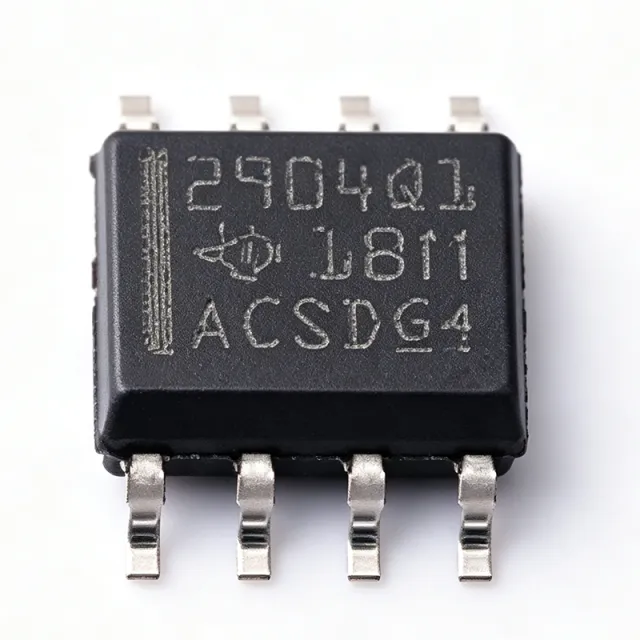
LM2904QDRQ1 - Dual 26V 700kHz Op Amp AEC-Q100 | TI
The Texas Instruments LM2904QDRQ1 is an automotive-grade, dual operational amplifier qualified to AEC-Q100, operating from a single supply of 3V to 26V (or dual supplies plus/minus 1.5V to plus/minus 13V) with a 700 kHz gain-bandwidth product in an 8-pin SOIC (D) package rated -40C to +125C. An operational amplifier (op amp) is a high-gain differential-input voltage amplifier and a fundamental analog building block within the signal-chain hierarchy: op amp -> amplifier IC -> analog/mixed-signal IC -> semiconductor. A dual op amp integrates two independent amplifiers in one package, cutting board space and BOM cost for multi-channel signal conditioning. Key features include a low 500 uA supply current per amplifier, a common-mode input range that includes ground (enabling true single-supply operation), internal frequency compensation, and output short-circuit protection. ESD protection exceeds 500 V per MIL-STD-883 Method 3015 and 200 V on the machine model, per the TI datasheet. Technically, the bipolar process yields a typical 2 mV input offset voltage (7 mV max) and 20 nA typical input bias current. The 0.3 V/us slew rate and 700 kHz GBW suit low-frequency sensor and control loops; the output swings close to the negative rail but is not rail-to-rail. Operation remains stable with moderate capacitive loads. Typical applications include automotive sensor signal conditioning (temperature, pressure, position), current sensing, active filters, DC motor control, and battery management front-ends, where the 26V rating allows direct operation from a 12V automotive battery rail with load-dump headroom. Design tip: decouple VCC with a 0.1 uF ceramic close to pin 8, keep the input common-mode below VCC-1.5V, and buffer high-impedance sources to limit offset errors. For new automotive designs requiring 36V ratings and tighter offset, consider the next-generation LM2904B-Q1 family.

LM321MF/NOPB - 1MHz, Single Op Amp, 3-32V, SOT-23-5 | TI
The Texas Instruments LM321MF/NOPB is a single-channel, low-power operational amplifier delivering 1 MHz unity-gain bandwidth and 0.4 V/us slew rate in a 5-pin SOT-23 (DBV) package. It operates from a single 3 V to 32 V supply (or dual +/-1.5 V to +/-16 V) and supports an input common-mode range that includes ground, enabling true single-supply operation. Housed in the industry-standard SOT-23-5 footprint, the LM321MF/NOPB combines economy with TI's LM321 bipolar architecture originally developed by National Semiconductor. An operational amplifier (op amp) is a high-gain DC-coupled electronic voltage amplifier with differential inputs and a single-ended output. Op amps belong to the amplifier IC family within integrated circuits, which also includes instrumentation amplifiers, comparators, and specialty audio/video amplifiers. The LM321MF/NOPB specifically is a general-purpose single op amp, meaning one amplifier channel per package; it sits in the hierarchy: op amp -> amplifier IC -> analog IC -> integrated circuit -> semiconductor. Key features include 1 MHz gain-bandwidth product, 0.4 V/us slew rate, low input offset voltage (typical 2 mV), input common-mode range that includes the negative rail, and large capacitive-load drive capability. The bipolar input stage with class-AB output provides robust performance across the wide 3 V to 32 V supply range. Internal ESD protection and thermal shutdown enhance field reliability. The LM321MF/NOPB uses a bipolar transistor input stage rather than CMOS or JFET, giving it inherently low noise voltage density but somewhat higher input bias current than modern CMOS alternatives. Its wide supply range allows direct connection to industrial 24 V rails, 12 V battery systems, or +/-15 V analog supplies, eliminating the need for additional level shifters. The 1 MHz bandwidth is sufficient for audio, sensor conditioning, and many active-filter topologies. Typical applications include transducer signal conditioning, low-frequency active filters, current sensing with high-side or low-side shunt, audio pre-amplifier stages, and general-purpose amplification in industrial controls. The SOT-23-5 footprint is ideal for space-constrained PCB designs such as handheld instruments and IoT sensor modules. When designing with the LM321MF/NOPB, verify input bias current (45 nA typical) is acceptable for high-impedance sensor interfaces. Place a 0.1 uF decoupling capacitor close to the VCC pin and ensure output capacitive loads stay within the datasheet's stability region to avoid oscillation. This page synthesizes distributor pricing, drop-in SOT-23-5 alternatives, and practical design notes not found in the manufacturer datasheet alone, giving engineers a faster path from datasheet to prototype.

LM324ADR2G - Quad Op Amp, 3-32V, 1MHz SOIC-14 | onsemi
The onsemi LM324ADR2G is a low-cost quad operational amplifier with four independent general-purpose amplifier circuits, true differential inputs, a supply range of 3V to 32V single-supply (or ±1.5V to ±16V split supply), a 1 MHz gain-bandwidth product, and a 0.6 V/µs slew rate, housed in a 14-pin SOIC package supplied on tape and reel. A quad operational amplifier is an integrated circuit that packs four identical, frequency-compensated op amp stages onto a single silicon die, sharing one set of power pins. Within the amplifier hierarchy, it belongs to the general-purpose bipolar op amp family: operational amplifier -> linear amplifier IC -> analog signal conditioning IC. Quad op amps reduce board area, cut per-channel cost, and improve channel-to-channel thermal matching versus four single op amps. Key features include single-supply operation down to 3V with input common-mode range that includes ground - the defining trait that made the LM324 the industry-standard quad op amp. The A-grade suffix guarantees a maximum input offset voltage of 3 mV, tighter than the base LM324. Internally frequency compensation eliminates external compensation components, and the low supply current of approximately 700 µA per amplifier (typical for the family) suits battery-powered designs. Technically, the LM324ADR2G uses a mature bipolar process with PNP input stages that enable ground-sensing inputs. The output stage is a classic single-ended Class-AB emitter follower, which means it can sink only limited current near ground and exhibits output crossover behavior under light loads - a known characteristic designers must account for in precision or audio paths. Typical applications include transducer signal conditioning, DC gain blocks, active filters, comparators, voltage followers, and industrial sensor interfaces where single-supply, ground-referenced inputs simplify the power architecture. Design consideration: keep total supply voltage within 32V, and remember the output cannot swing rail-to-rail - headroom of roughly 1.5V to the positive rail is required at moderate loads. This page adds value beyond the manufacturer datasheet by synthesizing distributor pricing, verified drop-in alternatives, a parametric comparison table, and practical design notes in one place.

LM324AWPT - Quad Low-Power Op Amp, 1.3MHz, TSSOP-14 | STMicroelectronics
The STMicroelectronics LM324AWPT is a low-power, low-input-bias-current quad operational amplifier integrating four independent, internally frequency-compensated gain stages in a single 14-pin TSSOP (Tape and Reel) package. The 'A' suffix designates the enhanced input-offset-voltage grade, which tightens Vio to a maximum of 2 mV at 25°C versus 7 mV for the standard LM324, while the 'W' suffix extends the operating temperature range to -40°C to +105°C for industrial environments. Each of the four channels delivers a gain-bandwidth product of approximately 1.3 MHz and a slew rate of 0.4 V/µs, drawing only 1.5 mA of quiescent supply current total regardless of channel loading. A quad operational amplifier (quad op-amp) is a monolithic integrated circuit that places four independent, internally-compensated op-amp cells in one package sharing common power pins. Quad op-amps belong to the broader operational amplifier family, which in turn falls under the linear IC hierarchy and finally under analog signal-conditioning semiconductors. Compared with single or dual op-amps, quad devices reduce PCB area, simplify routing, and lower the per-channel cost in applications requiring multiple gain, buffer, filter or comparator stages. The LM324 series uses bipolar transistor input stages that can operate from a single supply as low as 3 V or from split ±1.5 V to ±16 V rails, with true ground-sensing capability on the input common-mode range. The differential input range includes the negative rail, eliminating the need for external biasing in single-supply designs. Output swing typically reaches within a few millivolts of both rails at moderate loads, and the device sustains continuous output short-circuits to ground or either rail thanks to internal current limiting. Typical applications include active filters, transducer signal conditioning, DC gain blocks, voltage followers, comparators, and general-purpose analog signal chains in consumer, industrial and automotive subsystems. The wide supply range makes the part especially popular in 5 V single-rail microcontroller-interface circuits, where four op-amps share one supply rail alongside the MCU. When designing with the LM324AWPT, place a 0.1 µF ceramic bypass capacitor within 5 mm of the VCC pin and consider the input bias current of 20 nA typical (50 nA maximum) when selecting source impedances — bias currents up to 50 nA across a 100 kΩ source produce a 5 mV offset error. Avoid using this part in precision sub-millivolt instrumentation paths; choose the LM324A-grade offset only when 2 mV is acceptable. Always consult the official STMicroelectronics datasheet for full DC and AC characteristic curves.

LM324BAIDR - Quad 36V 1.2MHz Op-Amp | Texas Instruments
The Texas Instruments LM324BAIDR is a quadruple operational amplifier featuring four general-purpose amplifier channels with a 36V maximum supply, 1.2MHz gain-bandwidth product, and a low input offset voltage of 2mV (B, BA versions), housed in a 14-pin SOIC (D) package rated for -40C to +85C operation. An operational amplifier (op-amp) is a high-gain voltage amplifier with differential inputs and a single-ended output, the fundamental building block of analog signal conditioning. In the analog hierarchy, the op-amp sits above discrete transistors and below specialized amplifiers such as instrumentation and audio amplifiers; general-purpose quad op-amps like the LM324 family provide four independent channels in one package for cost-sensitive multi-channel designs. The LM324BA is the next-generation BA version of the classic LM324. Key improvements over legacy LM324/LM224/LM2902 parts include a wide 3V to 36V supply range, tighter 2mV input offset voltage specification, and enhanced robustness, while remaining pin-for-pin drop-in replacements for all legacy versions. The push-pull output stage improves output voltage swing and crossover behavior compared to older Class-AB output stages, reducing the well-known LM324 output crossover distortion near the negative rail. Each of the four amplifiers shares a common supply; single-supply operation down to 3V makes the part suitable for 3.3V and 5V logic-based systems as well as traditional up to 36V industrial rails. The common-mode input range includes the negative rail, a signature LM324-family trait that simplifies single-supply designs such as sensor buffering near ground. Typical applications include industrial signal conditioning, transducer amplifier front ends, active filters, comparators and level shifters, motor-control feedback loops, and consumer appliance analog interfaces. Design consideration: the 1.2MHz gain-bandwidth limits closed-loop bandwidth; at a gain of 10, expect roughly 120kHz of usable bandwidth, so verify gain-phase margin in high-gain configurations. This page synthesizes verified distributor pricing, drop-in alternatives, pinout data, and practical design notes not found in the manufacturer datasheet alone.
LM324DR - Quad 36V Op Amp | Texas Instruments | SOIC-14
The Texas Instruments LM324DR is a low-power, quadruple operational amplifier containing four independent, high-gain, internally frequency-compensated amplifiers in a 14-pin SOIC package. The verified product data identifies it as a general-purpose amplifier designed for operation from a single supply or split supply over a wide voltage range, with the B-family supply range specified as 3 V to 36 V. This quad topology lets one compact IC provide four separate analog signal-conditioning channels without requiring four discrete packages. An operational amplifier is an analog amplifier used in the wider semiconductor hierarchy of integrated circuits and analog signal-processing devices. The LM324 family is commonly used for voltage buffering, sensor-interface conditioning, current-to-voltage conversion, audio paths, filters, and control loops. Its single-supply capability is useful when the signal and system share a common ground reference, while split-supply operation supports bipolar signals in applications where positive and negative rails are available. Verified feature data identifies the LM324 family as a next-generation LM324B and LM2902B offering, with B versions intended as drop-in replacements for LM224, LM324, and LM2902 versions. The listed operating supply range is 3 V to 36 V. The family also includes versions with input offset voltage specified as low as plus or minus 2 mV, 2 kV HBM ESD protection for B, BA, and K versions, and internal RF and EMI filtering for B and BA versions. These features support general-purpose analog designs where supply tolerance and input conditioning matter. The LM324DR is packaged in the SOIC-14 footprint, making it suitable for conventional PCB assembly and educational, industrial-control, instrumentation, and embedded-control designs. The device is not a precision, rail-to-rail-input amplifier, so input common-mode range, output swing, input bias current, noise, slew rate, and stability behavior must be checked against the actual signal path. The four amplifiers share a package power supply but operate independently at their input, output, and feedback pins. Typical uses include four-channel sensor buffering, low-frequency active filtering, audio preamplification, DC gain stages, comparator-style threshold conditioning with suitable feedback arrangements, and general embedded analog interfaces. When designing around the LM324DR, verify the supply rails, keep input and feedback connections short, provide stable bypass capacitance near the supply pins, and account for the amplifier’s output-current and thermal limits. The manufacturer product page and datasheet are the authoritative sources for exact electrical limits and ordering information. This page combines verified manufacturer and distributor links with application guidance and explicitly marks electrical details that were not supplied in the verified excerpts. The LM324DR remains a practical choice when four general-purpose amplifiers, single-supply operation, and a standard SOIC-14 footprint are more important than precision or rail-to-rail performance.
LM324DR2G - Quad Op Amp, 3-32V, 1MHz SOIC-14 | onsemi
The onsemi LM324DR2G is a low-cost quad operational amplifier with four internally compensated, true-differential-input amplifiers in a 14-pin SOIC package, operating from a single 3V to 32V supply (or dual supplies up to +/-16V) with a 1 MHz gain-bandwidth product and 0.6 V/us slew rate. An operational amplifier (op-amp) is a high-gain voltage amplifier with differential inputs and a single-ended output, the foundational building block of the analog signal-chain hierarchy: op-amp -> amplifier IC -> analog front end -> mixed-signal system. The LM324 family is the industry-standard general-purpose quad op-amp, designed specifically for single-supply operation where its input common-mode range includes ground and its output swings to within tens of millivolts of the negative rail. Key features include a wide single-supply range of 3V to 32V, a common-mode input range that extends to the negative rail (ground-sensing capability), a typical input offset voltage of 5 mV (7 mV max per datasheet specifications), a minimum common-mode rejection ratio of 65 dB, and low supply current per amplifier that suits battery-powered designs. Four amplifiers in one SOIC-14 package reduce board area and BOM cost versus four single op-amps. The bipolar architecture is internally frequency-compensated, so no external compensation capacitors are required for unity-gain stability. Because all four amplifiers share one bias network, supply current is lower than four discrete units; however, channels can exhibit minor crosstalk in high-gain audio paths. Typical applications include transducer amplifiers, active filters, comparators (with caution regarding slow recovery), DC gain blocks, level shifters, and signal conditioning in industrial controls, consumer appliances, and automotive-adjacent systems. Designers should note the output stage is not rail-to-rail and can crossover-distort when sourcing current near the negative rail; biasing the output with a pull-down resistor mitigates this. Gain-bandwidth is 1 MHz, so keep closed-loop gains modest for bandwidth-critical circuits. This page adds value beyond the datasheet with distributor pricing tiers, verified drop-in alternatives, a parameter-by-parameter comparison table, and practical design notes not found on the manufacturer product page.
LM324DST - Quad Op-Amp, 14-SOIC, Low Power | STMicroelectronics
The STMicroelectronics LM324DST is a quad general-purpose operational amplifier integrating four independent, internally frequency-compensated high-gain op-amp circuits in a 14-pin SOIC (SO-14) surface-mount package. It operates from a single supply and delivers an output current capability of approximately 70 mA per the LCSC product listing, with low power consumption and low input bias current. A quad op-amp is an integrated circuit that houses four separate operational amplifiers on one die. An operational amplifier is a high-gain DC-coupled voltage amplifier with differential inputs and, in this family, a single-ended output; it is the foundational building block of the analog signal-chain hierarchy (op-amp -> amplifier IC -> linear IC -> analog/mixed-signal semiconductor). Quad op-amps like the LM324x family are chosen when multiple amplification stages share a common supply and ground, halving board area versus four single op-amps. Key features of the LM324DST include four internally compensated amplifiers requiring no external frequency-compensation components, wide single-supply operation, and an output that swings close to the negative rail, which is valuable in single-supply designs. The common-mode input range extends to include the negative supply rail, enabling sensing near ground. The internal compensation is implemented on-chip, giving unity-gain stability without external capacitors. This makes the part forgiving in general-purpose amplification, active filtering, comparators (non-precision), oscillators, and transducer interface circuits. Typical applications include industrial signal conditioning, consumer audio preamplification, battery-powered instrumentation, and logic-level level-shifting or buffering where four matched gain blocks are needed on one rail. Design consideration: the LM324 class-B output stage can exhibit crossover distortion at light loads and near-zero output currents; for precision AC applications consider a rail-to-rail upgrade such as the TL074 (JFET input) after verifying bias-current requirements. This page synthesizes distributor pricing, verified drop-in alternatives, pinout data, and practical design notes not found in the manufacturer datasheet alone.
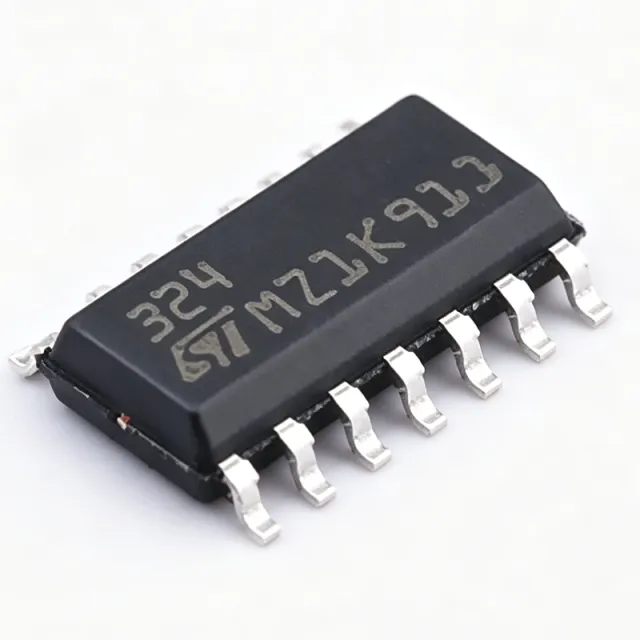
LM324DT - Quad Operational Amplifier | STMicroelectronics
The LM324DT is a quad operational amplifier from STMicroelectronics, featuring four independent, high-gain, internally frequency-compensated op-amps designed to operate from a single power supply over a wide range of voltages. It operates from 3V to 32V (or ±1.5V to ±16V dual supply) and delivers a typical output current of 40mA per channel. The device is housed in a 14-pin SOIC package, making it suitable for space-constrained PCB designs. Data verified as of 2026-08-05. An operational amplifier (op-amp) is a high-gain voltage amplifier with differential inputs and a single-ended output, used in analog signal conditioning, filtering, and mathematical operations. The LM324 is a classic general-purpose op-amp family, known for its low cost, wide supply range, and ability to operate with a single supply, making it a staple in analog electronics. It sits within the hierarchy: operational amplifier -> linear amplifier -> analog IC -> semiconductor. Key features include a wide supply voltage range (3V to 32V), low supply current (typically 700µA per amplifier), common-mode input voltage range including ground, and short-circuit protected outputs. The LM324DT also features true differential input stage, which allows the input to go below ground when operating from a single supply, and it has a typical gain-bandwidth product of 1.3MHz. These features make it versatile for many analog applications. The LM324 uses a bipolar transistor architecture with a class-AB output stage, providing low output saturation voltage and high output current capability. It has an input offset voltage of typically 2mV and input bias current of typically 20nA, which are adequate for many precision applications. The device is internally frequency compensated for unity-gain stability, eliminating the need for external compensation components. Typical applications include transducer amplifiers, DC gain blocks, active filters, and general-purpose signal conditioning in industrial, automotive, and consumer electronics. Its single-supply operation makes it ideal for battery-powered devices and automotive sensor interfaces where a negative rail is not available. When designing with the LM324DT, ensure proper decoupling of the power supply pins with a 0.1µF ceramic capacitor close to the device. The output can swing close to the positive rail but not to the negative rail (ground) when using a single supply, so consider the output voltage range in your design. Also, avoid exceeding the absolute maximum supply voltage of 32V to prevent damage. This page synthesizes distributor pricing, drop-in alternatives, and practical design notes not found in the STMicroelectronics datasheet, providing a comprehensive resource for engineers selecting the LM324DT.
LM324J - Quad 32 V 1 MHz Op Amp | Texas Instruments
The Texas Instruments LM324J is a low-power, general-purpose, quad operational amplifier built for single-supply operation across a wide voltage range. Each of its four amplifiers is intended for 32 V maximum supply operation and 1 MHz gain-bandwidth performance, while the J package is a 14-pin ceramic dual in-line package identified by the verified DigiKey listing. The device combines four amplifiers in one package, making it useful when several independent analog stages must fit on a relatively compact board. An operational amplifier is an active analog component that uses high open-loop gain and negative feedback to amplify the difference between two input signals. In the broader electronics hierarchy, an op amp belongs to amplifier ICs and analog signal-chain devices. The LM324 family supports common general-purpose tasks including voltage buffering, summing, comparison, filtering, transducer conditioning, and gain stages, provided the designer observes its supply, input, output, and stability limits. Verified distributor information identifies the LM324J as a standard, general-purpose, four-circuit amplifier in a 14-CDIP package. The Mouser listing further identifies it as a military quad operational amplifier with 32 V operation and 1 MHz bandwidth. Those confirmed points establish the device’s most important selection criteria: four integrated channels, wide single-supply capability, roughly 1 MHz bandwidth, and a through-hole ceramic DIP footprint for higher-temperature or ruggedized legacy-style assemblies. Each amplifier shares the same positive supply, negative supply, and ground pins on the 14-pin package. The common architecture saves board area and reduces package count compared with four separate single op-amp ICs. It also makes rail planning and decoupling straightforward: the designer must ensure that all four channels remain within their electrical limits simultaneously and that power-supply bypass capacitors are placed close to the package supply pins. Typical uses include industrial control interfaces, sensor signal conditioning, low-frequency active filters, audio preamplification, instrumentation, power-supply feedback, and general mixed-signal embedded systems. The 1 MHz bandwidth favors low- to moderate-frequency signals rather than high-speed video, RF, or precision signal-path work. For those applications, verify exact gain-bandwidth, slew-rate, input-offset, output-current, and temperature limits against the official LM324 manufacturer documentation before production release. The principal design consideration is ensuring adequate output-voltage headroom and stability at the selected supply voltage, load, and gain. Because the verified excerpts do not publish exact capacitor values, common-mode limits, output-current ratings, or full pin names, those details remain deliberately unstated rather than guessed. This page combines verified sourcing data, package information, application guidance, and a conservative interpretation of the LM324J’s general-purpose role. Its differentiation is practical rather than headline performance: one 14-CDIP package supplies four general-purpose amplifier channels, while the 32 V and 1 MHz figures cover common industrial and embedded signal-conditioning needs. For an existing 14-pin LM324-family footprint, engineers should still compare the exact suffix, grade, pinout, and operating-temperature limits before approving a substitute.
LM324M - Low-Power Quad Op Amp | Texas Instruments
The Texas Instruments LM324M is a low-power, general-purpose quad operational amplifier containing four independent, high-gain, internally frequency-compensated amplifiers in a 14-pin SOIC package. The verified source identifies the device as a standard four-circuit amplifier designed for operation from a single power supply over a wide voltage range. Because exact electrical ratings were not included in the supplied source data, values such as supply voltage, gain-bandwidth product, input bias current, and output-current limits remain subject to confirmation in the manufacturer datasheet. An operational amplifier is an analog signal-processing IC that uses high open-loop gain to amplify the difference between two inputs. Negative feedback establishes a stable closed-loop gain and bandwidth. The LM324 family belongs to the broader quad-operational-amplifier hierarchy: operational amplifier, analog amplifier, linear amplifier, and integrated circuit. Its four internally compensated channels can amplify AC or DC signals when supported by suitable biasing, decoupling, feedback, and output-loading conditions. The principal feature of LM324M is integration. Four amplifiers in one 14-pin SOIC reduce package count and simplify common dual-rail or single-supply analog boards. Internal frequency compensation means each channel does not require a separate compensation network for ordinary closed-loop operation. The verified manufacturer result specifically describes LM324 as low-power and optimized for single-supply operation, while the distributor result classifies LM324M as a standard general-purpose instrumentation and buffer amplifier. The four channels are intended for independent signal-conditioning tasks. Typical functions include noninverting and inverting amplification, voltage buffering, active filtering, cross-coupled analog networks, and sensor-signal conditioning. Internal compensation supports unity-gain buffer use, but stability, output swing, input common-mode range, slew rate, noise, and usable bandwidth must be checked against the actual circuit. A low-power general-purpose amplifier may not be suitable when very wide bandwidth, very low offset, low noise, rail-to-rail input/output, or high capacitive-drive capability is required. A practical single-supply design must establish a suitable input common-mode voltage and output bias point. Bypass the power pin close to the IC, route traces to avoid feedback around unintended paths, and avoid excessive capacitive loading on an output. Because the provided search result does not include verified temperature, RoHS, REACH, or package-dimension details, those specifications should be taken from the official LM324 documentation before release to production. Typical uses include low-frequency sensor conditioning, buffered instrumentation, active filters, classroom electronics, industrial control blocks, and general analog signal chains. This page summarizes the verified product identity and package, provides practical design guidance, distinguishes confirmed facts from missing ratings, and directs buyers to the official product page for complete electrical and qualification data.
LM324N - Low-Power Quad Op Amp, 14-PDIP | Texas Instruments
The Texas Instruments LM324N is a low-power quadruple operational amplifier containing four independent, high-gain, internally frequency-compensated amplifiers in a 14-pin PDIP package. According to the verified DigiKey listing, it is a standard general-purpose amplifier intended for transducer amplifiers, DC gain blocks, and conventional op-amp circuits. The four amplifiers can operate from a single power supply over a wide voltage range, making the device useful when one rail must be ground. An operational amplifier is a high-gain analog building block used to amplify, buffer, compare, or condition signals. The LM324 belongs to the broader hierarchy of operational amplifier, analog amplifier, linear amplifier, and semiconductor. Its internal frequency compensation removes the need for an external compensation network in many conventional closed-loop configurations, simplifying general-purpose analog designs. The verified product information establishes four amplifier circuits and a 14-pin PDIP package. The low-power designation reflects its use in low-voltage, low-current analog systems rather than high-performance precision signal chains. Because all four channels are housed in one through-hole package, a design can allocate the amplifiers across independent sensor channels, buffers, filters, or control loops while conserving board area. The manufacturer identifies the LM324-N as suitable for transducer amplifiers, DC gain blocks, and conventional op-amp circuits. These uses benefit from the device’s integrated quad-channel arrangement and single-supply operation. The verified snippets do not provide detailed electrical limits such as input-offset voltage, gain-bandwidth product, output-current capability, common-mode range, noise density, or temperature range, so those values are not inferred here. Typical implementation requires attention to supply bypassing, input common-mode limits, output swing, stability, and the relationship between the selected feedback network and closed-loop gain. Because this is a through-hole PDIP device, lead spacing and insertion orientation should be checked against the PCB footprint and the manufacturer pinout. This page consolidates the verified manufacturer and distributor references, identifies the application fit of the LM324N, and clearly separates confirmed data from parameters that require consultation of the exact manufacturer datasheet.

LM324PT - Quad Low-Power Op-Amp, 1.3MHz, TSSOP-14 | STMicroelectronics
The STMicroelectronics LM324PT is a low-power quad operational amplifier integrating four general-purpose amplifier channels in a 14-pin TSSOP package, operating from a single 3V to 32V supply or dual supplies of ±1.5V to ±16V, with a 1.3MHz gain-bandwidth product and 0.4 V/us slew rate. An operational amplifier (op-amp) is a high-gain differential voltage amplifier that, with external feedback networks, performs mathematical operations such as amplification, filtering, comparison, and integration. The op-amp sits at the foundation of the analog signal-chain hierarchy: op-amp -> amplifier IC -> analog front end -> signal conditioning system. Quad op-amps like the LM324 family pack four independent channels sharing one supply, reducing board area and BOM cost versus four single amplifiers. Key features of the LM324PT include an input common-mode voltage range that extends down to ground (ground-sensing inputs on single-supply rails), a large DC voltage gain of 100dB, and a very low supply current of approximately 375uA per amplifier. These characteristics make it a cost-effective workhorse for battery-powered and single-supply industrial designs. Architecturally, the LM324 uses a classic bipolar process with PNP input stages that enable the ground-sensing common-mode range, and class-AB output stages that can swing close to the negative rail. The four channels are well matched and thermally coupled, which minimizes offset drift between channels in multi-channel signal conditioning. Typical applications include transducer amplification, active RC filters, voltage comparators and level shifters, LED drivers, and DC gain blocks in consumer and industrial equipment. Design consideration: the LM324 is not a rail-to-rail output device - the output saturates roughly 1.5V below VCC, so set signal swings accordingly to avoid clipping near the positive rail. This page consolidates verified datasheet parameters, drop-in alternatives, pricing tiers, design notes, and comparison data not found together on the manufacturer datasheet.

LM324QDRQ1 - Automotive Quad Op Amp, 1MHz, RRO | TI
The Texas Instruments LM324QDRQ1 is an automotive-qualified quad operational amplifier delivering a 1 MHz gain-bandwidth product and rail-to-rail output (RRO) swing in a 14-pin SOIC (D) surface-mount package. It operates from a single supply of 2.7 V to 5.5 V (or dual supplies of +/-1.35 V to +/-2.75 V), making it well suited to battery-powered and low-voltage automotive systems. An operational amplifier (op amp) is a high-gain differential-input voltage amplifier and one of the most fundamental building blocks in analog electronics, used for signal conditioning, active filtering, and mathematical operations. Within the analog IC hierarchy, general-purpose op amps belong to linear integrated circuits, alongside comparators, voltage references, and voltage regulators. Quad op amps like this device integrate four matched amplifiers on a single die, saving board space and improving channel matching in multi-channel signal chains. Key features include rail-to-rail output swing that maximizes dynamic range at low supply voltages, a maximum input offset voltage of 4 mV, and a typical common-mode rejection ratio (CMRR) of 65 dB. Each amplifier draws approximately 100 uA of quiescent current, enabling low-power designs, while internal frequency compensation guarantees unity-gain stability without external components. Technically, the device uses bipolar process technology for good linearity, includes short-circuit protection and output current limiting for robustness, and specifies output current capability of around 160 mA per channel under rated conditions per distributor data. The AEC-Q100 qualification and wide temperature rating make it suitable for harsh automotive environments with 3.3 V and 5 V microcontroller-based systems. Typical applications include automotive sensor signal conditioning (temperature, pressure, and position sensors), battery management system monitoring front-ends, and motor control circuits paired with MCUs such as TI C2000 and MSPM0 families. Design tip: decouple the supply pin with a 0.1 uF ceramic capacitor placed close to the device, and respect the input common-mode range, which extends from ground to VCC - 1.5 V, to avoid phase-reversal and nonlinear behavior near the upper rail.
LM324QT - Quad Low Power Op Amp, 1.3MHz | STMicroelectronics
The LM324QT from STMicroelectronics is a quad general-purpose operational amplifier in a compact 16-pin QFN (3x3 mm) package. It operates from a single power supply over a wide voltage range, making it ideal for space-constrained, battery-powered applications. The device features four independent, high-gain, frequency-compensated amplifiers with a gain bandwidth product of 1.3 MHz and a slew rate of 0.4 V/us. An operational amplifier (op amp) is a high-gain voltage amplifier with differential inputs and a single-ended output. It is the fundamental building block of analog signal conditioning, used in filters, comparators, integrators, and many other circuits. The LM324QT belongs to the LM324 family, a classic industry-standard quad op amp known for its low power consumption and wide supply range, which includes the ability to operate from a single supply down to 3V. Key features include a wide gain bandwidth of 1.3 MHz, a large voltage gain of 100 dB, and a very low supply current per amplifier of 375 uA. The input common-mode voltage range includes ground, allowing single-supply operation with ground-referenced inputs. The device also features low input bias current and internal frequency compensation, simplifying design and reducing external component count. The LM324QT uses a bipolar process technology, providing robust performance over a wide temperature range. The QFN package offers excellent thermal performance and a small footprint, making it suitable for compact designs. The device is designed for low-power operation, making it ideal for battery-powered equipment where power efficiency is critical. Typical applications include sensor signal conditioning, active filters, DC gain blocks, and transducer amplifiers. The wide supply voltage range and low power consumption make it suitable for automotive, industrial, and consumer electronics. The QFN package is particularly well-suited for portable devices where board space is at a premium. When designing with the LM324QT, ensure proper decoupling of the power supply pins with a 0.1 uF ceramic capacitor placed close to the device. The input common-mode range includes ground, but for best performance, keep inputs within the specified range. The output can swing close to the rails, but avoid driving loads that require rail-to-rail output swing without proper design considerations.