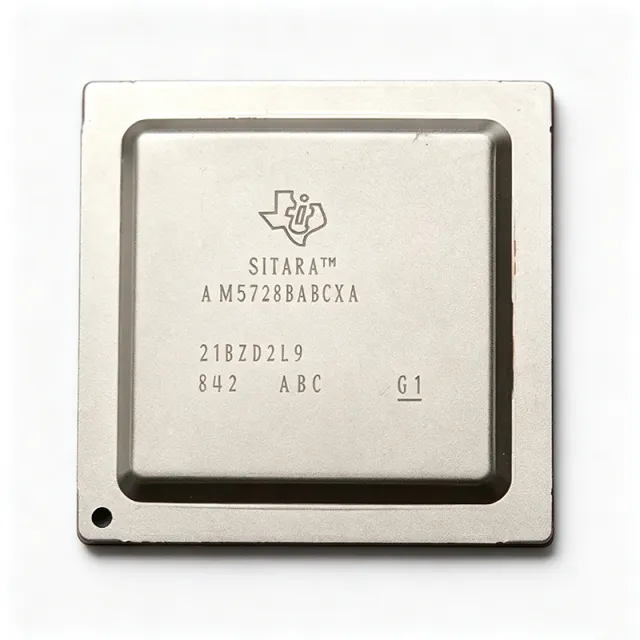
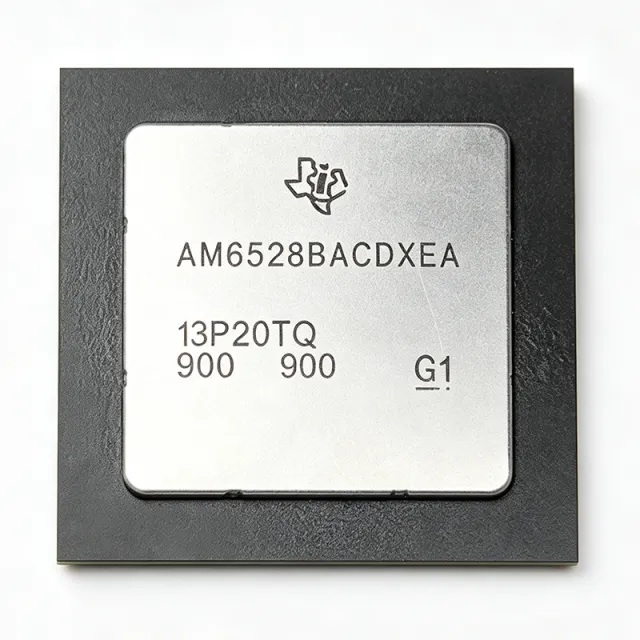
AM3357BZCZD60
AM3357BZCZD60 - Sitara ARM Cortex-A8 MPU 600MHz | Texas Instruments
The Texas Instruments AM3357BZCZD60 is a Sitara ARM Cortex-A8 32-bit microprocessor with integrated EtherCAT, PROFIBUS, PRU-ICSS and CAN support, operating at up to 600MHz and housed in a 324-ball NFBGA (15x15 mm) ZCZ package. As a member of TI's AM335x family, the AM3357BZCZD60 combines a single Cortex-A8 core running at 600MHz with two Programmable Real-time Units (PRU-ICSS), industrial protocol acceleration, and a rich peripheral set including two USB 2.0 ports, two Gigabit Ethernet MACs (one industrial-grade with two-port switch), and a 3D graphics engine. The device is qualified for an industrial -40C to +90C operating range and is targeted at deterministic real-time industrial communication.
A microprocessor (MPU) is an integrated processing device that integrates a CPU core, memory controller, peripheral controllers and I/O into a single chip, distinguishing it from a microcontroller (MCU) which typically emphasizes on-chip Flash and simpler peripherals. Within the system hierarchy, an MPU sits above basic MCUs and below application processors in computational capability, providing the horsepower to run high-level operating systems such as Linux while maintaining the deterministic I/O needed for industrial control. The Sitara family specifically targets applications requiring a balance of high-level OS support and real-time industrial protocols on a single die.
Key features include the Cortex-A8 core with NEON SIMD and VFPv3 floating-point hardware, 32KB L1 instruction and data caches, a 256KB L2 cache, a 32-bit LPDDR1/DDR2/DDR3/mDDR memory controller, two 12-bit ADCs, two USB 2.0 high-speed ports (with one capable of PHY interface), two industrial-grade CAN controllers, two PRU subsystems for deterministic I/O, a real-time clock, an SGX530 3D graphics accelerator, and a LCD controller with WXGA resolution support. The integrated EtherCAT slave controller and PROFIBUS support eliminate the need for an external ASIC, reducing BOM cost for industrial automation designs.
The architecture is built on TI's 65nm CMOS process, supports ARMv7-A instruction set, and provides boot sources including SPI, MMC/SD, UART and NAND/NOR Flash. Power management is handled through multiple core voltage domains enabling dynamic frequency scaling and deep sleep modes with RTC retention. A typical 1.1V core supply and 3.3V I/O supply are required, with the integrated LDOs and PMIC companion devices managing the sequencing. Security features include a hardware crypto accelerator (AES, SHA, RNG) and secure boot support through the AM335x ROM bootloader.
Typical applications include industrial programmable logic controllers (PLC), human-machine interfaces (HMI), point-of-sale (POS) terminals, industrial gateways, motor control drives with EtherCAT, machine vision systems, portable medical devices, and networked sensors with fieldbus connectivity. The dual-PRU subsystem is especially useful for custom industrial I/O protocols requiring sub-microsecond deterministic response without burdening the Cortex-A8 core.
When designing with this device, pay close attention to the DDR3 memory trace impedance and length matching - the DDR3 interface requires careful signal integrity work. The PRU firmware should be developed using TI's PRU-RemoteProc and CCS toolchain. For EtherCAT or PROFIBUS applications, use TI's certified protocol stacks rather than reimplementing from scratch. Refer to TI's AM335x Hardware User Guide and the PRU-ICSS Reference Guide for detailed peripheral programming examples and reference schematics. This page synthesizes distributor pricing, drop-in alternatives, and practical design notes not found in the manufacturer datasheet alone.
USD $25,90
Auf Lager