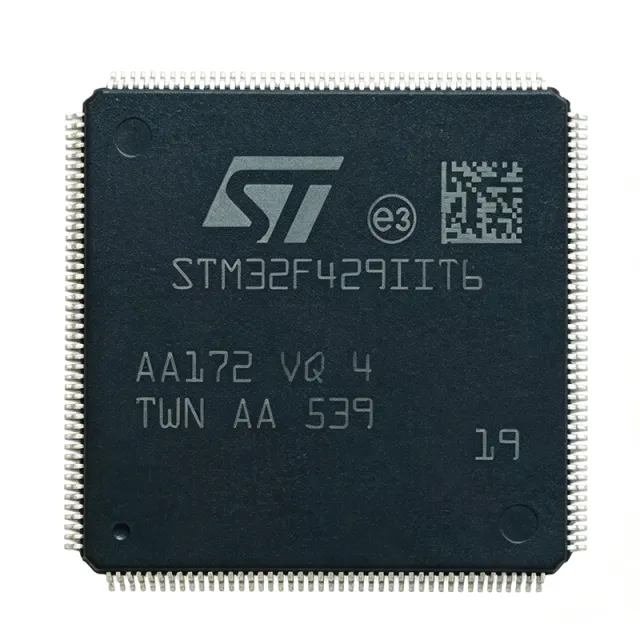
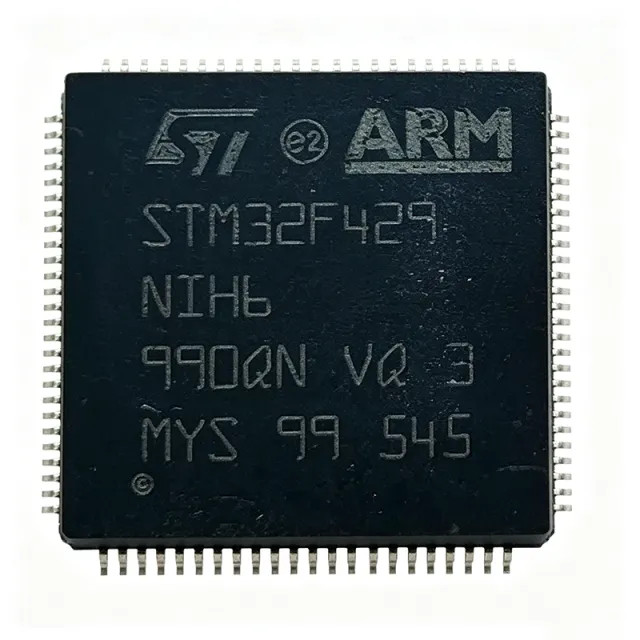
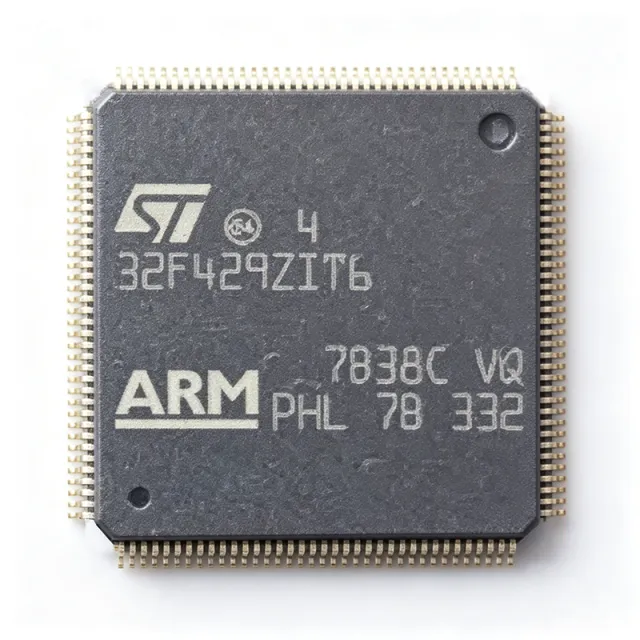
STM32F429ZIT6E
STM32F429ZIT6E - 180MHz Cortex-M4 MCU, 2MB Flash | STMicroelectronics
The STMicroelectronics STM32F429ZIT6E is a 32-bit Arm Cortex-M4 microcontroller with floating-point unit, up to 180 MHz operating frequency, 2 MB Flash memory, 256 KB SRAM plus 4 KB backup SRAM, and a 144-pin LQFP package. Its headline combination of 180 MHz performance, 2 MB program storage, USB, Ethernet, camera, LCD-TFT, and memory interfaces makes it suitable for connected embedded systems requiring substantial local resources.
What is a Cortex-M4 microcontroller? A microcontroller combines a processor core, memory, peripherals, and communication interfaces on one integrated circuit. The Arm Cortex-M4 core is a 32-bit reduced-instruction-set-computing processor designed for embedded control, while the FPU accelerates suitable floating-point operations. This device belongs to the STM32F4 high-performance microcontroller family and sits within the broader semiconductor and embedded-processing hierarchy.
Key features include up to 225 DMIPS, DSP instructions, an ART Accelerator, memory protection, three ADCs, seventeen timers, and numerous communication interfaces. The verified family datasheet describes USB OTG high-speed and full-speed support, Ethernet, camera, LCD-TFT, and flexible memory-controller capabilities. These resources reduce the need for external logic in graphics, communications, data acquisition, and industrial-control designs.
The Cortex-M4 processor operates at up to 180 MHz and provides 225 DMIPS, or 1.25 DMIPS/MHz with Dhrystone 2.1 as reported in the verified material. The STM32F429ZIT6E is identified with 2 MB Flash and 144-LQFP packaging. Detailed voltage limits, pin functions, peripheral electrical limits, clock trees, and memory partitioning are not all present in the supplied excerpts and are therefore not inferred here.
Typical applications include industrial automation, human-machine interfaces, data acquisition, USB-connected equipment, Ethernet-enabled controllers, camera modules, and embedded displays. The USB and Ethernet interfaces support connected-control designs, while the large Flash capacity can hold networking stacks, graphics resources, protocols, and application firmware. The LCD-TFT and camera resources are especially relevant to graphical monitoring systems.
Designers should verify clock configuration, supply voltage, decoupling, peripheral pin multiplexing, startup behavior, and memory timing against the complete STMicroelectronics datasheet before layout release. The final firmware must also confirm startup-file, linker-memory, peripheral-clock, and external-component requirements. Use an LQFP-144 footprint with adequate fanout routing and thermal-aware power distribution rather than treating pin compatibility as sufficient proof of functional equivalence.
This page consolidates verified manufacturer-family specifications, distributor identification, sourcing links, application guidance, and compatibility limitations. It distinguishes confirmed target identity from unverified electrical details and avoids presenting generic STM32 alternatives as guaranteed drop-in replacements. Its engineering value is the combination of traceable facts, explicit missing-data markers, and design-oriented procurement guidance.
Angebot
Auf Lager