Leistungsmanagement
Unterkategorien
Produkte (2770)

TPS7A1633DGNT - 60V 100mA LDO w/ Enable & PG | Texas Instruments
The Texas Instruments TPS7A1633DGNT is a 100 mA, 60 V, ultra-low-IQ, low-dropout (LDO) linear voltage regulator with active-high enable and open-drain power-good output, offered in a fixed 3.3 V output version. It comes in an 8-pin HVSSOP (DGN) package with PowerPAD exposed thermal pad. The device combines 3 V to 60 V wide-VIN tolerance with only 5 µA typical quiescent current and 1 µA shutdown current, enabling always-on power rails in battery-backed systems. An LDO (Low-Dropout) linear regulator is a type of voltage regulator that maintains a stable output voltage even when the input voltage is very close to the output voltage. LDOs belong to the linear regulator family, which is a sub-category of voltage regulators within power management ICs. Unlike switching regulators, LDOs have no switching noise, making them ideal for noise-sensitive analog and RF rails, but they dissipate (VIN − VOUT) × IOUT as heat. The TPS7A16 family extends the LDO hypernym into the wide-input, ultra-low-IQ segment where switching regulators become impractical. Key features include 60 mV typical dropout at 20 mA, 2% output accuracy, and an integrated open-drain active-high power-good (PG) output with user-programmable delay. The CMOS-compatible enable pin supports sub-µA shutdown, while the PowerPAD EP reduces θJA to enable continuous 100 mA output without external heatsinking at moderate VIN. The device is targeted at always-on microcontroller supply rails in industrial sensors, e-meters, and automotive body modules. The TPS7A16 uses a PNP-pass architecture with a precision bandgap reference and internal charge-pump drive. Its 60 V rating supports 24 V and 48 V industrial buses plus automotive load-dump transients (with external TVS). The 5 µA IQ makes it ideal for battery-powered applications where standby time dominates, and the PG output allows MCU-driven sequencing without extra supervisory ICs. Typical applications include 24 V industrial sensor rails, smart-metering data-logger supplies, battery management housekeeping rails, and automotive body-controller always-on logic. The wide VIN also suits fire/security panels and HVAC controllers. In every case the regulator sits between a noisy or high-voltage bus and a low-power MCU/analog domain. When designing with the TPS7A1633DGNT, observe the minimum VIN-VOUT headroom for regulation at 100 mA and place the input/output ceramic capacitors close to the IC pins. Tie PG to a logic-level pull-up, and use the EN pin for sequenced power-up. The exposed pad must be soldered to a sufficient copper area for thermal performance.

TPS7A1901DRBT - 450mA 40V LDO Regulator | Texas Instruments
The Texas Instruments TPS7A1901DRBT is a 450-mA, 40-V wide-VIN, low-IQ, adjustable low-dropout (LDO) linear regulator with power-good indicator and enable, supplied in an 8-pin SON (DRB, 3x3 mm) package. Its headline specifications are: 450 mA output current, 40 V maximum continuous input voltage, and an adjustable output voltage range of approximately 1.5 V to 18 V, plus a wide operating junction temperature of -40 °C to +125 °C. An LDO (Low-Dropout) linear regulator is a type of voltage regulator that maintains a stable output voltage even when its input voltage is only slightly above the desired output (low dropout). Within the broader taxonomy of power management ICs, an LDO belongs to the linear-regulator family, which is itself a subset of voltage regulators alongside DC-DC converters, charge pumps, and supervisors. LDOs are valued for their simplicity, very low output noise, fast transient response, and lack of switching ripple, making them ideal as post-regulators after a switching converter or as the primary supply in low-power segments. Key feature highlights of the TPS7A1901 include its ultra-wide 40 V VIN tolerance for industrial 24 V bus and automotive load-dump transients, a low quiescent current for always-on bias rails, an integrated open-drain power-good (PG) output for system rail sequencing and fault monitoring, and an active-high enable (EN) input for shutdown. The TPS7A1901 family also includes fixed-voltage versions for common rails, while the '01' suffix denotes the adjustable variant. Technically, the TPS7A1901 uses a PNP-pass architecture (per TI LDO convention) optimized for low-Iq and high-VIN capability, with internal soft-start, current-limit, and thermal-shutdown protection. The adjustable '01' output is set by an external resistor divider on the ADJ/SENSE pin, and the PG output flags when VOUT has risen into regulation - useful for MCU reset circuits or downstream converter enables. Typical applications include industrial sensor and PLC 24 V rails, building automation and HVAC controls, e-metering and smart-grid monitoring, low-noise post-regulation after a switching supply, and always-on microcontroller bias in white goods. The 40 V VIN rating also suits 12 V/24 V automotive and battery-fed systems. Design trade-off to note: as a linear regulator, power dissipation equals (VIN - VOUT) x IOUT; at 40 V input and 450 mA load, a 5 V output dissipates roughly 15.75 W and absolutely requires either a smaller VIN-VOUT delta or significant PCB copper / thermal mitigation. This page synthesizes live distributor pricing, verified drop-in alternatives, and design notes derived from TI's TPS7A19 family datasheet - information gain not found on any single distributor product page.

TPS7A2450DBVR - 200mA, 18V Ultra-Low IQ LDO, 5.0V Fixed | Texas Instruments
The Texas Instruments TPS7A2450DBVR is a 200-mA, 18-V, ultra-low-IQ, low-dropout (LDO) linear voltage regulator with fixed 5.0 V output, housed in a 5-pin SOT-23 (DBV) package. It supports a wide 2.4 V to 18 V input range, draws only 2 µA typical quiescent current, and delivers 200 mA continuous output current with a 250 mV dropout at full load. Output noise is 300 µVrms and PSRR is 70 dB at 100 Hz. An LDO (Low-Dropout) linear regulator is a type of voltage regulator that maintains a stable output voltage even when the input voltage is very close to the output voltage, eliminating the need for the large headroom required by older NPN-pass regulators. LDOs sit in the broader hierarchy of linear regulators, which themselves are a subset of voltage regulators within the power management IC category of semiconductor devices. Compared to switching converters, LDOs add no switching ripple but dissipate more heat at high VIN-VOUT differentials, making ultra-low-IQ variants like the TPS7A2450DBVR essential for always-on battery-powered systems. Key differentiating specifications include the 2 µA typical quiescent current - roughly 10x lower than typical 20 µA LDOs - which directly extends battery standby life in IoT nodes. The 70 dB PSRR at 100 Hz effectively filters ripple from upstream switching pre-regulators on a shared rail. Integrated enable (EN) pin supports < 1 µA shutdown current for power gating. Built-in protection features include thermal shutdown and current limit, plus the SOT-23-5 footprint enables compact PCB placement in space-constrained modules. Architecturally, the TPS7A2450DBVR uses a CMOS pass element with a precision bandgap reference, achieving the low-IQ target without sacrificing transient response. The 250 mV dropout at 200 mA ensures the regulator stays in regulation down to roughly 5.25 V on VIN when sourcing 200 mA into a 5.0 V load, simplifying system design when paired with a 1S Li-ion or USB supply. Typical applications include battery-powered IoT sensors, always-on microcontroller rails, industrial 12 V to 5 V post-regulation after a switching pre-regulator, and portable medical or wearable electronics. Designers select this part when standby power budget is the critical constraint rather than peak load current. A key design trade-off is thermal dissipation at high VIN - at VIN=18V, VOUT=5V, IOUT=200mA, dissipation is 2.6 W, which exceeds the SOT-23-5's continuous rating without copper pour mitigation. Plan copper area or limit VIN accordingly. This page synthesizes distributor pricing, drop-in alternatives, and practical design notes that go beyond the manufacturer datasheet to accelerate TPS7A2450DBVR selection.

TPS7A2633DRVR - 500mA 3.3V Ultra-Low-IQ LDO | Texas Instruments
The Texas Instruments TPS7A2633DRVR is a 500 mA, 3.3 V fixed-output, ultra-low-IQ (2.0 µA typical) low-dropout (LDO) linear regulator with an integrated open-drain power-good indicator, packaged in a 6-pin WSON (DRV) 2x2 mm package. It accepts input voltages from 2.4 V to 18 V and delivers a factory-trimmed 3.3 V output at 1% accuracy over temperature, with a maximum dropout of 590 mV at 500 mA load. The combination of wide VIN range, low quiescent current, and small footprint makes this regulator well suited to always-on subsystems in battery-powered and industrial applications. What is an LDO? An LDO (Low-Dropout) linear regulator is a DC linear voltage regulator that can maintain a regulated output voltage even when the input voltage approaches the output voltage (i.e., with very low VIN-VOUT headroom or "dropout"). In the power management IC hierarchy, LDOs sit beneath switching converters as a clean, low-noise post-regulation or auxiliary-rail building block. Unlike buck or boost switching converters, an LDO dissipates excess energy as heat and adds no switching ripple, which is why ultra-low-IQ LDOs such as the TPS7A26 family are preferred for biasing MCUs, sensors, and always-on rails where both noise and standby battery drain matter. The TPS7A26 platform integrates key differentiating features: 2.0 µA typical IQ for extended battery life, ±1% output accuracy across -40°C to +125°C, an open-drain PGOOD output for rails-ready sequencing and supervision, internal current limit, and thermal shutdown. Adjustable output versions (1.24 V to 17.4 V) are also available in the same DRV package, allowing PCB reuse across different rails in a platform. Architecturally, the TPS7A26 uses a PNP pass element topology with a precision bandgap reference and trimmed feedback network. The wide 18 V input range allows direct regulation from 12 V industrial buses, USB (5 V), or 2-cell lithium packs, while the 2.0 µA IQ keeps standby losses under 10 µW at 3.3 V, which is critical for IoT nodes that must run for years on a primary cell. Typical applications include low-power MCU rails (MSP430, STM32 in stop mode), wireless sensor nodes (Zigbee, BLE, LoRa), industrial 12 V to 3.3 V point-of-load regulation, e-metering and home-automation subsystems, battery-backed RTC and memory retention rails, and as a post-filter following a noisy DC/DC pre-regulator. When designing with this LDO, derate VIN - VOUT carefully: at 18 V input and 3.3 V output at full 500 mA load, the device dissipates roughly 7.35 W and requires a substantial copper pour to keep the junction within the 125°C limit. Decouple both input and output with at least 1 µF X7R/X5R ceramic close to the pins, and leave PGOOD floating or pulled up if monitoring is not required. This page synthesizes authorized distributor pricing, parametric drop-in alternatives from the same TPS7A26 family, and practical PCB/thermal design notes that go beyond the manufacturer datasheet's typical-application curves.

TPS7A3301 - 1A, -36V Ultra-Low Noise Negative LDO | Texas Instruments
The Texas Instruments TPS7A3301 is a negative-voltage, ultra-low-noise, high-PSRR linear regulator capable of delivering up to 1A of output current. It is designed for applications requiring a clean negative supply rail, such as audio, RF, and precision analog systems. The device operates from an input voltage range of -3V to -36V and provides an adjustable output voltage from -1.18V to -33V, set by external resistors. It is available in a 20-pin VQFN (RGW) package with an exposed thermal pad, enabling efficient heat dissipation in compact designs. Key features include an output noise of 12.7 uVrms (20 Hz to 100 kHz), a power supply rejection ratio (PSRR) of 75 dB at 1 kHz, and a low dropout voltage of 300 mV at full 1A load. The device also offers an active-low enable pin for power sequencing, a programmable soft-start function to limit inrush current, and thermal shutdown protection. The VQFN-20 package provides a thermal resistance of 31.4 C/W, allowing moderate power dissipation without external heatsinking. The TPS7A3301 employs a precision bandgap reference and a low-noise architecture, achieving noise performance comparable to discrete reference designs while maintaining regulator simplicity. The high PSRR minimizes ripple from upstream switching converters, making it ideal for noise-sensitive analog and RF signal chains where clean negative power rails are critical. Typical applications include audio DAC and op-amp negative supplies, RF transceiver bias circuits, precision ADC/DAC reference buffering, and test and measurement instrumentation. The wide input range also supports industrial -24V bus systems with adequate headroom. When designing with this device, ensure adequate input-to-output voltage headroom to maintain regulation under all load conditions. The enable pin allows sequential power-up in multi-rail systems, which is essential for processors requiring specific rail sequencing. Proper PCB layout with adequate copper pour is recommended for thermal management.
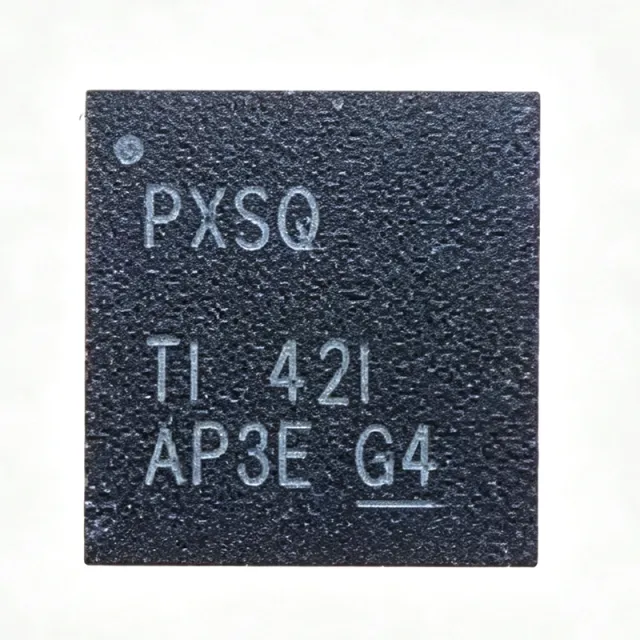
TPS7A4700RGWR - 36V 1A Ultralow-Noise LDO | Texas Instruments
The Texas Instruments TPS7A4700RGWR is a positive, ultralow-noise low-dropout (LDO) linear regulator sourcing up to 1A from a 3V to 36V input, housed in a 5x5 mm 20-pin VQFN (RGW) package with exposed thermal pad. An LDO is a type of linear voltage regulator that maintains a stable output even when the input-to-output differential is small. In the power-management IC hierarchy, an LDO typically follows a switching converter or battery to generate a clean analog rail for noise-sensitive loads such as op-amps, ADCs, and PLL/VCO blocks. Key features include 4.17 uVRMS output noise, high power supply rejection ratio (PSRR), and the unique ANY-OUT technique: the output voltage is user-programmable up to 20.5V via PCB layout connections without external feedback resistors or feed-forward capacitors, reducing component count and eliminating resistor thermal noise. Note this variant has no enable pin (choose TPS7A4701 for enable). Technically, the bipolar architecture with precision bandgap reference delivers high PSRR, suppressing switching-converter ripple and making the device an ideal post-regulator after a DC-DC stage. The absent external divider shortens the sense path, lowering the noise floor further. Typical applications include precision test and measurement instrumentation, RF transceiver PLL/VCO rails, audio DAC supplies, industrial 24V-bus sensor conditioning (36V rating provides headroom), and medical diagnostics. Design consideration: verify the PCB routing pattern that sets the output voltage, since this variant has no external adjust pin; use adequate copper pour under the exposed pad for thermal relief. As of 2026-08-29, the part is stocked at DigiKey and Mouser.
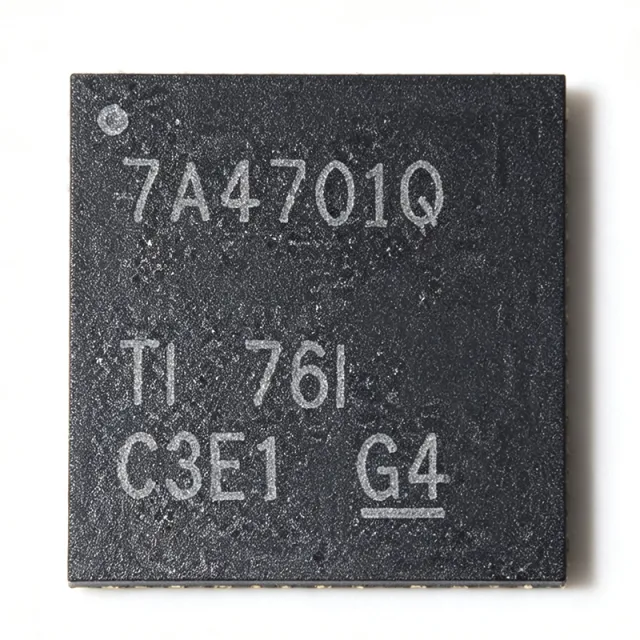
TPS7A4701QRGWRQ1 - 1A 35V Ultra-Low Noise LDO | TI Automotive
The Texas Instruments TPS7A4701QRGWRQ1 is an AEC-Q100 qualified, ultra-low-noise, high-PSRR LDO linear regulator delivering up to 1A output current in a 20-pin VQFN (5x5 mm) package with exposed pad. It accepts input voltages up to 35V and provides an adjustable output from 1.4V to 34V via external feedback resistors, or up to 20.5V with a user-programmable PCB layout. An LDO (low-dropout regulator) is a type of linear voltage regulator that maintains a stable output voltage even when the input is only slightly higher than the output. Within the power management IC hierarchy, the TPS7A47-Q1 sits at the precision post-regulation stage, typically cleaning up noisy switching-converter rails for sensitive analog loads. Key features include 4.2 uVRMS output noise (20 Hz to 100 kHz), very high PSRR that suppresses upstream DC-DC ripple, an enable pin for power sequencing, thermal shutdown, and bipolar process technology optimized for RF and analog performance. According to TI datasheet for TPS7A47-Q1, the device is designed primarily for noise-critical RF signal chains. Typical applications include automotive ADAS sensor power supplies, RF PLL/VCO rails, high-end audio DAC supplies, and precision data-converter reference rails. The 35V input tolerance supports automotive 12V and industrial 24V buses with load-dump headroom. Design consideration: at large VIN-VOUT deltas and 1A load, power dissipation is significant - ensure adequate PCB copper area on the exposed pad. Prices as of 2026-08-29.
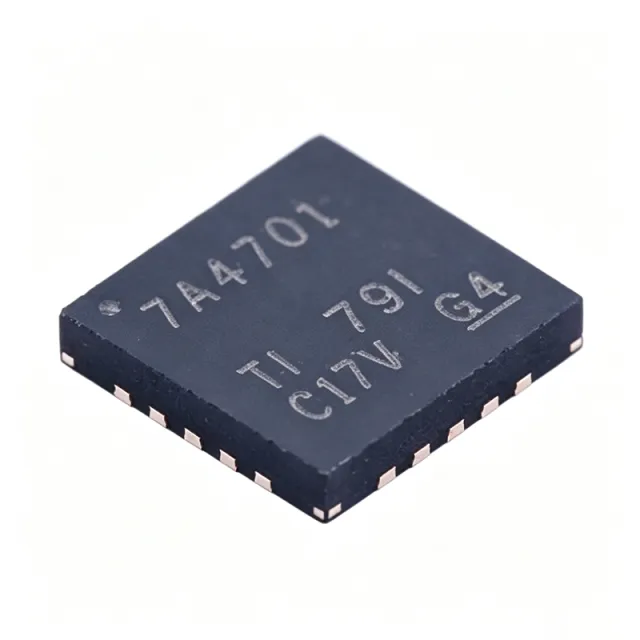
TPS7A4701RGWR - 1A, 35V Ultra-Low Noise LDO | Texas Instruments
The Texas Instruments TPS7A4701RGWR is an ultra-low-noise, high-PSRR LDO linear regulator delivering up to 1A output current in a 20-pin VQFN (RGW) package with exposed thermal pad. It features an adjustable output voltage range of 1.4V to 34V and supports input voltages from 3V to 35V. Key features include 4.17 uVrms output noise (20 Hz to 100 kHz), 72 dB PSRR at 1 kHz, and a low dropout voltage of 200 mV at full 1A load. The device also offers 6.4 mA quiescent current, an active-high enable pin for power sequencing, and thermal shutdown protection. The VQFN-20 package provides a thermal resistance of 31.4 C/W, enabling compact designs without external heatsinking at moderate power levels. The TPS7A4701 utilizes a bipolar architecture with a precision bandgap reference, achieving noise performance comparable to discrete reference designs while maintaining regulator simplicity. The high PSRR minimizes ripple from upstream switching converters, making it suitable for noise-sensitive analog and RF signal chains where clean power rails are critical. Typical applications include high-end audio DAC power supplies, PLL/VCO power rails in RF transceivers, precision ADC/DAC reference buffering, and test and measurement instrumentation. The wide input range also supports industrial 24V bus systems with adequate headroom. When designing with this device, ensure adequate input-to-output voltage headroom to maintain regulation under all load conditions. The enable pin allows sequential power-up in multi-rail systems, which is essential for processors requiring specific rail sequencing.
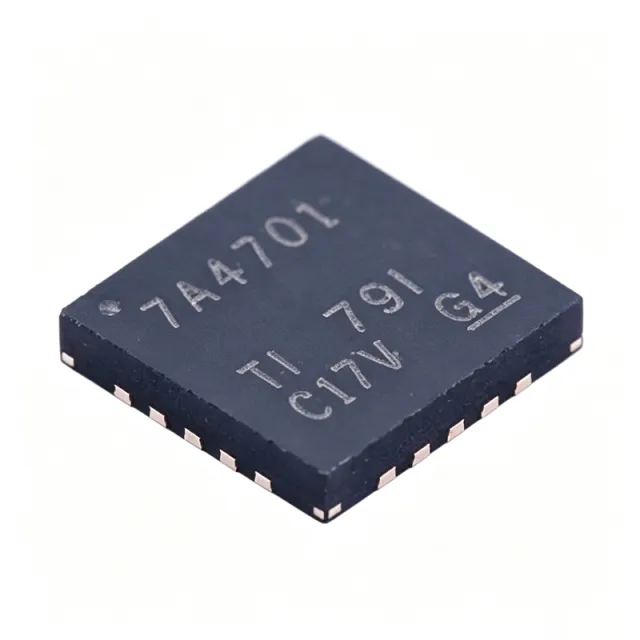
TPS7A4701RGWR - 1A, 36V Ultra-Low Noise LDO | Texas Instruments
The Texas Instruments TPS7A4701RGWR is a 1 A ultra-low-noise LDO linear regulator with 4.17 uVRMS output noise, a 3 V to 36 V input range, and an adjustable output from 1.4 V to 34 V, housed in a 20-pin VQFN (RGW) 5x5 mm package with exposed thermal pad. An LDO (low-dropout) linear regulator is a type of voltage regulator that maintains a stable output voltage even when the input voltage is only marginally higher than the output. Within the power management IC hierarchy, LDOs sit downstream of switching converters, providing the final, noise-free regulation stage that sensitive analog loads require. Unlike DC-DC converters, LDOs add no switching ripple, which is why they dominate RF, audio, and precision instrumentation power rails. Key features include 4.17 uVRMS output noise over the 20 Hz to 100 kHz bandwidth, 1 A output capability, and a low dropout voltage of approximately 307 mV, per the TI TPS7A47 datasheet. The TPS7A4701 variant offers an externally adjustable output via a feedback pin, while the sibling TPS7A4700 uses a PCB-programmable scheme requiring no external resistors. An enable pin supports power sequencing in multi-rail systems. The device is built on bipolar technology, chosen specifically for high-accuracy, high-precision instrumentation where clean rails maximize system performance. According to TI, the TPS7A47 family is optimized for powering operational amplifiers, ADCs, DACs, and other high-performance analog circuitry, where its high power-supply rejection suppresses upstream switching-converter ripple. Typical applications include RF PLL/VCO power supplies in transceivers, audio DAC/ADC analog rails, precision test-and-measurement instrumentation, and industrial systems running from 24 V buses where the 36 V input rating provides ample headroom. A key design consideration is thermal budget: at large input-to-output differentials and full 1 A load, dissipation can reach several watts, so the exposed pad must be soldered to a generous copper pour. The NR/SS capacitor also sets soft-start and noise-reduction bandwidth and should not be omitted. This page synthesizes distributor pricing (as of 2026-09-01), drop-in alternatives, and practical design notes not found in the manufacturer datasheet.

TPS7A5401RPST - 4A LDO Regulator, 1.1V VIN, 4.4µV Noise | Texas Instruments
The Texas Instruments TPS7A5401RPST is a 4-A, low-VIN (1.1-V), low-noise (4.4 µVRMS), high-accuracy, ultra-low-dropout (LDO) linear regulator in a 12-VQFN-HR (RPS, 2.2 mm x 2.5 mm) package with adjustable output from 0.8 V to 5.15 V. It sources up to 4 A with only 175 mV of maximum dropout, delivering high PSRR across the audio band and a tiny thermal footprint suited to dense multi-rail designs. An LDO (low-dropout linear regulator) is a type of voltage regulator that maintains a regulated output even when its input voltage approaches the output voltage with only minimal headroom (the dropout). LDOs sit inside the broader hierarchy of linear regulators, which in turn belong to the voltage regulator family and the wider power-management IC category. Unlike switching DC-DC converters, LDOs dissipate the difference between VIN and VOUT as heat but add no switching noise, making them ideal for post-regulation of switching rails or for powering noise-sensitive analog circuitry. Key specifications include 4.4 µVRMS output noise (10 Hz to 100 kHz), high PSRR of approximately 40 dB at 1 MHz, 4 A continuous output current, 175 mV maximum dropout at full load, and a sub-1.1 V minimum input voltage that allows direct operation from a 1.2 V or 1.8 V system rail without a preceding boost. Thermal resistance is engineered to support the 4 A load in a 2.2 x 2.5 mm outline when mounted with proper copper pours. Architecturally, the TPS7A54 uses TI's advanced bipolar process with a precision bandgap reference, soft-start, current limit, and thermal shutdown. The exposed die-pad package enables direct heat extraction from the silicon into the PCB copper, critical at 4 A. Combined with its wide 0.8 V to 5.15 V adjustable output range, the device targets high-current, low-noise point-of-load applications including FPGA core/SerDes rails, ASIC supplies, and precision data-acquisition power trees. Typical applications include powering noise-sensitive RF/SerDes blocks in networking line cards, FPGA and ASIC core rails in compact compute modules, high-current load-point regulation for test and measurement, and post-DCDC filtering for sensitive analog front ends in industrial and communications equipment. When designing with this LDO, prioritize a low-impedance PCB copper pour under the exposed pad and place input/output ceramics as close to the pins as possible. For VIN-to-VOUT headroom above ~0.5 V at 4 A, derate continuously or use airflow; the 12-VQFN-HR package is small but dissipation scales linearly with drop. This page synthesizes distributor pricing, drop-in alternatives, and practical design notes not found in the manufacturer datasheet itself, plus pinout, comparison table, and selection guidance for engineers evaluating the TPS7A5401RPST for production use.

TPS7A6333QPWPRQ1 - 300mA 40V Automotive LDO | Texas Instruments
The Texas Instruments TPS7A6333QPWPRQ1 is an automotive-grade low-dropout linear regulator (LDO) that delivers a fixed 3.3V output with up to 300mA of load current. It is engineered for off-battery applications, operating from a wide input voltage range up to 40V with 45V transient tolerance, making it ideal for harsh automotive electrical environments. A low-dropout regulator (LDO) is a linear voltage regulator that maintains a regulated output voltage even when the input supply is only slightly above the output. This category of voltage regulator sits within the power management IC hierarchy, providing clean, low-noise rails for sensitive loads. The TPS7A6333QPWPRQ1 features an ultra-low quiescent current of 35 µA (typical) at light loads and a sleep mode current of less than 2 µA when the enable pin is pulled low, reducing battery drain in always-on systems. Key features of this device include a 300mV dropout voltage at maximum output current, an integrated programmable window watchdog timer, and overcurrent protection. The LDO is stable with low-ESR ceramic output capacitors, simplifying external component selection and board layout. Its HTSSOP-14 (PWP) package with exposed pad provides good thermal performance, while the AEC-Q100 qualification ensures reliability in automotive environments. The TPS7A6333QPWPRQ1 is designed for off-battery supply rails in automotive ECUs, body control modules, and infotainment systems. The watchdog timer monitors the microcontroller and provides an independent reset mechanism, improving system reliability. The device also provides robust protection against overcurrent, safeguarding downstream loads. When using this LDO, designers must ensure sufficient input-output voltage headroom to maintain regulation under load transients. The enable pin allows power sequencing, and the watchdog output should be connected to the system reset line for proper fault monitoring. Consult the TI datasheet for detailed application circuits and layout guidelines.
TPS7A6633QDGNRQ1 - 150mA 40V Off-Battery LDO | Texas Instruments
The Texas Instruments TPS7A6633QDGNRQ1 is an automotive-grade, 150-mA, 40-V off-battery low-dropout (LDO) linear regulator that delivers a fixed 3.3V output from a 4V to 40V input range in an 8-pin HVSSOP (DGN) package with power-good indicator. It is qualified to the AEC-Q100 standard, drawing only 12 uA quiescent current at no load, making it well-suited for standby microcontroller power in automotive body and chassis ECUs. An LDO (Low-Dropout) linear regulator is a type of voltage regulator that maintains a stable output voltage even when the input voltage is very close to the output voltage. Within the broader taxonomy of voltage regulators, LDOs sit alongside switching regulators (buck/boost/buck-boost converters) as a sub-category of power management ICs (PMICs). Unlike a switching DC-DC converter, an LDO dissipates the VIN-VOUT difference as heat and therefore introduces no switching ripple, which is why off-battery automotive rails favor LDOs for noise-sensitive MCU cores and CAN transceivers. Key features of the TPS7A6633QDGNRQ1 include an integrated power-good (PG) open-drain output for MCU reset sequencing, short-circuit and over-current protection, thermal shutdown, and an input voltage tolerance that survives 45V load-dump transients. The HVSSOP-8 (DGN) PowerPAD package keeps thermal resistance low for sustained 150-mA loads in cramped under-hood layouts. The device uses a p-channel pass architecture with an internal bandgap reference, achieving tight output accuracy across the -40C to +125C automotive grade-1 temperature range. The reset delay on power-up (programmed by an external capacitor on the NR/SS pin) and the PG output combine to form a deterministic power-on sequence for the host MCU and CAN/LIN transceivers. Typical applications include always-on body-control modules, HVAC clusters, instrument-panel MCUs, RKE receivers, and lighting controllers where the part sits directly on the unswitched 12V battery rail. The wide VIN tolerance also suits industrial 24V PLC supplies with similar standby-power constraints. When designing with this part, place the input and output bulk capacitors as close to the IC as possible and use a low-ESR ceramic on the output to maintain loop stability; an input capacitor of at least 0.1 uF plus the recommended output capacitance is mandatory. Choose the PG pull-up to a logic-compatible rail (typically VOUT itself) so the host MCU sees a clean reset during crank and cold-start events. This page synthesizes distributor pricing, AEC-Q100 alternative coverage, and practical PCB layout notes not found in the manufacturer datasheet alone.
TPS7A6650QDGNRQ1 - 150mA 40V Off-Battery LDO | TI
The Texas Instruments TPS7A6650QDGNRQ1 is a 150-mA automotive-grade low-dropout (LDO) linear regulator accepting up to 40 V on the input and providing a fixed 5.0 V output, designed to operate directly from an automotive battery rail. It is offered in an 8-pin HVSSOP (PowerPAD MSOP, DGN) package with an exposed thermal pad that keeps junction temperatures low in standby-supply service. An LDO (Low-Dropout) linear regulator is a non-switching DC voltage regulator that maintains a tightly regulated output voltage even when the input-to-output differential voltage is small. As a member of the linear-regulator family, which itself belongs to the broader voltage-regulator and power-management IC hierarchy, the TPS7A6650-Q1 trades efficiency for noise cleanliness - it adds no switching ripple on its output, which is critical for keep-alive supplies that must not couple noise onto a vehicle's data network. Key specifications include an input voltage range of 4 V to 40 V (with 45-V transient survival), a 12-microampere quiescent current at no load, integrated short-circuit and overcurrent protection, a programmable power-good reset delay, and an operating junction temperature range of -40 °C to +125 °C. The part is qualified to AEC-Q100 grade 1 for automotive use, and is shipped in MSL-Level-3 packaging suitable for automotive production lines. The TPS7A6650-Q1 uses a bipolar pass architecture with a precision bandgap reference and an integrated power-good comparator, allowing the regulator to deliver a clean 5 V rail while signalling a valid output to a microcontroller through the PG pin. Reset delay is set by an external capacitor on the RESET_DELAY pin, eliminating the need for a separate supervisory IC. Typical applications include automotive standby microcontroller power (for body-control modules, instrument clusters, and remote keyless-entry receivers), off-battery always-on rails, CAN/LIN transceivers, and remote sensing modules that must survive load-dump transients on the vehicle bus. When designing with this regulator, route both input and output capacitors as close as possible to the IC pins and bond the exposed thermal pad to a copper pour of at least 1 square inch - the standby current is so low that thermal stress is normally a non-issue, but the high VIN margin means even brief short-to-battery events must be considered. This page synthesises distributor pricing, AEC-Q100 drop-in cross-references, and practical PCB layout notes that go beyond the manufacturer datasheet, giving automotive engineers a faster path to a robust keep-alive supply.

TPS7A7002DDA - 3A Low-VIN LDO Regulator w/ Enable | Texas Instruments
The Texas Instruments TPS7A7002DDA is a 3 A, low-VIN (1.4 V), adjustable ultra-low-dropout (LDO) linear voltage regulator with enable, supplied in an 8-pin SO PowerPad (HSOIC EP, DDA) package with an exposed thermal pad. The device operates from a single input rail as low as 1.425 V and delivers up to 3 A of continuous load current with a maximum dropout of 600 mV at full load (380 mV at 2 A). The output is adjustable from 0.5 V up to 5 V using an external resistor divider, allowing it to power FPGAs, DSPs, ASIC core rails, and point-of-load post-regulation from a noisy upstream DC-DC converter. An LDO (Low-Dropout) linear regulator is a type of voltage regulator that maintains a stable output voltage even when the input voltage is only marginally higher than the output. In the broader power-management hierarchy, an LDO sits beneath switching regulators: a switcher first steps down the bus voltage with high efficiency, then an LDO cleans the residual ripple and provides a low-noise rail. This two-stage architecture is now standard for powering noise-sensitive analog, RF, and digital load circuits from intermediate bus voltages such as 3.3 V or 5 V. Key features of the TPS7A7002 include 1 uA ground current in shutdown for battery-powered applications, current-limit and thermal-shutdown protection, an active-high EN pin for power sequencing, and a stable output with low-ESR ceramic output capacitors. The dropout voltage at 2 A is only 380 mV maximum, and at 3 A is limited to 600 mV maximum, allowing the regulator to hold regulation in headroom-constrained designs where VIN approaches VOUT. The HSOP-8 PowerPad package provides a low thermal-resistance path, dissipating up to several watts continuously without external heatsinking. The TPS7A7002 uses a PNP pass architecture that achieves very low dropout and excellent transient response when paired with ceramic output capacitors. The internal reference, soft-start, and current-limit blocks are designed for stable operation across the full -40 C to +125 C junction temperature range. The adjust pin allows the output to be programmed anywhere from 0.5 V to 5 V by R1/R2 feedback network, while the EN pin can be used for power sequencing across multiple rails. Typical applications include powering FPGA core and I/O rails, ASIC and DSP core supplies, post-regulation after a switching converter, low-voltage distributed power architectures in telecom and networking equipment, and any application that requires a high-current, low-noise point-of-load rail from a 1.5 V, 1.8 V, 2.5 V, 3.3 V, or 5 V intermediate bus. When designing with this device, ensure that the PCB copper area under the exposed pad is sufficient to keep the junction temperature within the safe operating area under worst-case load. Use 1% feedback resistors and a 10 uF or larger low-ESR ceramic output capacitor placed as close to the VOUT pin as possible; a feedforward capacitor across the top feedback resistor improves noise and transient performance.

TPS7A7200RGWR - 2A, 6.5V Ultra-LDO with PG/EN | Texas Instruments
The Texas Instruments TPS7A7200RGWR is a 2-A, ultra-low-dropout (LDO) linear regulator housed in a 20-pin VQFN (RGW) 5x5 mm package with exposed thermal pad, featuring user-configurable output voltage from 0.9 V to 3.5 V, an integrated power-good (PG) indicator, and an active-high enable (EN) pin. It accepts an input voltage from 1.5 V to 6.5 V and exhibits only 180 mV dropout at the full 2 A load, while supporting 1.43 V minimum VIN operation. Per the TI datasheet SBVS203A, the part delivers very fast load-transient response, making it suitable for powering low-voltage digital cores directly from 1.5 V rails. An LDO (Low-Dropout) linear regulator is a type of voltage regulator that maintains a stable output voltage even when the input voltage is very close to the output voltage, contrasting with switching regulators that use inductors and PWM control. LDOs belong to the linear regulator family, which sits under the voltage regulator hierarchy, which in turn belongs to the broader power management IC category. The TPS7A7200RGWR specifically targets high-current, low-voltage point-of-load (POL) conversion applications where a switching regulator's ripple would be unacceptable, trading efficiency for noise-free output and minimal BOM count. Key differentiating features of the TPS7A7200RGWR include 180 mV dropout at 2 A (one of the lowest in its class), user-configurable output voltage from 0.9 V to 3.5 V without external feedback resistors (eliminating the error and drift these would introduce), integrated open-drain PG output for rail sequencing and fault monitoring, and active-high EN for on/off management. The device also features internal soft-start to limit inrush current, thermal shutdown, and current-limit protection. The VQFN-20 (RGW) package provides a low thermal resistance path that helps dissipate the heat generated when VIN-VOUT differential is large. Technically, the TPS7A7200RGWR uses an internal P-channel pass element architecture (PMOS LDO), which is why its dropout is so low - PMOS LDO dropout is roughly RDS(on) x ILoad rather than Vth-limited like an NPN or N-channel LDO. The 0.9 V to 3.5 V output range is set via factory-configurable pin straps, meaning no external resistor divider is needed, and the output tolerance is tightened by avoiding external resistor drift over temperature. Typical applications include powering FPGAs, DSPs, ASICs, and microcontrollers from 1.5 V, 1.8 V, 2.5 V, 3.3 V or 3.5 V rails, post-regulation after a switching DC-DC converter to clean up switching noise, and powering sensitive analog/RF blocks that demand low ripple. The fast transient response makes it ideal for digital loads with rapid current steps. When using this device, ensure the input-to-output voltage differential remains within SOA limits to avoid excessive power dissipation, especially at 2 A full load - use adequate copper pours on the exposed pad.
TPS7A78 - 120mA Smart Cap-Drop LDO | Texas Instruments
The Texas Instruments TPS7A78 is a 120-mA, smart, capacitance-drop (cap-drop), low-dropout (LDO) linear voltage regulator designed for non-isolated AC/DC conversion. It uses an external high-voltage capacitor (CS) and an internally controlled active bridge rectifier to create a regulated DC output voltage from an AC mains input, eliminating the need for bulky magnetic transformers. This innovative architecture enables compact, low-cost, and highly efficient power supplies for low-power applications. A capacitance-drop regulator is a type of AC/DC converter that uses a capacitor to drop the AC voltage before rectification and regulation. Unlike traditional transformer-based supplies, it is non-isolated and relies on a series capacitor to limit current, making it lightweight and cost-effective. The TPS7A78 belongs to the family of linear voltage regulators, specifically smart LDOs that integrate active rectification and clamping to improve efficiency and standby power. Key features include a wide input voltage range of 85VAC to 265VAC, a fixed output voltage of 3.3V or 5V, and a maximum output current of 120mA. The device achieves high efficiency by actively clamping the rectified voltage, reducing power dissipation. It also features low quiescent current, thermal shutdown, and overcurrent protection, ensuring robust operation in harsh environments. The TPS7A78 is available in a 14-pin HTSSOP (PWP) package, which provides excellent thermal performance and a compact footprint. Technically, the TPS7A78 integrates a full-wave bridge rectifier using internal MOSFETs, which are controlled to minimize voltage drop and power loss. The external cap-drop capacitor (CS) is selected based on the desired output current and input voltage, allowing designers to optimize the trade-off between size and performance. The device also includes an internal clamp that limits the rectified voltage to a safe level, protecting downstream circuitry from overvoltage conditions. Typical applications include smart meters, home automation, IoT devices, LED lighting, and other low-power appliances that require a compact, non-isolated power supply. The TPS7A78 is particularly suited for applications where space is limited and where magnetic components are undesirable due to cost or EMI concerns. Its high efficiency and low standby power make it ideal for always-on devices that need to meet stringent energy regulations. When designing with the TPS7A78, it is critical to select the appropriate cap-drop capacitor (CS) value and voltage rating based on the input voltage and load current. Additionally, proper PCB layout is essential to minimize parasitic inductance and ensure stable operation. The device's thermal performance should be evaluated under worst-case conditions, and adequate copper area should be provided for heat dissipation.

TPS7A8001DRBT - 1A LDO, 6V Adjustable, Low-Noise SON-8 | TI
The Texas Instruments TPS7A8001DRBT is a low-noise, wide-bandwidth, high-PSRR, low-dropout 1-A linear regulator (LDO) housed in an 8-pin SON (DRB) package measuring 3 mm x 3 mm. It accepts an input voltage range of 2.2 V to 6.5 V and delivers an adjustable output from 0.8 V to 6.0 V at up to 1 A of continuous load current, while exhibiting a low dropout of approximately 170 mV at 1 A. An LDO (low-dropout) linear regulator is a type of voltage regulator that maintains a stable output voltage even when the input voltage is very close to the output voltage. As a member of the broader linear regulator family, it falls within the voltage regulator category and ultimately the power management IC hierarchy used in modern electronic systems. Unlike switching regulators, LDOs do not introduce switching noise into the rail, which is the primary reason they are preferred for noise-sensitive analog and RF signal chains. Key specifications include 32 uVrms output noise (0.1 Hz to 100 kHz), 63 dB PSRR at 1 kHz, and 60 dB PSRR at 1 MHz, achieved through an advanced BiCMOS process and a PMOSFET pass element. The device also provides an active-high enable (EN) input for sequenced power-up, internal soft-start, current limit, and thermal-shutdown protection. The exposed thermal pad on the DRB package keeps junction-to-ambient thermal resistance low for high-current operation. The TPS7A80 architecture combines a precision bandgap reference with a high-gain error amplifier driving the PMOS pass device. This topology minimizes load-transient overshoot while maintaining high DC accuracy, making the regulator well suited as a post-regulator stage following a noisy switching converter. Typical applications include powering RF transceivers and PLLs in wireless infrastructure, FPGA and DSP core rails in industrial embedded systems, noise-sensitive ADC and DAC reference supplies, and portable/battery-powered electronics where low quiescent current and high efficiency at light loads extend battery runtime. When designing with the TPS7A8001DRBT, ensure that the input-to-output differential does not exceed 6.5 V at any time, use a minimum 2.2 uF ceramic input capacitor for stability, and provide adequate PCB copper area beneath the exposed pad to manage up to 1 A continuous dissipation. This page synthesizes distributor pricing, drop-in alternatives, and practical design notes not found on individual distributor listings, providing engineers a single, citable reference for evaluation and sourcing.
TPS7A8300RGRR - 2A Low-Noise LDO, 6uVRMS | Texas Instruments
The Texas Instruments TPS7A8300RGRR is a low-noise (6 uVRMS), low-VIN, ultra-low-dropout voltage regulator (LDO) capable of sourcing a 2-A load with only 125 mV of maximum dropout. It provides a user-programmable output from 0.8V to 5V and is packaged in a 20-pin VQFN (3.5x3.5 mm) with exposed thermal pad. An LDO (Low-Dropout) linear regulator is a voltage regulator that maintains a stable output even when the input voltage is very close to the output voltage. It is a subclass of linear regulators within the broader voltage regulator and power management IC hierarchy, essential for noise-sensitive circuits where switching regulators introduce unacceptable ripple and EMI. Key features include the 6 uVRMS output noise (10 Hz to 100 kHz), the ANY-OUT architecture that lets the output voltage be programmed via PCB pin connections up to 3.95V without external resistors, and a power-good (PG) output. Enable and soft-start functions are integrated, along with overcurrent and thermal shutdown protection. Dropout of only 125 mV at 2 A enables high-efficiency, low-headroom designs. Architecturally, the TPS7A8300 uses a PMOS pass element with a precision reference. Its low-VIN capability and ceramic-capacitor stability simplify BOM and layout. Excellent line/load regulation and high PSRR make it well suited to post-regulation of switching converter rails. Typical applications include RF transceiver and PLL power rails, audio DAC/ADC supplies, FPGA and processor core voltages, and precision analog front-ends in industrial and communications equipment. Design tip: solder the exposed pad to a substantial copper pour for thermal dissipation, configure the ANY-OUT sense pins correctly for the target voltage, and provide 10 uF ceramic output capacitance for stability.
TPS7A84 - 3A Low-Noise High-Accuracy LDO | Texas Instruments
The Texas Instruments TPS7A84 is a high-current, low-noise, low-dropout linear regulator (LDO) capable of sourcing 3 A with a maximum dropout voltage of only 180 mV. It is designed to power noise-sensitive components in high-speed communications, video, medical, and test and measurement applications. The device operates from an input of 1.4 V to 6.5 V without BIAS, and 1.1 V to 6.5 V with BIAS, with output pin-programmable from 0.8 V to 3.95 V or adjustable from 0.8 V to 5.0 V. An LDO (low-dropout) linear regulator is a voltage regulator that maintains a stable output even when input voltage is very close to the output. As a subclass of linear regulators, LDOs use a pass transistor in its linear region and are essential power management ICs, providing clean, low-noise rails for sensitive analog and digital loads. Hierarchy: LDO -> linear regulator -> voltage regulator -> power management IC. Key features include 3 A output current, 180 mV maximum dropout, 4.4 uVRMS output noise (0.8 V output) and 7.7 uVRMS at 5.0 V output, and 1% maximum output accuracy over line, load, and temperature. High PSRR rejects upstream switching-converter ripple, and pin-programmable output voltages eliminate external feedback resistors. The BIAS pin enables operation from inputs as low as 1.1 V. Internally, a precision bandgap reference and low-noise architecture deliver the accuracy and noise performance. Current limit and thermal shutdown protect against faults, while the exposed thermal pad of the 20-pin VQFN (RGR) package supports full 3 A delivery with proper PCB layout. Junction temperature range is -40C to +125C. Typical applications include powering FPGAs, DSPs, ASICs, SerDes, PLLs, VCOs, and high-speed ADCs/DACs in communications, video processing, medical imaging, and test equipment. Low noise limits power-supply-generated phase noise and clock jitter. Design tip: ensure adequate input-output headroom, use low-ESR ceramic capacitors, connect BIAS to a higher rail to reduce dropout, and manage thermals at high current and large dropout voltages.
TPS7A8400RGRR - 3A Low-VIN Ultra-Low Noise LDO | Texas Instruments
The Texas Instruments TPS7A8400RGRR is a 3-A, low-VIN, low-noise, ultra-low-dropout (LDO) linear regulator with power-good indication and high accuracy, supplied in a 20-pin VQFN (RGR) package measuring 3.5 mm × 3.5 mm. It delivers up to 3 A of continuous output current with only 180 mV of maximum dropout, while output noise is held to 4.4 µVRMS at 0.8-V output and 7.7 µVRMS at 5.0-V output. The device features 1% (max) accuracy over line, load, and temperature, and supports both pin-programmable (0.8 V to 3.95 V) and adjustable (0.8 V to 5.0 V) output configurations via an external resistor divider. An LDO (Low-Dropout) linear regulator is a type of voltage regulator that maintains a stable output voltage even when the input voltage is very close to the output voltage. Unlike switching regulators, LDOs add no switching noise to the output, making them ideal for powering noise-sensitive analog and RF blocks. Architecturally, LDOs sit between bulk DC-DC converters and downstream sensitive ICs in the power-tree hierarchy: switching regulator → LDO → analog/RF load. The TPS7A84 family is engineered specifically for high-current, low-noise analog rails where both high PSRR and high output current are simultaneously required. Key differentiating features include an input voltage range of 1.4 V to 6.5 V (without BIAS) and a higher range with BIAS, an integrated open-drain power-good (PG) output for sequencing and fault monitoring, and a programmable soft-start (SS) pin for inrush-current control. The high PSRR effectively attenuates residual ripple from upstream switching converters, which is critical in multi-rail systems where switching noise would otherwise couple into precision analog paths. Architecturally, the TPS7A8400 uses a precision bandgap reference and an advanced NMOS pass element that achieves both low dropout and high current. This combination enables point-of-load regulation for high-speed serializers/deserializers, RF transceivers, and FPGA core rails, where each load requires an isolated, low-noise supply. The high PSRR over a wide frequency range keeps supply-ripple-induced deterministic jitter low on clock and data paths. Typical applications include powering FPGAs, ASICs, DSPs, high-speed ADCs/DACs, and RF transceivers in telecom, industrial, and test-and-measurement equipment. The wide output range supports both sub-1V core voltages for advanced CMOS devices and standard 3.3 V/5 V analog rails. When designing in this part, place input and output ceramic capacitors as close as possible to the IC pins and follow TI's recommended capacitor types. The exposed thermal pad must be soldered to a sufficient copper pour to keep junction temperature within limits at 3-A continuous load.
TPS7A9201DSKT - 2A Low-Noise High-PSRR LDO | Texas Instruments
The Texas Instruments TPS7A9201DSKT is a 2-A low-noise, high-PSRR, adjustable ultra-low-dropout (LDO) linear regulator housed in a 10-pin WSON package (DSK, 2.5x2.5 mm). Key headline parameters include a maximum output current of 2 A, output noise of 4.6 µVRMS, and a maximum dropout voltage of 180 mV at full load. An LDO (Low-Dropout) linear regulator is a DC voltage regulator that maintains a stable output voltage even when the input voltage approaches the output voltage (small VIN-VOUT headroom). LDOs are a subclass of linear regulators, which in turn fall under voltage regulators within the broader power management IC (PMIC) hierarchy. Unlike switching converters, an LDO dissipates the difference between input and output power as heat, so its efficiency is VOUT/VIN, but it adds no switching noise to the output - making it ideal for noise-sensitive analog and RF rails. The TPS7A9201DSKT accepts an input voltage from 1.4 V to 6.5 V and produces an adjustable output from 0.8 V to 5.2 V set by external resistors. It delivers 4.6 µVRMS output noise (20 Hz-100 kHz), high PSRR, and 1% output voltage accuracy over line, load, and temperature. Internal soft-start and current-limit features reduce inrush stress and protect the device during output short events. The regulator uses a PMOS pass-element architecture with a precision bandgap reference, achieving low-noise performance suitable for RF, audio, and high-speed data-converter applications. The exposed thermal pad (DSK package) keeps junction temperature rise manageable at 2-A loads. Typical applications include powering FPGA and ASIC core rails, RF transceiver VCO/PLL supplies, high-speed ADC and DAC reference rails, audio codec power, and post-regulation following a switching converter in point-of-load designs. When designing with this part, place the input and output ceramic capacitors as close as possible to the IC pins and lay out a copper pour under the exposed pad for thermal relief. Verify that the worst-case VIN-VOUT dropout stays below 180 mV at the expected minimum load. This page synthesizes distributor pricing, drop-in alternatives, and practical design notes not found in the manufacturer datasheet, giving engineers a single reference for TPS7A9201DSKT selection.
TPS7B6933DBVR - 150mA, 40V LDO Regulator, 3.3V Fixed | TI
The Texas Instruments TPS7B6933DBVR is a 150-mA, 40-V low-dropout linear regulator in a 5-pin SOT-23 (DBV) package that delivers a fixed 3.3 V output from a 4 V to 40 V wide input range (with up to 45 V transient tolerance). It features 15 µA typical quiescent current at light loads and 25 µA maximum across full temperature, integrated short-circuit and overcurrent protection, and 450 mV typical dropout at full load. A low-dropout (LDO) linear regulator is a type of voltage regulator that maintains a stable output voltage even when the input voltage drops very close to the output voltage. The TPS7B6933DBVR belongs to the broader hierarchy of linear regulator -> voltage regulator -> power management IC -> semiconductor. The low-Iq advantage places it in the always-on regulator family used to bias standby microcontrollers and metrology sub-systems without draining batteries or violating standby power budgets. Key features include the wide 4 V to 40 V continuous input window with 45 V transient survivability, a 450-mV dropout at 150 mA, an internal current limit with thermal shutdown, and only 15 µA typical Iq. The SOT-23-5 footprint and 5 µA-grade quiescent current make it suited to compact, thermally constrained boards that need to survive harsh automotive transients and industrial surge events. The device uses a PNP-pass architecture followed by a precision bandgap reference and an error amplifier that drives the pass element to regulate VOUT. With 15 µA Iq at light loads, internal compensation is employed to reduce external parts; an output capacitor of at least 1 µF with ESR between 0.25 Ω and 5 Ω is required for stability per the manufacturer datasheet. Typical applications include standby rails in e-meters, fire and smoke alarm sensors, automotive body-control modules, and industrial PLC logic supplies. The 40 V input window also makes it attractive as a post-switching-rail cleanup LDO for 24 V industrial buses. When designing, ensure VIN - VOUT headroom and dissipation are budgeted. At 24 V input, 3.3 V output, and 100 mA load, the device dissipates about 2.07 W - a SOT-23-5 will require copper-pour heatsinking. This page integrates verified distributor pricing, drop-in alternatives (same-package, parametrically validated), and practical PCB/thermal design notes not found in the standalone manufacturer datasheet.

TPS7B6933QDCYRQ1 - 40V 150mA LDO Regulator, 3.3V Fixed | TI
The Texas Instruments TPS7B6933QDCYRQ1 is a high-voltage, ultra-low-quiescent-current, automotive-grade LDO linear regulator delivering a fixed 3.3 V output at up to 150 mA from a 4 V to 40 V input rail, housed in a 4-pin SOT-223 (DCY) package with tab. It is qualified to AEC-Q100 Grade 1 (-40°C to +125°C), making it well suited for always-on automotive body and powernet subsystems. An LDO (Low-Dropout) linear regulator is a type of voltage regulator that maintains a stable output voltage even when the input voltage is only slightly higher than the output. LDOs sit within the broader linear-regulator family, which is itself a subset of voltage regulators and power-management ICs. They are favored for low-noise, low-Iq rails because, unlike switching converters, they introduce no switching ripple into sensitive analog or microcontroller supply domains. Key features include 15 µA typical quiescent current at light load, integrated short-circuit and overcurrent protection, thermal shutdown, and an extremely wide 4 V to 40 V input operating range that tolerates load-dump and cold-crank transients on 12 V automotive buses. The SOT-223 (DCY) package with exposed tab provides a low thermal resistance path, allowing the regulator to sustain 150 mA continuous load across the full automotive temperature range. Architecturally, the TPS7B6933QDCYRQ1 uses a precision bandgap reference and a PNP pass element topology that achieves very low dropout and ultra-low Iq at light loads. The wide Vin window eliminates the need for a pre-regulator on 12 V or 24 V buses, simplifying BOM and saving PCB space in ECU modules. Typical applications include automotive body control modules, ECU keep-alive supplies, sensor power rails, infotainment standby rails, and industrial 24 V loop-powered instruments. The fixed 3.3 V option is ideal for directly powering MCUs, CAN transceivers, and LIN slaves without additional regulation stages. When designing with this device, place a 1 µF or larger ceramic input capacitor close to VIN, and a 2.2 µF or larger low-ESR ceramic output capacitor close to VOUT. Verify that worst-case dropout at 150 mA still keeps VIN above VOUT + Vdo across all transient conditions, and use the tab copper pour to keep junction temperature within limits. This page synthesizes distributor pricing, AEC-Q100 drop-in alternatives, application circuit guidance, and practical design notes not consolidated on any single manufacturer or distributor page.
TPS7B6950QDBVRQ1 - 40V 150mA Ultra-Low IQ LDO | Texas Instruments
The Texas Instruments TPS7B6950QDBVRQ1 is a 40-V, 150-mA, ultra-low quiescent-current, low-dropout (LDO) linear regulator in a 5-pin SOT-23 (DBV) package, AEC-Q100 qualified for automotive applications. It operates over a 4 V to 40 V input range and delivers a fixed 5 V output with 450 mV typical dropout at 100 mA, making it ideal for off-battery and always-on automotive rails. Quiescent current is only 15 uA typical at light load, allowing standby microcontrollers and CAN transceivers to remain powered through ignition-off conditions. An LDO (Low-Dropout) linear regulator is a type of voltage regulator that maintains a stable output voltage even when the input voltage is only slightly higher than the output. Within the broader taxonomy, an LDO is a linear regulator, which is a subset of voltage regulators, which in turn fall under power management integrated circuits (PMICs). LDOs are favored over switching regulators in noise-sensitive applications because they introduce no switching ripple and require minimal external components. Key features of the TPS7B6950QDBVRQ1 include 15 uA typical quiescent current, integrated short-circuit and overcurrent protection, thermal shutdown, input undervoltage lockout (UVLO), and an enable pin for power sequencing. The device offers 60 dB PSRR at 100 Hz and operates across a -40 C to +125 C ambient temperature range, with a maximum junction temperature of 150 C. The SOT-23-5 footprint occupies roughly 6 mm^2 of PCB area and exposes a thermal pad via the GND pin for board-level heat spreading. Architecturally, the TPS7B6950QDBVRQ1 uses a high-side PNP pass element combined with a precision bandgap reference, allowing the part to regulate with very low dropout and tolerate the harsh automotive transient environment (load dump up to 40 V). The ultra-low IQ design keeps battery drain to a minimum during key-off, a critical parameter for parking-monitoring telematic control units and e-meters. Typical applications include automotive body-control modules, infotainment standby rails, e-meter and smart-sensor always-on supplies, and industrial PLC backup-power circuits. The wide 4 V to 40 V input range also suits 24 V industrial sensor backbones and fire/smoke detector standby rails. When designing with this device, place a 1 uF ceramic input capacitor and a 1 uF to 10 uF ceramic output capacitor as close as possible to the IC pins to ensure stability and transient response. A bulk aluminum-polymer capacitor on the input further suppresses load-dump transients on long automotive wiring harnesses. This page consolidates distributor pricing, drop-in same-package alternatives, and practical design notes that go beyond the manufacturer datasheet to help engineers select and qualify the right LDO.