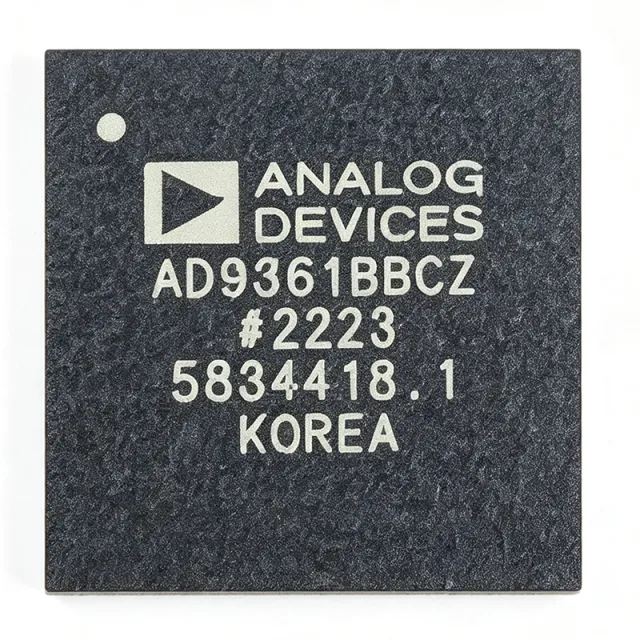
AD9361BBCZ-REEL - 70MHz-6GHz RF Agile Transceiver | Analog Devices
Teilenummer: AD9361BBCZ-REEL ✓ Aktiv| Menge | Stückpreis | Gesamt |
|---|---|---|
| 1 | $89.5 | $89,50 |
| 10 | $82.3 | $823,00 |
| 100 | $74.1 | $7.410,00 |
| 500 | $66.9 | $33.450,00 |
| 1.000 | $59.7 | $59.700,00 |
AD9361BBCZ-REEL Übersicht
An RF transceiver is a device that combines both a transmitter and a receiver, sharing common circuitry. The AD9361 is an agile transceiver, meaning it can be dynamically reconfigured to support different frequency bands, channel bandwidths, and modulation schemes. This flexibility makes it a key component in software-defined radio (SDR) systems, where the same hardware can adapt to various communication standards without redesign. The AD9361 sits at the heart of the RF front-end, bridging the antenna and the digital baseband processor, and is essential for modern wireless infrastructure.
Key features include a frequency range of 70 MHz to 6 GHz, support for channel bandwidths from less than 200 kHz to 56 MHz, and a highly linear receiver with noise figure as low as 2 dB. The transmitter offers excellent error vector magnitude (EVM) performance, enabling high-order modulation schemes. The device also includes integrated fractional-N synthesizers, digital filters, and automatic gain control (AGC), reducing external component count and simplifying design.
Technically, the AD9361 employs a direct conversion architecture with advanced calibration algorithms to mitigate I/Q imbalance and DC offset. It supports both FDD and TDD modes, and its programmable interface allows seamless integration with various baseband processors. The device operates from a 1.3V core supply and includes multiple power-down modes for efficient power management.
Typical applications include 3G/4G base stations, small cells, software-defined radios, military communications, and test and measurement equipment. Its wide frequency range and programmability make it suitable for multi-band, multi-standard radio platforms.
When designing with the AD9361, careful attention must be paid to power supply decoupling and PCB layout to achieve optimal RF performance. The device requires a clean 1.3V supply and proper grounding to minimize noise and interference.
Drop-in-Alternativen für AD9361BBCZ-REEL – gleiches Gehäuse, Pin-kompatibel. Bauteile mit anderem Gehäuse, die eine PCB-Überarbeitung erfordern, sind ausgeschlossen.
Varianten dieser Serie
Modelle derselben Serie, die drop-in-kompatibel sind mit AD9361BBCZ-REEL (gleiche Bauform und Footprint) – abweichend in Frequency Range, Integrated Synthesizers, Package.
Schnellvergleichstool – Wählen Sie Alternativbauteile für den Direktvergleich:
AD9361BBCZ
✓ Auf Lager
$62 / Stück
Datenblatt ansehen →AD9364BBCZ-REEL
✓ Auf Lager
$59.9 / Stück
Datenblatt ansehen →AD9371BBCZ-REEL
✓ Auf Lager
$147 / Stück
Datenblatt ansehen →AD9363BBCZ
📋 Referenzalternative (nicht im Katalog)
GX9361
📋 Referenzalternative (nicht im Katalog)
AD9361BBCZ-REEL Technische Daten
| Frequency Range | 70 MHz to 6 GHz |
| Number of Channels | 2x2 (2 TX, 2 RX) |
| Channel Bandwidth | Less than 200 kHz to 56 MHz |
| Noise Figure | 2 dB (typical) |
| Digital Interface | 12-bit CMOS/LVDS |
| Core Supply Voltage | 1.3 V |
| Gehäuse | 144-ball CSPBGA (10 mm x 10 mm) |
| Montageart | Surface Mount |
| Betriebstemperaturbereich | -40°C to +85°C |
| Modulation Support | FDD and TDD |
| Integrated Synthesizers | Fractional-N |
| Automatic Gain Control | Yes |
| Digital Filters | Yes |
| Power-Down Modes | Multiple |
| RoHS-Status | Compliant |
AD9361BBCZ-REEL Pin-Konfiguration
| Pin A1 | VSSA — Analog ground |
| Pin A2 | VSSA — Analog ground |
| Pin A3 | RX1A_P — Receiver 1 positive RF input |
| Pin A4 | RX1A_N — Receiver 1 negative RF input |
| Pin A5 | VSSA — Analog ground |
| Pin A6 | RX2A_P — Receiver 2 positive RF input |
| Pin A7 | RX2A_N — Receiver 2 negative RF input |
| Pin A8 | VSSA — Analog ground |
| Pin A9 | TX1A_P — Transmitter 1 positive RF output |
| Pin A10 | TX1A_N — Transmitter 1 negative RF output |
| Pin A11 | VSSA — Analog ground |
| Pin A12 | TX2A_P — Transmitter 2 positive RF output |
| Pin A13 | TX2A_N — Transmitter 2 negative RF output |
| Pin A14 | VSSA — Analog ground |
Typische Anwendungen
AD9361BBCZ-REEL ist geeignet für 6 Anwendungs: 3G/4G Base Stations, Software-Defined Radio (SDR), Small Cells, Military Communications, Test and Measurement Equipment, IoT and Smart Grid.
3G/4G Base Stations
The AD9361BBCZ-REEL is designed for 3G and 4G base station applications, providing a highly integrated 2x2 transceiver solution. Its frequency range of 70 MHz to 6 GHz covers all cellular bands, and its support for channel bandwidths up to 56 MHz enables high-capacity LTE and WCDMA deployments. The device's programmability allows dynamic reconfiguration for different standards, reducing hardware complexity and time-to-market. Its low noise figure of 2 dB ensures excellent receiver sensitivity, while the integrated synthesizers and AGC simplify the RF front-end design. This makes the AD9361 ideal for macro, micro, and pico base stations where performance and flexibility are critical.
Empfohlen
Software-Defined Radio (SDR)
The AD9361BBCZ-REEL is a cornerstone of software-defined radio systems, offering a wide frequency range and reconfigurable architecture. Its ability to support multiple modulation schemes and channel bandwidths makes it ideal for cognitive radio, spectrum monitoring, and amateur radio applications. The 12-bit CMOS/LVDS interface connects directly to FPGAs or baseband processors, enabling rapid prototyping and flexible waveform development. The device's integrated calibration algorithms ensure consistent performance across temperature and frequency, which is essential for reliable SDR operation. Its compact 144-ball CSPBGA package allows for dense integration in portable SDR platforms, making it a preferred choice for both commercial and military SDR designs.
Empfohlen
Small Cells
The AD9361BBCZ-REEL is well-suited for small cell deployments, including femtocells, picocells, and microcells. Its high level of integration reduces the bill of materials and PCB area, which is critical for space-constrained small cell designs. The device supports both FDD and TDD modes, allowing flexibility in spectrum allocation. Its low power consumption and multiple power-down modes help meet strict energy efficiency requirements. The wide frequency range covers all LTE and 5G sub-6 GHz bands, making it a future-proof choice for evolving small cell standards. The integrated AGC and digital filters simplify the baseband interface, reducing development effort and accelerating time-to-market for small cell products.
Empfohlen
Military Communications
The AD9361BBCZ-REEL is used in military communications systems, including tactical radios, electronic warfare, and satellite communications. Its wide frequency range from 70 MHz to 6 GHz covers many military bands, and its agile reconfigurability supports frequency hopping and adaptive waveforms. The device's high linearity and low noise figure ensure robust performance in challenging electromagnetic environments. The 144-ball CSPBGA package is rugged and suitable for harsh operating conditions. The integrated calibration and self-test features enhance reliability and reduce maintenance. Its support for both FDD and TDD modes provides flexibility for various military communication protocols, making it a versatile choice for defense applications.
Empfohlen
Test and Measurement Equipment
The AD9361BBCZ-REEL is ideal for test and measurement equipment such as spectrum analyzers, signal generators, and channel emulators. Its wide frequency range and programmable bandwidth allow it to cover a broad range of test scenarios. The device's high dynamic range and low noise figure enable accurate signal analysis. The 12-bit digital interface provides high-resolution data for precise measurements. The integrated synthesizers and AGC simplify the RF front-end, reducing design complexity and cost. The device's ability to operate in both FDD and TDD modes makes it suitable for testing various wireless standards. Its compact package and low power consumption are advantageous for portable test instruments.
Empfohlen
IoT and Smart Grid
The AD9361BBCZ-REEL can be used in IoT and smart grid applications that require reliable wireless connectivity over a wide frequency range. Its support for sub-GHz bands and 2.4 GHz ISM band makes it suitable for various IoT protocols such as LoRa, Zigbee, and Wi-Fi. The device's low power consumption and power-down modes are essential for battery-powered IoT devices. The integrated AGC and digital filters simplify the baseband processing, reducing the load on low-power microcontrollers. The wide frequency range allows a single hardware platform to support multiple regional IoT bands, reducing inventory and development costs. Its compact package is ideal for space-constrained IoT modules.
Empfohlen
Zusammenfassung der empfohlenen Produkte
Technische Referenzdaten für AD9361BBCZ-REEL – Vergleich, Designhinweise und Compliance-Informationen.
Auswahlhilfe
Vergleich mit Alternativen
| Parameter | Dieses Produkt | AD9361BBCZ | AD9364BBCZ-REEL | AD9363BBCZ | GX9361 |
|---|---|---|---|---|---|
| Package | 144-ball CSPBGA | 144-ball CSPBGA | 144-ball CSPBGA | 144-ball CSPBGA | 144-ball CSPBGA |
| Brand | Analog Devices | Analog Devices | Analog Devices | Analog Devices | GXSChip |
| Number of Channels | 2x2 | 2x2 | 1x1 | 2x2 | 2x2 |
| Frequency Range | 70 MHz to 6 GHz | 70 MHz to 6 GHz | 70 MHz to 6 GHz | 325 MHz to 3.8 GHz | 70 MHz to 6 GHz |
| Channel Bandwidth | 200 kHz to 56 MHz | 200 kHz to 56 MHz | 200 kHz to 56 MHz | 200 kHz to 20 MHz | 200 kHz to 56 MHz |
| Noise Figure | 2 dB | 2 dB | 2 dB | 2 dB | 2 dB |
| Digital Interface | 12-bit CMOS/LVDS | 12-bit CMOS/LVDS | 12-bit CMOS/LVDS | 12-bit CMOS/LVDS | 12-bit CMOS/LVDS |
| Core Supply Voltage | 1.3 V | 1.3 V | 1.3 V | 1.3 V | 1.3 V |
Wichtigste Unterscheidungsmerkmale
- Wide frequency range from 70 MHz to 6 GHz (vs. AD9363BBCZ)
- 2x2 MIMO capability (vs. AD9364BBCZ-REEL)
- Pin-to-pin compatible with GX9361 (vs. GX9361)
Designhinweise
The AD9361BBCZ-REEL requires a clean 1.3V core supply. Use low-dropout regulators (LDOs) with high PSRR to minimize noise on the analog and digital supplies. Decouple each supply pin with a 100nF capacitor placed as close as possible to the pin, and use a 10uF bulk capacitor per supply domain. Proper power sequencing is essential: apply the 1.3V core supply before the I/O supply to avoid latch-up. Refer to the AD9361 datasheet for the recommended power-up sequence.
For optimal RF performance, use a 4-layer or more PCB with a solid ground plane. Place the AD9361 on a 50-ohm controlled impedance stack-up. Keep RF traces short and use coplanar waveguide with ground vias on both sides. Separate analog and digital ground planes and connect them at a single point under the device. Use via stitching around the RF pins to minimize parasitic inductance. Follow the layout guidelines in the AD9361 reference design for best results.
The AD9361BBCZ-REEL can dissipate significant power, especially during transmit. Ensure adequate thermal relief by providing a thermal pad on the PCB connected to a large copper pour. Use thermal vias to transfer heat to inner ground planes. The maximum junction temperature is 125°C, so calculate the power dissipation based on your operating conditions and ensure the thermal resistance of the package and PCB is sufficient. For high-power applications, consider adding a heatsink or forced air cooling.
Compliance-Informationen
RoHS compliant per Analog Devices product page. Not AEC-Q100 qualified as it is not intended for automotive applications.




