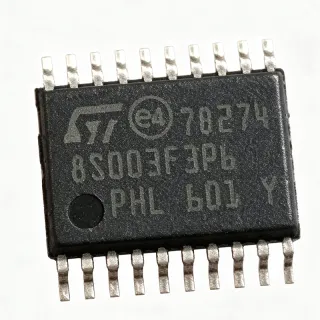
MC9S08SH32CTJ - 8-bit MCU, 32KB Flash, 40MHz | NXP
Teilenummer: MC9S08SH32CTJ ✗ Abgekündigt| Menge | Stückpreis | Gesamt |
|---|---|---|
| 1 | $2.45 | $2,45 |
| 10 | $2.21 | $22,10 |
| 100 | $1.96 | $196,00 |
| 500 | $1.72 | $860,00 |
| 1.000 | $1.52 | $1.520,00 |
MC9S08SH32CTJ Übersicht
An 8-bit microcontroller is a single-chip computer that integrates a processor core, non-volatile flash memory for program storage, SRAM for data, and peripheral modules such as timers, ADCs, and serial communication interfaces on one die. Within the power management hierarchy of embedded systems, an MCU like the S08SH sits at the control layer, executing user firmware to drive sensors, actuators, and communication links in cost-sensitive, general-purpose applications.
Key features of the S08SH family include a 40MHz HCS08 CPU executing the HC08 instruction set with an added BGND instruction, up to 32 interrupt/reset sources, and a 12-channel, 10-bit ADC. The family operates in the 5-volt range with 3.3V/5V supply support, making it a low-end option for industrial and automotive control nodes.
Technical depth comes from its development support: a single-wire background debug interface (BKGD), in-circuit breakpoint capability, and an on-chip debug module with two comparators, nine trigger modes, and an eight-deep FIFO storing change-of-flow address and event-only data. The S08SH also provides the MTIM (modulo timer) peripheral and a ganged output option allowing one write to change multiple port pins simultaneously.
Typical applications include automotive body electronics, industrial control, home appliances, and low-end motor or relay control boards where 5V operation, low cost, and small footprint matter.
Design consideration: NXP lists this part as End of Life (EOL); new designs should evaluate the pinout-compatible S08SG family, which offers the same tools and software compatibility with a wider range of package options.
This page synthesizes distributor pricing, drop-in alternatives, and practical design notes not found in the manufacturer datasheet.
Drop-in-Alternativen für MC9S08SH32CTJ – gleiches Gehäuse, Pin-kompatibel. Bauteile mit anderem Gehäuse, die eine PCB-Überarbeitung erfordern, sind ausgeschlossen.
Varianten dieser Serie
Modelle derselben Serie, die drop-in-kompatibel sind mit MC9S08SH32CTJ (gleiche Bauform und Footprint) – abweichend in Package, Core Processor, Debug Interface, Instruction Set, Number of I/O.
Schnellvergleichstool – Wählen Sie Alternativbauteile für den Direktvergleich:
S9S08SG32E1CTJ
✅ Drop-In📋 Referenzalternative (nicht im Katalog)
MC9S08SH16CTJ
✅ Drop-In ⚠️ Spezifikationen ungeprüft✓ Auf Lager
$4.73 / Stück
Datenblatt ansehen →MC9S08SH4CTJ
✅ Drop-In✓ Auf Lager
$1.85 / Stück
Datenblatt ansehen →MC9S08SL16CTJ
✅ Drop-In✓ Auf Lager
$1.83 / Stück
Datenblatt ansehen →S9S08SG32E1CTJR
✅ Drop-In📋 Referenzalternative (nicht im Katalog)
MC9S08SH32CTJ Grenzwerte & elektrische Eigenschaften
| Core Processor | HCS08 (S08) |
| Core Size | 8-Bit |
| Maximale Taktfrequenz | 40 MHz |
| Flash Memory | 32 KB (32K x 8) |
| RAM Size | 1 KB |
| Versorgungsspannung | 3.3 V / 5 V |
| Number of I/O | up to 16 GPIO |
| ADC Resolution | 10-bit |
| ADC Channels | 12-channel |
| Interrupt/Reset Sources | up to 32 |
| Debug Interface | Single-wire background debug (BKGD) |
| On-Chip Debug Module | ICE with 2 comparators, 9 trigger modes, 8-deep FIFO |
| Timers | MTIM (modulo timer) |
| Gehäuse | 20-TSSOP |
| Montageart | Surface Mount |
| Qualification | AEC-Q100 |
| Packaging | Tube |
| Lebenszyklusstatus | End of Life (per NXP product page) |
MC9S08SH32CTJ 20-tssop Pinbelegungsleitfaden
Pinbelegung für MC9S08SH32CTJ (20-tssop-Gehäuse). Dieser digitale IC umfasst GPIO, Kommunikationsschnittstellen (UART, SPI, I2C) und Versorgungspins. Alternative Pin-Funktionen und Konfigurationsoptionen entnehmen Sie dem Herstellerdatenblatt. Unverzichtbar für Embedded-System-Design und PCB-Layout.

Keine detaillierten Pinbelegungsdaten verfügbar für MC9S08SH32CTJ.
Siehe die Datenblatt für die vollständige Pin-Konfiguration.
Typische Anwendungen
MC9S08SH32CTJ ist geeignet für 6 Anwendungs: Automotive Body Electronics, Industrial Control Boards, Home Appliance Control, Low-End Motor Control, Sensor and Data Acquisition Nodes, Legacy Design Maintenance and Continuation.
Automotive Body Electronics
The MC9S08SH32CTJ fits automotive body control nodes because its AEC-Q100 qualification guarantees the reliability level demanded by in-vehicle environments, while its 3.3V/5V operation tolerates automotive supply rails. The 12-channel 10-bit ADC reads switches, resistive sensors, and analog diagnostic lines; up to 16 GPIO with the ganged output option drives lamps and relays with a single register write for synchronized load switching. Firmware such as door-module logic, seat-control sequences, and lamp diagnostics fits comfortably in 32KB flash with 1KB RAM. Running the 40MHz HCS08 core allows fast interrupt service for input-change detection. Designers should note the EOL status and map to the pin-compatible S9S08SG32E1CTJ for new automotive programs.
Empfohlen
Industrial Control Boards
In industrial control, the MC9S08SH32CTJ provides a cost-optimized controller for relay logic boards, sensor hubs, and small automation nodes operating from industrial 5V supplies. The 10-bit, 12-channel ADC digitizes process variables such as potentiometer positions and analog sensor outputs, while the MTIM modulo timer implements periodic control-loop scheduling without complex timer setup. The single-wire BKGD interface allows unobtrusive field debugging through a single pin, and the on-chip debug module's eight-deep FIFO captures change-of-flow data for diagnosing intermittent faults during commissioning. With 32KB flash there is headroom for communication parsing and state machines. Verify stock before production given NXP's End-of-Life declaration; the S08SG family offers tools-compatible continuation.
Empfohlen
Home Appliance Control
Appliance control boards - fan speed selectors, temperature monitors, user-interface scanners - benefit from the MC9S08SH32CTJ's combination of 5V operation, 20-pin TSSOP small footprint, and low component count. The 10-bit ADC reads NTC thermistors and user potentiometers with adequate resolution for thermostat hysteresis control, and GPIO directly drives seven-segment displays and relays through transistors. The 40MHz core executes key-scanning loops and debouncing with large timing margins. AEC-Q100-grade manufacturing quality transfers to appliance reliability requirements where thermal cycling is common. The 32KB flash supports feature-rich menus and multi-language UI text tables. Given EOL status, new appliance platforms should adopt the S9S08SG32E1CTJ to secure long-term supply.
Empfohlen
Low-End Motor Control
For simple fan and small motor control, the MC9S08SH32CTJ delivers the timing performance and analog feedback path needed for basic PWM speed regulation. The MTIM and core timing resources generate PWM at the 40MHz clock, the 10-bit ADC monitors current-sense resistor voltages and back-EMF, and fast interrupt response keeps control loops deterministic. Operation in the 5-volt range simplifies interfacing with discrete gate drivers and power stages common in appliance and automotive blower designs. Its AEC-Q100 qualification covers automotive HVAC blower applications explicitly. With 32KB flash, sensorless startup routines and fault tables fit easily. Note the EOL status: design continuity is available through the pin-compatible S08SG32 devices from NXP.
Empfohlen
Sensor and Data Acquisition Nodes
The MC9S08SH32CTJ works as a compact acquisition front-end: its 12-channel, 10-bit ADC multiplexes up to twelve analog inputs, converting thermistor, potentiometer, and 0-5V sensor signals under firmware control. The 1KB RAM buffers conversion results and averages readings for noise reduction, while 32KB flash stores calibration tables per channel. The ganged output feature drives channel-select multiplexers with one write, reducing bus turnaround time. The single-wire BKGD debug interface allows calibration rigs to reflash units through a single test point on production fixtures. At 40MHz, oversampling sequences complete quickly for multi-channel scans. For designs needing serial upload of results, evaluate the LIN-oriented S08SL family in the same TSSOP-20 footprint.
Empfohlen
Legacy Design Maintenance and Continuation
Because NXP has declared the MC9S08SH32CTJ End of Life, one of its most important current roles is supporting existing designs through their service life. Field-return repair, spares provisioning, and bridge production runs can use remaining distributor stock at DigiKey, Mouser, Newark, and Arrow, or XAIPART quote-based supply. For boards that must continue in production, the pin-compatible S9S08SG32E1CTJ from the S08SG family is the recommended migration path: NXP states S08SG is similar to S08SH in pinout, tools, and software compatibility, so firmware ports are typically recompiles rather than rewrites, and the CodeWarrior toolchain and debug probes remain the same. Plan last-time-buy quantities before stock depletion.
Empfohlen
Zusammenfassung der empfohlenen Produkte
Technische Referenzdaten für MC9S08SH32CTJ – Vergleich, Designhinweise und Compliance-Informationen.
Auswahlhilfe
Vergleich mit Alternativen
| Parameter | Dieses Produkt | S9S08SG32E1CTJ | MC9S08SH16CTJ | MC9S08SH4CTJ | MC9S08SL16CTJ | S9S08SG32E1CTJR |
|---|---|---|---|---|---|---|
| Package | TSSOP-20 | TSSOP-20 - same | TSSOP-20 - same | TSSOP-20 - same | TSSOP-20 - same | TSSOP-20 - same |
| Brand | NXP Semiconductors | NXP Semiconductors | NXP Semiconductors | NXP (Freescale legacy) | NXP Semiconductors | NXP Semiconductors |
| Flash Memory | 32 KB | 32 KB | 16 KB | 4 KB | 16 KB | 32 KB |
| Max Clock Frequency | 40 MHz | 40 MHz | 40 MHz | 40 MHz | 40 MHz | 40 MHz |
| Core | S08 (HCS08), 8-bit | S08, 8-bit | S08, 8-bit | S08, 8-bit | S08, 8-bit | S08, 8-bit |
| AEC-Q100 Qualification | Yes | Yes | Yes (same family) | Yes (per comparison data) | Yes (per comparison data) | Yes |
| Supply Voltage | 3.3 V / 5 V | 3.3 V / 5 V | 3.3 V / 5 V | 3.3 V / 5 V | 3.3 V / 5 V | 3.3 V / 5 V |
| Peripheral Focus | MTIM timer, 10-bit ADC | Similar peripheral set, more package options | Identical S08SH peripherals | Identical S08SH peripherals | LIN-focused serial peripherals | Similar peripheral set |
Wichtigste Unterscheidungsmerkmale
- Largest flash in the 20-pin S08SH family (vs. MC9S08SH16CTJ)
- Full migration path exists (vs. S9S08SG32E1CTJ)
- Automotive qualification at 8-bit cost (vs. MC9S08SH4CTJ)
Designhinweise
The MC9S08SH32CTJ is declared End of Life on the NXP product page. Do not start new production designs on this part. For continuity, NXP guidance (community forum, 2025) identifies the S08SG family - e.g., S9S08SG32E1CTJ - as similar in pinout, tools, and software compatibility with more package options. For existing designs, compute last-time-buy quantity as (annual usage x expected remaining service years) plus a 10-15% attrition margin, and place orders early since EOL stock at DigiKey, Mouser, Newark, and Arrow is finite and date-code fragmented.
The S08SH is a 5-volt-range MCU supporting 3.3V/5V operation. When running from an unregulated automotive or appliance 12V-derived rail, use a 5V regulator with adequate transient response; the 10-bit ADC reference accuracy depends directly on supply quality, so add local 0.1uF decoupling at the VDD pin plus a bulk capacitor per board section. Estimated: at 40MHz the S08 core draws on the order of 10-20mA (verify exact figure in the MC9S08SH32 datasheet electrical characteristics chapter before finalizing regulator sizing), plus load current on GPIO-driven outputs.
Use the single-wire BKGD debug pin as an accessible test point on the PCB: it allows programming and in-circuit debugging through one pad, which is invaluable for production calibration and field diagnostics given the on-chip debug module's eight-deep FIFO for change-of-flow capture. Keep the BKGD trace short and away from switching nodes. Reserve ADC input series resistance (1-10k) to protect channels from transients in automotive environments, consistent with AEC-Q100 deployment practice.
Compliance-Informationen
AEC-Q100 qualification confirmed by Arrow and Xecor product data. RoHS/REACH/lead-free details not stated in provided data; refer to the NXP product page's Quality/Environmental section.