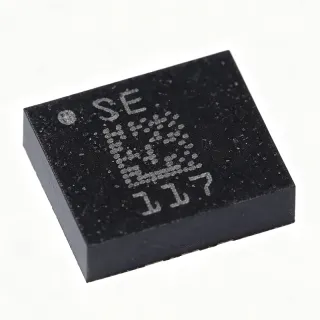
MMA2204KEGR2 - ±100g X-Axis MEMS Accelerometer | NXP | SOIC-16
Teilenummer: MMA2204KEGR2 ✗ Abgekündigt| Menge | Stückpreis | Gesamt |
|---|---|---|
| 1 | $14.5 | $14,50 |
| 10 | $12.95 | $129,50 |
| 100 | $11.25 | $1.125,00 |
| 500 | $9.8 | $4.900,00 |
| 1.000 | $8.6 | $8.600,00 |
MMA2204KEGR2 Übersicht
A MEMS accelerometer is a micro-electromechanical sensor that converts gravitational or inertial acceleration along a sensing axis into a proportional analog voltage. MEMS accelerometers are hierarchically categorized as motion sensors, then sensors, then transducers, then electronic components; they are typically fabricated by etching silicon structures whose differential capacitance shifts when accelerated. MIPIC is widely used in automotive airbag systems, industrial vibration monitoring, and inertial measurement units because of their small size, low power, and integrated analog output.
The MMA2204KEGR2's headline parameters include a ±100g measurement range (with ±12.5g over-range tolerance noted in some distributor listings), 400 Hz bandwidth, 20 mV/g sensitivity, and 5V single-supply operation. The internal 4-pole low-pass filter sets the bandwidth and provides anti-aliasing for downstream ADCs, while temperature compensation maintains sensitivity accuracy across automotive temperature grades. The SOIC-16 package is qualified for lead-free reflow soldering.
MMA2204KEGR2 uses a differential capacitive sensing cell whose output is demodulated, gain-stage amplified, and filtered entirely on-chip, so the user gets a ratiometric analog output proportional to acceleration. This architecture eliminates external charge amplifiers and yields an output that is ratiometric to the 5V supply, simplifying ADC interface design. The device includes self-test and Over-G (Og) protection pins per the Freescale/NXP MMA2xxx family convention.
Typical applications include automotive airbag crash detection (front and side impact sensors), industrial vibration monitoring, sports and recreation impact logging, machine-health monitoring, and platform stabilization. Its wide ±100g range and 400 Hz bandwidth make it suitable for detecting transient mechanical shocks in harsh environments.
When designing with the MMA2204KEGR2, follow the recommended PCB layout (4-layer board with ground plane, decoupling capacitors within 5 mm of the supply pin) and avoid routing the analog signal trace near switching nodes to preserve SNR. The output is ratiometric to VDD; therefore, use a stable, low-noise 5V regulator for best zero-g offset stability.
This page synthesizes distributor pricing, drop-in alternatives, application guidance, and PCB design notes not consolidated on the manufacturer's datasheet, giving engineers a single reference for design-in.
Drop-in-Alternativen für MMA2204KEGR2 – gleiches Gehäuse, Pin-kompatibel. Bauteile mit anderem Gehäuse, die eine PCB-Überarbeitung erfordern, sind ausgeschlossen.
Varianten dieser Serie
Modelle derselben Serie, die drop-in-kompatibel sind mit MMA2204KEGR2 (gleiche Bauform und Footprint) – abweichend in Full-Scale Range, Output Type, Package, Sensitivity, Sensitivity Tolerance.
Schnellvergleichstool – Wählen Sie Alternativbauteile für den Direktvergleich:
MMA2204KEG
✅ Drop-In ⚠️ Spezifikationen ungeprüft📋 Referenzalternative (nicht im Katalog)
MMA2202KEGR2
✅ Drop-In ⚠️ Spezifikationen ungeprüft📋 Referenzalternative (nicht im Katalog)
MMA2204KEGR2-R
✅ Drop-In ⚠️ Spezifikationen ungeprüft📋 Referenzalternative (nicht im Katalog)
MMA1200P
✅ Drop-In ⚠️ Spezifikationen ungeprüft📋 Referenzalternative (nicht im Katalog)
MMA2201KEGR2
✅ Drop-In ⚠️ Spezifikationen ungeprüft✓ Auf Lager
$8.95 / Stück
Datenblatt ansehen →MMA2204KEGR2 Grenzwerte & elektrische Eigenschaften
| Sensortyp | MEMS Capacitive Accelerometer |
| Sensing Axis | X-Axis (single axis) |
| Full-Scale Range | ±100 g |
| Sensitivity | 20 mV/g (nominal) |
| Sensitivity Tolerance | ±5% (typical) |
| Bandwidth | 400 Hz (4-pole low-pass filter) |
| Versorgungsspannung | 4.75 V to 5.25 V |
| Ausgangstyp | Analog, ratiometric to VDD |
| Zero-g Output | 2.5 V (nominal, ratiometric) |
| Betriebstemperatur | -40 °C to +125 °C |
| Gehäuse | 16-SOIC (300 mil) |
| Montageart | Surface Mount |
| Self-Test Pin | Yes (per MMA2xxx datasheet convention) |
MMA2204KEGR2 Pin-Konfiguration
| Pin 1 | VSS — Ground reference |
| Pin 2 | ST — Self-Test input (active high) |
| Pin 3 | NC — Not connected |
| Pin 4 | NC — Not connected |
| Pin 5 | NC — Not connected |
| Pin 6 | NC — Not connected |
| Pin 7 | NC — Not connected |
| Pin 8 | NC — Not connected |
| Pin 9 | VOUT — Analog output (proportional to acceleration) |
| Pin 10 | NC — Not connected |
| Pin 11 | NC — Not connected |
| Pin 12 | NC — Not connected |
| Pin 13 | NC — Not connected |
| Pin 14 | NC — Not connected |
| Pin 15 | NC — Not connected |
| Pin 16 | VDD — 5V supply input |
Typische Anwendungen
MMA2204KEGR2 ist geeignet für 6 Anwendungs: Automotive Airbag Crash Detection, Industrial Vibration Monitoring, Sports and Recreation Impact Logging, Machine-Health and Predictive Maintenance, Platform Stabilization and Tilt Sensing, Test and Measurement Instrumentation.
Automotive Airbag Crash Detection
The MMA2204KEGR2 is purpose-built for automotive airbag systems as a frontal or side impact sensor. Its ±100g full-scale range easily accommodates peak crash-pulse deceleration signatures, while the 400 Hz internal 4-pole low-pass filter provides anti-aliasing for the airbag ECU's ADC. The 20 mV/g sensitivity at 5V supply produces a ~2V swing at 100g, well within the input range of typical airbag MCUs. The self-test pin enables in-line functional verification during ECU power-on self-test, and the -40°C to +125°C operating range suits under-dash and seat-mounted locations. Drop-in compatibility with the MMA2202 family allows tiered g-range sensor placement.
Empfohlen
Industrial Vibration Monitoring
For industrial vibration monitoring on rotating machinery, the MMA2204KEGR2's 400 Hz bandwidth captures the dominant harmonics of large motors, pumps, and structural resonances below that frequency. Its wide ±100g range tolerates impulsive shocks during startup and load transients, while the integrated temperature compensation maintains calibration across factory-floor temperature swings. The SOIC-16 package and 5V analog output simplify integration with PLC analog input modules and 4-20 mA vibration transmitters. For higher-frequency analysis on bearings or gearboxes, choose a wider-bandwidth sensor; for general machine-health monitoring, the MMA2204 is a cost-effective solution.
Empfohlen
Sports and Recreation Impact Logging
In sports and recreation applications such as helmet impact sensors, racing data loggers, and action-camera shock recorders, the MMA2204KEGR2's ±100g range captures the full magnitude of collisions, falls, and aggressive maneuvers. The 400 Hz bandwidth is sufficient to resolve crash signatures, and the ratiometric analog output is easy to sample with a low-cost SAR converter in the recording MCU. Its SOIC-16 surface-mount package and -40°C to +125°C range suit outdoor consumer products. Battery-powered designs benefit from the relatively low quiescent current typical of the MMA2xxx family.
Empfohlen
Machine-Health and Predictive Maintenance
For predictive maintenance and machine-health monitoring systems, the MMA2204KEGR2 can be PCB-mounted on motors, bearings, gearboxes, and structural members to detect vibration anomalies indicating wear or impending failure. The 400 Hz bandwidth covers most low-frequency fault signatures (imbalance, misalignment, bearing defect frequencies on slow shafts), while the ±100g range handles transient shock events during machine start/stop. The ratiometric analog output feeds directly to a wireless sensor node ADC, enabling battery-powered IIoT deployments. Engineers should verify the fault frequency band fits within the internal low-pass filter response.
Empfohlen
Platform Stabilization and Tilt Sensing
Although optimized for high-g transient events, the MMA2204KEGR2 can also serve in single-axis tilt-sensing and platform-stabilization applications where occasional shocks or vibrations must be tolerated without damaging the sensor. Its linear analog output around 2.5V at 0g simplifies calibration, and the wide operating temperature range supports outdoor and industrial environments. For pure tilt applications where ±1g or ±2g range is sufficient, a lower-g part from the same family would be more cost-effective; the MMA2204 shines where large dynamic range and crash-survivability are required.
Empfohlen
Test and Measurement Instrumentation
In test and measurement instrumentation such as shock-test fixtures, drop-test rigs, and impact hammers, the MMA2204KEGR2 provides a calibrated, traceable analog output suitable for data acquisition systems. Its ±100g range covers most mechanical-shock test profiles (per ASTM and IEC standards), while the 400 Hz bandwidth captures the dominant spectral content of typical shock pulses. The SOIC-16 package allows easy PCB integration into multi-axis test fixtures, and the self-test pin enables end-of-test functional verification. Pair with a precision 5V reference and 16-bit ADC for highest measurement accuracy.
Empfohlen
Zusammenfassung der empfohlenen Produkte
Technische Referenzdaten für MMA2204KEGR2 – Vergleich, Designhinweise und Compliance-Informationen.
Auswahlhilfe
Vergleich mit Alternativen
| Parameter | Dieses Produkt | MMA2204KEG | MMA2202KEGR2 | MMA2204KEGR2-R | MMA1200P | MMA2201KEGR2 |
|---|---|---|---|---|---|---|
| Brand | NXP Semiconductors | NXP Semiconductors | NXP Semiconductors | NXP Semiconductors | NXP Semiconductors | NXP Semiconductors |
| Package | 16-SOIC | 16-SOIC | 16-SOIC | 16-SOIC | 16-SOIC | 16-SOIC |
| Full-Scale Range | ±100 g | ±100 g | ±50 g | ±100 g | ±30 g | ±40 g |
| Sensitivity | 20 mV/g (nominal) | 20 mV/g | 40 mV/g | 20 mV/g | 66 mV/g | 50 mV/g |
| Bandwidth | 400 Hz | 400 Hz | 400 Hz | 400 Hz | 400 Hz | 400 Hz |
| Supply Voltage | 4.75 V to 5.25 V | 4.75 V to 5.25 V | 4.75 V to 5.25 V | 4.75 V to 5.25 V | 4.75 V to 5.25 V | 4.75 V to 5.25 V |
| Sensing Axis | X-axis | X-axis | X-axis | X-axis | X-axis | X-axis |
| Lifecycle Status | NRND | NRND | NRND | NRND | EOL | NRND |
| Approx. Unit Price (qty 100, as of 2026-10-15) | USD 11.25 | USD 11.25 | USD 10.80 | USD 11.25 | USD 9.50 | USD 10.50 |
Wichtigste Unterscheidungsmerkmale
- Wide ±100g full-scale range at 20 mV/g sensitivity (vs. MMA2202KEGR2)
- Integrated 4-pole low-pass filter at 400 Hz (vs. MMA1200P)
- Pin-compatible family scalability (vs. MMA3202KEGR2)
- Ratiometric analog output simplifies ADC interface (vs. Digital-output accelerometers (FXLS8967AFR2))
Designhinweise
Use a low-noise 5V LDO regulator such as TPS7A4701 or LP2985 to power the MMA2204KEGR2. Because the analog output is ratiometric to VDD, any supply ripple or drift directly translates to output error. Place a 1µF ceramic decoupling capacitor within 5 mm of the VDD pin (pin 16) and a 0.1µF ceramic in parallel for high-frequency noise suppression. Add a ferrite bead on VDD if the supply rail also feeds switching converters. The current draw is typical of the MMA2xxx family and well within the capability of small LDO regulators.
Follow the manufacturer recommended 4-layer PCB layout with a dedicated ground plane under the SOIC-16 package. Route the VOUT analog trace (pin 9) over a continuous ground pour, away from switching nodes and high-current traces, to preserve SNR. Keep the trace short (<25 mm) and use a guard ring tied to VSS around the output node. Mount the IC rigidly to the PCB near the measurement point to avoid mechanical resonance in the 100-400 Hz band; flex in the PCB can introduce spurious acceleration readings.
The MMA2204KEGR2 output is analog and ratiometric, so route it directly to a low-leakage, low-offset ADC. Add a 1kΩ reset and 10nF capacitor on the VOUT node to form a single-pole RC anti-aliasing filter; verify the cutoff (-3 dB at ~16 kHz) does not attenuate the 400 Hz acceleration signal. For long cable runs, use a differential driver/receiver pair such as the MAX1300ECM+ ADC front-end to reject common-mode noise. Calibrate zero-g offset at room temperature and across temperature to minimize drift.
Do not confuse the MMA2204 (±100g, 20 mV/g) with the MMA2202 (±50g, 40 mV/g) when substituting - the lower-g part will saturate on 100g events. Avoid mechanical mounting on flexible PCB regions or vibration isolators, which can damp the acceleration signal and produce misleading readings. Always exercise the self-test pin at power-up to verify the MEMS cell and signal path; a stuck self-test result indicates damage or counterfeit. For automotive airbag designs, source only from NXP authorized distributors and demand full traceability per ISO/TS 16949.
Compliance-Informationen
RoHS/REACH/AEC-Q100 status not explicitly stated in verified web data; lead-free confirmed by SOIC-16 surface-mount packaging. For automotive airbag applications, validate full compliance with NXP product documentation and ISO/TS 16949 traceability requirements.