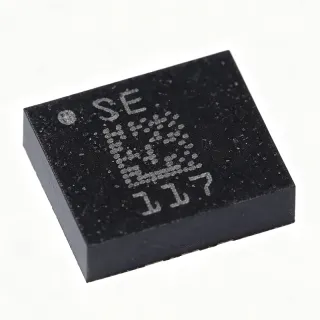
MMA7260Q - ±1.5/2/4/6g 3-Axis Accelerometer 16-QFN | NXP
Teilenummer: MMA7260Q ✗ Abgekündigt| Menge | Stückpreis | Gesamt |
|---|---|---|
| 1 | $8.5 | $8,50 |
| 10 | $7.6 | $76,00 |
| 100 | $6.4 | $640,00 |
| 500 | $5.5 | $2.750,00 |
| 1.000 | $4.75 | $4.750,00 |
MMA7260Q Übersicht
An accelerometer is a MEMS (Micro-Electro-Mechanical Systems) sensor that measures proper acceleration along one or more axes, converting it into a proportional analog or digital output. The MMA7260Q belongs to the broader class of motion sensors and inertial measurement devices, sitting in the hierarchy: 3-axis accelerometer → MEMS accelerometer → motion sensor → inertial sensor. It is widely used wherever low-g tilt, vibration, shock, or motion detection must be sensed without the complexity of a full IMU.
Key features include factory-calibrated zero-g offset and full-scale span requiring no external trim components, four selectable g-ranges via two logic inputs (g-Select1 and g-Select2), a low current consumption of approximately 500 µA in active mode and 3 µA in Sleep Mode, and a single-supply operation from 2.2 V to 3.6 V. The integrated 1-pole low-pass filter has a bandwidth of 350 Hz on the X and Y axes and 150 Hz on the Z axis. The 16-QFN package provides a small 6 mm × 6 mm footprint suitable for space-constrained PCB designs.
Architecturally, the device uses a surface-micromachined capacitive sensing cell with a dedicated ASIC for amplification, demodulation, temperature compensation, and filtering. The capacitive sensing principle delivers good noise performance and stability across its full operating temperature range of -20 °C to +85 °C, while the g-Select multiplexing allows the same silicon to serve multiple application ranges without mechanical reconfiguration.
Typical applications for the MMA7260Q include HDD free-fall detection, portable consumer electronics tilt sensing, motion-activated user interfaces, vibration monitoring in appliances, gaming controllers, and industrial equipment health monitoring. The selectable ranges make it well suited to both high-resolution tilt measurement (using the ±1.5g range) and shock or free-fall detection (using the ±6g range).
When designing with this part, note that the device is specified for 2.2 V to 3.6 V single-supply operation only; for 5 V microcontroller systems an external LDO is required. Place the decoupling capacitor as close as possible to the supply pin, route the analog output traces away from switching nodes, and respect the g-Select logic timing during range switching to avoid transient invalid outputs.
This page synthesizes distributor pricing, drop-in alternative options, and practical MEMS design notes not found in the manufacturer datasheet alone.
Drop-in-Alternativen für MMA7260Q – gleiches Gehäuse, Pin-kompatibel. Bauteile mit anderem Gehäuse, die eine PCB-Überarbeitung erfordern, sind ausgeschlossen.
Varianten dieser Serie
Modelle derselben Serie, die drop-in-kompatibel sind mit MMA7260Q (gleiche Bauform und Footprint) – abweichend in Output Type, Package, RoHS Status, Sensor Type, Acceleration Range.
Schnellvergleichstool – Wählen Sie Alternativbauteile für den Direktvergleich:
MMA7260QT
✅ Drop-In✓ Auf Lager
$3.25 / Stück
Datenblatt ansehen →MMA7261QT
✅ Drop-In📋 Referenzalternative (nicht im Katalog)
MMA7260Q-2
✅ Drop-In ⚠️ Spezifikationen ungeprüft📋 Referenzalternative (nicht im Katalog)
MMA7455L
✅ Drop-In📋 Referenzalternative (nicht im Katalog)
MMA7260Q Grenzwerte & elektrische Eigenschaften
| Sensortyp | 3-axis capacitive MEMS accelerometer |
| Acceleration Range | ±1.5g / ±2g / ±4g / ±6g (selectable) |
| Number of Axes | X, Y, Z |
| Sensitivity (g-Select) | 4 user-selectable ranges via g-Select1/g-Select2 logic inputs |
| Bandwidth (X, Y axes) | 350 Hz |
| Bandwidth (Z axis) | 150 Hz |
| Versorgungsspannung | 2.2 V to 3.6 V |
| Ausgangstyp | Analog, three channels |
| Zero-g Offset | Factory calibrated |
| Temperature Compensation | Built-in |
| Filter Type | 1-pole low-pass |
| Betriebstemperaturbereich | -20 °C to +85 °C |
| Gehäuse | 16-QFN (6 mm × 6 mm) |
| Montageart | Surface Mount |
| Sleep Mode | Yes |
| RoHS-Status | Non-Compliant (contains lead) |
MMA7260Q 16-qfn (6 mm × 6 mm) Pinbelegungsleitfaden
Pinbelegung für MMA7260Q (16-qfn (6 mm × 6 mm)-Gehäuse). Pin-Nummerierung, Funktionen und Anschlussdiagramme sind im Herstellerdatenblatt definiert. Entnehmen Sie diesem den genauen Footprint und Lötrichtlinien.

Keine detaillierten Pinbelegungsdaten verfügbar für MMA7260Q.
Siehe die Datenblatt für die vollständige Pin-Konfiguration.
Typische Anwendungen
MMA7260Q ist geeignet für 6 Anwendungs: HDD Free-Fall Detection, Portable Consumer Tilt Sensing, Motion-Activated User Interfaces, Appliance Vibration Monitoring, Industrial Equipment Health Monitoring, Gaming and Controller Motion Sensing.
HDD Free-Fall Detection
The MMA7260Q is well suited to hard-disk drive free-fall protection because its selectable ±6g range provides enough headroom to detect hard accelerations while the integrated 1-pole low-pass filter at 350 Hz X/Y and 150 Hz Z suppresses mechanical noise from the chassis. Placed near the HDD connector, the device samples all three axes simultaneously and a host microcontroller triggers a head-park routine when any axis exceeds a programmable threshold; the ±6g range gives approximately 100 mg/count at 10-bit resolution, sufficient margin to detect drops while remaining robust to typing-level vibrations. Sleep Mode (3 µA) makes it practical for battery-powered mobile storage devices.
Empfohlen
Portable Consumer Tilt Sensing
For handheld consumer products such as remote controls, toys, and personal media players, the MMA7260Q's ±1.5g low-g range delivers the highest resolution for tilt measurement, with the g-Select logic inputs allowing designers to switch ranges on demand. Typical circuits place the device near the product center-of-mass and route the X/Y analog outputs to the host ADC; the 350 Hz X/Y bandwidth captures brisk tilt gestures while ignoring sensor noise. The 6 mm × 6 mm QFN footprint eases placement in space-constrained enclosures, and the 2.2 V to 3.6 V supply range supports direct connection to a Li-ion or two-AAA battery stack.
Empfohlen
Motion-Activated User Interfaces
Gesture and motion-triggered user interfaces benefit from the MMA7260Q's wide dynamic range and fast wake-up from Sleep Mode (less than 1 ms typical). The device can sit in 3 µA Sleep Mode until motion is detected, then wake the host microcontroller for gesture decoding; this power profile makes the part attractive for battery-driven wearables and IoT devices. The three analog outputs let the host perform tap, double-tap, and orientation detection in firmware without complex state-machine hardware. With the 16-QFN footprint, it fits into compact wearable enclosures.
Empfohlen
Appliance Vibration Monitoring
White goods such as washing machines and refrigerators employ the MMA7260Q for vibration and unbalance monitoring during spin cycles. The ±6g range covers the high-G shock loads that occur during bearing failure, while the ±1.5g range provides resolution for routine unbalance measurements. The Z-axis bandwidth of 150 Hz is a natural match for mechanical vibration spectra, and the integrated temperature compensation maintains calibration across the appliance's thermal envelope. Analog outputs feed a low-cost MCU ADC for predictive-maintenance algorithms.
Empfohlen
Industrial Equipment Health Monitoring
In factory environments, the MMA7260Q performs low-cost vibration analysis on pumps, fans, and small motors. The selectable range scales the output for either ISO-10816 vibration envelope compliance at ±1.5g/±2g or shock sensing during fault events at ±6g. The 16-QFN industrial-grade package withstands the typical 0 °C to 70 °C equipment-compartment temperatures, and the analog outputs simplify integration into legacy PLC analog-input modules. The Sleep Mode enables battery-powered wireless sensor nodes that monitor unpowered equipment intermittently.
Empfohlen
Gaming and Controller Motion Sensing
Game controllers and pointing devices historically used the MMA7260Q to capture fast motion gestures because the 350 Hz X/Y bandwidth responds to abrupt player movement without aliasing. The selectable range lets designers trade resolution against motion magnitude for casual versus competitive gaming profiles. The 6 mm × 6 mm QFN integrates cleanly into compact controller enclosures, and the low active current of about 500 µA preserves battery life across long play sessions. Tap-to-wake via interrupt logic adds quick-resume behaviour favored in handheld gaming platforms.
Empfohlen
Zusammenfassung der empfohlenen Produkte
Technische Referenzdaten für MMA7260Q – Vergleich, Designhinweise und Compliance-Informationen.
Auswahlhilfe
Vergleich mit Alternativen
| Parameter | Dieses Produkt | MMA7260QT | MMA7261QT | MMA7260Q-2 | MMA7455L | ADXL335 |
|---|---|---|---|---|---|---|
| Brand | NXP Semiconductors | NXP Semiconductors | NXP Semiconductors | NXP Semiconductors | NXP Semiconductors | Analog Devices |
| Package | 16-QFN (6x6) | 16-QFN (6x6) | 16-QFN (6x6) | 16-QFN (6x6) | 16-QFN (6x6) | 16-LFCSP (4x4) |
| Sensor Type | 3-axis analog MEMS | 3-axis analog MEMS | 3-axis analog MEMS | 3-axis analog MEMS | 3-axis digital MEMS (I2C/SPI) | 3-axis analog MEMS |
| Acceleration Range | ±1.5/2/4/6g selectable | ±1.5/2/4/6g selectable | ±2.5/3.3/6.7/10.5g selectable | ±1.5/2/4/6g selectable | ±2/4/8g selectable | ±3g fixed |
| Supply Voltage | 2.2 V to 3.6 V | 2.2 V to 3.6 V | 2.2 V to 3.6 V | 2.2 V to 3.6 V | 2.4 V to 3.6 V | 1.8 V to 3.6 V |
| Bandwidth (X/Y) | 350 Hz | 350 Hz | 350 Hz | 350 Hz | configurable digital filter | 1600 Hz (much wider) |
| Output Type | Analog | Analog | Analog | Analog | Digital I2C/SPI | Analog |
| RoHS Status | Non-Compliant | Non-Compliant | Non-Compliant | Non-Compliant | Compliant | Compliant |
| Operating Temperature Range | -20 °C to +85 °C | -20 °C to +85 °C | -20 °C to +85 °C | -20 °C to +85 °C | -40 °C to +85 °C | -40 °C to +85 °C |
Wichtigste Unterscheidungsmerkmale
- User-selectable g-range without hardware changes (vs. ADXL335)
- Integrated Sleep Mode for ultra-low-power battery operation (vs. MMA7455L)
- Factory-calibrated zero-g offset and full-scale span (vs. Generic MEMS modules)
Designhinweise
Estimated: at 3.3 V VDD, the MMA7260Q draws approximately 500 µA active; with a 3 µA Sleep Mode, a battery-powered design can use a Sleep/wake cycle calculated as t_sleep * 3 µA + t_active * 500 µA to minimize average current. Place a 100 nF decoupling capacitor within 5 mm of the VDD pin, plus a 10 µF bulk reservoir near the analog ground. For 5 V microcontroller projects, add an external LDO such as the NXP TLV1117-33 to step 5 V to 3.3 V before the sensor supply.
Route the analog X, Y, Z output traces as short as possible, away from switching DC-DC converter inductors and digital clocks. Keep a solid ground plane under the device with no cuts directly below the MEMS sensing cell; mechanical stress from PCB flex near the package can shift zero-g bias. Maintain symmetric copper pours around the package to balance thermal expansion and minimize temperature-induced offset drift.
Critical: do NOT exceed 3.6 V on VDD - the MMA7260Q is a 3.3 V part and overvoltage will damage the ESD structures. Critical: when changing the g-Select1/g-Select2 logic inputs, allow at least one sample period before trusting the output as the internal filter and demodulator require settling time. Common pitfall: the device is RoHS non-compliant and contains lead; do not specify it for new RoHS-required designs without an explicit exemption.
The integrated temperature compensation is factory calibrated across -20 °C to +85 °C, eliminating the need for host-side temperature compensation in most designs. If your enclosure exceeds 85 °C ambient, derate the g-Select ranges accordingly or move to the MMA7361L which extends the operating range. Thermal gradients across the PCB during high-current switching events can induce transient zero-g offset shifts; isolate the accelerometer from heat sources.
Compliance-Informationen
Per manufacturer datasheet: RoHS non-compliant, contains lead. Not AEC-Q100 qualified. New designs should select the RoHS-compliant MMA7361L or MMA845x family instead.