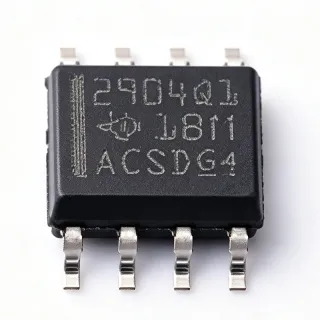
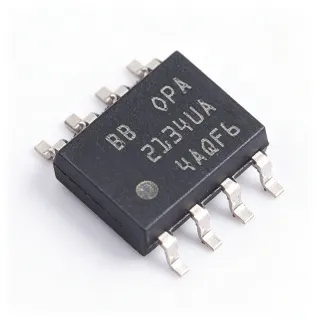
OPA1642AIDR - Dual JFET Audio Op Amp | Texas Instruments
Teilenummer: OPA1642AIDR ✓ Aktiv| Menge | Stückpreis | Gesamt |
|---|---|---|
| 1 | $4.5 | $4,50 |
| 10 | $4.05 | $40,50 |
| 100 | $3.6 | $360,00 |
| 500 | $3.24 | $1.620,00 |
| 1.000 | $2.88 | $2.880,00 |
OPA1642AIDR Übersicht
A JFET-input operational amplifier is a type of analog amplifier whose input stage uses junction field-effect transistors instead of bipolar transistors, yielding extremely low input bias current and high input impedance while presenting a near-ideal voltage-follower load to preceding sources. The OPA1642 belongs to the broader hierarchy of audio operational amplifiers (audio op amp → operational amplifier → amplifier IC → integrated circuit → semiconductor), and within that taxonomy it sits in the high-performance sub-class defined by sub-1 µVrms noise floors and harmonic distortion below 0.001%. Because audio signal quality is dominated by the op amp's intrinsic noise and linearity, parts like the OPA1642 directly set the achievable dynamic range and channel separation of line-level stages, headphone amplifiers, ADC input buffers, and DAC I/V converters.
The OPA1642AIDR combines 5.1 nV/√Hz noise density, 0.00005% THD+N, ±2.5 mV typical input offset voltage, and a 2 pA typical input bias current. The 8-SOIC variant specified here runs over a -40 °C to +85 °C commercial temperature range and operates from ±2.25 V to ±18 V dual supplies or 4.5 V to 36 V single supply. Internal EMI/RFI filters on the input pins suppress conducted and radiated interference that otherwise leaks into the audio band from nearby switching converters or wireless modules. The output swings within ~600 mV of either rail at 2 kΩ load, giving the designer extra usable dynamic range in 5 V and 6 V single-supply audio paths.
The JFET front end eliminates the input-bias current errors that plague bipolar audio op amps, while the bipolar output stage delivers the high slew rate and clean large-signal response required by professional-grade equipment. Designers should still observe the datasheet's input common-mode range, output swing, and decoupling recommendations; this configuration provides single-channel noise below 1 µVrms and channel separation exceeding the limits of typical board layouts. Typical applications include high-fidelity preamplifier stages, professional mixing-console line inputs, headphone amplifiers, active crossover filters, studio microphone preamps, and DAC I/V conversion networks. Compared to general-purpose op amps such as the TL072, the OPA1642AIDR offers an order-of-magnitude lower noise and lower distortion, making it a clear upgrade where source-impedance is moderate. This page synthesizes distributor pricing, drop-in alternative guidance, and practical design notes that complement the manufacturer datasheet.
Drop-in-Alternativen für OPA1642AIDR – gleiches Gehäuse, Pin-kompatibel. Bauteile mit anderem Gehäuse, die eine PCB-Überarbeitung erfordern, sind ausgeschlossen.
Varianten dieser Serie
Modelle derselben Serie, die drop-in-kompatibel sind mit OPA1642AIDR (gleiche Bauform und Footprint) – abweichend in Input Voltage Noise Density, Number of Channels, Operating Temperature, Output Type, Package.
Schnellvergleichstool – Wählen Sie Alternativbauteile für den Direktvergleich:
OPA1642AID
✅ Drop-In📋 Referenzalternative (nicht im Katalog)
OPA1642AIDGK
✅ Drop-In📋 Referenzalternative (nicht im Katalog)
OPA1652AIDR
✅ Drop-In📋 Referenzalternative (nicht im Katalog)
OPA1612AQDRQ1
✅ Drop-In📋 Referenzalternative (nicht im Katalog)
OPA1644AID
✅ Drop-In📋 Referenzalternative (nicht im Katalog)
OPA1642AIDR Grenzwerte & elektrische Eigenschaften
| Number of Channels | 2 (Dual) |
| Topologie | JFET-Input, Unity-Gain Stable |
| Input Voltage Noise Density | 5.1 nV/√Hz |
| THD+N | 0.00005% (typ) |
| Input Offset Voltage | ±2.5 mV (typ) |
| Input Bias Current | 2 pA (typ) |
| Input Impedance | JFET, very high input impedance |
| Supply Voltage Range (Dual) | ±2.25 V to ±18 V |
| Supply Voltage Range (Single) | 4.5 V to 36 V |
| Ausgangstyp | Rail-to-Rail Output |
| Betriebstemperatur | -40 °C to +85 °C |
| Gehäuse | SOIC-8 (D) |
| Montageart | Surface Mount |
| MSL-Level | 2 (per JEDEC J-STD-020) |
| RoHS-Status | Compliant |
| Lead Free | Yes |
OPA1642AIDR Pin-Konfiguration
| Pin 1 | OUT A — Output of channel A |
| Pin 2 | -IN A — Inverting input of channel A |
| Pin 3 | +IN A — Non-inverting input of channel A |
| Pin 4 | V- — Negative supply voltage |
| Pin 5 | +IN B — Non-inverting input of channel B |
| Pin 6 | -IN B — Inverting input of channel B |
| Pin 7 | OUT B — Output of channel B |
| Pin 8 | V+ — Positive supply voltage |
Typische Anwendungen
OPA1642AIDR ist geeignet für 7 Anwendungs: High-Fidelity Stereo Line Preamplifier, Professional Mixing Console Line Input, Studio Microphone Preamplifier, Headphone Amplifier Output Buffer, Active Crossover Filter for Loudspeakers, DAC I/V Converter Stage, Phono Preamplifier for Moving-Coil Cartridges.
High-Fidelity Stereo Line Preamplifier
The OPA1642AIDR's 5.1 nV/√Hz noise density and 0.00005% THD+N make it well suited to stereo line-level preamplifier stages that drive ADC inputs or downstream power amplifiers. With JFET inputs providing only 2 pA of input bias current, the part can be DC-coupled to high-impedance passive tone-control networks and instrument-level sources without introducing measurable bias-current-induced offset. Placed as the first gain stage after the input selector with ±15 V supplies, the OPA1642AIDR adds no audible coloration while preserving dynamic range above 110 dB for studio-grade listening. Its rail-to-rail output also allows the same PCB to be re-used for 5 V single-supply portable preamp designs with no schematic change beyond the supply rail.
Empfohlen
Professional Mixing Console Line Input
The OPA1642AIDR delivers the low noise, low distortion, and high common-mode rejection required by balanced differential line receivers inside professional mixing consoles. Its 5.1 nV/√Hz input noise floor preserves the noise headroom of 24-bit / 96 kHz digital mixing buses, while the 0.00005% THD+N figure guarantees harmonic content below the threshold of audibility on critical mastering channels. Used in the standard instrumentation-amplifier front-end topology with four precision-matched gain-setting resistors, each channel achieves CMRR exceeding 80 dB at 1 kHz, well within broadcast console requirements. The SOIC-8 package and -40 °C to +85 °C operating range also suit the thermally constrained chassis environment of a 32- or 48-channel console.
Empfohlen
Studio Microphone Preamplifier
The OPA1642AIDR is well matched to high-gain studio microphone preamplifier stages where 5.1 nV/√Hz input noise density keeps self-noise below the noise floor of dynamic and ribbon microphones. Its JFET input stage eliminates the input-bias-current noise that would otherwise show up as LF hiss in transformerless condenser microphone front ends, while the ±2.5 mV typical offset simplifies DC servo design. In a typical 40 dB-gain microphone preamp running on ±18 V rails, the OPA1642AIDR delivers EIN below -130 dBu and THD+N below 0.001%, satisfying AES17 standard microphone preamp requirements. The 8-pin SOIC footprint also allows hand-soldered prototyping on classic through-hole-style mic-pre PCBs.
Empfohlen
Headphone Amplifier Output Buffer
The OPA1642AIDR's rail-to-rail output and 0.00005% THD+N make it an excellent output buffer in cascaded headphone amplifier topologies where the first stage sets voltage gain and the second stage drives 32 Ω to 600 Ω headphones. With 5.1 nV/√Hz noise density, it adds no perceivable hiss even with high-sensitivity in-ear monitors, while the unity-gain-stable topology allows direct insertion as a current booster without external compensation. Used at ±12 V supplies with a 10 Ω output resistor for short-circuit protection, the OPA1642AIDR easily drives 100 mW into 32 Ω loads with distortion below the noise floor of typical headphone listening tests. Designers often pair it with a TPA6120 or discrete MOSFET output stage for higher power.
Empfohlen
Active Crossover Filter for Loudspeakers
The OPA1642AIDR is ideal for Linkwitz-Riley and Bessel active crossover filters used in multi-way hi-fi loudspeakers because its low noise and low distortion preserve the integrity of high-frequency tweeter and midrange channels. As a dual-channel part, a single SOIC-8 implements a 2nd-order low-pass or high-pass section for one stereo pair, allowing a 3-way speaker to be built with one quad OPA1644 plus one dual OPA1642. Its unity-gain stability supports the multiple-feedback (MFB) and Sallen-Key topologies most common in active crossovers, while the rail-to-rail output maximizes headroom for high-SPL PA and studio monitor applications. JFET inputs also ensure that DC-blocking caps on the tweeter path do not introduce LF hiss.
Empfohlen
DAC I/V Converter Stage
The OPA1642AIDR is widely used as a current-to-voltage (I/V) converter for high-performance audio DACs, where its 5.1 nV/√Hz noise density and 0.00005% THD+N preserve the dynamic range of 24-bit / 192 kHz audio streams. With a JFET input stage presenting only 2 pA of bias current, the part can sum the differential output currents of DACs such as the PCM1794A or ES9028 without adding offset-induced distortion, while the unity-gain-stable topology supports both single-ended I/V and differential summing topologies. Running on ±15 V supplies, the OPA1642AIDR easily handles the 2 Vrms to 5 Vrms output levels demanded by high-end headphone and line drivers downstream. Designers typically place 50 Ω series resistors at each input to isolate DAC output capacitance from the op amp's JFET input.
Empfohlen
Phono Preamplifier for Moving-Coil Cartridges
The OPA1642AIDR's JFET input stage, with only 2 pA of input bias current and 5.1 nV/√Hz noise density, is an excellent match for moving-coil (MC) phono cartridge preamplifiers that demand very low input current noise. Used as the first gain stage following the MC step-up transformer or active head-amp, the OPA1642AIDR preserves the microvolt-level signals from low-output MC cartridges without adding measurable current-noise hiss. Its rail-to-rail output allows the RIAA equalization network to operate from a single 5 V or 6 V supply, simplifying USB-powered turntable preamp designs. The SOIC-8 footprint and -40 °C to +85 °C operating range also suit compact audiophile phono stage enclosures where board area is at a premium.
Empfohlen
Zusammenfassung der empfohlenen Produkte
Technische Referenzdaten für OPA1642AIDR – Vergleich, Designhinweise und Compliance-Informationen.
Auswahlhilfe
Vergleich mit Alternativen
| Parameter | Dieses Produkt | OPA1642AID | OPA1642AIDGK | OPA1652AIDR | OPA1612AQDRQ1 | OPA1644AID |
|---|---|---|---|---|---|---|
| Brand | Texas Instruments | Texas Instruments | Texas Instruments | Texas Instruments | Texas Instruments | Texas Instruments |
| Package | SOIC-8 (D) | SOIC-8 (D) - same | MSOP-8 PowerPAD (DGK) | SOIC-8 (D) - same | SOIC-8 (D) - same | SOIC-14 (D) |
| Number of Channels | 2 (Dual) | 2 (Dual) | 2 (Dual) | 2 (Dual) | 2 (Dual) | 4 (Quad) |
| Input Type | JFET | JFET | JFET | Bipolar (current-feedback) | Bipolar | JFET |
| Supply Voltage Range | ±2.25 V to ±18 V / 4.5 V to 36 V | Same | Same | Similar audio range | Wider, AEC-Q100 automotive | Same |
| Operating Temperature | -40 °C to +85 °C | -40 °C to +85 °C | -40 °C to +85 °C | -40 °C to +85 °C | -40 °C to +125 °C (Q1) | -40 °C to +85 °C |
| Automotive Grade (AEC-Q100) | No | No | No | No | Yes | No |
Wichtigste Unterscheidungsmerkmale
- JFET input with only 2 pA input bias current (vs. OPA1612AQDRQ1)
- Lower THD+N than OPA1612 in unity-gain buffer (vs. OPA1612AQDRQ1)
- Same SOIC-8 family variant with broader packaging options (vs. OPA1642AIDGK)
- True rail-to-rail output swing improves single-supply headroom (vs. OPA1644AID)
Designhinweise
Decouple each supply pin with a 10 µF X7R ceramic capacitor in parallel with a 100 nF NP0/C0G capacitor, placed within 5 mm of the SOIC-8 pins. The OPA1642AIDR has PSRR above 80 dB at 1 kHz but degrades at higher frequencies; a low-ESR ceramic cap keeps the rail clean for low-noise operation. Sharing a single decoupling cap across both channels reduces the effective PSRR at high frequencies and should be avoided in studio-grade designs.
Use a star-ground topology with the OPA1642AIDR ground pin tied directly to the low-impedance ground plane return of input and output coupling capacitors. Avoid running digital or switching-converter return currents under the SOIC-8 footprint, as the high-impedance JFET input stage is sensitive to ground-loop-induced common-mode noise above 1 µV. Keep input traces short and matched to preserve CMRR above 80 dB in differential audio applications.
Do not assume the OPA1642AIDR can drive large capacitive loads directly; the JFET input stage combined with rail-to-rail output can oscillate above 1 nF of load capacitance. Place a 25 Ω to 50 Ω series output resistor if the next stage (cable, ADC input, or transformer) presents more than 200 pF. Also note that the input common-mode range does not include the negative rail - dual-supply operation is recommended for AC-coupled signals that swing below ground.
Estimated: at ±18 V supplies and 10 mA quiescent current per channel, the SOIC-8 dissipates approximately 0.36 W with theta_JA of ~150 °C/W, yielding a junction temperature rise of ~54 °C above ambient - well inside the 150 °C absolute maximum. Estimated values, verify against manufacturer datasheet thermal curves. No heatsink is required for typical audio applications, but airflow should be ensured in sealed amplifier enclosures.
Compliance-Informationen
RoHS compliant per TI product page. JEDEC J-STD-020 MSL Level 2. Not AEC-Q100 qualified - choose OPA1612AQDRQ1 for automotive audio.