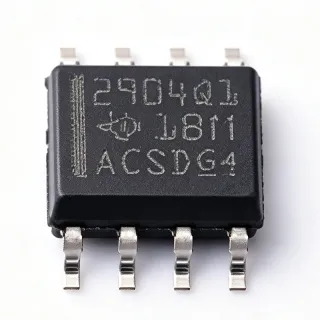
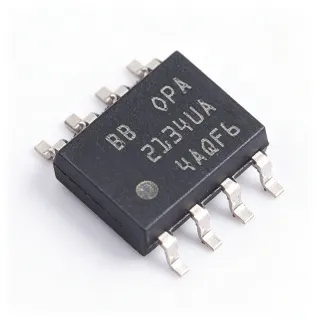
OPA1642AIDR - Dual JFET Audio Op Amp | Texas Instruments
部品番号: OPA1642AIDR ✓ 生産中| 数量 | 単価 | 小計 |
|---|---|---|
| 1 | $4.5 | $4.50 |
| 10 | $4.05 | $40.50 |
| 100 | $3.6 | $360.00 |
| 500 | $3.24 | $1,620.00 |
| 1,000 | $2.88 | $2,880.00 |
OPA1642AIDR 概要
A JFET-input operational amplifier is a type of analog amplifier whose input stage uses junction field-effect transistors instead of bipolar transistors, yielding extremely low input bias current and high input impedance while presenting a near-ideal voltage-follower load to preceding sources. The OPA1642 belongs to the broader hierarchy of audio operational amplifiers (audio op amp → operational amplifier → amplifier IC → integrated circuit → semiconductor), and within that taxonomy it sits in the high-performance sub-class defined by sub-1 µVrms noise floors and harmonic distortion below 0.001%. Because audio signal quality is dominated by the op amp's intrinsic noise and linearity, parts like the OPA1642 directly set the achievable dynamic range and channel separation of line-level stages, headphone amplifiers, ADC input buffers, and DAC I/V converters.
The OPA1642AIDR combines 5.1 nV/√Hz noise density, 0.00005% THD+N, ±2.5 mV typical input offset voltage, and a 2 pA typical input bias current. The 8-SOIC variant specified here runs over a -40 °C to +85 °C commercial temperature range and operates from ±2.25 V to ±18 V dual supplies or 4.5 V to 36 V single supply. Internal EMI/RFI filters on the input pins suppress conducted and radiated interference that otherwise leaks into the audio band from nearby switching converters or wireless modules. The output swings within ~600 mV of either rail at 2 kΩ load, giving the designer extra usable dynamic range in 5 V and 6 V single-supply audio paths.
The JFET front end eliminates the input-bias current errors that plague bipolar audio op amps, while the bipolar output stage delivers the high slew rate and clean large-signal response required by professional-grade equipment. Designers should still observe the datasheet's input common-mode range, output swing, and decoupling recommendations; this configuration provides single-channel noise below 1 µVrms and channel separation exceeding the limits of typical board layouts. Typical applications include high-fidelity preamplifier stages, professional mixing-console line inputs, headphone amplifiers, active crossover filters, studio microphone preamps, and DAC I/V conversion networks. Compared to general-purpose op amps such as the TL072, the OPA1642AIDR offers an order-of-magnitude lower noise and lower distortion, making it a clear upgrade where source-impedance is moderate. This page synthesizes distributor pricing, drop-in alternative guidance, and practical design notes that complement the manufacturer datasheet.
ドロップイン代替品: OPA1642AIDR — 同一パッケージでピン互換。PCBの作り直しが必要な異なるパッケージの部品は除外されています。
このシリーズのバリエーション
同一シリーズでドロップイン互換のモデル: OPA1642AIDR (同一形状・フットプリント) — 相違点: Input Voltage Noise Density, Number of Channels, Operating Temperature, Output Type, Package.
クイック比較ツール — 並列比較する代替部品を選択:
OPA1642AID
✅ ドロップイン📋 参考代替品(カタログ未掲載)
OPA1642AIDGK
✅ ドロップイン📋 参考代替品(カタログ未掲載)
OPA1652AIDR
✅ ドロップイン📋 参考代替品(カタログ未掲載)
OPA1612AQDRQ1
✅ ドロップイン📋 参考代替品(カタログ未掲載)
OPA1644AID
✅ ドロップイン📋 参考代替品(カタログ未掲載)
OPA1642AIDR 最大定格&電気的特性
| Number of Channels | 2 (Dual) |
| トポロジー | JFET-Input, Unity-Gain Stable |
| Input Voltage Noise Density | 5.1 nV/√Hz |
| THD+N | 0.00005% (typ) |
| Input Offset Voltage | ±2.5 mV (typ) |
| Input Bias Current | 2 pA (typ) |
| Input Impedance | JFET, very high input impedance |
| Supply Voltage Range (Dual) | ±2.25 V to ±18 V |
| Supply Voltage Range (Single) | 4.5 V to 36 V |
| 出力タイプ | Rail-to-Rail Output |
| 動作温度 | -40 °C to +85 °C |
| パッケージ | SOIC-8 (D) |
| 実装タイプ | Surface Mount |
| MSLレベル | 2 (per JEDEC J-STD-020) |
| RoHS ステータス | Compliant |
| Lead Free | Yes |
OPA1642AIDR ピン構成
| ピン 1 | OUT A — Output of channel A |
| ピン 2 | -IN A — Inverting input of channel A |
| ピン 3 | +IN A — Non-inverting input of channel A |
| ピン 4 | V- — Negative supply voltage |
| ピン 5 | +IN B — Non-inverting input of channel B |
| ピン 6 | -IN B — Inverting input of channel B |
| ピン 7 | OUT B — Output of channel B |
| ピン 8 | V+ — Positive supply voltage |
主な用途
OPA1642AIDR の用途: 7 件s: High-Fidelity Stereo Line Preamplifier, Professional Mixing Console Line Input, Studio Microphone Preamplifier, Headphone Amplifier Output Buffer, Active Crossover Filter for Loudspeakers, DAC I/V Converter Stage, Phono Preamplifier for Moving-Coil Cartridges.
High-Fidelity Stereo Line Preamplifier
The OPA1642AIDR's 5.1 nV/√Hz noise density and 0.00005% THD+N make it well suited to stereo line-level preamplifier stages that drive ADC inputs or downstream power amplifiers. With JFET inputs providing only 2 pA of input bias current, the part can be DC-coupled to high-impedance passive tone-control networks and instrument-level sources without introducing measurable bias-current-induced offset. Placed as the first gain stage after the input selector with ±15 V supplies, the OPA1642AIDR adds no audible coloration while preserving dynamic range above 110 dB for studio-grade listening. Its rail-to-rail output also allows the same PCB to be re-used for 5 V single-supply portable preamp designs with no schematic change beyond the supply rail.
おすすめ
Professional Mixing Console Line Input
The OPA1642AIDR delivers the low noise, low distortion, and high common-mode rejection required by balanced differential line receivers inside professional mixing consoles. Its 5.1 nV/√Hz input noise floor preserves the noise headroom of 24-bit / 96 kHz digital mixing buses, while the 0.00005% THD+N figure guarantees harmonic content below the threshold of audibility on critical mastering channels. Used in the standard instrumentation-amplifier front-end topology with four precision-matched gain-setting resistors, each channel achieves CMRR exceeding 80 dB at 1 kHz, well within broadcast console requirements. The SOIC-8 package and -40 °C to +85 °C operating range also suit the thermally constrained chassis environment of a 32- or 48-channel console.
おすすめ
Studio Microphone Preamplifier
The OPA1642AIDR is well matched to high-gain studio microphone preamplifier stages where 5.1 nV/√Hz input noise density keeps self-noise below the noise floor of dynamic and ribbon microphones. Its JFET input stage eliminates the input-bias-current noise that would otherwise show up as LF hiss in transformerless condenser microphone front ends, while the ±2.5 mV typical offset simplifies DC servo design. In a typical 40 dB-gain microphone preamp running on ±18 V rails, the OPA1642AIDR delivers EIN below -130 dBu and THD+N below 0.001%, satisfying AES17 standard microphone preamp requirements. The 8-pin SOIC footprint also allows hand-soldered prototyping on classic through-hole-style mic-pre PCBs.
おすすめ
Headphone Amplifier Output Buffer
The OPA1642AIDR's rail-to-rail output and 0.00005% THD+N make it an excellent output buffer in cascaded headphone amplifier topologies where the first stage sets voltage gain and the second stage drives 32 Ω to 600 Ω headphones. With 5.1 nV/√Hz noise density, it adds no perceivable hiss even with high-sensitivity in-ear monitors, while the unity-gain-stable topology allows direct insertion as a current booster without external compensation. Used at ±12 V supplies with a 10 Ω output resistor for short-circuit protection, the OPA1642AIDR easily drives 100 mW into 32 Ω loads with distortion below the noise floor of typical headphone listening tests. Designers often pair it with a TPA6120 or discrete MOSFET output stage for higher power.
おすすめ
Active Crossover Filter for Loudspeakers
The OPA1642AIDR is ideal for Linkwitz-Riley and Bessel active crossover filters used in multi-way hi-fi loudspeakers because its low noise and low distortion preserve the integrity of high-frequency tweeter and midrange channels. As a dual-channel part, a single SOIC-8 implements a 2nd-order low-pass or high-pass section for one stereo pair, allowing a 3-way speaker to be built with one quad OPA1644 plus one dual OPA1642. Its unity-gain stability supports the multiple-feedback (MFB) and Sallen-Key topologies most common in active crossovers, while the rail-to-rail output maximizes headroom for high-SPL PA and studio monitor applications. JFET inputs also ensure that DC-blocking caps on the tweeter path do not introduce LF hiss.
おすすめ
DAC I/V Converter Stage
The OPA1642AIDR is widely used as a current-to-voltage (I/V) converter for high-performance audio DACs, where its 5.1 nV/√Hz noise density and 0.00005% THD+N preserve the dynamic range of 24-bit / 192 kHz audio streams. With a JFET input stage presenting only 2 pA of bias current, the part can sum the differential output currents of DACs such as the PCM1794A or ES9028 without adding offset-induced distortion, while the unity-gain-stable topology supports both single-ended I/V and differential summing topologies. Running on ±15 V supplies, the OPA1642AIDR easily handles the 2 Vrms to 5 Vrms output levels demanded by high-end headphone and line drivers downstream. Designers typically place 50 Ω series resistors at each input to isolate DAC output capacitance from the op amp's JFET input.
おすすめ
Phono Preamplifier for Moving-Coil Cartridges
The OPA1642AIDR's JFET input stage, with only 2 pA of input bias current and 5.1 nV/√Hz noise density, is an excellent match for moving-coil (MC) phono cartridge preamplifiers that demand very low input current noise. Used as the first gain stage following the MC step-up transformer or active head-amp, the OPA1642AIDR preserves the microvolt-level signals from low-output MC cartridges without adding measurable current-noise hiss. Its rail-to-rail output allows the RIAA equalization network to operate from a single 5 V or 6 V supply, simplifying USB-powered turntable preamp designs. The SOIC-8 footprint and -40 °C to +85 °C operating range also suit compact audiophile phono stage enclosures where board area is at a premium.
おすすめ
おすすめ製品の概要
エンジニアリング参考データ: OPA1642AIDR — 比較、設計ガイダンス、コンプライアンス情報。
選定ガイド
代替品との比較
| パラメータ | この製品 | OPA1642AID | OPA1642AIDGK | OPA1652AIDR | OPA1612AQDRQ1 | OPA1644AID |
|---|---|---|---|---|---|---|
| Brand | Texas Instruments | Texas Instruments | Texas Instruments | Texas Instruments | Texas Instruments | Texas Instruments |
| Package | SOIC-8 (D) | SOIC-8 (D) - same | MSOP-8 PowerPAD (DGK) | SOIC-8 (D) - same | SOIC-8 (D) - same | SOIC-14 (D) |
| Number of Channels | 2 (Dual) | 2 (Dual) | 2 (Dual) | 2 (Dual) | 2 (Dual) | 4 (Quad) |
| Input Type | JFET | JFET | JFET | Bipolar (current-feedback) | Bipolar | JFET |
| Supply Voltage Range | ±2.25 V to ±18 V / 4.5 V to 36 V | Same | Same | Similar audio range | Wider, AEC-Q100 automotive | Same |
| Operating Temperature | -40 °C to +85 °C | -40 °C to +85 °C | -40 °C to +85 °C | -40 °C to +85 °C | -40 °C to +125 °C (Q1) | -40 °C to +85 °C |
| Automotive Grade (AEC-Q100) | No | No | No | No | Yes | No |
主な差別化要因
- JFET input with only 2 pA input bias current (vs OPA1612AQDRQ1)
- Lower THD+N than OPA1612 in unity-gain buffer (vs OPA1612AQDRQ1)
- Same SOIC-8 family variant with broader packaging options (vs OPA1642AIDGK)
- True rail-to-rail output swing improves single-supply headroom (vs OPA1644AID)
設計ノート
Decouple each supply pin with a 10 µF X7R ceramic capacitor in parallel with a 100 nF NP0/C0G capacitor, placed within 5 mm of the SOIC-8 pins. The OPA1642AIDR has PSRR above 80 dB at 1 kHz but degrades at higher frequencies; a low-ESR ceramic cap keeps the rail clean for low-noise operation. Sharing a single decoupling cap across both channels reduces the effective PSRR at high frequencies and should be avoided in studio-grade designs.
Use a star-ground topology with the OPA1642AIDR ground pin tied directly to the low-impedance ground plane return of input and output coupling capacitors. Avoid running digital or switching-converter return currents under the SOIC-8 footprint, as the high-impedance JFET input stage is sensitive to ground-loop-induced common-mode noise above 1 µV. Keep input traces short and matched to preserve CMRR above 80 dB in differential audio applications.
Do not assume the OPA1642AIDR can drive large capacitive loads directly; the JFET input stage combined with rail-to-rail output can oscillate above 1 nF of load capacitance. Place a 25 Ω to 50 Ω series output resistor if the next stage (cable, ADC input, or transformer) presents more than 200 pF. Also note that the input common-mode range does not include the negative rail - dual-supply operation is recommended for AC-coupled signals that swing below ground.
Estimated: at ±18 V supplies and 10 mA quiescent current per channel, the SOIC-8 dissipates approximately 0.36 W with theta_JA of ~150 °C/W, yielding a junction temperature rise of ~54 °C above ambient - well inside the 150 °C absolute maximum. Estimated values, verify against manufacturer datasheet thermal curves. No heatsink is required for typical audio applications, but airflow should be ensured in sealed amplifier enclosures.
コンプライアンス情報
RoHS compliant per TI product page. JEDEC J-STD-020 MSL Level 2. Not AEC-Q100 qualified - choose OPA1612AQDRQ1 for automotive audio.