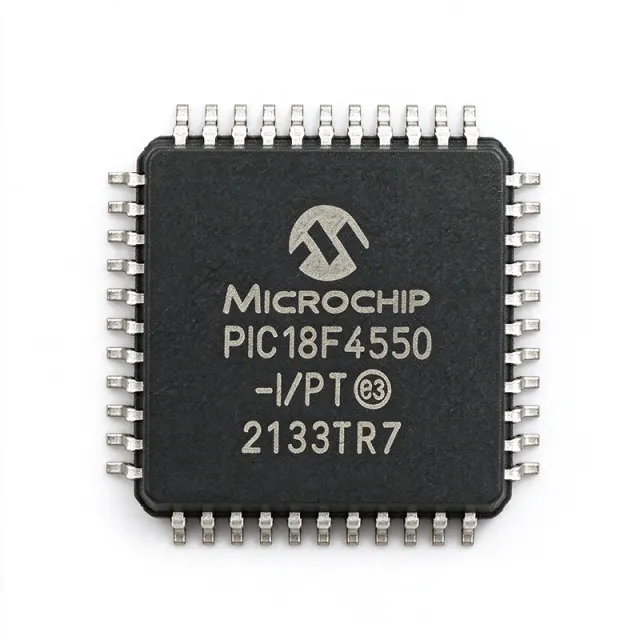
PIC18F458-E/L
PIC18F458-E/L - 8-Bit 40MHz 32KB Flash MCU w/ CAN | Microchip
The Microchip Technology PIC18F458-E/L is an 8-bit PIC18 microcontroller with integrated CAN (Controller Area Network) module, 32KB of on-chip Flash program memory, 1536 bytes of RAM, and 256 bytes of EEPROM, operating at up to 40 MHz and housed in a 44-pin PLCC (J-lead) package. The 'E' suffix denotes the Extended industrial temperature grade (-40C to +125C), and the 'L' suffix denotes the PLCC package. The part integrates a 10-bit ADC with up to 8 channels, a CAN 2.0B controller, MSSP (SPI/I2C), USART, and 34 digital I/O pins, making it well-suited for embedded networking and motor control.
A PIC microcontroller is a microcontroller unit (MCU) based on Microchip's PIC (Peripheral Interface Controller) RISC architecture, which combines a Harvard-architecture CPU core with on-chip Flash, RAM, and a rich peripheral set. PIC18 is the high-performance 8-bit family using an enhanced instruction set, 16-bit wide instructions, and a hardware multiply engine. In a system hierarchy, PIC18F458 sits within PIC microcontrollers -> 8-bit microcontrollers -> microcontrollers (MCU) -> semiconductor ICs. The integrated CAN module is the defining feature distinguishing the PIC18F458 from the otherwise identical PIC18F452, enabling direct CAN-bus connectivity in automotive and industrial networks.
Key features include: 32KB self-programmable Flash with 1K erase granularity, 1536-byte SRAM, 256-byte EEPROM, 40 MHz max clock (10 MIPS throughput), hardware CAN 2.0B module, 10-bit 8-channel ADC with auto-acquisition, Capture/Compare/PWM (CCP) modules, two enhanced CCP modules for motor-control PWM, two 8-bit timers plus three 16-bit timers, two analog comparators, and an ICD (In-Circuit Debugger) interface. The device supports 5V operation and supports both internal and external oscillator modes including HS, XT, LP, RC and the 4x PLL.
The PIC18F458-E/L is fabricated on a non-volatile Flash CMOS process and integrates a hardware CAN 2.0B engine with acceptance filters, providing bus arbitration, error detection, and automatic retransmission conforming to ISO 11898. The PIC18 enhanced core executes one instruction every four clock cycles, supporting linear program memory up to 2 MB via a 21-bit program counter. Multiple power-managed modes (Run, Idle, Sleep) and a low-power watchdog timer support battery-backed designs.
Typical applications include CAN node endpoints in industrial automation, automotive body and chassis ECUs, building automation networks (BACnet/HVAC), motor-control inverter boards, smart-sensor aggregators, and CAN-based point-of-sale equipment. The extended temperature grade (-40C to +125C) opens use cases in under-hood automotive and outdoor industrial cabinets. Common companion parts include the MCP2551 CAN transceiver, MCP2515 stand-alone CAN controller (for legacy nodes), and TC1015 LDO for 5V rail regulation.
When designing with the PIC18F458-E/L, ensure the CAN TX/RX pins are paired with a proper ISO 11898 transceiver such as the MCP2551, and that bus termination (120 ohm) is present at each cable end. Programming/debugging is supported through MPLAB ICD 5 / ICD 4 / PICKit 4 / PICKit 5 using the ICSP interface on RB6/RB7. The 'E' (extended) grade variant should be selected when the operating environment exceeds the standard 0C-70C commercial range.
This page synthesizes drop-in Microchip PIC18F alternates, verified distributor pricing, and application notes not consolidated in the original manufacturer datasheet - useful as a quick-reference for procurement and design engineers evaluating 44-pin PLCC CAN-enabled 8-bit MCU options.
Cotización
Contacto