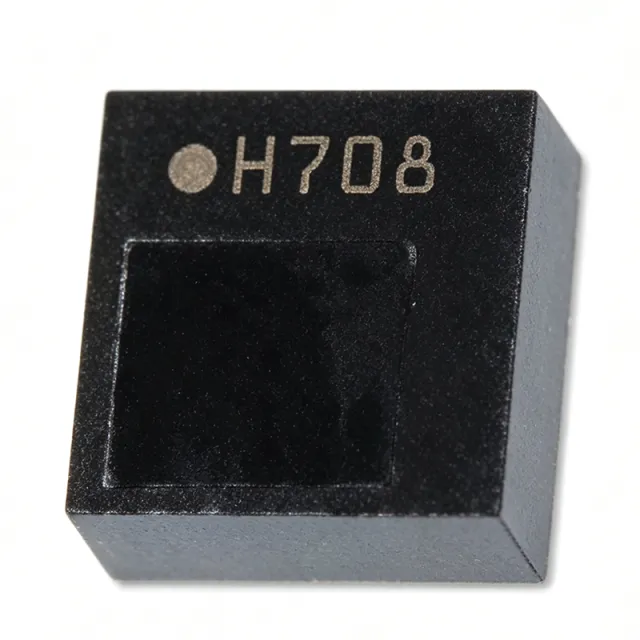
HTS221 - Capacitive Digital Humidity & Temperature Sensor | STMicroelectronics
N.º de pieza: HTS221 ✓ Activo| Cant. | Precio unitario | Total |
|---|---|---|
| 1 | $6.5455 | $6,55 |
| 10 | $4.7273 | $47,27 |
| 100 | $4.1818 | $418,18 |
| 500 | $4 | $2.000,00 |
| 1.000 | $3.8182 | $3.818,20 |
HTS221 Descripción general
A humidity and temperature sensor is a device that measures the amount of water vapor in the air and the ambient temperature, converting these physical quantities into digital signals for processing. In the system hierarchy, the HTS221 is a MEMS sensor that falls under the category of environmental sensors, which are part of the broader sensor family used in IoT, automotive, and industrial applications. Its role is to provide real-time environmental data that enables smart systems to react to changes in humidity and temperature.
Key features of the HTS221 include a relative humidity accuracy of ±3.5% RH (20-80% RH), a temperature accuracy of ±0.5 °C (15-40 °C), and a humidity resolution of 0.004% RH. The sensor operates from a 1.7V to 3.6V supply, with a typical current consumption of 2 µA at 1 Hz output data rate, making it ideal for battery-powered devices. It communicates via I2C and SPI interfaces, and includes a programmable interrupt output for threshold detection.
The HTS221 uses a capacitive sensing principle, where a polymer dielectric absorbs water vapor, changing the capacitance of the sensing element. This change is converted to a digital signal by a 16-bit ADC, providing high resolution and stability. The sensor also features an embedded heater for dew point measurement and condensation prevention, enhancing its versatility in demanding environments.
Typical applications include smart home thermostats, HVAC systems, weather stations, and wearable health monitors. In smart thermostats, the HTS221 provides accurate humidity and temperature data to optimize comfort and energy efficiency. In wearables, its low power consumption extends battery life while enabling continuous environmental monitoring.
When designing with the HTS221, ensure proper PCB layout with a clean ground plane and adequate decoupling capacitors (100 nF) near the VDD pin. The sensor should be placed away from heat sources and direct airflow to avoid measurement errors. For best performance, follow the recommended soldering profile and reflow conditions specified in the datasheet.
Alternativas directas para HTS221 — mismo encapsulado, compatible pin a pin. Se excluyen las piezas de otro encapsulado que requieren retrabajo de la PCB.
Variantes de esta serie
Modelos de la misma serie compatibles directamente con HTS221 (mismo factor de forma y huella) — difiere en Current Consumption, Humidity Range, Interface, Package, Temperature Accuracy.
Herramienta de comparación rápida — seleccione piezas alternativas para compararlas lado a lado:
HTS221TR
✓ En stock
$1.6 / unidad
Ver hoja de datos →SHT30-DIS-B
📋 Alternativa de referencia (no en el catálogo)
SHTC3
📋 Alternativa de referencia (no en el catálogo)
HDC1080
📋 Alternativa de referencia (no en el catálogo)
HTS221 Valores máximos y características eléctricas
| Humidity Accuracy | ±3.5% RH (20-80% RH) |
| Temperature Accuracy | ±0.5 °C (15-40 °C) |
| Humidity Resolution | 0.004% RH |
| Temperature Resolution | 0.01 °C |
| Tensión de alimentación | 1.7V to 3.6V |
| Current Consumption | 2 µA at 1 Hz ODR |
| Interfaz | I2C and SPI |
| Rango de temperatura de funcionamiento | -40°C to +120°C |
| Humidity Range | 0-100% RH |
| Encapsulado | HLGA 2.0 x 2.0 x 0.9 mm |
| Output Data Rate | 1 Hz to 12.5 Hz |
| Interrupt Output | Programmable |
| Embedded Heater | Yes |
| Estado RoHS | Compliant |
| Nivel MSL | 1 |
Configuración de pines de HTS221
| Pin 1 | VDD — Power supply (1.7V to 3.6V) |
| Pin 2 | GND — Ground |
| Pin 3 | SDA — I2C data line (open-drain) |
| Pin 4 | SCL — I2C clock line |
| Pin 5 | CS — Chip select (low for SPI, high for I2C) |
| Pin 6 | INT — Interrupt output (programmable) |
Aplicaciones típicas
HTS221 es adecuado para 6 aplicacións: Smart Thermostat, Wearable Health Monitor, IoT Environmental Monitoring, HVAC System, Weather Station, Smart Agriculture.
Smart Thermostat
The HTS221 provides accurate humidity and temperature data for smart thermostats, enabling precise climate control and energy efficiency. Its low power consumption (2 µA) allows continuous monitoring without draining batteries. The I2C interface simplifies integration with microcontrollers, and the small package fits compact thermostat designs. The sensor's accuracy (±3.5% RH, ±0.5 °C) ensures reliable comfort control, while the programmable interrupt can trigger alerts for humidity thresholds, preventing mold growth. Compared to other sensors, the HTS221's low power and small size make it ideal for battery-powered thermostats, though its accuracy is slightly lower than some competitors.
Recomendado
Wearable Health Monitor
In wearable health monitors, the HTS221 tracks ambient humidity and temperature to provide context for physiological measurements. Its ultra-low power consumption (2 µA) is critical for battery life, and the 2.0x2.0 mm package fits into small wearable devices. The sensor's I2C interface connects easily to BLE SoCs like the nRF52832. The embedded heater can be used for dew point measurement, useful in sweat detection. The HTS221's accuracy is sufficient for consumer wearables, and its low power enables continuous operation. Designers must ensure proper placement away from body heat to avoid temperature measurement errors.
Recomendado
IoT Environmental Monitoring
The HTS221 is ideal for IoT nodes that monitor environmental conditions in smart buildings, agriculture, and logistics. Its low power consumption enables battery-powered operation for years, and the I2C/SPI interface allows easy integration with various MCUs. The sensor's accuracy (±3.5% RH, ±0.5 °C) is adequate for most monitoring applications. The programmable interrupt can be used to wake the system when humidity or temperature exceeds thresholds, saving power. The small package and wide operating temperature range (-40°C to +120°C) make it suitable for outdoor and industrial environments. Compared to other sensors, the HTS221 offers a good balance of power, size, and cost.
Recomendado
HVAC System
In HVAC systems, the HTS221 provides real-time humidity and temperature data to optimize comfort and energy efficiency. Its accuracy (±3.5% RH, ±0.5 °C) is sufficient for HVAC control, and the I2C interface simplifies integration with building automation controllers. The sensor's low power consumption is beneficial for battery-powered thermostats. The programmable interrupt can trigger ventilation or dehumidification when humidity exceeds setpoints. The HTS221's small package allows easy placement in ductwork or wall-mounted units. Compared to industrial-grade sensors, the HTS221 offers a cost-effective solution for residential and commercial HVAC.
Recomendado
Weather Station
The HTS221 is used in personal weather stations to measure humidity and temperature. Its accuracy (±3.5% RH, ±0.5 °C) is suitable for consumer-grade stations, and the low power consumption allows solar-powered operation. The I2C interface connects to microcontrollers like the Arduino. The sensor's wide operating temperature range (-40°C to +120°C) ensures reliable outdoor performance. The embedded heater can prevent condensation on the sensor, improving reliability in humid conditions. Compared to professional weather sensors, the HTS221 offers a compact and affordable solution for hobbyist and semi-professional use.
Recomendado
Smart Agriculture
In smart agriculture, the HTS221 monitors humidity and temperature in greenhouses and fields to optimize crop growth. Its low power consumption enables long-term battery-powered deployment, and the I2C interface allows easy integration with LoRaWAN modules. The sensor's accuracy (±3.5% RH, ±0.5 °C) is adequate for agricultural monitoring. The programmable interrupt can alert farmers when conditions deviate from optimal ranges. The small package and robust operating temperature range make it suitable for outdoor use. Compared to specialized agricultural sensors, the HTS221 offers a cost-effective solution for distributed monitoring networks.
Recomendado
Resumen de productos recomendados
Datos de referencia de ingeniería para HTS221 — comparación, orientación de diseño e información de cumplimiento.
Guía de selección
Comparación con alternativas
| Parámetro | Este producto | HTS221TR | SHT30-DIS-B | SHTC3 | HDC1080 |
|---|---|---|---|---|---|
| Package | HLGA 2.0x2.0x0.9 mm | HLGA 2.0x2.0x0.9 mm - same | DFN-8 2.5x2.5 mm - different | DFN-4 2.0x2.0 mm - different | WSON-6 2.0x2.0 mm - different |
| Brand | STMicroelectronics | STMicroelectronics | Sensirion | Sensirion | Texas Instruments |
| Humidity Accuracy | ±3.5% RH | ±3.5% RH | ±2% RH | ±2% RH | ±2% RH |
| Temperature Accuracy | ±0.5 °C | ±0.5 °C | ±0.2 °C | ±0.2 °C | ±0.2 °C |
| Supply Voltage | 1.7V to 3.6V | 1.7V to 3.6V | 2.4V to 5.5V | 1.62V to 3.6V | 2.7V to 5.5V |
| Current Consumption | 2 µA at 1 Hz | 2 µA at 1 Hz | 4.8 µA at 1 Hz | 1 µA at 1 Hz | 1.3 µA at 1 Hz |
| Interface | I2C and SPI | I2C and SPI | I2C | I2C | I2C |
| Embedded Heater | Yes | Yes | No | No | No |
Diferenciadores clave
- Ultra-low power consumption of 2 µA at 1 Hz (frente a SHT30-DIS-B)
- Smaller package size of 2.0x2.0 mm (frente a SHT30-DIS-B)
- Embedded heater for dew point measurement (frente a SHT30-DIS-B)
Notas de diseño
Place a 100 nF decoupling capacitor as close as possible to the VDD pin. Use a clean ground plane and avoid routing high-speed signals near the sensor. For I2C, add pull-up resistors (typically 4.7 kΩ) on SDA and SCL lines. Ensure the CS pin is tied high for I2C mode or low for SPI mode.
The HTS221 measures ambient temperature, so it should be placed away from heat sources such as MCUs, power regulators, and other components that generate heat. Provide adequate airflow around the sensor. If the sensor is mounted on a PCB, consider thermal isolation slots to minimize heat transfer from the board.
Avoid exposing the sensor to condensation or direct water contact, as this can damage the sensing element. The embedded heater can be used to prevent condensation, but it will increase power consumption. Also, ensure the I2C address (0x5F) does not conflict with other devices on the bus. For SPI mode, the CS pin must be toggled correctly to avoid communication errors.
Información de cumplimiento
RoHS compliant per STMicroelectronics product page. Not AEC-Q100 qualified; for automotive use, consider AEC-Q100 qualified sensors.







