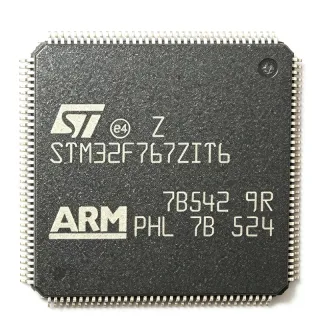
MAC7111MAG40 - 32-Bit ARM7 MCU 512KB Flash 144-LQFP | NXP
N.º de pieza: MAC7111MAG40 ✗ Fin de vida| Cant. | Precio unitario | Total |
|---|---|---|
| 1 | $18.5 | $18,50 |
| 10 | $16.2 | $162,00 |
| 100 | $13.8 | $1.380,00 |
| 500 | $11.45 | $5.725,00 |
| 1.000 | $9.95 | $9.950,00 |
MAC7111MAG40 Descripción general
Background: A 32-bit microcontroller (MCU) is a single-chip computer that integrates a processor core, program memory (Flash/ROM), data memory (RAM), and a rich peripheral set. The ARM7TDMI-S core is a 32-bit RISC architecture featuring the Thumb instruction set for improved code density, widely adopted in automotive and industrial embedded systems. Within the broader taxonomy, the MAC7111MAG40 belongs to the MCU -> microcontroller -> embedded processor -> semiconductor IC hierarchy, and to the Flash-based automotive MCU sub-family.
Key features include 512KB program Flash, 32KB SRAM, 50 MHz core clock, 112 GPIO lines, 16-channel 10-bit ADC, two CAN 2.0A/B controllers, an external bus interface for memory expansion, and AEC-Q100 Grade 1 qualification supporting -40C to +125C operation. The MAC7111 family is pin-compatible with MAC7120/MAC7130/MAC7140 devices, allowing scalability between Flash sizes and peripheral mixes.
Architecture depth: the MAC7111MAG40 uses the ARM7TDMI-S core with a 3-stage pipeline and Von Neumann bus. Its embedded Flash controller accelerates in-application programming, and the Enhanced Capture Timer (ECT) module supports up to 10 channels for precise PWM and pulse measurement. The device integrates a 16-channel 10-bit ADC with 7 us minimum conversion time.
Typical applications include automotive body control modules (BCMs), instrument clusters, HVAC controllers, lighting modules, and CAN node ECUs. AEC-Q100 Grade 1 qualification makes it suitable for under-hood and chassis systems exposed to high thermal stress.
Design consideration: when migrating from the MAC7110 to MAC7111 family, verify the external bus timing parameters against any SRAM or peripheral glue logic, and ensure that the 144-LQFP pad layout and pinout match the MAC71xx pin-compatible devices to enable drop-in scalability.
This page consolidates distributor pricing, pin-compatible drop-in alternatives, and design notes that go beyond the manufacturer datasheet, supporting both new designs and lifecycle refresh decisions for long-life automotive programs.
Alternativas directas para MAC7111MAG40 — mismo encapsulado, compatible pin a pin. Se excluyen las piezas de otro encapsulado que requieren retrabajo de la PCB.
Herramienta de comparación rápida — seleccione piezas alternativas para compararlas lado a lado:
MAC7110MAG40
✅ Sustitución directa📋 Alternativa de referencia (no en el catálogo)
MAC7120MAG40
✅ Sustitución directa📋 Alternativa de referencia (no en el catálogo)
MAC7121MAG40
✅ Sustitución directa📋 Alternativa de referencia (no en el catálogo)
MAC7141MAG40
✅ Sustitución directa📋 Alternativa de referencia (no en el catálogo)
MAC7142MAG40
✅ Sustitución directa📋 Alternativa de referencia (no en el catálogo)
S9S12GN32F1MLC
✅ Sustitución directa ⚠️ Especificaciones sin verificar📋 Alternativa de referencia (no en el catálogo)
MAC7111MAG40 Valores máximos y características eléctricas
| Core Architecture | ARM7TDMI-S (32-bit RISC) |
| Core Clock Speed | 50 MHz |
| Program Memory | 512 KB Flash |
| RAM | 32 KB |
| Tensión de alimentación | 2.35 V to 2.75 V (core), 5 V I/O |
| I/O Ports | 112 GPIO |
| ADC | 16-channel, 10-bit |
| CAN | 2x CAN 2.0A/B controllers |
| External Bus | Yes (with chip-select outputs) |
| Timers | Enhanced Capture Timer (ECT), 10 channels |
| Temperatura de funcionamiento | -40C to +125C (AEC-Q100 Grade 1) |
| Encapsulado | 144-LQFP (20x20 mm, 0.5 mm pitch) |
| Tipo de montaje | Surface Mount |
| Nivel MSL | 3 (168 hours) |
| Estado RoHS | Compliant |
Guía de configuración de pines de MAC7111MAG40 144-lqfp (20x20 mm, 0.5 mm pitch)
Configuración de pines para MAC7111MAG40 (encapsulado 144-lqfp (20x20 mm, 0.5 mm pitch)). Este CI digital incluye GPIO, interfaces de comunicación (UART, SPI, I2C) y pines de alimentación. Consulte la hoja de datos del fabricante para conocer las funciones alternativas de los pines y las opciones de configuración. Esencial para el diseño de sistemas embebidos y el diseño de PCB.

No hay datos detallados de patillaje disponibles para MAC7111MAG40.
Consulte la hoja de datos para ver la configuración completa de patillas.
Aplicaciones típicas
MAC7111MAG40 es adecuado para 6 aplicacións: Automotive Body Control Module (BCM), Automotive Instrument Cluster, HVAC Control Module, Automotive Lighting Control Module, CAN Node ECU / Sensor Cluster, Industrial CAN-Based Controller.
Automotive Body Control Module (BCM)
The MAC7111MAG40 fits automotive BCM applications because it integrates two CAN 2.0 controllers, 112 GPIO, and AEC-Q100 Grade 1 qualification covering -40C to +125C. Its 50 MHz ARM7TDMI-S core plus 512 KB Flash comfortably runs lighting, door, mirror, and wiper control logic together with CAN-based diagnostics. The 144-LQFP footprint gives designers abundant GPIO for relay drivers and switch inputs. Compared with newer Cortex-M BCM MCUs, the MAC7111MAG40 offers lower unit cost at the expense of newer peripherals, making it ideal for high-volume entry-level BCMs.
Recomendado
Automotive Instrument Cluster
Driving instrument cluster stepper gauges and TFT displays benefits from the MAC7111MAG40's 50 MHz core, 32 KB RAM, and 16-channel 10-bit ADC for analog gauge position sensing. The external bus interface can attach an external graphics controller or memory, while dual CAN enables gateway communication with the powertrain CAN bus. AEC-Q100 Grade 1 qualification ensures cluster operation across the full automotive thermal range. The 144-LQFP package provides sufficient GPIO for multiple stepper motor drivers and indicator LEDs.
Recomendado
HVAC Control Module
The MAC7111MAG40 is well suited for HVAC control modules because its 16-channel 10-bit ADC digitizes multiple temperature, pressure, and airflow sensor signals simultaneously. The Enhanced Capture Timer provides precise PWM outputs for blower motor speed control and blend door actuators, while the 50 MHz core handles PID control loops and CAN networking. AEC-Q100 Grade 1 qualification supports under-dash mounting conditions. The 144-LQFP footprint accommodates all HVAC I/O without external bus expansion.
Recomendado
Automotive Lighting Control Module
Headlamp levelling, adaptive lighting, and LED matrix control modules leverage the MAC7111MAG40's 112 GPIO and Enhanced Capture Timer to drive multiple PWM channels for dimming and beam positioning. Its dual CAN 2.0 interfaces connect to body and chassis networks, while AEC-Q100 Grade 1 qualification ensures operation near the headlamp thermal envelope. 512 KB Flash stores complex lighting algorithms and diagnostics. Compared with smaller automotive MCUs, the 144-LQFP package gives ample GPIO for matrix LED drivers.
Recomendado
CAN Node ECU / Sensor Cluster
Distributed CAN sensor nodes for chassis and body systems rely on the MAC7111MAG40 to aggregate switch, sensor, and actuator signals and forward them over CAN 2.0. Its 16-channel ADC samples wheel-speed, suspension-height, and temperature sensors, while dual CAN ports support gateway topologies. AEC-Q100 Grade 1 qualification supports under-hood chassis locations. The 512 KB Flash stores CAN stack, diagnostics (UDS/KWP2000), and bootloader. The 144-LQFP package suits dense sensor hubs with many analog channels.
Recomendado
Industrial CAN-Based Controller
Beyond automotive, the MAC7111MAG40 serves industrial CAN-based controllers such as programmable logic controllers, motor drives, and remote I/O gateways. Its dual CAN interfaces and 16-channel ADC suit multi-axis motor control boards, while the 144-LQFP package and -40C to +125C thermal range handle factory-floor conditions. 512 KB Flash supports IEC 61131 application logic and CANopen stacks. Compared with newer Cortex-M industrial MCUs, the MAC7111MAG40 provides proven AEC-Q100 robustness at competitive cost.
Recomendado
Resumen de productos recomendados
Datos de referencia de ingeniería para MAC7111MAG40 — comparación, orientación de diseño e información de cumplimiento.
Guía de selección
Comparación con alternativas
| Parámetro | Este producto | MAC7110MAG40 | MAC7120MAG40 | MAC7121MAG40 | MAC7141MAG40 | MAC7142MAG40 |
|---|---|---|---|---|---|---|
| Brand | NXP Semiconductors | NXP Semiconductors | NXP Semiconductors | NXP Semiconductors | NXP Semiconductors | NXP Semiconductors |
| Package | 144-LQFP (20x20 mm) | 144-LQFP (20x20 mm) - same | 144-LQFP (20x20 mm) - same | 144-LQFP (20x20 mm) - same | 144-LQFP (20x20 mm) - same | 144-LQFP (20x20 mm) - same |
| Core | ARM7TDMI-S 32-bit | ARM7TDMI-S 32-bit | ARM7TDMI-S 32-bit | ARM7TDMI-S 32-bit | ARM7TDMI-S 32-bit | ARM7TDMI-S 32-bit |
| Clock Speed | 50 MHz | 50 MHz | 50 MHz | 50 MHz | 50 MHz | 50 MHz |
| RAM | 32 KB | 32 KB | 32 KB | 32 KB | 32 KB | 32 KB |
| CAN Controllers | 2x CAN 2.0A/B | 2x CAN 2.0A/B | 2x CAN 2.0A/B | 2x CAN 2.0A/B | 2x CAN 2.0A/B | 2x CAN 2.0A/B |
| ADC | 16-ch, 10-bit | 16-ch, 10-bit | 16-ch, 10-bit | 16-ch, 10-bit | 16-ch, 10-bit | 16-ch, 10-bit |
| Automotive Grade | AEC-Q100 Grade 1 | AEC-Q100 Grade 1 | AEC-Q100 Grade 1 | AEC-Q100 Grade 1 | AEC-Q100 Grade 1 | AEC-Q100 Grade 1 |
| Operating Temperature | -40C to +125C | -40C to +125C | -40C to +125C | -40C to +125C | -40C to +125C | -40C to +125C |
Diferenciadores clave
- Pin-compatible MAC71xx family scalability (frente a MAC7110MAG40)
- Dual CAN 2.0 controllers integrated (frente a MAC7110MAG40)
- AEC-Q100 Grade 1 qualification (frente a Non-automotive Cortex-M MCU)
- External bus interface for memory expansion (frente a MAC7110MAG40)
Notas de diseño
Estimated: the MAC7111MAG40 core consumes approximately 80 mA at 50 MHz from the 2.5 V rail, requiring a low-noise LDO with at least 200 mA headroom for in-rush. Designers should place a 10 uF bulk ceramic plus a 0.1 uF decoupling cap adjacent to each VDD/VSS pair and add a ferrite bead if the 5 V supply is shared with switching regulators.
The 144-LQFP package has a 0.5 mm pitch, demanding PCB land patterns per IPC-7351 with 0.30 mm pads and 0.20 mm solder mask expansion. Route CAN differential pairs (CANH, CANL) as a 100 ohm impedance matched pair within 50 mils length tolerance, and keep ADC analog traces short and guarded by ground pours to avoid digital switching noise coupling into sensor readings.
The MAC7111MAG40 is in NRND status, meaning new designs should target the MAC71xx successor or the S32K automotive MCU family rather than committing to long-term PPAP builds. When using the external bus, verify the chip-select timing against any SRAM or peripheral glue logic; misconfigured wait-state registers cause bus faults and watchdog resets.
Estimated: with theta_JA near 35 C/W on a 4-layer JEDEC PCB, continuous 50 MHz operation reaches roughly 110 C junction at 85 C ambient. For under-hood applications approaching 125 C ambient, designers should add thermal vias beneath the exposed pad and consider a 1-oz copper pour on top and bottom layers.
Información de cumplimiento
AEC-Q100 Grade 1 qualified per NXP product documentation. RoHS compliant. Conflict-minerals compliant per NXP policy.