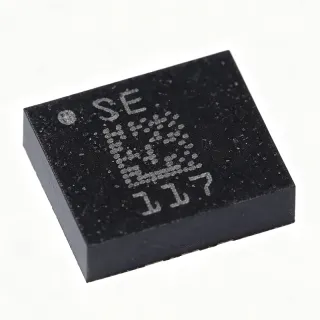
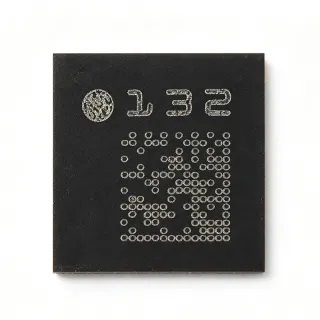
MMA5212KWR2 - 120g X-Axis PSI5 Inertial Sensor | NXP Semiconductors
N.º de pieza: MMA5212KWR2 ✗ Fin de vida| Cant. | Precio unitario | Total |
|---|---|---|
| 1 | $12.5 | $12,50 |
| 10 | $11.2 | $112,00 |
| 100 | $9.85 | $985,00 |
| 500 | $8.4 | $4.200,00 |
| 1.000 | $7.1 | $7.100,00 |
MMA5212KWR2 Descripción general
A PSI5 Inertial Sensor is a self-contained satellite accelerometer that communicates with the host ECU over the Peripheral Sensor Interface 5 (PSI5) automotive standard, a two-wire current-loop interface widely adopted for airbag front and side satellite crash sensors. Within the broader sensor taxonomy, PSI5 inertial sensors belong to MEMS accelerometers, which fall under the accelerometer, motion sensor, and inertial measurement unit family (accelerometer -> motion sensor -> inertial sensor -> MEMS sensor -> semiconductor). The PSI5 standardized bus allows multiple sensors to share wiring and simplifies airbag restraint system architecture.
Key features of the MMA5212KWR2 include a +/-120g full-scale measurement range, low-pass overdamped frequency response optimized for crash pulse capture, integrated PSI5 Manchester/Half-Bit data transmission, on-board self-test capability, and AKLV27 protocol compatibility. The accelerometer's overdamped mechanical transfer function eliminates the need for external low-pass filtering for crash pulse characterization, while integrated EEPROM stores calibration coefficients for sensitivity and offset compensation at production trim.
Architecturally, the device integrates a surface-micromachined MEMS proof mass, a sigma-delta front-end, and a PSI5 transceiver with on-chip temperature compensation. The overdamped mechanical response is engineered to have a flat frequency response within the airbag crash-pulse bandwidth, while PSI5 synchronization supports time-multiplexed operation of up to four satellite sensors on a single ECU channel. The MMA5212KWR2 is specified for the automotive temperature grade (-40C to +125C).
Typical applications include front and side airbag satellite crash sensors, seatbelt pretensioner sensors, knee airbag occupant detection, and pedestrian protection impact detection units. AEC-Q100 qualification, combined with PSI5 interoperability, makes the part particularly well-suited for distributed airbag architectures where each sensor is positioned remotely from the central ECU and communicates reliably over a single twisted pair.
When designing with this device, follow the PSI5 bus wiring topology (twisted pair, daisy-chain or parallel configuration) and observe the ECU receiver synchronization requirements. Proper PCB layout includes a star ground reference, robust power supply decoupling at the device, and routing discipline to keep the PSI5 pair away from high-current switching traces to preserve signal integrity for crash-event measurement.
This page synthesizes distributor pricing, drop-in alternatives, and practical design notes that are not aggregated in any single manufacturer datasheet view.
Alternativas directas para MMA5212KWR2 — mismo encapsulado, compatible pin a pin. Se excluyen las piezas de otro encapsulado que requieren retrabajo de la PCB.
Variantes de esta serie
Modelos de la misma serie compatibles directamente con MMA5212KWR2 (mismo factor de forma y huella) — difiere en Package, Supply Voltage, Axis, Sensor Type, RoHS Status.
Herramienta de comparación rápida — seleccione piezas alternativas para compararlas lado a lado:
MMA5212LWR2
✅ Sustitución directa📋 Alternativa de referencia (no en el catálogo)
MMA5212AKW
✅ Sustitución directa ⚠️ Especificaciones sin verificar✓ En stock
$9.4 / unidad
Ver hoja de datos →MMA5224AKW
✅ Sustitución directa ⚠️ Especificaciones sin verificar✓ En stock
$4.95 / unidad
Ver hoja de datos →MMA5224KWR2
✅ Sustitución directa📋 Alternativa de referencia (no en el catálogo)
AD22301
✅ Sustitución directa📋 Alternativa de referencia (no en el catálogo)
AD22300
✅ Sustitución directa📋 Alternativa de referencia (no en el catálogo)
MMA5212KWR2 Valores máximos y características eléctricas
| Tipo de sensor | Accelerometer (single-axis, X-axis, overdamped) |
| Rango de medición | ±120 g |
| Axis | X (lateral) |
| Tipo de salida | PSI5 digital (Manchester / Half-Bit encoded) |
| Tensión de alimentación | 5 V / 9 V / 12 V / 15 V (PSI5 standard) |
| Interface Protocol | PSI5 Version 1.3 and AKLV27 |
| Temperatura de funcionamiento | -40 °C to +125 °C |
| Encapsulado | 16-pin QFN EP (6 × 6 mm) with exposed pad |
| Tipo de montaje | Surface Mount |
| Self-Test | Integrated (electrostatic self-test) |
| Programmability | Internal EEPROM for calibration coefficients |
| Automotive Qualification | AEC-Q100 (Freescale/NXP SafeAssure family) |
| Mechanical Response | Overdamped (suitable for crash pulse capture) |
| Estado RoHS | Compliant |
| Lead-Free Status | Lead Free (per digchip listing) |
| Sin halógenos | Compliant (per GlobalSpec listing) |
Configuración de pines de MMA5212KWR2
| Pin 1 | PSI5_DATA — PSI5 Manchester data line / Vsupply input (tied to host ECU) |
| Pin 2 | NC — Not connected (per datasheet) |
| Pin 3 | GND — Ground reference |
| Pin 4 | NC — Not connected (per datasheet) |
| Pin 5 | NC — Not connected (per datasheet) |
| Pin 6 | NC — Not connected (per datasheet) |
| Pin 7 | NC — Not connected (per datasheet) |
| Pin 8 | NC — Not connected (per datasheet) |
| Pin 9 | GND — Ground reference |
| Pin 10 | NC — Not connected (per datasheet) |
| Pin 11 | NC — Not connected (per datasheet) |
| Pin 12 | NC — Not connected (per datasheet) |
| Pin 13 | NC — Not connected (per datasheet) |
| Pin 14 | NC — Not connected (per datasheet) |
| Pin 15 | NC — Not connected (per datasheet) |
| Pin 16 | EP — Exposed pad - thermal and ground tie (PCB mounting) |
Aplicaciones típicas
MMA5212KWR2 es adecuado para 6 aplicacións: Frontal Airbag Satellite Crash Sensor, Side-Impact Airbag Satellite Sensor, Seatbelt Pretensioner Sensor, Pedestrian Protection Impact Sensor, Knee Airbag Occupant Sensing, Distributed Crash Sensor Network ECU.
Frontal Airbag Satellite Crash Sensor
The MMA5212KWR2 is mounted at the front crashtube or radiator support to capture the frontal crash signature within the first 10-15 ms of impact. Its ±120 g range handles the high-amplitude deceleration pulses generated in a 50 km/h rigid-barrier impact, while the overdamped mechanical transfer function reproduces the crash pulse without resonant ringing that would normally require external low-pass filtering. The device communicates the digitized acceleration stream to the airbag ECU over the PSI5 two-wire bus, allowing the ECU to discriminate between deployment-required and non-deployment events with high confidence. Compared with analog-output sensors like the AD22301, the digital PSI5 link avoids analog noise pickup over long harness runs - a critical advantage in noisy engine-bay environments.
Recomendado
Side-Impact Airbag Satellite Sensor
Mounted in the B-pillar or door cavity, the MMA5212KWR2 detects the lateral acceleration signature of a side collision within 5-10 ms. The X-axis (lateral) sensitivity is aligned with the crash direction of side-impact events, and the 120 g ceiling preserves headroom for the brief but extremely high amplitude pulses common in pole-impact tests. PSI5 bus compatibility lets the side satellite share wiring infrastructure with front satellite sensors, lowering harness complexity. The part's overdamped response ensures the digital accelerometer data sent to the ECU is a clean representation of the true crash waveform, not a corrupted version amplified by mechanical resonance.
Recomendado
Seatbelt Pretensioner Sensor
Used as a remote crash anticipation sensor for seatbelt pretensioner firing decisions, the MMA5212KWR2 communicates with the central ECU over PSI5 to flag a high-G event quickly enough to retract the belt before occupant forward excursion. Its 120 g dynamic range provides sufficient margin for the rapid acceleration that occurs even in moderate frontal crashes, and the PSI5 synchronization enables the seatbelt sensor sample to be time-aligned with frontal sensor data for combined-crash discrimination logic. AEC-Q100 qualification provides the reliability needed for this safety-critical function, where missed or false detection carries regulatory and liability risk.
Recomendado
Pedestrian Protection Impact Sensor
Embedded behind the front bumper, the MMA5212KWR2 acts as a pedestrian-impact satellite for active hood deployment and pedestrian airbag systems. The 120 g range and overdamped response make it well suited to detect the relatively short-duration, high-amplitude acceleration pulses generated by pedestrian lower-leg impacts. The PSI5 interface allows the bumper sensors to be wired in parallel or daisy-chain topologies, reducing wiring harness mass in the energy-absorbing zone of the bumper. NXP's SafeAssure family designation indicates that the part was designed and validated for this particular safety-critical use case.
Recomendado
Knee Airbag Occupant Sensing
When deployed in distributed architectures for knee airbag deployment decisions, the MMA5212KWR2 provides lateral crash-G data to the ECU via PSI5. The single X-axis sensitivity is convenient where the crash direction is known and primary, and the integrated PSI5 bus interface reduces the harness count inside the dashboard. The 6x6 mm QFN footprint allows the satellite to be tucked into tight door or knee-bolster locations where PCB space is constrained, while its automotive-grade operating range (-40C to +125C) tolerates the high thermal environment near instrument panels.
Recomendado
Distributed Crash Sensor Network ECU
The MMA5212KWR2 is integrated into the airbag ECU's distributed crash sensor network, with up to four PSI5 satellite sensors time-multiplexed over a single twisted pair. Each sensor transmits Manchester-coded acceleration data which the ECU decodes, time-aligns, and uses to drive deployment decisions. The 5 V/9 V/12 V/15 V supply flexibility lets the ECU power the satellite directly over the data pair using the PSI5 standardized current modulation scheme, eliminating a separate power wire. The 16-QFN EP package's exposed pad simplifies PCB thermal design for the harsh under-hood or vehicle-cabin thermal environments encountered during normal operation.
Recomendado
Resumen de productos recomendados
Datos de referencia de ingeniería para MMA5212KWR2 — comparación, orientación de diseño e información de cumplimiento.
Guía de selección
Comparación con alternativas
| Parámetro | Este producto | MMA5212LWR2 | MMA5212AKW | MMA5224KWR2 | AD22301 |
|---|---|---|---|---|---|
| Package | 16-QFN EP (6x6 mm) | 16-QFN (6x6) - same | 16-QFN (6x6) - same | 16-QFN (6x6) - same | 16-QFN (6x6) - same footprint |
| Brand | NXP Semiconductors | NXP Semiconductors | NXP Semiconductors | NXP Semiconductors | Analog Devices |
| Measurement Range | ±120 g | ±60 g | ±120 g | ±240 g | ±50 g (analog) |
| Axis | X (lateral) | X (lateral) | X (lateral) | X (lateral) | X (lateral) |
| Output / Interface | PSI5 digital | PSI5 digital | PSI5 digital | PSI5 digital | Analog output |
| Protocol | PSI5 V1.3 + AKLV27 | PSI5 V1.3 + AKLV27 | AKLV27 | PSI5 V1.3 + AKLV27 | Analog (no PSI5) |
| Lifecycle Status | Obsolete | Obsolete (NRND) | Obsolete | Obsolete | Varies by variant |
Diferenciadores clave
- Digital PSI5 native output eliminates analog-signal-chain noise (frente a AD22301)
- Overdamped mechanical transfer function captures clean crash waveform (frente a Generic 2nd-order underdamped accelerometers)
- AKLV27 + PSI5 V1.3 dual-protocol operation for multi-ECU compatibility (frente a MMA5212AKW)
- Automotive SafeAssure-qualified (frente a Industrial-only alternatives)
Notas de diseño
Place the MMA5212KWR2 with the X-axis sensing direction aligned with the principal crash direction at the chosen satellite location (front crashtube, B-pillar, door cavity, etc.). Maintain mechanical isolation between the PCB and the housing to prevent high-frequency vibrations from the body structure from coupling into the MEMS proof mass. Use a star-ground topology with the exposed pad tied to ground through multiple thermal vias, since the EP serves both as ground and as the primary thermal-dissipation path.
The MMA5212KWR2 receives its supply (5 V/9 V/12 V/15 V) over the same PSI5 twisted-pair that carries Manchester data, using current-mode modulation. Decouple the device pin with a 100 nF X7R ceramic capacitor placed within 2 mm of the package pin, in parallel with a 10 µF X7R bulk capacitor for transient suppression during synchronization pulses. The ECU receiver handles current-mode synchronization, so the satellite-side power consumption must remain within the PSI5 V1.3 standard for the relevant voltage mode.
Route the PSI5 pair as a controlled-impedance differential or single-ended twisted pair (per PSI5 specification), keeping the wire length under the bus maximum and avoiding any branches longer than 10 cm. Keep the PSI5 pair away from high-current switching traces (fuel injectors, electric power steering) and from any 12 V or 48 V power cables. Apply a 100 nF X7R capacitor as close to the PSI5 line as practicable to suppress transient ringing at connector pins.
Although the MMA5212KW family is described as drop-in alternatives within the same package, the g-range (±120 g vs ±60 g vs ±240 g) and protocol selection (AKLV27 vs PSI5 V1.3) must match the ECU firmware expectations. Verify the OTP register settings before substituting. Self-test should be invoked periodically by the ECU during normal driving operation to detect sensor faults; do not skip this step because a stuck-satellite at deployment time cannot be distinguished from a non-deployment event.
Although sensor quiescent dissipation is low, the device is rated to +125 °C which places thermal stress on adjacent PCB materials. Estimate: the 16-QFN EP with the recommended 2×2 thermal via array yields θJA ≈ 35 °C/W; worst-case 50 mW in-sensor dissipation gives a 1.7 °C rise above ambient. Use high-Tg FR-4 (Tg ≥ 170 °C) or polyimide substrate for modules mounted in engine-adjacent zones.
Información de cumplimiento
RoHS and lead-free status from digchip listing; halogen-free from GlobalSpec; AEC-Q100 qualified per NXP/Freescale SafeAssure family. Part is marked obsolete/end-of-life per GlobalSpec metadata dated 2011-12-17.