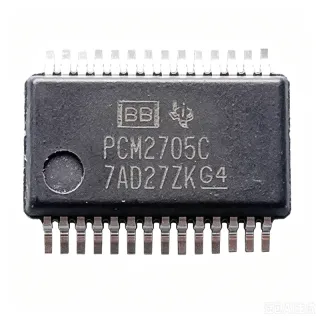
PCM3500E/2K - 16-Bit Mono Voice Codec | Texas Instruments
N.º de pieza: PCM3500E/2K ✓ ActivoPCM3500E/2K Descripción general
A voice codec is a mixed-signal semiconductor that converts between an analog audio signal and a digital serial data stream. The PCM3500 integrates a 16-bit delta-sigma ADC, a 16-bit delta-sigma DAC, microphone and line-level analog paths, voice-band filtering, and a serial interface. Its architecture is intended for modem analog front ends, speech-processing systems, portable communications equipment, and other compact voice-recording products.
Key features include support for modem operation up to 56 kbps, a 512fS system clock, master or slave clock operation, and an integrated power-down function. The ADC includes reference circuitry, mono single-to-differential conversion, a fully differential fifth-order delta-sigma modulator, a decimation filter with a digital high-pass function, and a serial interface. These functions concentrate the essential voice-processing path into one device.
The PCM3500E/2K uses the 24-pin SSOP package identified as DB by Texas Instruments. Its low supply-voltage range suits systems built around 3.3 V power rails, while the integrated power-down mode helps reduce consumption when the voice path is inactive. The serial interface permits connection to a digital signal processor, application processor, modem, or other codec through clock and data signals.
Typical uses include modem analog front ends, speech-capture terminals, telephone interface modules, portable voice appliances, industrial communication equipment, and embedded speech-recording systems. Its voice-band sampling range is particularly appropriate for speech rather than high-fidelity music, and its mono architecture avoids using resources that a stereo codec would require.
For a new design, route the microphone or line input through the appropriate analog pins, configure the serial interface for the required master or slave clock relationship, and use the manufacturer pin-description table when assigning PCB tracks. Decoupling and analog grounding should follow the recommended application circuit because mixed-signal codec performance depends on separating digital switching activity from sensitive audio paths.
This product page consolidates the codec's electrical characteristics, ordering information, drop-in alternatives, application guidance, and PCB-oriented design notes into an engineering-focused reference for voice and modem signal-chain development.
Alternativas directas para PCM3500E/2K — mismo encapsulado, compatible pin a pin. Se excluyen las piezas de otro encapsulado que requieren retrabajo de la PCB.
Variantes de esta serie
Modelos de la misma serie compatibles directamente con PCM3500E/2K (mismo factor de forma y huella) — difiere en Package, Channel Configuration.
PCM3500EG4
✅ Sustitución directaConsulte el precio
Ver hoja de datos →PCM3500E/2KG4
✅ Sustitución directa📋 Alternativa de referencia (no en el catálogo)
PCM3500E/2K Especificaciones
| Codec Type | Mono SoundPlus voice/modem codec |
| ADC Resolution | 16 bit |
| DAC Resolution | 16 bit |
| Number of Audio Channels | 1 mono channel |
| Supply Voltage Range | 2.7 V to 3.6 V |
| Sampling Frequency Range | 7.2 kHz to 26 kHz |
| Typical Dynamic Range | 88 dB at fs = 8 kHz and fin = 1 kHz |
| Supported Modem Data Rate | Up to 56 kbps |
| System Clock | 512fS |
| Clock Operation | Master or slave |
| ADC Modulator | Fully differential fifth-order delta-sigma |
| ADC Input Conversion | Mono single-to-differential |
| ADC Decimation Filter | Digital high-pass filter included |
| Power-Down Mode | Integrated |
| Encapsulado | 24-pin SSOP (DB) |
| Tipo de montaje | Surface mount |
| Estado RoHS | Compliant |
| REACH Status | Compliant |
Guía de configuración de pines de PCM3500E/2K 24-pin ssop (db)
Configuración de pines para PCM3500E/2K (encapsulado 24-pin ssop (db)). La numeración de pines, las funciones y los diagramas de conexión se definen en la hoja de datos del fabricante. Consúltela para conocer el footprint exacto y las directrices de soldadura.

No hay datos detallados de patillaje disponibles para PCM3500E/2K.
Consulte la hoja de datos para ver la configuración completa de patillas.
Aplicaciones típicas
PCM3500E/2K es adecuado para 6 aplicacións: Modem Analog Front End, Speech Capture Terminal, Portable Voice Communication Device, Telephone Interface Module, Industrial Voice Monitor, Embedded Speech Processor.
Modem Analog Front End
The PCM3500E/2K fits a modem analog front end because it combines a mono 16-bit ADC, a mono 16-bit DAC, and voice-band signal processing in one 24-pin SSOP device. Its 2.7 V to 3.6 V operating range supports a 3.3 V communications design, while operation up to 56 kbps matches the voice-channel role. The 512fS clock requirement supports 7.2 kHz through 26 kHz sampling, and master or slave operation allows the codec to align with modem or digital-controller timing. Place the analog and digital return paths carefully and follow the manufacturer's decoupling and application-circuit recommendations to limit codec noise and clock coupling.
Recomendado
Speech Capture Terminal
The PCM3500E/2K is appropriate for a compact speech-capture terminal that records a single voice channel rather than a stereo music stream. Its 16-bit ADC can be driven by the appropriate analog microphone or line input, and the 7.2 kHz to 26 kHz sampling range covers common voice-processing rates. The integrated power-down function helps conserve power between recording intervals, while the 2.7 V to 3.6 V supply range supports portable 3.3 V equipment. Use the manufacturer pin-description table to assign the microphone input, analog reference, serial clock, and serial-data routing without introducing digital crosstalk into the analog capture path.
Recomendado
Portable Voice Communication Device
The PCM3500E/2K suits a portable voice communication device built around a 3.3 V supply because it combines low-voltage operation, a mono 16-bit conversion path, and an integrated power-down mode. The codec can sample at rates from 7.2 kHz to 26 kHz and support modem rates up to 56 kbps, covering speech rather than full-bandwidth audio. Master or slave clock operation lets it work with either a local controller or an external communications timing source. Layout should keep the SSOP codec close to the microphone or line input, use a quiet analog ground strategy, and route serial clock and data away from sensitive input components.
Recomendado
Telephone Interface Module
The PCM3500E/2K can serve as the voice-band conversion element in a telephone interface module. Its mono ADC and DAC provide the analog-to-digital and digital-to-analog functions required to bridge a voice channel, while support for 512fS system clocking and master or slave timing supports integration with modem, DSP, or controller circuitry. The 2.7 V to 3.6 V supply range permits operation from a 3.3 V rail, and the integrated power-down mode can reduce consumption during inactive intervals. Engineers should follow the manufacturer reference circuit for analog filtering, reference bypassing, clock generation, and grounded return paths.
Recomendado
Industrial Voice Monitor
The PCM3500E/2K is suitable for an industrial voice monitor that records or processes one audio channel at voice-band sampling rates. The 16-bit ADC, 88 dB typical dynamic range at an 8 kHz sample rate, and operating range up to 56 kbps provide useful performance for speech capture without the complexity of a multichannel codec. Its low-voltage 2.7 V to 3.6 V operation and power-down mode are advantageous in permanently installed equipment that must limit energy use. Keep the analog input path short, maintain separation from switching supplies and digital clocks, and use stable reference bypassing to preserve signal quality over the required environmental range.
Recomendado
Embedded Speech Processor
The PCM3500E/2K can serve as the voice analog front end for an embedded speech processor. A 16-bit mono ADC and DAC provide a compact conversion interface, while the 512fS system clock and selectable master or slave operation provide flexibility with an embedded digital engine. Sampling rates from 7.2 kHz to 26 kHz cover common narrowband voice-processing tasks, and the 2.7 V to 3.6 V supply range is compatible with a 3.3 V embedded power architecture. Validate the serial mode, data timing, and system clock ratio in the digital controller, then isolate analog input routing from processor clock and switching-node currents.
Recomendado
Resumen de productos recomendados
Datos de referencia de ingeniería para PCM3500E/2K — comparación, orientación de diseño e información de cumplimiento.
Guía de selección
Comparación con alternativas
| Parámetro | Este producto | PCM3500EG4 | PCM3500E/2KG4 |
|---|---|---|---|
| Package | SSOP-24 (DB) | SSOP-24 (DB) | SSOP-24 (DB) |
| Brand | Texas Instruments | Texas Instruments | Texas Instruments |
| Codec Function | Mono SoundPlus voice/modem codec | Closely related mono voice/modem codec | Closely related PCM3500E codec |
| ADC Resolution | 16 bit | 16 bit | 16 bit |
Diferenciadores clave
- Purpose-built mono voice conversion (frente a PCM3500EG4)
- Defined narrowband operating range (frente a PCM3500E/2KG4)
- Low-voltage system compatibility (frente a PCM3500EG4)
Notas de diseño
Separate the analog input and output routing from serial clock, serial data, and digital-control traces. Place the codec's bypass capacitors close to their associated supply pins, use the shortest practical analog traces, and route the analog return toward the codec's ground reference. This mixed-signal device combines sensitive converter inputs with high-speed digital timing, so layout discipline is essential for preserving voice-channel performance.
Do not substitute a generic 24-pin SSOP footprint without checking pin pitch and terminal geometry. Use the manufacturer DB package drawing and verify that the PCB land pattern matches the body dimensions, lead span, pitch, and solder-mask clearance. Also confirm the master or slave clock mode and 512fS system-clock ratio in the digital controller before committing the serial interface timing.
Keep the codec supply within its 2.7 V to 3.6 V operating range and design the 3.3 V rail for both analog and digital load transients. Use the manufacturer's recommended bypass capacitors and power-down sequence. The integrated power-down mode reduces consumption during inactive periods, but the final power budget must use current values from the manufacturer datasheet for the actual clock rate, channel state, and analog input condition.
Account for the 512fS system clock when routing serial signals and validating timing at the connected controller. Keep clock traces short, provide a continuous return path, and avoid routing them beneath the analog input network. If the analog source has substantial high-frequency energy, use the manufacturer filtering guidance to prevent out-of-band content from aliasing into the voice-band delta-sigma converter.
Información de cumplimiento
RoHS, REACH, and conflict-minerals status are identified as compliant in the available compliance information. AEC-Q100 qualification is not applicable to this voice codec, and separate lead-free or halogen-free classifications are not stated.