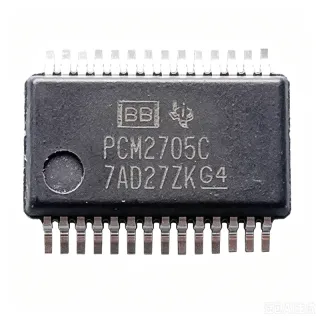
PCM3500E/2K - 16-Bit Mono Voice Codec | Texas Instruments
料号: PCM3500E/2K ✓ 量产中PCM3500E/2K 概述
A voice codec is a mixed-signal semiconductor that converts between an analog audio signal and a digital serial data stream. The PCM3500 integrates a 16-bit delta-sigma ADC, a 16-bit delta-sigma DAC, microphone and line-level analog paths, voice-band filtering, and a serial interface. Its architecture is intended for modem analog front ends, speech-processing systems, portable communications equipment, and other compact voice-recording products.
Key features include support for modem operation up to 56 kbps, a 512fS system clock, master or slave clock operation, and an integrated power-down function. The ADC includes reference circuitry, mono single-to-differential conversion, a fully differential fifth-order delta-sigma modulator, a decimation filter with a digital high-pass function, and a serial interface. These functions concentrate the essential voice-processing path into one device.
The PCM3500E/2K uses the 24-pin SSOP package identified as DB by Texas Instruments. Its low supply-voltage range suits systems built around 3.3 V power rails, while the integrated power-down mode helps reduce consumption when the voice path is inactive. The serial interface permits connection to a digital signal processor, application processor, modem, or other codec through clock and data signals.
Typical uses include modem analog front ends, speech-capture terminals, telephone interface modules, portable voice appliances, industrial communication equipment, and embedded speech-recording systems. Its voice-band sampling range is particularly appropriate for speech rather than high-fidelity music, and its mono architecture avoids using resources that a stereo codec would require.
For a new design, route the microphone or line input through the appropriate analog pins, configure the serial interface for the required master or slave clock relationship, and use the manufacturer pin-description table when assigning PCB tracks. Decoupling and analog grounding should follow the recommended application circuit because mixed-signal codec performance depends on separating digital switching activity from sensitive audio paths.
This product page consolidates the codec's electrical characteristics, ordering information, drop-in alternatives, application guidance, and PCB-oriented design notes into an engineering-focused reference for voice and modem signal-chain development.
直接替换替代料: PCM3500E/2K ——相同封装,引脚兼容。需要 PCB 改动的不同封装料号已排除。
本系列中的变体
可与以下型号直接替换的同系列型号: PCM3500E/2K (相同外形与封装尺寸) ——差异在于 Package, Channel Configuration.
PCM3500EG4
✅ 直接替换联系询价
查看数据手册 →PCM3500E/2KG4
✅ 直接替换📋 参考替代料(不在目录中)
PCM3500E/2K 规格参数
| Codec Type | Mono SoundPlus voice/modem codec |
| ADC Resolution | 16 bit |
| DAC Resolution | 16 bit |
| Number of Audio Channels | 1 mono channel |
| Supply Voltage Range | 2.7 V to 3.6 V |
| Sampling Frequency Range | 7.2 kHz to 26 kHz |
| Typical Dynamic Range | 88 dB at fs = 8 kHz and fin = 1 kHz |
| Supported Modem Data Rate | Up to 56 kbps |
| System Clock | 512fS |
| Clock Operation | Master or slave |
| ADC Modulator | Fully differential fifth-order delta-sigma |
| ADC Input Conversion | Mono single-to-differential |
| ADC Decimation Filter | Digital high-pass filter included |
| Power-Down Mode | Integrated |
| 封装 | 24-pin SSOP (DB) |
| 安装类型 | Surface mount |
| RoHS 状态 | Compliant |
| REACH Status | Compliant |
PCM3500E/2K 24-pin ssop (db) 引脚配置指南
PCM3500E/2K(24-pin ssop (db) 封装)的引脚配置。 引脚编号、功能和连接图在制造商数据手册中定义。请参阅该手册以了解确切的封装尺寸和焊接指南。

暂无详细引脚数据: PCM3500E/2K.
请参阅 数据手册 以查看完整引脚配置。
典型应用
PCM3500E/2K 适用于 6 应用s: Modem Analog Front End, Speech Capture Terminal, Portable Voice Communication Device, Telephone Interface Module, Industrial Voice Monitor, Embedded Speech Processor.
Modem Analog Front End
The PCM3500E/2K fits a modem analog front end because it combines a mono 16-bit ADC, a mono 16-bit DAC, and voice-band signal processing in one 24-pin SSOP device. Its 2.7 V to 3.6 V operating range supports a 3.3 V communications design, while operation up to 56 kbps matches the voice-channel role. The 512fS clock requirement supports 7.2 kHz through 26 kHz sampling, and master or slave operation allows the codec to align with modem or digital-controller timing. Place the analog and digital return paths carefully and follow the manufacturer's decoupling and application-circuit recommendations to limit codec noise and clock coupling.
推荐
Speech Capture Terminal
The PCM3500E/2K is appropriate for a compact speech-capture terminal that records a single voice channel rather than a stereo music stream. Its 16-bit ADC can be driven by the appropriate analog microphone or line input, and the 7.2 kHz to 26 kHz sampling range covers common voice-processing rates. The integrated power-down function helps conserve power between recording intervals, while the 2.7 V to 3.6 V supply range supports portable 3.3 V equipment. Use the manufacturer pin-description table to assign the microphone input, analog reference, serial clock, and serial-data routing without introducing digital crosstalk into the analog capture path.
推荐
Portable Voice Communication Device
The PCM3500E/2K suits a portable voice communication device built around a 3.3 V supply because it combines low-voltage operation, a mono 16-bit conversion path, and an integrated power-down mode. The codec can sample at rates from 7.2 kHz to 26 kHz and support modem rates up to 56 kbps, covering speech rather than full-bandwidth audio. Master or slave clock operation lets it work with either a local controller or an external communications timing source. Layout should keep the SSOP codec close to the microphone or line input, use a quiet analog ground strategy, and route serial clock and data away from sensitive input components.
推荐
Telephone Interface Module
The PCM3500E/2K can serve as the voice-band conversion element in a telephone interface module. Its mono ADC and DAC provide the analog-to-digital and digital-to-analog functions required to bridge a voice channel, while support for 512fS system clocking and master or slave timing supports integration with modem, DSP, or controller circuitry. The 2.7 V to 3.6 V supply range permits operation from a 3.3 V rail, and the integrated power-down mode can reduce consumption during inactive intervals. Engineers should follow the manufacturer reference circuit for analog filtering, reference bypassing, clock generation, and grounded return paths.
推荐
Industrial Voice Monitor
The PCM3500E/2K is suitable for an industrial voice monitor that records or processes one audio channel at voice-band sampling rates. The 16-bit ADC, 88 dB typical dynamic range at an 8 kHz sample rate, and operating range up to 56 kbps provide useful performance for speech capture without the complexity of a multichannel codec. Its low-voltage 2.7 V to 3.6 V operation and power-down mode are advantageous in permanently installed equipment that must limit energy use. Keep the analog input path short, maintain separation from switching supplies and digital clocks, and use stable reference bypassing to preserve signal quality over the required environmental range.
推荐
Embedded Speech Processor
The PCM3500E/2K can serve as the voice analog front end for an embedded speech processor. A 16-bit mono ADC and DAC provide a compact conversion interface, while the 512fS system clock and selectable master or slave operation provide flexibility with an embedded digital engine. Sampling rates from 7.2 kHz to 26 kHz cover common narrowband voice-processing tasks, and the 2.7 V to 3.6 V supply range is compatible with a 3.3 V embedded power architecture. Validate the serial mode, data timing, and system clock ratio in the digital controller, then isolate analog input routing from processor clock and switching-node currents.
推荐
推荐产品汇总
工程参考数据: PCM3500E/2K ——对比、设计指导和合规信息。
选型指南
与替代料对比
| 参数 | 本产品 | PCM3500EG4 | PCM3500E/2KG4 |
|---|---|---|---|
| Package | SSOP-24 (DB) | SSOP-24 (DB) | SSOP-24 (DB) |
| Brand | Texas Instruments | Texas Instruments | Texas Instruments |
| Codec Function | Mono SoundPlus voice/modem codec | Closely related mono voice/modem codec | Closely related PCM3500E codec |
| ADC Resolution | 16 bit | 16 bit | 16 bit |
关键差异点
- Purpose-built mono voice conversion (对比 PCM3500EG4)
- Defined narrowband operating range (对比 PCM3500E/2KG4)
- Low-voltage system compatibility (对比 PCM3500EG4)
设计说明
Separate the analog input and output routing from serial clock, serial data, and digital-control traces. Place the codec's bypass capacitors close to their associated supply pins, use the shortest practical analog traces, and route the analog return toward the codec's ground reference. This mixed-signal device combines sensitive converter inputs with high-speed digital timing, so layout discipline is essential for preserving voice-channel performance.
Do not substitute a generic 24-pin SSOP footprint without checking pin pitch and terminal geometry. Use the manufacturer DB package drawing and verify that the PCB land pattern matches the body dimensions, lead span, pitch, and solder-mask clearance. Also confirm the master or slave clock mode and 512fS system-clock ratio in the digital controller before committing the serial interface timing.
Keep the codec supply within its 2.7 V to 3.6 V operating range and design the 3.3 V rail for both analog and digital load transients. Use the manufacturer's recommended bypass capacitors and power-down sequence. The integrated power-down mode reduces consumption during inactive periods, but the final power budget must use current values from the manufacturer datasheet for the actual clock rate, channel state, and analog input condition.
Account for the 512fS system clock when routing serial signals and validating timing at the connected controller. Keep clock traces short, provide a continuous return path, and avoid routing them beneath the analog input network. If the analog source has substantial high-frequency energy, use the manufacturer filtering guidance to prevent out-of-band content from aliasing into the voice-band delta-sigma converter.
合规信息
RoHS, REACH, and conflict-minerals status are identified as compliant in the available compliance information. AEC-Q100 qualification is not applicable to this voice codec, and separate lead-free or halogen-free classifications are not stated.