STMicroelectronics

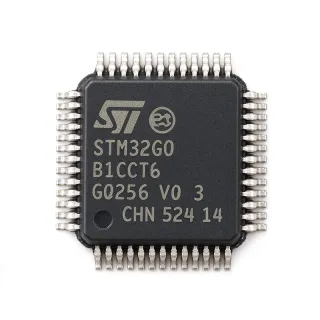
STM32F302RDT7 - 72MHz Cortex-M4 MCU | STMicroelectronics

N.º de pieza: STM32F302RDT7 ✓ Activo
2.5 V or 3.3 V Vdss 64-pin LQFP, 10 x 10 mm Package 72 MHz Speed 384 KB Memory
MOQ: 1 |

STM32F302RDT7 Descripción general

The STMicroelectronics STM32F302RDT7 is a 32-bit ARM Cortex-M4 microcontroller with FPU, operating at 72 MHz, integrating 384 KB of flash memory, and housed in a 64-pin LQFP package measuring 10 x 10 mm. The STM32F302RDT7 belongs to the STM32F3 family of mixed-signal microcontrollers designed for industrial control, embedded automation, motor-control, communications, and sensor-processing systems.

A microcontroller is a programmable system-on-chip that integrates a processor core, memory, peripherals, and communication interfaces into one device. The ARM Cortex-M4 core uses a reduced-instruction architecture optimized for embedded control, while its floating-point unit accelerates floating-point calculations used in motor control, signal processing, and industrial algorithms. Within the device hierarchy, the STM32F302RDT7 is an MCU, a semiconductor containing a processor, memory, timers, analog interfaces, and serial communications.

Its 72 MHz operating frequency provides substantial processing headroom for real-time control tasks, and the 384 KB embedded flash supports substantially larger programs than basic 8-bit or 16-bit controllers. The STM32F3 family also includes mixed-signal resources intended for applications requiring both digital control and analog measurement. Its 64-pin LQFP-64 package exposes considerably more I/O than smaller 32-pin or 48-pin packages, making it suitable for designs requiring multiple peripheral connections.

The STM32F302RDT7 is manufactured for a 2.5 V or 3.3 V operating environment, as identified in the product listing. This voltage range supports common embedded industrial and consumer system rails. Designers should use the pin-description table, electrical characteristics, clock tree, and peripheral configuration guidance in the manufacturer datasheet when assigning pins, selecting decoupling, and establishing system timing.

Typical uses include programmable logic controllers, industrial sensor nodes, motor-control controllers, building automation modules, communication equipment, and compact embedded control boards. In each case, the Cortex-M4 processor can execute control software while the MCU’s timers, serial interfaces, and mixed-signal peripherals handle time-critical input and output. The 64-pin package also reduces the need for external interface expanders when a design requires multiple sensors, actuators, or communications links.

PCB implementation should preserve the exposed supply and ground connections required by the LQFP-64 footprint and place decoupling capacitors close to their associated pins. Confirm boot, reset, clock, debug, and programming interfaces against the manufacturer pin table before layout release. Also verify that every external peripheral uses a voltage compatible with the STM32F302RDT7’s 2.5 V or 3.3 V operating condition.

This product page combines manufacturer-family information with package, memory, core, frequency, sourcing, replacement, and PCB guidance. It also organizes practical comparisons and application patterns so engineers can assess whether the STM32F302RDT7 fits the control complexity, I/O count, and board-space requirements of a new embedded design.

Alternativas directas para STM32F302RDT7 — mismo encapsulado, compatible pin a pin. Se excluyen las piezas de otro encapsulado que requieren retrabajo de la PCB.

Variantes de esta serie

Modelos de la misma serie compatibles directamente con STM32F302RDT7 (mismo factor de forma y huella) — difiere en Package, Product Type, Flash Memory, Processor Core.

STMicroelectronics
Package: 64-LQFP
Flash Memory: 384 KB
Comparar con STM32F302RDT7 →
STMicroelectronics
Package: 64-LQFP (10 x 10 mm)
Product Type: Mixed-signal microcontroller
Flash Memory: 256 KB
Comparar con STM32F302RDT7 →

STM32F302RDT6

✅ Sustitución directa ⚠️ Especificaciones sin verificar
STMicroelectronics
📦 LQFP-64 (10 x 10 mm)
32-bit ARM Cortex-M4 microcontroller with FPU · 72 MHz · 384 KB · 384K x 8 bits · 32-bit ARM Cortex-M4 RISC · Yes · 12 bits · 12 bits

Consulte el precio

Ver hoja de datos →

STM32F303RDT7

✅ Sustitución directa ⚠️ Especificaciones sin verificar
📦 LQFP-64 (10 x 10 mm)
Flash remains 384 KB and CPU frequency remains 72 MHz; the STM32F303 family changes the peripheral mix, so affected timer, USB, and analog functions must be reassigned.

📋 Alternativa de referencia (no en el catálogo)

STM32F302RET7

✅ Sustitución directa
📦 LQFP-64 (10 x 10 mm)
Flash increases from 384 KB to 512 KB, a 33.3% increase, while CPU frequency remains 72 MHz; the larger memory configuration changes the device variant.

📋 Alternativa de referencia (no en el catálogo)

STM32F303RCT7

✅ Sustitución directa ⚠️ Especificaciones sin verificar
STMicroelectronics
📦 LQFP-64 (10 x 10 mm)
Mixed-signal microcontroller · Arm Cortex-M4 32-bit CPU with FPU · 72 MHz · 90 DMIPS from CCM · DSP instructions · 256 KB · Up to 40 KB · Implemented on the first 16 KB of SRAM

Consulte el precio

Ver hoja de datos →

STM32F302RDU6

✅ Sustitución directa ⚠️ Especificaciones sin verificar
📦 LQFP-64 (10 x 10 mm)
Flash remains 384 KB and frequency remains 72 MHz; the ordering code changes the shipping format and temperature-grade identifier, so the exact ordering code must be confirmed.

📋 Alternativa de referencia (no en el catálogo)

STM32F302RDT7 Valores máximos y características eléctricas

Product Type 32-bit ARM Cortex-M4 microcontroller with FPU
Processor Core ARM Cortex-M4
Architecture 32-bit RISC
Maximum CPU Frequency 72 MHz
Embedded Flash Memory 384 KB
Flash Organization 384K x 8 bits
Operating Voltage 2.5 V or 3.3 V
Encapsulado 64-pin LQFP, 10 x 10 mm
Package Type LQFP-64
Tipo de montaje Surface mount
Floating-Point Unit Yes
Product Series STM32F3
Family STM32F302xD/E
Estado RoHS unknown
REACH Status unknown
AEC-Q100 Qualification not_applicable

Guía de configuración de pines de STM32F302RDT7 lqfp-64

Configuración de pines para STM32F302RDT7 (encapsulado lqfp-64). Este CI digital incluye GPIO, interfaces de comunicación (UART, SPI, I2C) y pines de alimentación. Consulte la hoja de datos del fabricante para conocer las funciones alternativas de los pines y las opciones de configuración. Esencial para el diseño de sistemas embebidos y el diseño de PCB.

Diagrama de patillaje del encapsulado lqfp-64 para STM32F302RDT7

No hay datos detallados de patillaje disponibles para STM32F302RDT7.

Consulte la hoja de datos para ver la configuración completa de patillas.

Aplicaciones típicas

STM32F302RDT7 es adecuado para 6 aplicacións: Industrial PLC and Automation Controller, Brushless Motor Control, Industrial Sensor and Condition Monitoring Node, Building Automation and HVAC Control, Communication Equipment and Protocol Gateway, Embedded Data Acquisition System.

🏭

Industrial PLC and Automation Controller

The STM32F302RDT7 fits compact PLC and industrial automation modules because its 72 MHz ARM Cortex-M4 core provides real-time processing capacity and its 64-pin LQFP exposes more I/O than small 32-pin devices. The 384 KB embedded flash can hold control logic, communication stacks, diagnostics, and configuration handling. Use its timers for periodic tasks and its serial interfaces for sensors or field buses, while confirming peripheral multiplexing against the 64-pin datasheet. A design with multiple slow digital I/O channels may also benefit from an I/O expander such as the PCA9548APWR when the MCU pins are constrained.

⚡

Brushless Motor Control

The STM32F302RDT7 is suitable for compact brushless motor controllers where deterministic control, numeric calculation, and multiple peripheral connections are needed. Its 72 MHz Cortex-M4 core and hardware FPU support current-loop and commutation calculations, while the STM32F3 mixed-signal feature set is relevant to sensing motor voltage and current. The 384 KB flash provides room for control algorithms and diagnostics. Exact timer channels, ADC inputs, op-amp connectivity, and pin multiplexing must be selected from the manufacturer pin table, and gate-driver isolation and current-sense scaling remain external board-design requirements.

🧩

Industrial Sensor and Condition Monitoring Node

The STM32F302RDT7 can serve as the processing center of a vibration, temperature, or environmental monitoring node. The 72 MHz Cortex-M4 core can combine sensor acquisition, filtering, threshold logic, and local data logging within the 384 KB embedded flash, while the 64-pin package provides sufficient connections for analog inputs, digital sensors, and communications. Select ADC and timer channels from the exact pin-assignment table and preserve analog signal conditioning away from switching nodes. For distributed systems requiring additional low-speed digital inputs, PCA9546APWR can expand the control interface.

🏠

Building Automation and HVAC Control

The STM32F302RDT7 suits building automation controllers that coordinate environmental sensors, actuators, and wired communications. Its 384 KB flash can store scheduling logic, configuration data, diagnostic rules, and communication handlers, while the 72 MHz core supports responsive multi-peripheral control. The 64-pin LQFP is useful for systems requiring several timer outputs, serial links, and analog channels without immediately adding another microcontroller. Validate the operating voltage against every external 3.3 V or 2.5 V device and use an I/O expander such as PCA9548APWR when the HVAC controller needs more discrete input or output points.

🌐

Communication Equipment and Protocol Gateway

The STM32F302RDT7 can implement a compact protocol gateway or embedded communications controller because the Cortex-M4 core runs at 72 MHz and includes a floating-point unit for handling protocol and signal-processing tasks. The 384 KB flash supports substantial firmware, while the 64-pin package offers access to multiple UART, SPI, I2C, timer, and interrupt resources subject to pin multiplexing. For gateways connecting several low-speed sensor buses, PCA9546APWR can provide additional I2C branches. Production designs should verify peripheral conflicts, interrupt priority, clock configuration, and communication timing in the manufacturer reference material.

🖥️

Embedded Data Acquisition System

The STM32F302RDT7 is appropriate for a compact data-acquisition system that must sample multiple analog channels, timestamp events, and transfer results through serial interfaces. The 72 MHz Cortex-M4 core handles acquisition sequencing and control software, while the 384 KB flash supports buffering, calibration, and protocol functions. The 64-pin LQFP provides more analog and digital connections than smaller MCU packages, although the available ADC channels and alternate functions must be confirmed for each pin. An external converter such as ADS1220IPW can extend measurement resolution when the internal converter does not meet the required accuracy or channel count.

What is the STM32F302RDT7?
The STM32F302RDT7 is a 32-bit mixed-signal ARM Cortex-M4 microcontroller from STMicroelectronics, operating at 72 MHz with an FPU and 384 KB of embedded flash. According to the manufacturer STM32F302xD/E product page, the device combines the Cortex-M4 RISC core with mixed-signal resources for embedded control applications. It is packaged in a 64-pin, 10 x 10 mm LQFP and is positioned for applications requiring more processing capability and I/O than small 8-bit or 16-bit microcontrollers.
What are the key specifications of STM32F302RDT7 that engineers should know?
The STM32F302RDT7 combines a 72 MHz ARM Cortex-M4 core, a hardware floating-point unit, 384 KB of flash, and a 64-pin LQFP package. STMicroelectronics identifies the STM32F302xD/E family as a high-performance Cortex-M4 mixed-signal MCU family, while distributor technical listings specify 384K x 8-bit flash and a 10 x 10 mm package. The listed operating condition is 2.5 V or 3.3 V, making the device relevant to industrial control, automation, communications, and embedded sensor systems.
Where can I download the STM32F302RDT7 datasheet PDF?
The STM32F302RDT7 datasheet and product resources are available through the official STMicroelectronics STM32F302RD product page at https://www.st.com/en/microcontrollers-microprocessors/stm32f302rd.html. Use the manufacturer document for the authoritative pin descriptions, electrical characteristics, memory map, peripheral details, clock configuration, and recommended application circuits. The Octopart datasheet result also links to the latest manufacturer documentation, but the ST page should remain the controlling source for design decisions.
Where can I find the STM32F302RDT7 pinout?
The STM32F302RDT7 pinout is documented in the pin-description table of the STMicroelectronics manufacturer datasheet for the STM32F302xD/E family. Because the exact package has 64 pins, use that table when assigning power, ground, reset, boot, clocks, debug, analog, and communication functions. The device uses a 64-pin LQFP footprint measuring 10 x 10 mm. Confirm all assignments against the exact orderable MPN before routing the PCB because adjacent pins can support multiple peripheral functions.
How much flash memory does the STM32F302RDT7 have?
The STM32F302RDT7 contains 384 KB of embedded flash organized as 384K x 8 bits. STMicroelectronics describes the STM32F302xD/E family as a Cortex-M4 MCU platform operating at 72 MHz, and the DigiKey product listing explicitly identifies the 384 KB flash configuration for this MPN. The larger program storage supports bootloader space, application firmware, calibration data, and protocol tables, although final partition sizing should account for the boot configuration and update mechanism used by the product.
What is the maximum operating frequency of STM32F302RDT7?
The STM32F302RDT7 operates at a maximum frequency of 72 MHz. According to the STMicroelectronics STM32F302xD/E product page, the MCU family uses a high-performance ARM Cortex-M4 32-bit RISC core with an FPU at 72 MHz. That clock rate supports responsive digital control and floating-point-heavy routines, but the actual bus, peripheral, and flash execution behavior should be evaluated with the clock-tree and timing information in the manufacturer datasheet.
Is the STM32F302RDT7 suitable for industrial motor-control applications?
The STM32F302RDT7 is suitable for many industrial motor-control applications because it combines a 72 MHz Cortex-M4 core, an FPU, 384 KB of flash, and a 64-pin LQFP with substantial I/O access. The floating-point unit is useful for control calculations, while the larger package can accommodate timer, communication, and analog signal connections. Actual suitability depends on motor characteristics, required control-loop rate, peripheral assignments, voltage levels, and the electrical limits published in the manufacturer documentation.
STM32F302RDT7 vs STM32F302RET7: which is better for a 384 KB design?
Choose the STM32F302RDT7 when the design specifically targets 384 KB of flash, because the STM32F302RET7 belongs to the 512 KB STM32F302xE configuration. Both are STM32F3 devices associated with the same Cortex-M4 family and 64-pin LQFP form factor, but flash capacity differs by 128 KB, or 33.3% relative to the STM32F302RDT7. For firmware that requires exactly 384 KB or less, the RDT7 is the closer configuration; an E-series part provides additional program space rather than identical memory sizing.
When should I choose STM32F302RDT7 over STM32F302RCT7?
Choose the STM32F302RDT7 when 384 KB of flash is required or preferred, while the STM32F302RCT7 provides 256 KB. The RDT7 therefore offers 128 KB, or 50%, more flash than the RCT7. Both devices occupy the 64-pin LQFP package and share the 72 MHz Cortex-M4 architecture, but firmware-image size is a decisive selection criterion. If a new design can fit within 256 KB, the RCT7 may reduce flash oversizing; if code growth, dual-bank use, or application data is expected, the RDT7 offers more margin.
What can replace the STM32F302RDT7?
The closest same-family drop-in candidates include the STM32F302RDT6 and STM32F303RDT7 in the same 64-pin LQFP format, with the STM32F302RET7 and STM32F303RCT7 offering different flash capacities. No cross-manufacturer pin-compatible replacement was established from the available cross-reference results. Before selecting any substitute, compare the LQFP-64 pin functions, operating voltage, clock limits, peripheral mix, flash/RAM requirements, and boot configuration, then qualify the replacement firmware and production test process.
Is the STM32F302RDT7 the same as STM32F302RET7?
No. The STM32F302RDT7 and STM32F302RET7 both use a 64-pin LQFP package and belong to the STM32F3 Cortex-M4 platform, but their flash configurations differ. The RDT7 provides 384 KB, while the RET7 provides 512 KB, a difference of 128 KB. They can share a board footprint, but they are not memory-identical parts. Firmware, boot code, part-number markings, and production configuration must be reviewed before using either device interchangeably.
What is the best STMicroelectronics equivalent for STM32F302RDT7?
The best STMicroelectronics-family alternatives depend on which constraint is most important. STM32F302RDT6 preserves the 384 KB flash and 64-pin LQFP arrangement but represents a different ordering-temperature configuration. STM32F303RDT7 retains 384 KB and the same package while changing the exact peripheral mix within the STM32F3 family. STM32F302RET7 provides 512 KB, while STM32F303RCT7 provides 256 KB. For a production substitution, verify pin-level peripheral reassignment and rerun firmware, clock, ADC, timer, and communication validation.
Where can I buy STM32F302RDT7 online?
Use the Request a Quote form on this page to request STM32F302RDT7 availability, lead time, and order handling. The part is listed for a 64-LQFP tray package, and the manufacturer’s direct ordering page also lists the MPN. Current stock and lead time should be confirmed at the time of quotation rather than inferred from a static catalog page. Include your required quantity, target delivery date, and whether reel or tray packing is needed when submitting the request.
What is the price of STM32F302RDT7?
The current unit price for the STM32F302RDT7 is shown through the Request a Quote workflow on this page. Use that form for the quantity-specific price and availability applicable to your order. The exact MPN is offered in a 64-LQFP tray package, but configuration, quantity, delivery timing, and sourcing status can affect the final quotation. Request a formal quote when you need a purchase commitment or documented commercial response.
What is the lead time for STM32F302RDT7?
The current lead time for the STM32F302RDT7 should be requested through the Request a Quote form on this page. The manufacturer’s direct product ordering result lists the exact MPN, while distributor results provide additional sourcing channels, but neither should be treated as a fixed promise without a quotation. State your required quantity, factory packaging preference, and target shipment date in the request so the response reflects the actual order configuration.
Is STM32F302RDT7 in stock?
Stock status for the STM32F302RDT7 is best confirmed through the Request a Quote form on this page. The exact MPN is commercially listed in a 64-LQFP tray package, and at least one product listing reports inventory, but inventory can change rapidly and may differ between channels. Submit the desired quantity and packaging requirement to obtain a current availability response. For production planning, request confirmation of the manufacturing date and delivery schedule as part of the quotation.
What PCB layout practices are important for STM32F302RDT7?
The STM32F302RDT7 layout should preserve the LQFP-64 footprint, expose all 64 connections, and place every required power and ground pin according to the manufacturer pin table. Put decoupling capacitors close to their associated supply pins, keep switching or high-current analog paths away from sensitive inputs, and follow the datasheet guidance for analog grounds and external components. Confirm pin multiplexing for boot, reset, clock, debug, timers, and communication interfaces before routing, and follow the manufacturer’s recommended footprint and assembly guidance.
Does STM32F302RDT7 meet automotive, RoHS, or REACH requirements?
The STM32F302RDT7 is an industrial-temperature-style STM32F3 MCU rather than an automotive-qualified ordering code, so it should not be treated as AEC-Q100 qualified without a specific qualification statement. RoHS and REACH status must be confirmed from the manufacturer’s current material-compliance declarations or product documentation. Use the Request a Quote form to request current compliance paperwork for the exact MPN and package configuration when compliance is a purchasing qualification requirement.

Datos de referencia de ingeniería para STM32F302RDT7 — comparación, orientación de diseño e información de cumplimiento.

Guía de selección

Choose the STM32F302RDT7 when a design needs a 72 MHz ARM Cortex-M4 MCU with 384 KB of flash and a 64-pin LQFP-64 footprint. Select the STM32F302RDT6 when the same memory and core parameters apply but the required ordering-temperature configuration differs. Consider the STM32F303RDT7 when its alternate peripheral mix provides a useful feature, while checking timer, USB, communication, and analog assignments. Use the STM32F302RET7 only when 512 KB of flash is acceptable, and consider the STM32F303RCT7 when 256 KB is sufficient and its peripheral configuration meets the design. No cross-manufacturer substitute was established by the available cross-reference results, so a production second source requires independent pin, electrical, firmware, and qualification validation.

Comparación con alternativas

Parámetro Este producto STM32F302RDT6 STM32F303RDT7 STM32F302RET7 STM32F303RCT7 STM32F302RDU6
Brand STMicroelectronics STMicroelectronics STMicroelectronics STMicroelectronics STMicroelectronics STMicroelectronics
Package LQFP-64 (10 x 10 mm) LQFP-64 (10 x 10 mm) LQFP-64 (10 x 10 mm) LQFP-64 (10 x 10 mm) LQFP-64 (10 x 10 mm) LQFP-64 (10 x 10 mm)
Processor Core ARM Cortex-M4 ARM Cortex-M4 ARM Cortex-M4 ARM Cortex-M4 ARM Cortex-M4 ARM Cortex-M4
Maximum CPU Frequency 72 MHz 72 MHz 72 MHz 72 MHz 72 MHz 72 MHz
Flash Memory 384 KB 384 KB 384 KB 512 KB 256 KB 384 KB
Floating-Point Unit Yes Yes Yes Yes Yes Yes
Ordering Temperature Identifier T7 T6 T7 T7 T7 U6
Product Series STM32F302 STM32F302 STM32F303 STM32F302 STM32F303 STM32F302

Diferenciadores clave

  • Higher flash capacity than the 256 KB STM32F303RCT7 candidate (frente a STM32F303RCT7)
  • Lower flash capacity than the 512 KB STM32F302RET7 candidate (frente a STM32F302RET7)
  • Same 72 MHz Cortex-M4 processing platform as the closest STM32F3 drop-in candidates (frente a STM32F303RDT7)

Notas de diseño

Use the manufacturer’s LQFP-64 footprint and pin table as the controlling PCB references. The STM32F302RDT7 is a 10 x 10 mm surface-mount MCU, so verify courtyard clearance, solder-paste aperture dimensions, pad numbering, and assembly orientation before releasing artwork. Pin 1 and the numbering direction must match the package drawing, and every one of the 64 package leads must remain accessible if leaded rework or inspection is planned.

Plan the 2.5 V or 3.3 V power architecture around the exact pin names and voltage requirements in the manufacturer datasheet. Place required decoupling capacitors next to their associated supply pins and keep return-current paths short. Separate analog and digital return paths where the application permits, and provide clean references for clock, reset, and high-impedance sensor inputs. Confirm absolute maximum and operating limits for every externally connected signal rather than assuming all peripherals tolerate the full supply range.

Assign timer channels, ADC inputs, communication interfaces, and debug signals from the complete pin multiplexing table before finalizing signal integrity requirements. A peripheral may be electrically compatible but unavailable at a chosen pin because another channel owns the same alternate function. Check pin conflicts across boot mode, debug access, clock sources, and communication peripherals. Route fast or sensitive analog signals away from switching nodes and provide local grounding around analog front-end components.

Do not treat the STM32F302RDT7, STM32F302RET7, and STM32F302RCT7 as identical memory configurations merely because they use the same LQFP-64 footprint. Their flash capacities differ, and alternate STM32F3 family members can change the peripheral set. Before substitution, verify RAM, ADC channels, timer resources, communication interfaces, pin multiplexing, boot behavior, temperature grade, and firmware compatibility. A successful footprint match does not by itself establish drop-in production equivalence.

Información de cumplimiento

RoHS
Unknown
REACH
Unknown
AEC-Q100
Not Applicable
Libre de plomo
Unknown
Libre de halógenos
Unknown
Minerales en conflicto
Unknown

The available product information does not explicitly state RoHS, REACH, lead-free, halogen-free, or conflict-minerals status. Request current compliance documentation for the exact MPN when these requirements apply.
Datos verificados el: 2026-11-23 — datos verificados y seleccionados por el equipo de ingeniería de componentes de XAIPART

Búsquedas relacionadas

STM32F302RDT7 datasheet STM32F302RDT7 pinout STM32F302RDT7 datasheet pdf STM32F302RDT7 equivalent STM32F302RDT7 replacement STM32F302RDT7 price STM32F302RDT7 stock STMicroelectronics STM32F302RDT7 STM32F302RDT7 LQFP-64 pinout STM32F302RDT7 footprint STM32F302RDT7 vs STM32F302RET7 STM32F302RDT7 72MHz Cortex-M4 STM32F302RDT7 motor control application STM32F302RDT7 industrial controller STM32F302RDT7 programming

Componentes & términos relacionados

STMicroelectronics STM32F302RDT7 STM32F302RDT6 STM32F303RDT7 STM32F302RET7 STM32F303RCT7 STM32F302RDU6 ARM Cortex-M4 ARM Cortex-M4F microcontroller MCU 32-bit RISC mixed-signal microcontroller embedded microcontroller semiconductor LQFP-64 LQFP package family surface mount SMD embedded flash memory 384 KB flash 72 MHz floating-point unit industrial control motor control sensor acquisition building automation communication gateway data acquisition system
RFQ de presupuesto rápido
Complete los detalles — nuestro equipo de ventas responderá en un plazo de 24 horas
Número de pieza Fabricante Encapsulado QTY Precio objetivo Total
✓
¡Presupuesto enviado!

Responderemos a su correo electrónico en un plazo de 24 horas

1
RFQ enviado
2
Presupuesto recibido
3
Pedido realizado
4
Pago
5
Enviado
6
Entregado
Ver detalles del RFQ