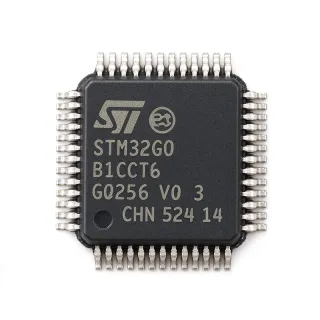
STM32F302RDT7 - 72MHz Cortex-M4 MCU | STMicroelectronics
Référence : STM32F302RDT7 ✓ ActifSTM32F302RDT7 Présentation
A microcontroller is a programmable system-on-chip that integrates a processor core, memory, peripherals, and communication interfaces into one device. The ARM Cortex-M4 core uses a reduced-instruction architecture optimized for embedded control, while its floating-point unit accelerates floating-point calculations used in motor control, signal processing, and industrial algorithms. Within the device hierarchy, the STM32F302RDT7 is an MCU, a semiconductor containing a processor, memory, timers, analog interfaces, and serial communications.
Its 72 MHz operating frequency provides substantial processing headroom for real-time control tasks, and the 384 KB embedded flash supports substantially larger programs than basic 8-bit or 16-bit controllers. The STM32F3 family also includes mixed-signal resources intended for applications requiring both digital control and analog measurement. Its 64-pin LQFP-64 package exposes considerably more I/O than smaller 32-pin or 48-pin packages, making it suitable for designs requiring multiple peripheral connections.
The STM32F302RDT7 is manufactured for a 2.5 V or 3.3 V operating environment, as identified in the product listing. This voltage range supports common embedded industrial and consumer system rails. Designers should use the pin-description table, electrical characteristics, clock tree, and peripheral configuration guidance in the manufacturer datasheet when assigning pins, selecting decoupling, and establishing system timing.
Typical uses include programmable logic controllers, industrial sensor nodes, motor-control controllers, building automation modules, communication equipment, and compact embedded control boards. In each case, the Cortex-M4 processor can execute control software while the MCU’s timers, serial interfaces, and mixed-signal peripherals handle time-critical input and output. The 64-pin package also reduces the need for external interface expanders when a design requires multiple sensors, actuators, or communications links.
PCB implementation should preserve the exposed supply and ground connections required by the LQFP-64 footprint and place decoupling capacitors close to their associated pins. Confirm boot, reset, clock, debug, and programming interfaces against the manufacturer pin table before layout release. Also verify that every external peripheral uses a voltage compatible with the STM32F302RDT7’s 2.5 V or 3.3 V operating condition.
This product page combines manufacturer-family information with package, memory, core, frequency, sourcing, replacement, and PCB guidance. It also organizes practical comparisons and application patterns so engineers can assess whether the STM32F302RDT7 fits the control complexity, I/O count, and board-space requirements of a new embedded design.
Alternatives de remplacement direct pour STM32F302RDT7 — même boîtier, compatible broche à broche. Les références à boîtier différent nécessitant une retouche du PCB sont exclues.
Variantes de cette série
Modèles de la même série directement compatibles avec STM32F302RDT7 (même facteur de forme et même empreinte) — différant par Package, Product Type, Flash Memory, Processor Core.
STM32F302RDT6
✅ Remplacement direct ⚠️ Spécifications non vérifiéesContactez-nous pour le prix
Voir la fiche technique →STM32F303RDT7
✅ Remplacement direct ⚠️ Spécifications non vérifiées📋 Alternative de référence (hors catalogue)
STM32F302RET7
✅ Remplacement direct📋 Alternative de référence (hors catalogue)
STM32F303RCT7
✅ Remplacement direct ⚠️ Spécifications non vérifiéesContactez-nous pour le prix
Voir la fiche technique →STM32F302RDU6
✅ Remplacement direct ⚠️ Spécifications non vérifiées📋 Alternative de référence (hors catalogue)
STM32F302RDT7 Valeurs maximales et caractéristiques électriques
| Product Type | 32-bit ARM Cortex-M4 microcontroller with FPU |
| Processor Core | ARM Cortex-M4 |
| Architecture | 32-bit RISC |
| Maximum CPU Frequency | 72 MHz |
| Embedded Flash Memory | 384 KB |
| Flash Organization | 384K x 8 bits |
| Operating Voltage | 2.5 V or 3.3 V |
| Boîtier | 64-pin LQFP, 10 x 10 mm |
| Package Type | LQFP-64 |
| Type de montage | Surface mount |
| Floating-Point Unit | Yes |
| Product Series | STM32F3 |
| Family | STM32F302xD/E |
| Statut RoHS | unknown |
| REACH Status | unknown |
| AEC-Q100 Qualification | not_applicable |
Guide de configuration des broches du STM32F302RDT7 lqfp-64
Configuration des broches du STM32F302RDT7 (boîtier lqfp-64). Ce circuit intégré numérique comprend des GPIO, des interfaces de communication (UART, SPI, I2C) et des broches d'alimentation. Consultez la fiche technique du fabricant pour les fonctions alternatives des broches et les options de configuration. Indispensable pour la conception de systèmes embarqués et la conception de circuits imprimés.
Aucune donnée de brochage détaillée disponible pour STM32F302RDT7.
Consultez la fiche technique pour la configuration complète des broches.
Applications typiques
STM32F302RDT7 convient pour 6 applications: Industrial PLC and Automation Controller, Brushless Motor Control, Industrial Sensor and Condition Monitoring Node, Building Automation and HVAC Control, Communication Equipment and Protocol Gateway, Embedded Data Acquisition System.
Industrial PLC and Automation Controller
The STM32F302RDT7 fits compact PLC and industrial automation modules because its 72 MHz ARM Cortex-M4 core provides real-time processing capacity and its 64-pin LQFP exposes more I/O than small 32-pin devices. The 384 KB embedded flash can hold control logic, communication stacks, diagnostics, and configuration handling. Use its timers for periodic tasks and its serial interfaces for sensors or field buses, while confirming peripheral multiplexing against the 64-pin datasheet. A design with multiple slow digital I/O channels may also benefit from an I/O expander such as the PCA9548APWR when the MCU pins are constrained.
Recommandé
Brushless Motor Control
The STM32F302RDT7 is suitable for compact brushless motor controllers where deterministic control, numeric calculation, and multiple peripheral connections are needed. Its 72 MHz Cortex-M4 core and hardware FPU support current-loop and commutation calculations, while the STM32F3 mixed-signal feature set is relevant to sensing motor voltage and current. The 384 KB flash provides room for control algorithms and diagnostics. Exact timer channels, ADC inputs, op-amp connectivity, and pin multiplexing must be selected from the manufacturer pin table, and gate-driver isolation and current-sense scaling remain external board-design requirements.
Recommandé
Industrial Sensor and Condition Monitoring Node
The STM32F302RDT7 can serve as the processing center of a vibration, temperature, or environmental monitoring node. The 72 MHz Cortex-M4 core can combine sensor acquisition, filtering, threshold logic, and local data logging within the 384 KB embedded flash, while the 64-pin package provides sufficient connections for analog inputs, digital sensors, and communications. Select ADC and timer channels from the exact pin-assignment table and preserve analog signal conditioning away from switching nodes. For distributed systems requiring additional low-speed digital inputs, PCA9546APWR can expand the control interface.
Recommandé
Building Automation and HVAC Control
The STM32F302RDT7 suits building automation controllers that coordinate environmental sensors, actuators, and wired communications. Its 384 KB flash can store scheduling logic, configuration data, diagnostic rules, and communication handlers, while the 72 MHz core supports responsive multi-peripheral control. The 64-pin LQFP is useful for systems requiring several timer outputs, serial links, and analog channels without immediately adding another microcontroller. Validate the operating voltage against every external 3.3 V or 2.5 V device and use an I/O expander such as PCA9548APWR when the HVAC controller needs more discrete input or output points.
Recommandé
Communication Equipment and Protocol Gateway
The STM32F302RDT7 can implement a compact protocol gateway or embedded communications controller because the Cortex-M4 core runs at 72 MHz and includes a floating-point unit for handling protocol and signal-processing tasks. The 384 KB flash supports substantial firmware, while the 64-pin package offers access to multiple UART, SPI, I2C, timer, and interrupt resources subject to pin multiplexing. For gateways connecting several low-speed sensor buses, PCA9546APWR can provide additional I2C branches. Production designs should verify peripheral conflicts, interrupt priority, clock configuration, and communication timing in the manufacturer reference material.
Recommandé
Embedded Data Acquisition System
The STM32F302RDT7 is appropriate for a compact data-acquisition system that must sample multiple analog channels, timestamp events, and transfer results through serial interfaces. The 72 MHz Cortex-M4 core handles acquisition sequencing and control software, while the 384 KB flash supports buffering, calibration, and protocol functions. The 64-pin LQFP provides more analog and digital connections than smaller MCU packages, although the available ADC channels and alternate functions must be confirmed for each pin. An external converter such as ADS1220IPW can extend measurement resolution when the internal converter does not meet the required accuracy or channel count.
Recommandé
Récapitulatif des produits recommandés
Données de référence d'ingénierie pour STM32F302RDT7 — comparaison, recommandations de conception et informations de conformité.
Guide de sélection
Comparaison avec les alternatives
| Paramètre | Ce produit | STM32F302RDT6 | STM32F303RDT7 | STM32F302RET7 | STM32F303RCT7 | STM32F302RDU6 |
|---|---|---|---|---|---|---|
| Brand | STMicroelectronics | STMicroelectronics | STMicroelectronics | STMicroelectronics | STMicroelectronics | STMicroelectronics |
| Package | LQFP-64 (10 x 10 mm) | LQFP-64 (10 x 10 mm) | LQFP-64 (10 x 10 mm) | LQFP-64 (10 x 10 mm) | LQFP-64 (10 x 10 mm) | LQFP-64 (10 x 10 mm) |
| Processor Core | ARM Cortex-M4 | ARM Cortex-M4 | ARM Cortex-M4 | ARM Cortex-M4 | ARM Cortex-M4 | ARM Cortex-M4 |
| Maximum CPU Frequency | 72 MHz | 72 MHz | 72 MHz | 72 MHz | 72 MHz | 72 MHz |
| Flash Memory | 384 KB | 384 KB | 384 KB | 512 KB | 256 KB | 384 KB |
| Floating-Point Unit | Yes | Yes | Yes | Yes | Yes | Yes |
| Ordering Temperature Identifier | T7 | T6 | T7 | T7 | T7 | U6 |
| Product Series | STM32F302 | STM32F302 | STM32F303 | STM32F302 | STM32F303 | STM32F302 |
Principaux différenciateurs
- Higher flash capacity than the 256 KB STM32F303RCT7 candidate (vs STM32F303RCT7)
- Lower flash capacity than the 512 KB STM32F302RET7 candidate (vs STM32F302RET7)
- Same 72 MHz Cortex-M4 processing platform as the closest STM32F3 drop-in candidates (vs STM32F303RDT7)
Notes de conception
Use the manufacturer’s LQFP-64 footprint and pin table as the controlling PCB references. The STM32F302RDT7 is a 10 x 10 mm surface-mount MCU, so verify courtyard clearance, solder-paste aperture dimensions, pad numbering, and assembly orientation before releasing artwork. Pin 1 and the numbering direction must match the package drawing, and every one of the 64 package leads must remain accessible if leaded rework or inspection is planned.
Plan the 2.5 V or 3.3 V power architecture around the exact pin names and voltage requirements in the manufacturer datasheet. Place required decoupling capacitors next to their associated supply pins and keep return-current paths short. Separate analog and digital return paths where the application permits, and provide clean references for clock, reset, and high-impedance sensor inputs. Confirm absolute maximum and operating limits for every externally connected signal rather than assuming all peripherals tolerate the full supply range.
Assign timer channels, ADC inputs, communication interfaces, and debug signals from the complete pin multiplexing table before finalizing signal integrity requirements. A peripheral may be electrically compatible but unavailable at a chosen pin because another channel owns the same alternate function. Check pin conflicts across boot mode, debug access, clock sources, and communication peripherals. Route fast or sensitive analog signals away from switching nodes and provide local grounding around analog front-end components.
Do not treat the STM32F302RDT7, STM32F302RET7, and STM32F302RCT7 as identical memory configurations merely because they use the same LQFP-64 footprint. Their flash capacities differ, and alternate STM32F3 family members can change the peripheral set. Before substitution, verify RAM, ADC channels, timer resources, communication interfaces, pin multiplexing, boot behavior, temperature grade, and firmware compatibility. A successful footprint match does not by itself establish drop-in production equivalence.
Informations de conformité
The available product information does not explicitly state RoHS, REACH, lead-free, halogen-free, or conflict-minerals status. Request current compliance documentation for the exact MPN when these requirements apply.