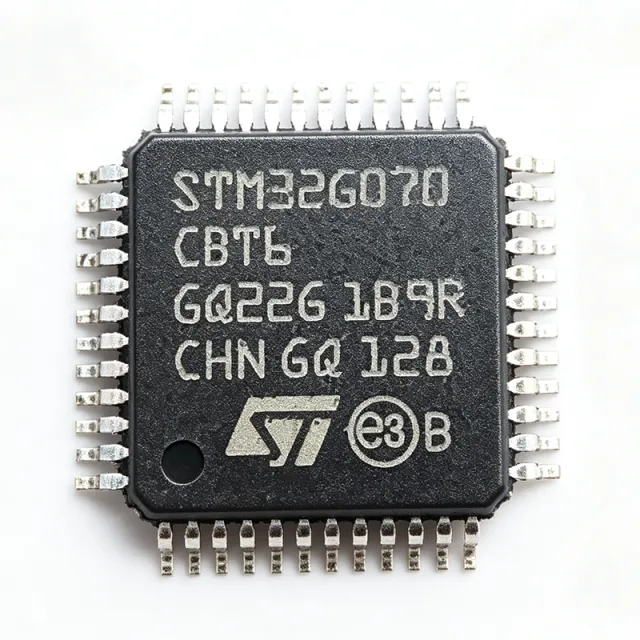
STM32G070CBT6 - 128KB Flash ARM Cortex-M0+ MCU | STMicroelectronics
N.º de pieza: STM32G070CBT6 ✓ Activo| Cant. | Precio unitario | Total |
|---|---|---|
| 1 | $2.63 | $2,63 |
| 10 | $1.78 | $17,80 |
| 100 | $1.39 | $139,00 |
| 500 | $1.3 | $650,00 |
| 1.000 | $1.23 | $1.230,00 |
| 1.500 | $1.17 | $1.755,00 |
STM32G070CBT6 Descripción general
A microcontroller (MCU) is a compact integrated circuit designed to govern a specific operation in an embedded system. It contains a processor core, memory, and programmable input/output peripherals on a single chip. The STM32G070CBT6 belongs to the STM32G0 series, which is part of the broader STM32 family of 32-bit ARM Cortex-M microcontrollers. This hierarchy places it within the embedded processing domain, where it serves as the central control unit for a wide range of applications.
Key features include a 12-bit ADC with up to 19 channels, multiple timers (including advanced-control timers), and a variety of communication interfaces such as I2C, SPI, USART, and a low-power UART. The device also includes a DMA controller, a CRC calculation unit, and a random number generator. Its low-power modes (Sleep, Stop, Standby) make it suitable for battery-powered applications.
The STM32G070CBT6 is built on a high-performance ARM Cortex-M0+ core with a single-cycle multiplier and a nested vectored interrupt controller (NVIC). It supports a wide range of clock sources, including an internal 16MHz RC oscillator, an external crystal oscillator, and a PLL for higher frequencies. The device is designed for robust operation with brown-out reset, power-on reset, and a programmable voltage detector.
Typical applications include industrial control, consumer electronics, IoT devices, and home automation. Its rich peripheral set and low power consumption make it ideal for sensor hubs, motor control, and smart home gateways. The 48-pin LQFP package provides a good balance between pin count and board space, enabling compact designs.
When designing with this MCU, ensure proper decoupling of the power supply pins and a clean ground plane. The internal RC oscillator is sufficient for many applications, but an external crystal is recommended for precise timing requirements. The device supports in-circuit programming and debugging via SWD, simplifying firmware development.
Alternativas directas para STM32G070CBT6 — mismo encapsulado, compatible pin a pin. Se excluyen las piezas de otro encapsulado que requieren retrabajo de la PCB.
Herramienta de comparación rápida — seleccione piezas alternativas para compararlas lado a lado:
STM32G071CBT6
📋 Alternativa de referencia (no en el catálogo)
STM32G070CBT6TR
📋 Alternativa de referencia (no en el catálogo)
STM32G070CBT6 Valores máximos y características eléctricas
| Core | ARM Cortex-M0+ |
| Max CPU Frequency | 64 MHz |
| Flash Memory | 128 KB |
| SRAM | 36 KB |
| Tensión de alimentación | 2.0 V to 3.6 V |
| Encapsulado | LQFP48 |
| Temperatura de funcionamiento | -40C to +85C |
| ADC Resolution | 12-bit |
| ADC Channels | 19 |
| Timers | Advanced-control, general-purpose, basic |
| Communication Interfaces | I2C, SPI, USART, LPUART |
| DMA Channels | 5 |
| GPIO Pins | 37 |
| Low Power Modes | Sleep, Stop, Standby |
| Estado RoHS | Compliant |
Configuración de pines de STM32G070CBT6
| Pin 1 | VBAT — Battery backup supply |
| Pin 2 | PC13 — GPIO / RTC tamper |
| Pin 3 | PC14 — GPIO / OSC32_IN |
| Pin 4 | PC15 — GPIO / OSC32_OUT |
| Pin 5 | PF0 — GPIO / OSC_IN |
| Pin 6 | PF1 — GPIO / OSC_OUT |
| Pin 7 | NRST — Reset (active low) |
| Pin 8 | VDD — Digital power supply |
| Pin 9 | VSS — Ground |
| Pin 10 | PA0 — GPIO / ADC_IN0 |
| Pin 11 | PA1 — GPIO / ADC_IN1 |
| Pin 12 | PA2 — GPIO / USART2_TX |
| Pin 13 | PA3 — GPIO / USART2_RX |
| Pin 14 | PA4 — GPIO / SPI1_NSS |
| Pin 15 | PA5 — GPIO / SPI1_SCK |
| Pin 16 | PA6 — GPIO / SPI1_MISO |
| Pin 17 | PA7 — GPIO / SPI1_MOSI |
| Pin 18 | PB0 — GPIO / ADC_IN8 |
| Pin 19 | PB1 — GPIO / ADC_IN9 |
| Pin 20 | PB2 — GPIO / BOOT1 |
| Pin 21 | PB10 — GPIO / I2C2_SCL |
| Pin 22 | PB11 — GPIO / I2C2_SDA |
| Pin 23 | PB12 — GPIO / SPI2_NSS |
| Pin 24 | PB13 — GPIO / SPI2_SCK |
| Pin 25 | PB14 — GPIO / SPI2_MISO |
| Pin 26 | PB15 — GPIO / SPI2_MOSI |
| Pin 27 | PA8 — GPIO / MCO |
| Pin 28 | PA9 — GPIO / USART1_TX |
| Pin 29 | PA10 — GPIO / USART1_RX |
| Pin 30 | PA11 — GPIO / USART1_CTS |
| Pin 31 | PA12 — GPIO / USART1_RTS |
| Pin 32 | PA13 — GPIO / SWDIO |
| Pin 33 | PA14 — GPIO / SWCLK |
| Pin 34 | PA15 — GPIO / JTDI |
| Pin 35 | PB3 — GPIO / JTDO |
| Pin 36 | PB4 — GPIO / NJTRST |
| Pin 37 | PB5 — GPIO / I2C1_SMBA |
| Pin 38 | PB6 — GPIO / I2C1_SCL |
| Pin 39 | PB7 — GPIO / I2C1_SDA |
| Pin 40 | BOOT0 — Boot mode selection |
| Pin 41 | PB8 — GPIO / CAN_RX |
| Pin 42 | PB9 — GPIO / CAN_TX |
| Pin 43 | VDD — Digital power supply |
| Pin 44 | VSS — Ground |
| Pin 45 | PC14 — GPIO / OSC32_IN |
| Pin 46 | PC15 — GPIO / OSC32_OUT |
| Pin 47 | PC13 — GPIO / RTC_TAMP |
| Pin 48 | VBAT — Battery backup supply |
Aplicaciones típicas
STM32G070CBT6 es adecuado para 6 aplicacións: Industrial Control, IoT Devices, Consumer Electronics, Home Automation, Motor Control, Sensor Hubs.
Industrial Control
The STM32G070CBT6 is ideal for industrial control systems due to its robust timer peripherals, multiple communication interfaces, and wide operating temperature range. Its 64MHz Cortex-M0+ core provides sufficient processing power for real-time control loops, while the 12-bit ADC enables precise analog sensing. In a typical PLC or motor controller, the MCU manages digital I/O, reads sensor data, and generates PWM signals for actuators. The advanced-control timers can produce complementary PWM with dead-time insertion, essential for H-bridge and three-phase inverter designs. The device's UART, SPI, and I2C interfaces allow seamless connection to industrial fieldbuses, sensors, and displays. Its low-power modes help reduce energy consumption in remote monitoring stations. The LQFP48 package is compact yet provides enough pins for control signals, making it a cost-effective choice for industrial applications.
Recomendado
IoT Devices
The STM32G070CBT6 is well-suited for IoT devices that require low power consumption and wireless connectivity. Its multiple low-power modes, including Standby with 0.3 uA current, extend battery life in battery-powered sensors. The device's UART and SPI interfaces can connect to Wi-Fi, BLE, or LoRa modules, enabling cloud connectivity. In a typical smart home sensor, the MCU wakes periodically, reads temperature or humidity sensors, and transmits data via a wireless module. The 128KB flash provides ample space for firmware and protocol stacks. The internal RC oscillator eliminates the need for an external crystal, reducing BOM cost. The device's small LQFP48 package fits well on compact PCB designs. Its wide supply voltage range (2.0V-3.6V) allows direct battery connection, simplifying power management.
Recomendado
Consumer Electronics
The STM32G070CBT6 is a versatile MCU for consumer electronics such as smart appliances, remote controls, and wearable devices. Its rich peripheral set, including timers, ADC, and communication interfaces, supports a wide range of functions. In a smart appliance, the MCU controls user interfaces (buttons, LEDs), reads sensors, and communicates with other devices. The device's low power consumption is crucial for battery-operated remotes and wearables. The 64MHz clock speed ensures responsive user interaction. The LQFP48 package is easy to solder and suitable for mass production. The device's robust design, including brown-out reset and power-on reset, ensures reliable operation in consumer environments. Its support for in-circuit programming via SWD simplifies firmware updates during manufacturing.
Recomendado
Home Automation
The STM32G070CBT6 is an excellent choice for home automation hubs and smart home devices. Its multiple UARTs and SPI interfaces allow connection to various sensors and actuators, while its low-power modes enable energy-efficient operation. In a smart thermostat, the MCU reads temperature sensors, controls heating/cooling relays, and communicates with a central hub via Wi-Fi or Zigbee. The device's 12-bit ADC can interface with analog sensors, and its timers can generate PWM for dimming lights or controlling motorized blinds. The 128KB flash is sufficient for complex automation logic. The device's wide operating temperature range (-40C to +85C) ensures reliable operation in various home environments. Its compact LQFP48 package fits well in wall-mounted devices.
Recomendado
Motor Control
The STM32G070CBT6 is well-suited for motor control applications, including BLDC, PMSM, and stepper motors. Its advanced-control timers provide complementary PWM outputs with programmable dead-time, essential for driving H-bridges and three-phase inverters. The 12-bit ADC with up to 19 channels can sample motor currents and voltages for closed-loop control. The device's 64MHz Cortex-M0+ core executes control algorithms efficiently. In a typical BLDC motor driver, the MCU generates PWM signals, reads Hall sensor or encoder feedback, and adjusts duty cycles to maintain speed and torque. The device's fault handling features, such as break inputs on timers, enhance system safety. Its wide supply voltage range and robust I/O structure make it compatible with various motor driver ICs.
Recomendado
Sensor Hubs
The STM32G070CBT6 is ideal for sensor hub applications, where it aggregates data from multiple sensors and processes or forwards it to a host processor. Its multiple communication interfaces (I2C, SPI, USART) allow connection to a variety of digital sensors, while its ADC can interface with analog sensors. In a wearable health monitor, the MCU reads heart rate, accelerometer, and temperature sensors, processes the data, and transmits it via BLE. The device's low power consumption is critical for battery life. The 36KB SRAM provides ample buffer for sensor data. The device's DMA controller enables efficient data transfer without CPU load. Its compact LQFP48 package is suitable for space-constrained designs.
Recomendado
Resumen de productos recomendados
Datos de referencia de ingeniería para STM32G070CBT6 — comparación, orientación de diseño e información de cumplimiento.
Guía de selección
Comparación con alternativas
| Parámetro | Este producto | STM32G071CBT6 | STM32G070CBT6TR | STM32G070CBT6 |
|---|---|---|---|---|
| Package | LQFP48 | LQFP48 - same | LQFP48 - same | LQFP48 - same |
| Flash Memory | 128 KB | 128 KB | 128 KB | 128 KB |
| SRAM | 36 KB | 36 KB | 36 KB | 36 KB |
| Max CPU Frequency | 64 MHz | 64 MHz | 64 MHz | 64 MHz |
| ADC Channels | 19 | 19 (plus second ADC) | 19 | 19 |
| DAC | No | Yes | No | No |
| Communication Interfaces | I2C, SPI, USART, LPUART | I2C, SPI, USART, LPUART | I2C, SPI, USART, LPUART | I2C, SPI, USART, LPUART |
| Price (qty 1000) | $1.82 | $2.10 | $1.82 | $1.82 |
Diferenciadores clave
- Cost-effective 128KB flash MCU (frente a STM32G071CBT6)
- Low power consumption (frente a STM32G071CBT6)
- Simpler peripheral set (frente a STM32G071CBT6)
Notas de diseño
Decouple each VDD pin with a 100nF ceramic capacitor placed as close as possible to the pin. Additionally, add a 4.7uF bulk capacitor on the main power rail. For the VDDA pin, use a 1uF capacitor and connect it to VDD through a ferrite bead to reduce noise on the analog supply.
Ensure a solid ground plane under the MCU to minimize noise and improve EMC. Keep high-speed signals (SPI, USART) away from the crystal oscillator pins (PF0/PF1) to avoid interference. Use series resistors on clock lines to reduce ringing.
Do not leave unused GPIO pins floating; configure them as outputs or enable internal pull-ups/pull-downs to avoid excessive current consumption. Also, ensure the BOOT0 pin is properly pulled low for normal boot from flash, and verify the NRST pin has a 100nF capacitor to ground for reliable reset.
Información de cumplimiento
RoHS and REACH compliant per STMicroelectronics product page. Not AEC-Q100 qualified - this is a general-purpose MCU, not automotive grade.







