محصولات (39,000+)

STM32F765VIH6 - 216MHz Cortex-M7 MCU 2MB Flash | ST
STM32F765VIH6

STM32F765VIH6 - 216MHz Cortex-M7 MCU 2MB Flash | ST

The STMicroelectronics STM32F765VIH6 is a high-performance 32-bit microcontroller based on the Arm Cortex-M7 core operating at up to 216 MHz, with 2 MB of Flash memory, 462 DMIPS of processing performance, and an 8x8 mm 100-ball TFBGA package. A microcontroller (MCU) is a single-chip computer that integrates a processor core, memory, and peripherals onto one die, serving as the computational heart of embedded systems. Within the system hierarchy, the STM32F765 belongs to the STM32F7 Series of high-performance MCUs, which sits above mainstream Cortex-M4 families and below multicore application processors, making it the workhorse choice for demanding real-time embedded control. Key features include the Arm Cortex-M7 core with double-precision FPU and Armv7E-M DSP instructions, the adaptive real-time (Art) memory accelerator that achieves 0-wait-state execution from Flash at 216 MHz, and L1 instruction and data caches that maximize performance from external memory. Peripherals include SDRAM interface support, DFSDM (digital filter for sigma-delta modulators), multiple high-speed communication interfaces, and advanced analog blocks suitable for motor control and digital power. Architecturally, the Art Accelerator and 16-Kbyte L1 instruction cache allow the Cortex-M7 to sustain its full 1082 CoreMark/MHz-class throughput even when fetching from on-chip Flash, a key differentiator from earlier Cortex-M families that required SRAM execution for peak performance. The double-precision FPU accelerates scientific and signal-processing math natively without software emulation. Typical applications include industrial motor drives and digital power conversion (leveraging DFSDM and high-resolution timers), medical and test instrumentation requiring 216 MHz DSP throughput, and high-end consumer devices with graphical displays driven via SDRAM and LCD interfaces. A key design consideration: the TFBGA package demands careful PCB design with controlled-impedance fanout, and the low core voltage is generated by an embedded regulator, so follow ST layout guidelines for VCAP capacitors and decoupling. This page synthesizes distributor pricing, verified drop-in alternatives, design guidance, and application notes not consolidated in the manufacturer datasheet.

RFQ تماس
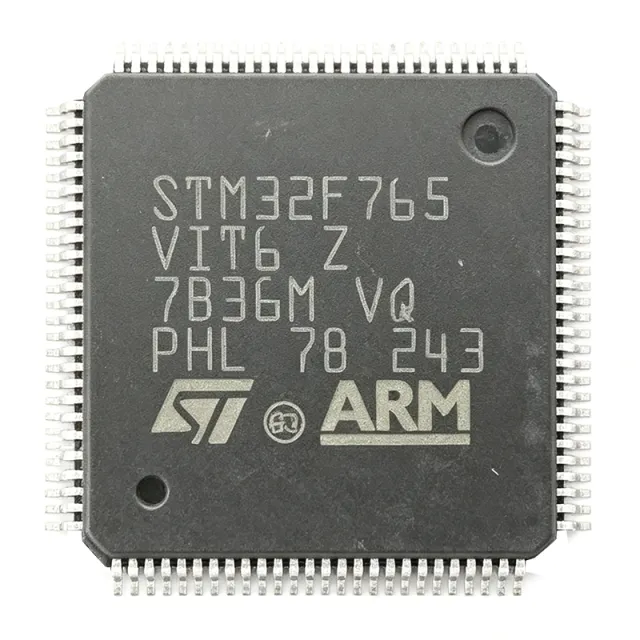
STM32F765VIT6 - 2MB Flash, 512KB RAM Cortex-M7 MCU | STMicroelectronics
STM32F765VIT6

STM32F765VIT6 - 2MB Flash, 512KB RAM Cortex-M7 MCU | STMicroelectronics

The STM32F765VIT6 is a high-performance 32-bit microcontroller from STMicroelectronics based on the ARM Cortex-M7 core, operating at up to 216 MHz. It features 2 MB of Flash memory and 512 KB of SRAM, making it suitable for complex applications requiring substantial code and data storage. The device is housed in a 100-pin LQFP package (LQFP100) and supports a wide supply voltage range of 1.7V to 3.6V. Data verified as of 2026-08-05. What is a microcontroller? A microcontroller (MCU) is a compact integrated circuit designed to govern a specific operation in an embedded system. It integrates a processor core, memory (Flash and SRAM), and programmable input/output peripherals on a single chip. In the system hierarchy, the STM32F765VIT6 is a microcontroller -> embedded processor -> integrated circuit -> semiconductor. This MCU family is part of the STM32F7 series, which is positioned as a high-performance line within the broader STM32 ecosystem, offering a balance of processing power, memory, and peripheral integration for industrial, consumer, and IoT applications. Key features include a 216 MHz ARM Cortex-M7 core with double-precision FPU, 2 MB of dual-bank Flash, 512 KB of SRAM, and a comprehensive set of peripherals: multiple 12-bit ADCs, DACs, timers, USARTs, SPIs, I2Cs, USB OTG HS/FS, Ethernet MAC, camera interface, and cryptographic acceleration. The device also includes a Chrom-ART Accelerator for 2D graphics and a TFT LCD controller, enabling rich user interfaces. The Cortex-M7 core delivers 7 CoreMark/MHz, providing high computational throughput for DSP and control applications. Technically, the STM32F765VIT6 is built on a 40nm process technology, offering low power consumption with multiple low-power modes (Sleep, Stop, Standby). It includes a memory protection unit (MPU), a cache (I-Cache and D-Cache) to optimize performance, and a flexible memory controller (FMC) for external memory expansion. The device supports a wide range of communication interfaces, making it a versatile choice for connectivity-centric designs. Typical applications include industrial control systems, motor drives, power conversion, IoT gateways, audio processing, and advanced human-machine interfaces (HMI). The combination of high clock speed, large memory, and rich peripherals makes it ideal for applications requiring real-time processing and connectivity. When designing with this MCU, pay attention to power supply decoupling: place a 100nF capacitor close to each VDD pin and a 4.7uF capacitor at the main supply. Also, ensure proper layout for the high-speed USB and Ethernet interfaces to maintain signal integrity. The device supports in-circuit programming and debugging via SWD and JTAG, facilitating development. This page synthesizes distributor pricing, drop-in alternatives, and practical design notes not found in the ST datasheet, providing a comprehensive resource for engineers evaluating the STM32F765VIT6.

USD $10.37 تماس
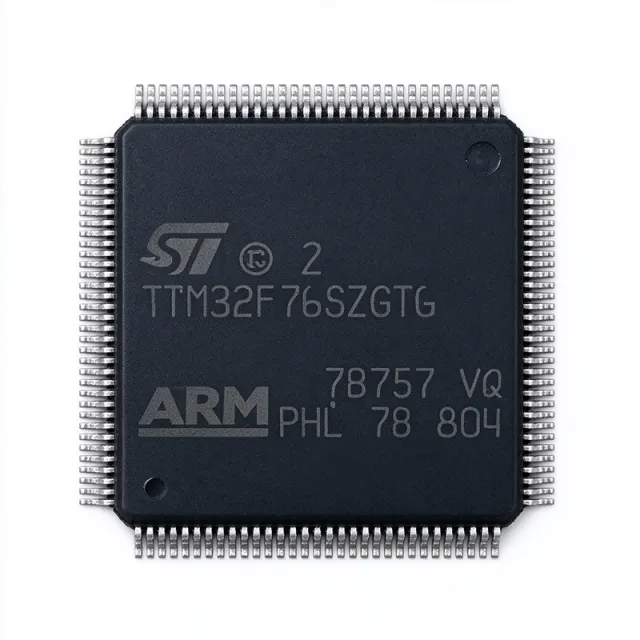
STM32F765ZGT6 - 216MHz Cortex-M7 MCU, 1MB Flash | STMicroelectronics
STM32F765ZGT6

STM32F765ZGT6 - 216MHz Cortex-M7 MCU, 1MB Flash | STMicroelectronics

The STMicroelectronics STM32F765ZGT6 is a high-performance 32-bit ARM Cortex-M7 microcontroller with double-precision FPU, operating at up to 216 MHz, integrating 1 MB of Flash memory and 384 KB of SRAM in a 144-pin LQFP package (20x20 mm). It delivers 462 DMIPS (2.14 DMIPS/MHz, Dhrystone 2.1) and supports DSP instructions with single-precision floating point, plus a memory protection unit (MPU) for robust embedded designs. A microcontroller (MCU) is a single-chip embedded computer that combines a processor core, on-chip memory, and programmable peripherals, sitting at the heart of nearly every modern electronic system. Within the component taxonomy, the STM32F765ZGT6 belongs to the STM32F7 series of 32-bit Flash MCUs, which falls under the broader STM32 family and the ARM Cortex-M ecosystem, serving industrial, consumer, and medical applications that demand more compute headroom than Cortex-M4 devices can deliver. The Cortex-M7 in turn inherits from ARM's Cortex-M processor lineage, while MCU itself is a hypernym of microprocessor. Key differentiating features include the Adaptive Real-Time (ART) Accelerator with 16 Kbytes I/D L1 cache enabling 0-wait-state execution from embedded Flash, the Chrom-ART Accelerator (DMA2D) that offloads 2D graphics work, and a rich peripheral set including multiple 12-bit ADCs, DACs, advanced timers, USART/UART, SPI, I2C, CAN, USB OTG full-speed/high-speed, an Ethernet MAC with IEEE 1588 support, and a camera interface. A flexible external memory controller (FMC) supports SDRAM, SRAM, and NOR/NAND Flash for large frame buffers. Technically, the Cortex-M7 6-stage pipeline with branch prediction and dual-issue capability sustains high throughput even under interrupt load, while the integrated FPU accelerates signal-processing tasks. Supply range is 1.7V to 3.6V with operation from -40C to +85C ambient for the STM32F765ZGT6 industrial grade, and the part supports Sleep, Stop, and Standby low-power modes. Typical applications include industrial automation (PLCs, motor control), human-machine interfaces with graphical TFT displays, IoT gateways where the Ethernet MAC enables precise IEEE 1588 time synchronization, and audio processing using the DSP extensions. The wide peripheral set also suits building automation, point-of-sale terminals, and medical instrumentation. Design-wise, place 100nF decoupling capacitors on each VDD pin and a 4.7uF bulk cap on the main supply, follow ST's reference layout for the HSE crystal and VREF+ analog domain, and exploit the low-power modes for battery-sensitive designs. This page synthesizes distributor pricing, drop-in alternatives, FAQ answers, and practical design notes not found in the manufacturer datasheet, with pricing as of 2026-10-10.

USD $22.97 موجود در انبار
STM32F765ZGT6TR - 216MHz Cortex-M7 MCU, 1MB Flash | STMicroelectronics (Tape & Reel)
STM32F765ZGT6TR

STM32F765ZGT6TR - 216MHz Cortex-M7 MCU, 1MB Flash | STMicroelectronics (Tape & Reel)

The STMicroelectronics STM32F765ZGT6TR is a high-performance 32-bit ARM Cortex-M7 microcontroller with double-precision FPU, operating at up to 216 MHz, integrating 1 MB of Flash memory and 384 KB of SRAM in a 144-pin LQFP package (20x20 mm). It delivers 462 DMIPS (2.14 DMIPS/MHz, Dhrystone 2.1) and supports DSP instructions with single-precision floating point, plus a memory protection unit (MPU) for robust embedded designs. A microcontroller (MCU) is a single-chip embedded computer that combines a processor core, on-chip memory, and programmable peripherals, sitting at the heart of nearly every modern electronic system. Within the component taxonomy, the STM32F765ZGT6TR belongs to the STM32F7 series of 32-bit Flash MCUs, which falls under the broader STM32 family and the ARM Cortex-M ecosystem, serving industrial, consumer, and medical applications that demand more compute headroom than Cortex-M4 devices can deliver. The Cortex-M7 in turn inherits from ARM's Cortex-M processor lineage, while MCU itself is a hypernym of microprocessor. Key differentiating features include the Adaptive Real-Time (ART) Accelerator with 16 Kbytes I/D L1 cache enabling 0-wait-state execution from embedded Flash, the Chrom-ART Accelerator (DMA2D) that offloads 2D graphics work, and a rich peripheral set including multiple 12-bit ADCs, DACs, advanced timers, USART/UART, SPI, I2C, CAN, USB OTG full-speed/high-speed, an Ethernet MAC with IEEE 1588 support, and a camera interface. A flexible external memory controller (FMC) supports SDRAM, SRAM, and NOR/NAND Flash for large frame buffers. Technically, the Cortex-M7 6-stage pipeline with branch prediction and dual-issue capability sustains high throughput even under interrupt load, while the integrated FPU accelerates signal-processing tasks. Supply range is 1.7V to 3.6V with operation from -40C to +85C ambient for the STM32F765ZGT6TR industrial grade, and the part supports Sleep, Stop, and Standby low-power modes. Typical applications include industrial automation (PLCs, motor control), human-machine interfaces with graphical TFT displays, IoT gateways where the Ethernet MAC enables precise IEEE 1588 time synchronization, and audio processing using the DSP extensions. The wide peripheral set also suits building automation, point-of-sale terminals, and medical instrumentation. Design-wise, place 100nF decoupling capacitors on each VDD pin and a 4.7uF bulk cap on the main supply, follow ST's reference layout for the HSE crystal and VREF+ analog domain, and exploit the low-power modes for battery-sensitive designs. This page synthesizes distributor pricing, drop-in alternatives, FAQ answers, and practical design notes not found in the manufacturer datasheet, with pricing as of 2026-10-10.

USD $22.97 موجود در انبار
STM32F765ZGT7 - 216MHz Cortex-M7 1MB MCU | STMicroelectronics
STM32F765ZGT7

STM32F765ZGT7 - 216MHz Cortex-M7 1MB MCU | STMicroelectronics

STMicroelectronics STM32F765ZGT7 is a 32-bit Arm Cortex-M7 microcontroller with a 216 MHz maximum operating frequency, 1 MB of flash memory, and a 144-pin LQFP package measuring 20 mm by 20 mm. The device is positioned for high-performance embedded control, connected industrial equipment, audio and communications, and real-time signal-processing systems. Verified distributor data identifies it as an STM32F7-series MCU with DSP, FPU, cache, Art Accelerator, SDRAM, and DFSDM capabilities. A microcontroller is a programmable system-on-chip that integrates a processor core, nonvolatile program memory, data memory, peripherals, and communication interfaces into one device. The STM32F7 family belongs to the embedded MCU hierarchy and uses the Arm Cortex-M7 RISC architecture. This combination provides a high-performance platform for real-time control while retaining the software portability and ecosystem benefits associated with Arm Cortex-M processors. The STM32F765ZGT7 headline features are its 216 MHz Cortex-M7 core, 1 MB flash capacity, and 144-pin LQFP footprint. Its architecture is designed for high-performance and DSP applications, with the verified sources specifically listing an FPU, cache, Art Accelerator, SDRAM, and DFSDM. The LQFP package provides a large lead count and a mechanically accessible footprint for industrial, communications, and embedded-control boards. Exact RAM, voltage range, peripheral inventory, and temperature limits are not provided in the supplied verified data. The STM32F765xx family combines a 32-bit RISC core with high-performance and DSP-oriented processing. The FPU accelerates floating-point workloads, while cache support can improve instruction and data access behavior in suitable workloads. SDRAM support is relevant for systems requiring external memory, and DFSDM can support applications involving digital filter or ADC-related signal acquisition. These features make the MCU suitable where deterministic control and higher computational throughput are needed beyond a basic general-purpose microcontroller. Typical applications include industrial automation, communications equipment, consumer electronics, medical-device control, automotive electronics, and real-time embedded systems. The 216 MHz operating speed is useful for protocol processing, control loops, and signal-processing tasks, while 1 MB flash provides room for larger firmware and application code. Engineers should verify the complete pinout, electrical limits, memory map, peripheral availability, and package details in the official STMicroelectronics datasheet before final PCB release. A key design consideration is package and firmware verification. Because the supplied evidence confirms a 144-pin LQFP package and a 1 MB flash configuration but does not provide a complete verified pin table, do not rely on generic STM32F7 pin assumptions. Confirm the exact STM32F765ZGT7 datasheet, board support package, clock tree, power rails, decoupling, and exposed thermal requirements. XAIPART provides the product record, source links, pricing tiers, and engineering guidance, while missing technical values remain explicitly marked for validation. This page combines verified distributor availability, the official STMicroelectronics family description, package and processor specifications, application context, and replacement-screening guidance. It is intended to accelerate component search and engineering review without inventing electrical values that were not supplied by the verified sources.

RFQ تماس
STM32F765ZIT6 - 216MHz Cortex-M7 MCU, 2MB Flash, LQFP-144 | STMicroelectronics
STM32F765ZIT6

STM32F765ZIT6 - 216MHz Cortex-M7 MCU, 2MB Flash, LQFP-144 | STMicroelectronics

The STMicroelectronics STM32F765ZIT6 is a high-performance 32-bit Arm Cortex-M7 microcontroller operating at up to 216 MHz, packaged in a 144-pin LQFP with 2 MB of embedded Flash and 512 KB of SRAM. It integrates a double-precision FPU, DSP instructions, and a 16-Kbyte I-cache plus 16-Kbyte D-cache, enabling 0-wait-state execution from Flash at full 216 MHz speed and delivering up to 462 DMIPS (2.14 DMIPS/MHz). The LQFP-144 footprint also exposes the full set of high-speed peripherals required for graphics, Ethernet, and USB 2.0 HS workloads. An MCU (Microcontroller Unit) is a single-chip computer that integrates a CPU core, volatile and non-volatile memory, and a rich set of peripherals such as timers, ADCs, and communication interfaces. The STM32F7 family sits at the high-performance end of the Cortex-M hierarchy — Cortex-M7 > Cortex-M4 > Cortex-M3 > Cortex-M0 — and is a member of the broader Arm Cortex-M MCU taxonomy under embedded microcontrollers, semiconductor devices, and integrated circuits. Within ST's portfolio, the F7 line bridges Cortex-M4-class parts (such as the STM32F4 series) and Cortex-M7 application processors. Key features include up to 17 timers (including motor-control, HRTIM, and 32-bit timers), two 12-bit ADCs sampling at 2.4 MSPS, two 12-bit DACs, a true random number generator (RNG), cryptographic accelerators, and a Chrom-ART accelerator for offloading GUI rendering. An integrated 2.4-inch TFT-LCD controller (LTDC) supports up to XGA resolution without an external graphics chip, while USB 2.0 High-Speed with on-chip PHY and 10/100 Ethernet with IEEE 1588 make the part attractive for connected embedded designs. Architecturally, the Cortex-M7 core pairs a 6-stage superscalar pipeline with branch prediction and tightly-coupled memory for deterministic interrupt response. The 2 MB of dual-bank Flash supports read-while-write for safe in-field firmware upgrades, and the 512 KB SRAM is split into multiple AHB-matrix regions for simultaneous DMA and CPU access. This bandwidth is what allows driving parallel TFT displays while running DSP-style audio or motor-control loops concurrently. Typical applications include industrial HMI panels with TFT-LCD touchscreens, motor-control and field-oriented control drives, industrial Ethernet gateways, USB audio interfaces, and barcode/scanner modules. Specific uses range from PLC operator panels to medical instrumentation front-ends and office printers requiring raster image processing. When PCB area is constrained, designers often migrate to the LQFP-100 or LQFP-176 versions of the same silicon, but the ZIT6 in LQFP-144 maximizes peripheral exposure without stepping up to a BGA. For power-supply design, the part requires a 1.8V to 3.6V supply with decoupling on every VDD/VBAT pin; bypassing must keep PCB track inductance below roughly 1 nH to avoid noise coupling into the PLL. Trade-off: peak performance at 216 MHz pushes core current beyond 100 mA, so efficiency-aware designs often drop to 180 MHz when full throughput is not required. This page synthesizes distributor pricing, same-package drop-in alternatives from across the STM32 family, and design notes not contained in a single manufacturer datasheet.

RFQ تماس
STM32F765ZIT7 - 216MHz Cortex-M7 MCU, 2MB Flash, 144-LQFP | STMicroelectronics (Tape & Reel)
STM32F765ZIT7

STM32F765ZIT7 - 216MHz Cortex-M7 MCU, 2MB Flash, 144-LQFP | STMicroelectronics (Tape & Reel)

The STMicroelectronics STM32F765ZIT7 is a high-performance ARM Cortex-M7 32-bit RISC microcontroller with FPU, operating at up to 216 MHz and delivering 462 DMIPS of compute throughput, housed in a 144-pin LQFP (20x20 mm) package. It integrates 2 MB of embedded Flash and 512+16+4 KB of SRAM, plus an extensive set of high-speed peripherals including USB OTG HS/FS, two CAN 2.0B interfaces, an LCD-TFT controller, an MIPI-DSI host, and a hardware cryptographic accelerator suite. The 'I' suffix denotes the industrial-grade (-40C to +85C) operating range, and 'TR' designates Tape & Reel packaging. A microcontroller (MCU) is a single-chip computer that integrates a CPU core, memory, and programmable I/O peripherals. The Cortex-M7 is ARM's highest-performance Cortex-M core, featuring a six-stage superscalar pipeline, branch prediction, and an integrated single-precision floating-point unit; it sits at the top of the Cortex-M family alongside the Cortex-M4 and Cortex-M33. STM32F7-series MCUs belong to the broader ARM Cortex-M taxonomy, which itself falls under 32-bit RISC microcontrollers and, more generally, embedded microprocessors and semiconductor ICs. Compared with Cortex-M4 parts, the Cortex-M7 offers roughly doubled DSP performance and is aimed at demanding signal-processing and graphics workloads. Key features that distinguish this part include the dual-bank 2 MB Flash with ART Accelerator for zero-wait-state execution from Flash, 16-bit and 32-bit timers, up to 28 communication interfaces (USART/UART/SPI/I2S/I2C), a 12-bit ADC reaching 2.4 MSPS, two 12-bit DACs, an SDMMC host interface for external SD cards or eMMC, and an Ethernet MAC with dedicated DMA. The integrated cryptographic accelerator (AES-256, SHA-1/SHA-2, HMAC, and TRNG) enables hardware-bound secure boot and TLS/SSL offload. The Chrom-ART Accelerator 2D DMA engine accelerates bitmap operations for HMI applications. Typical applications include industrial motor drives and PLCs, medical patient-monitoring and diagnostic equipment, human-machine interface (HMI) panels with TFT-LCD or DSI displays, factory-automation controllers with EtherCAT/PROFINET bridges, point-of-sale terminals, building-automation gateways, and audio-processing units including USB audio class endpoints. The 216 MHz Cortex-M7 with single-precision FPU and DSP extensions makes the part particularly suited to real-time FFT-based analytics, digital filtering, and motor-control algorithms using FOC (field-oriented control). Pin-compatible upgrades within the STM32F765 family extend to the STM32F767/F769 line for projects that need additional MIPI-DSI lanes or the SPDIF interface. When designing with this MCU, attention must be paid to decoupling (1 uF + 100 nF near each VDD pin), the layout of the 25 MHz HSE crystal traces within 5 mm of the OSC_IN/OSC_OUT pins, and the thermal dissipation in continuous high-CPU-load scenarios. The 144-LQFP package has a thermal resistance of approximately 38 C/W (theta_JA on a 4-layer JEDEC board) and is adequate for industrial operating points up to about 0.8 W steady-state dissipation without airflow. This page synthesizes 144-LQFP same-package drop-in alternatives, distributor pricing tiers, and practical design notes not found in a single source.

RFQ تماس
STM32F765ZIT7TR - 216MHz Cortex-M7 MCU, 2MB Flash, 144-LQFP | STMicroelectronics
STM32F765ZIT7TR

STM32F765ZIT7TR - 216MHz Cortex-M7 MCU, 2MB Flash, 144-LQFP | STMicroelectronics

The STMicroelectronics STM32F765ZIT7TR is a high-performance ARM Cortex-M7 32-bit RISC microcontroller with FPU, operating at up to 216 MHz and delivering 462 DMIPS of compute throughput, housed in a 144-pin LQFP (20x20 mm) package. It integrates 2 MB of embedded Flash and 512+16+4 KB of SRAM, plus an extensive set of high-speed peripherals including USB OTG HS/FS, two CAN 2.0B interfaces, an LCD-TFT controller, an MIPI-DSI host, and a hardware cryptographic accelerator suite. The 'I' suffix denotes the industrial-grade (-40C to +85C) operating range, and 'TR' designates Tape & Reel packaging. A microcontroller (MCU) is a single-chip computer that integrates a CPU core, memory, and programmable I/O peripherals. The Cortex-M7 is ARM's highest-performance Cortex-M core, featuring a six-stage superscalar pipeline, branch prediction, and an integrated single-precision floating-point unit; it sits at the top of the Cortex-M family alongside the Cortex-M4 and Cortex-M33. STM32F7-series MCUs belong to the broader ARM Cortex-M taxonomy, which itself falls under 32-bit RISC microcontrollers and, more generally, embedded microprocessors and semiconductor ICs. Compared with Cortex-M4 parts, the Cortex-M7 offers roughly doubled DSP performance and is aimed at demanding signal-processing and graphics workloads. Key features that distinguish this part include the dual-bank 2 MB Flash with ART Accelerator for zero-wait-state execution from Flash, 16-bit and 32-bit timers, up to 28 communication interfaces (USART/UART/SPI/I2S/I2C), a 12-bit ADC reaching 2.4 MSPS, two 12-bit DACs, an SDMMC host interface for external SD cards or eMMC, and an Ethernet MAC with dedicated DMA. The integrated cryptographic accelerator (AES-256, SHA-1/SHA-2, HMAC, and TRNG) enables hardware-bound secure boot and TLS/SSL offload. The Chrom-ART Accelerator 2D DMA engine accelerates bitmap operations for HMI applications. Typical applications include industrial motor drives and PLCs, medical patient-monitoring and diagnostic equipment, human-machine interface (HMI) panels with TFT-LCD or DSI displays, factory-automation controllers with EtherCAT/PROFINET bridges, point-of-sale terminals, building-automation gateways, and audio-processing units including USB audio class endpoints. The 216 MHz Cortex-M7 with single-precision FPU and DSP extensions makes the part particularly suited to real-time FFT-based analytics, digital filtering, and motor-control algorithms using FOC (field-oriented control). Pin-compatible upgrades within the STM32F765 family extend to the STM32F767/F769 line for projects that need additional MIPI-DSI lanes or the SPDIF interface. When designing with this MCU, attention must be paid to decoupling (1 uF + 100 nF near each VDD pin), the layout of the 25 MHz HSE crystal traces within 5 mm of the OSC_IN/OSC_OUT pins, and the thermal dissipation in continuous high-CPU-load scenarios. The 144-LQFP package has a thermal resistance of approximately 38 C/W (theta_JA on a 4-layer JEDEC board) and is adequate for industrial operating points up to about 0.8 W steady-state dissipation without airflow. This page synthesizes 144-LQFP same-package drop-in alternatives, distributor pricing tiers, and practical design notes not found in a single source.

RFQ تماس
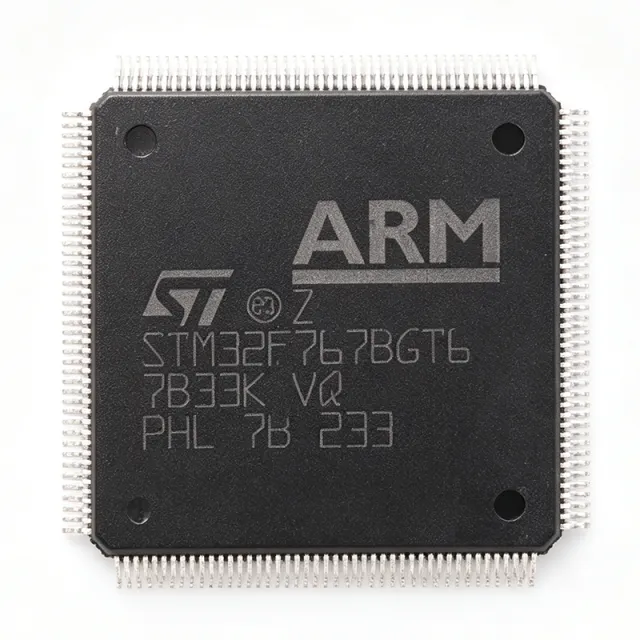
STM32F767BGT6 - 216MHz Cortex-M7 MCU, 1MB Flash | STMicroelectronics
STM32F767BGT6

STM32F767BGT6 - 216MHz Cortex-M7 MCU, 1MB Flash | STMicroelectronics

The STM32F767BGT6 is a high-performance 32-bit microcontroller from STMicroelectronics, built around the Arm® Cortex®-M7 core with a floating-point unit (FPU) and digital signal processing (DSP) instructions. Operating at up to 216 MHz, it delivers 462 DMIPS, making it suitable for demanding embedded applications. The device integrates 1 MB of flash memory and 512 KB of SRAM, along with a rich set of peripherals including USB OTG HS/FS, multiple communication interfaces, an LCD controller, and a DSI host. A microcontroller (MCU) is a compact integrated circuit designed to govern a specific operation in an embedded system. It contains a processor core, memory, and programmable input/output peripherals on a single chip. The STM32F7 series sits at the high-performance end of the STM32 portfolio, positioned above the mainstream F4 series and below the application processors in the STM32MP1 line. This hierarchy places the STM32F767BGT6 as a top-tier MCU for applications requiring significant compute power and connectivity. Key features include a 216 MHz Arm Cortex-M7 core with double-precision FPU, 1 MB of flash memory, 512 KB of SRAM, and a comprehensive set of peripherals. The device supports a wide range of communication interfaces, including USB OTG HS/FS, Ethernet, multiple USARTs, SPIs, I2Cs, and CAN. It also features an LCD-TFT controller and a DSI host, enabling direct connection to displays. The STM32F767BGT6 is available in a 208-pin LQFP package (28x28 mm), providing ample I/O for complex designs. The STM32F767BGT6 leverages the Arm Cortex-M7 architecture, which includes a 6-stage pipeline, branch prediction, and a memory protection unit (MPU). The FPU supports both single and double precision, accelerating mathematical operations for signal processing and control algorithms. The device also includes a Chrom-ART Accelerator™ for 2D graphics, offloading the CPU for graphical user interfaces. With its high clock speed and advanced peripherals, the STM32F767BGT6 excels in applications such as industrial control, motor control, audio processing, and human-machine interfaces. Typical applications include high-end industrial automation, robotics, audio processing, and advanced human-machine interfaces. The device's high performance and rich peripheral set make it ideal for applications requiring real-time control and complex user interfaces. For example, in industrial automation, the STM32F767BGT6 can handle multiple communication protocols simultaneously while executing complex control algorithms. When designing with the STM32F767BGT6, ensure adequate power supply decoupling with 100 nF capacitors close to each power pin and a bulk capacitor. The device supports a wide supply voltage range of 1.7V to 3.6V, allowing flexible power design. For high-speed communication interfaces, pay attention to PCB layout to maintain signal integrity.

USD $11.55 تماس
STM32F767BIT6 - ARM Cortex-M7 MCU, 2MB Flash, 216MHz | STMicroelectronics
STM32F767BIT6

STM32F767BIT6 - ARM Cortex-M7 MCU, 2MB Flash, 216MHz | STMicroelectronics

The STMicroelectronics STM32F767BIT6 is a high-performance 32-bit ARM Cortex-M7 microcontroller with FPU, 2 MB of embedded Flash and 512 KB of SRAM, integrated into a 208-pin LQFP (28x28 mm) package. Key headline specifications include a 216 MHz maximum CPU clock delivering 462 DMIPS (2.14 DMIPS/MHz, Dhrystone 2.1), DSP instructions and an ART Accelerator with 16 KB I/D L1 cache enabling zero-wait-state execution from Flash. The device integrates a Cryptography accelerator (AES-256, Hash, RNG) and an Embedded SDRAM controller supporting external SDRAM up to 32-bit wide. What is a Cortex-M7 MCU? An ARM Cortex-M7 microcontroller is a high-end 32-bit microcontroller core designed by Arm for deterministic real-time embedded systems. The Cortex-M7 belongs to the Cortex-M family and is positioned above Cortex-M4 by adding a double-precision FPU, single-precision floating-point pipeline, branch prediction, and tightly-coupled instruction/data caches. The STM32F7 line is part of ST's mainstream performance tier that also introduces MIPI-DSI display, USB Type-C / Power Delivery and a richer analog set over the F4 generation, making it suitable for industrial control, audio DSP, HMI graphics and motor-control loops. Key features of the STM32F767BIT6 include: up to 18 timer channels, three 12-bit ADC converters (up to 2.4 MSPS each), two 12-bit DACs, a USB 2.0 OTG full-speed/high-speed PHY, two CAN 2.0B controllers, an SDIO/MMC interface, a Quad-SPI flash interface and an LCD-TFT controller. The Cryptography block accelerates AES-256, SHA-1/SHA-2 hashing, and true RNG, easing secure-boot and TLS link setups. The 208-LQFP footprint routes out 162 GPIO pins plus a wide parallel-interface bus, sufficient for SDRAM + TFT display + Ethernet + USB Type-C concurrently. The architecture pairs a dual-issue FPU + DSP pipeline with ART Accelerator to minimise flash wait-states; combined with the 16 KB L1 cache, the device achieves 462 DMIPS at 216 MHz with deterministic interrupt latency of <30 ns typical. Cryptography hardware offloads AES, SHA-1/2 and RNG; this dramatically reduces CPU overhead in TLS handshakes compared to software-only implementations. Embedded SRAM is split into 384 KB DTCM + 128 KB SRAM + 4 KB backup SRAM, with the SDRAM controller extending external memory up to 32-bit wide for display or data buffers. Typical applications are industrial HMI panels, motor drives and servo controllers, USB-C PD chargers and audio DSP platforms. The combination of TFT-LCD controller + DMA2D + SDRAM controller + USB high-speed on-chip PHY makes the F767 a single-chip candidate for 4.3-inch touchscreen displays with secure field updates. When designing with this device the 1.7-3.6 V supply and an external 25 MHz HSE crystal (with optional LSE 32.768 kHz for RTC) must be provided. Decoupling follows ST AN4365 placement rules: 100 nF + 4.7 µF near each VDD/VSS pair, plus a dedicated 1 µF bulk for the USB OTG PHY rail. For SDRAM operation use layed-out matched length with VREF = VDD/2 and 50 Ω impedance; bypass VBAT with a 0.1 µF cap if no battery is fitted.

RFQ تماس
STM32F767IGK6 - 216MHz Cortex-M7 MCU 1MB Flash 176+25UFBGA
STM32F767IGK6

STM32F767IGK6 - 216MHz Cortex-M7 MCU 1MB Flash 176+25UFBGA

The STMicroelectronics STM32F767IGK6 is a high-performance 32-bit ARM Cortex-M7 microcontroller with FPU and DSP instructions, operating at up to 216 MHz and delivering 462 DMIPS / 1082 CoreMark performance. It integrates 1 MB of Flash and 512 KB of SRAM in a 176+25-pin UFBGA (10x10 mm) package, with 140 I/O ports supporting a wide range of peripherals including Ethernet MAC, USB OTG, CAN, SDMMC, and three 12-bit ADCs. An ARM Cortex-M7 microcontroller belongs to the ARM Cortex-M processor family, designed for embedded real-time systems. The Cortex-M7 is the highest-performance member of this family, featuring a superscalar pipeline, branch prediction, single-precision and double-precision FPU, and dedicated DSP extensions (SIMD). These MCUs sit in the embedded processor hierarchy: microcontroller -> embedded processor -> semiconductor IC, and are used wherever deterministic real-time response, rich connectivity, and graphics/audio processing are required in a single chip. Key features include an integrated 216 MHz Cortex-M7 core with 16 KB I-cache and 16 KB D-cache for high-throughput execution, hardware JPEG codec, random number generator (TRNG), and crypto/hash peripherals supporting AES-256, SHA-256, and HMAC. Three 12-bit ADCs sample at 2.4 MSPS each, and the device also includes two 12-bit DACs, up to 18 timers, and an SDMMC interface for microSD card storage. The LQFP176/UFBGA176 family pinout supports display interfaces (LCD-TFT) and an 8- to 14-bit camera parallel interface. The architecture combines an AXI/AHB multilayer bus matrix with a dedicated Chrom-ART graphics accelerator, enabling efficient on-chip LTDC and DMA2D operations without burdening the CPU. This makes the STM32F767IGK6 suitable for human-machine interfaces (HMI), where the CPU remains free for application logic while the accelerator handles pixel rendering. Typical applications include industrial HMI panels with TFT LCD touchscreens, motor-control inverter boards, building-automation gateways with Ethernet connectivity, point-of-sale and barcode-scanner terminals, medical patient-monitoring front panels, and consumer audio products that need MP3/WMA decoding with on-the-fly graphics overlays. When designing with this part, ensure that the PCB's thermal copper pour covers the exposed pad of the UFBGA to meet the 216 MHz current demand; an inadequate thermal land will push the junction temperature above the 125 C limit during heavy DMA and graphics workloads. Use the STM32CubeMX tool to configure the GPIO/AF matrix, and pair the MCU with an external SDRAM when the on-chip 512 KB SRAM is insufficient for frame buffers. This page synthesises verified distributor pricing, same-family drop-in alternatives, and practical thermal/PCB layout notes not consolidated in the STMicroelectronics datasheet DM00273119 alone.

RFQ تماس
STM32F767IGT6 - 216MHz Cortex-M7 1MB MCU | STMicroelectronics
STM32F767IGT6

STM32F767IGT6 - 216MHz Cortex-M7 1MB MCU | STMicroelectronics

The STMicroelectronics STM32F767IGT6 is a high-performance 32-bit Arm Cortex-M7 microcontroller with a maximum operating frequency of 216 MHz, 1 MB of flash memory, and a 176-LQFP 24 mm × 24 mm package. It combines a high-performance microcontroller core with extensive connectivity and embedded-control resources for industrial, communications, audio, and real-time embedded applications. A microcontroller is a programmable embedded-control IC that integrates a processor core, memory, peripherals, and communication interfaces on one package. The STM32F7 Series belongs to the hierarchy microcontroller → 32-bit microcontroller → Arm Cortex-M microcontroller → embedded processing IC. STM32F767IGT6 is specifically intended for designs that require more processing performance and peripheral capability than entry-level Cortex-M devices. The verified device data identifies an Arm Cortex-M7 32-bit RISC core, up to 216 MHz operating frequency, 1 MB of flash organized as 1M × 8 bits, and a 176-LQFP package measuring 24 mm × 24 mm. The family documentation also identifies up to 462 DMIPS and up to 2 MB of flash across the STM32F765xx, STM32F767xx, STM32F768Ax, and STM32F769xx families. A 512 KB RAM value is reported by a secondary datasheet index. Its architecture is suited to computationally intensive control tasks that still require deterministic embedded real-time behavior. The Cortex-M7 platform supports floating-point-oriented workloads, while integrated connectivity allows the MCU to participate directly in Ethernet, USB, industrial, and human-interface designs. Exact peripheral availability, I/O voltage limits, current consumption, and operating-temperature limits must be confirmed in the manufacturer datasheet for the selected order code. Typical uses include industrial control equipment, connected industrial gateways, real-time communication equipment, audio and digital signal-processing systems, and high-end embedded control platforms. Designers evaluating this MCU for an STM32F767IGT6 replacement must confirm more than package dimensions: peripheral mapping, bootloader behavior, clock configuration, pin multiplexing, supply requirements, and software-driver support also determine whether a substitute is truly interchangeable. For new layouts, preserve the 176-pin footprint and place all required decoupling and programming-test points according to the manufacturer reference design. Before production release, verify the exact flash and RAM configuration, power domains, exposed-pin requirements, thermal limits, and firmware support against the current STMicroelectronics documentation. This page consolidates verified distributor specifications, official family information, package-aware alternatives, comparison parameters, and practical replacement checks so engineers can evaluate the STM32F767IGT6 for procurement, schematic capture, PCB design, and firmware planning without relying on a basic distributor listing alone.

RFQ تماس
STM32F767IIK6 - 216MHz Cortex-M7 2MB MCU | STMicroelectronics
STM32F767IIK6

STM32F767IIK6 - 216MHz Cortex-M7 2MB MCU | STMicroelectronics

The STMicroelectronics STM32F767IIK6 is a 32-bit Arm Cortex-M7 microcontroller operating at 216 MHz, with 2 MB of embedded Flash memory and a 176-ball UFBGA package measuring 10 mm by 10 mm. It combines high-performance floating-point and signal-processing capability with extensive connectivity and memory resources for demanding embedded systems. A microcontroller is a programmable system-on-chip that integrates a CPU, memory, peripherals, and communication interfaces on one semiconductor device. The STM32F7 series belongs to the high-performance Arm Cortex-M embedded-microcontroller hierarchy, combining real-time control with substantially greater compute throughput than basic 8-bit or 16-bit controllers. The STM32F767IIK6 therefore sits between conventional control MCUs and higher-complexity application processors. Verified distributor data identifies an Arm Cortex-M7 core, 32-bit architecture, 216 MHz maximum clock, and 2 MB Flash organized as 2M x 8 bits. Additional datasheet-index data lists 462 DMIPS, 512 KB plus 16 KB plus 4 KB RAM, USB OTG high-speed and full-speed support, 28 communication interfaces, LCD capability, and DSI capability. These features suit high-throughput control, communications, graphics, audio, and data-acquisition systems. The 176+25 UFBGA package provides a compact surface-mount solution but requires careful PCB escape routing, clean power delivery, and adequate thermal design. Compared with a leaded package, its fine-pitch ball grid increases assembly and inspection complexity, although it supports denser industrial and embedded products. Its 216 MHz Cortex-M7 core offers more compute headroom than lower-frequency STM32 devices, while the 2 MB Flash capacity simplifies firmware storage and update handling. Typical uses include industrial automation, network-connected embedded equipment, motor and motion control, USB peripherals, display systems, and high-speed signal processing. The part is also appropriate for audio and communications equipment when a high-performance MCU, integrated USB, and substantial Flash are more important than a low-cost minimal controller. Exact peripheral availability, electrical limits, pin functions, and programming requirements should be confirmed in the manufacturer datasheet before layout or firmware deployment. Because pin multiplexing, power sequencing, decoupling, and signal-integrity requirements are package-sensitive, preserve the manufacturer's reference layout and validate the final PCB across temperature, voltage, and peripheral loads. This data page synthesizes distributor specifications, sourcing information, application guidance, and engineering considerations for STM32F767IIK6.

RFQ تماس
STM32F767IIT6 - 216MHz Cortex-M7 MCU 2MB Flash | STMicroelectronics
STM32F767IIT6

STM32F767IIT6 - 216MHz Cortex-M7 MCU 2MB Flash | STMicroelectronics

The STMicroelectronics STM32F767IIT6 is a high-performance ARM Cortex-M7 32-bit RISC microcontroller operating at up to 216 MHz, packaged in a 176-pin LQFP (24x24 mm) and integrating 2 MB of Flash plus 512 KB of SRAM. According to the official datasheet, it delivers 462 DMIPS / 2.14 DMIPS/MHz (Dhrystone 2.1) and includes a single-precision FPU, 16 KB I/D L1 cache, and the ART Accelerator that enables 0-wait-state execution from embedded Flash. An ARM Cortex-M7 microcontroller (MCU) is a 32-bit processor core designed for high-performance, deterministic embedded applications such as motor control, audio processing, and industrial networking. The Cortex-M7 sits at the top of the Cortex-M family, above Cortex-M4/M33, in the broader taxonomy of microcontrollers -> embedded processors -> semiconductors. It adds dual-issue pipeline, tightly-coupled memory, and SIMD DSP instructions while retaining the deterministic interrupt response that made Cortex-M ubiquitous in real-time designs. Key features of the STM32F767IIT6 include integrated crypto/hash peripherals (AES, SHA, MD5, HMAC), a TFT LCD controller, a JPEG codec, two USB OTG controllers (FS + HS with PHY), two CAN 2.0B interfaces, an Ethernet MAC, an SDMMC interface, three I2C, six SPI (two with I2S), four USART plus two UART, and 12-bit ADC/DAC blocks. Chrom-ART (DMA2D) acceleration and the proprietary Chrom-GRC graphics functions simplify TFT GUI development. Architecturally, the part pairs the Cortex-M7 core with a multi-AHB bus matrix, dual-bank Flash for safe field updates, and a flexible low-power run/sleep/stop/standby/shutdown power profile. Internal regulators plus VBAT domain preserve RTC and backup registers during main-rail loss, and four PWM-capable 16-bit timers plus two 32-bit timers support complex motor-control or digital-power topologies. Typical applications include HMI panels with TFT LCD, industrial PLCs and inverters, audio processing and codec bridging, secure IoT gateways, and USB-based peripherals or test instruments. The wide peripheral mix makes it a single-chip solution for products that previously required an MPU plus external peripherals. When designing with this MCU, allocate PCB area for LQFP-176 fanout and provide bulk decoupling on each VDDS/VDD pair. Use ST's STM32CubeMX to generate pin mux and clock-tree configurations and validate trace routing for the parallel TFT interface if used. This page synthesizes distributor pricing, drop-in same-package alternatives, and practical design notes beyond the manufacturer datasheet, giving engineers a single reference for sourcing and design validation.

RFQ تماس
STM32F767NGH6 - 216MHz Cortex-M7 MCU | STMicroelectronics
STM32F767NGH6

STM32F767NGH6 - 216MHz Cortex-M7 MCU | STMicroelectronics

The STMicroelectronics STM32F767NGH6 is a 32-bit ARM Cortex-M7 microcontroller operating at up to 216 MHz, with 1 MB of flash memory and a 216-TFBGA package measuring 13 x 13 mm. It belongs to the STM32F7 series, a high-performance embedded microcontroller family positioned between general-purpose microcontrollers and more specialized real-time control devices. The part is identified by STMicroelectronics as the STM32F767NGH6 and is supplied in a 216-TFBGA package. The STM32F7 series is a microcontroller family within the broader embedded processor and semiconductor hierarchy. Its ARM Cortex-M7 core is designed for high-performance control applications, combining a 32-bit architecture with floating-point and DSP-oriented processing. The STM32F767NGH6 provides 216 MHz operation, 1 MB of flash memory, and 512 KB of RAM according to the retrieved product information. Its package and peripheral resource density make it suitable for industrial control, communications, audio, and embedded systems requiring more performance than a basic microcontroller. Key specifications include a 216 MHz maximum CPU frequency, 1 MB of flash memory, and 512 KB of RAM. The device supports operation from 1.8 V, 2.5 V, and 3.3 V supply arrangements, with a reported supply-voltage range of 1.7 V to 3.6 V in comparison data. The 216-TFBGA package provides a compact surface-mount footprint for high-density designs, while the 13 x 13 mm body enables placement alongside other fine-pitch components. The STM32F767NGH6 combines an ARM Cortex-M7 processor with extensive on-chip resources for connected and control-oriented products. Its high clock speed supports responsive task scheduling, communication protocol handling, signal processing, and control-loop execution. The large flash and RAM resources allow more application code and data to be retained locally, reducing dependence on external memory in many designs. Typical applications include industrial automation and factory control, industrial networking gateways, audio and digital signal processing equipment, medical monitoring instruments, and embedded communications platforms. These applications benefit from the combination of 216 MHz processing speed, 1 MB flash memory, 512 KB RAM, and a high-pin-count package with extensive peripheral connectivity. Design considerations should focus on power-supply integrity, decoupling, thermal performance, and fine-pitch BGA assembly. The 1.7 V to 3.6 V operating range requires careful rail sequencing and voltage supervision, particularly when external memory or communication interfaces are used. Differential and high-speed signals should be routed with controlled return paths, while the exposed thermal and power-distribution network should be designed according to STMicroelectronics layout and assembly guidance. This product data combines verified manufacturer and distributor information with practical engineering guidance, package considerations, pricing context, and a strict drop-in comparison framework. It is intended to help engineers evaluate the STM32F767NGH6 for high-performance embedded designs while separating confirmed specifications from parameters that still require verification from the manufacturer datasheet.

RFQ تماس
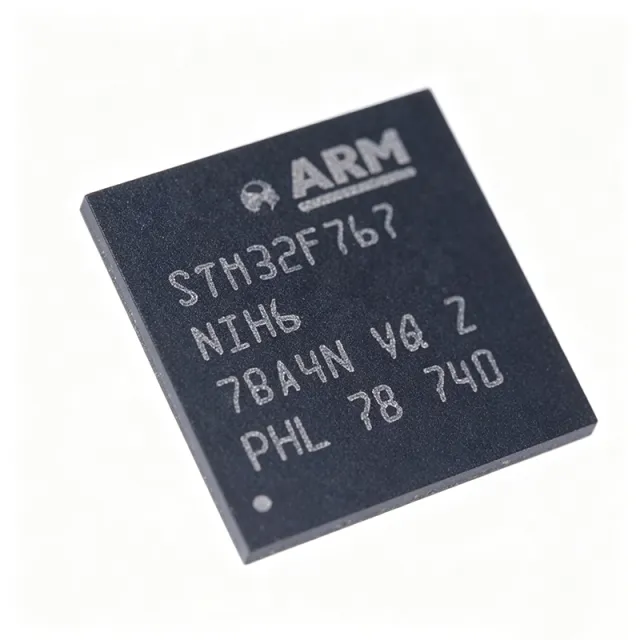
STM32F767NIH6 - 32-bit ARM Cortex-M7 MCU, 2MB Flash, 216MHz | STMicroelectronics
STM32F767NIH6

STM32F767NIH6 - 32-bit ARM Cortex-M7 MCU, 2MB Flash, 216MHz | STMicroelectronics

The STMicroelectronics STM32F767NIH6 is a high-performance 32-bit microcontroller based on the Arm Cortex-M7 core with double-precision FPU, running at up to 216 MHz and achieving 462 DMIPS/2.14 DMIPS/MHz (Dhrystone 2.1), housed in a 216-pin TFBGA package (13x13 mm). It integrates 2 MB of Flash memory, 512 KB of SRAM, and a 16 Kbyte I/D cache enabling 0-wait-state execution from embedded Flash and external memories, plus DSP instructions and a Chrom-ART Accelerator for 2D graphics offload. What is a microcontroller? A microcontroller (MCU) is a compact integrated circuit that combines a processor core, on-chip memory (Flash and SRAM), and programmable I/O peripherals on a single die, intended to govern a specific operation in an embedded system. Microcontrollers are the backbone of embedded designs ranging from simple motor controllers to complex IoT gateways. The STM32F767NIH6 belongs to the STM32F7 series, a high-performance family within the broader STM32 ecosystem positioned for graphics-rich HMI, motor control, and audio processing where Cortex-M4 class performance is insufficient. Key features of the STM32F767NIH6 include 4x I2C, 4x USART, 4x UART, 6x SPI, 3x CAN, 2x USB OTG, 1x Ethernet MAC, 1x SDMMC, a 16-bit ADC at 3.6 MSPS, a 12-bit DAC, hardware AES/3DES/DES cryptographic engines, a true random number generator (TRNG), 159 I/O lines, a 32-bit external data bus, and a 26-bit address bus. The device also integrates a JPEG codec, DFSDM (digital filter for sigma-delta modulators), and a TFT LCD controller for direct display driving without external graphics RAM. Technically, the STM32F767NIH6 uses an ART Accelerator with branch prediction and a 6-stage pipeline to maintain 0-wait-state Flash access at full 216 MHz, while dual-bank Flash supports read-while-write firmware updates. The MPU, separate instruction and data caches, and DSP extensions allow real-time DSP workloads alongside control tasks. The device operates from 1.7V to 3.6V across -40C to +85C (industrial grade) and offers multiple low-power modes. Typical applications include industrial control systems, motor drives, IoT gateways, human-machine interfaces (HMIs) with TFT displays, audio processing, and high-end consumer electronics. The combination of 216 MHz performance, large memory, and rich peripherals makes it ideal for applications that demand real-time processing and connectivity. When designing with this MCU, ensure proper decoupling of the power supply pins and a stable clock source. The device supports multiple boot modes and has a flexible power management scheme with multiple low-power modes. For high-speed interfaces like Ethernet and USB, careful PCB layout is essential to maintain signal integrity. This page synthesizes distributor pricing, drop-in alternatives, and practical design notes not found in the manufacturer datasheet, plus comparison tables and AEO-optimized application guidance.

USD $10.85 تماس
STM32F767NIH7 - 216MHz Cortex-M7 2MB MCU | STMicroelectronics
STM32F767NIH7

STM32F767NIH7 - 216MHz Cortex-M7 2MB MCU | STMicroelectronics

STMicroelectronics STM32F767NIH7 is an Arm Cortex-M7 32-bit microcontroller with a 216 MHz maximum operating frequency, 2 MB of embedded Flash memory, and a 216-pin TFBGA package measuring 13 mm by 13 mm. It also provides a floating-point unit, 462 DMIPS, DSP instructions, an MPU, and separate 16 KB instruction and data caches. The MCU is designed for high-performance embedded control, data acquisition, communications, and applications requiring substantial local memory. A microcontroller is a programmable semiconductor that integrates a processor core, memory, peripherals, and communication interfaces on one device. In the embedded-device hierarchy, the STM32F767NIH7 belongs to the 32-bit Arm Cortex-M7 microcontroller class, combining real-time control capability with high-throughput digital signal processing. Its 2 MB Flash stores firmware and constants, while its SRAM supports working data, stack operations, DMA buffers, graphics data, and communication frames. Key features include operation up to 216 MHz, a 462 DMIPS processing rating, and a dedicated floating-point unit for mathematically intensive control and signal-processing tasks. The Cortex-M7 core supports DSP instructions, zero-wait-state execution from embedded Flash through the stated cache architecture, and an MPU for memory protection. Verified sources also identify USB OTG high-speed and full-speed operation, up to 28 communication interfaces, LCD and DSI support, and a broad collection of analog and timer peripherals. The device architecture combines a high-performance 32-bit RISC core with extensive connectivity. Its 16 KB instruction cache and 16 KB data cache help reduce memory-access penalties, while the ART Accelerator supports embedded-Flash execution according to the manufacturer datasheet. Total SRAM is listed as 512 KB, 16 KB, and 4 KB in separate memory regions, allowing firmware designers to partition code, data, and communications or display buffers without relying entirely on external memory. Typical applications include industrial data-acquisition and factory-control equipment, connected embedded systems requiring USB, high-speed graphical or camera interfaces, and real-time signal-processing systems. The 216 MHz core and FPU benefit filtering, control algorithms, and protocol handling, while the 2 MB Flash accommodates larger firmware images and richer user interfaces. The 216-pin TFBGA also provides access to the family's extensive GPIO and peripheral set but requires careful escape routing and multilayer PCB design. Designers should base the PCB footprint and pin assignments on the manufacturer package drawing rather than generic BGA conventions. The 13 mm by 13 mm TFBGA requires a dense, controlled fanout, thermal management appropriate for the selected power dissipation, and verification of signal integrity on high-speed interfaces. Firmware should also account for peripheral errata, clock-tree configuration, memory placement, and independent USB, Ethernet, display, and DMA requirements before production release. This page consolidates the verified manufacturer specifications, distributor package information, comparison parameters, and application guidance for STM32F767NIH7. It also distinguishes directly compatible STM32F7 package options from cross-brand alternatives, helping engineering teams choose a replacement while preserving PCB, firmware, qualification, and procurement requirements.

RFQ تماس
STM32F767VGH6 - 216MHz Cortex-M7 1MB MCU | STMicroelectronics
STM32F767VGH6

STM32F767VGH6 - 216MHz Cortex-M7 1MB MCU | STMicroelectronics

The STMicroelectronics STM32F767VGH6 is a 32-bit Arm Cortex-M7 microcontroller with a 216 MHz operating frequency, 1 MB of embedded Flash memory, and a 100-pin TFBGA package measuring 8 x 8 mm. The MCU combines an ART Accelerator, separate 16 KB instruction and data caches, an FPU, and DSP instructions for high-performance embedded control. According to the manufacturer family datasheet, the STM32F767VGH6 can deliver 462 DMIPS and 2.14 DMIPS/MHz. A microcontroller is a programmable system-on-chip that integrates a CPU, memory, peripherals, and communication interfaces onto one package. The STM32F7 family belongs to the embedded microcontroller hierarchy and is positioned for applications requiring substantially more processing capability than entry-level Cortex-M devices. Its Cortex-M7 architecture is suitable when designers need real-time responsiveness, higher arithmetic throughput, and access to graphics, communications, storage, and control peripherals without using an application processor. Key verified features include a 216 MHz maximum CPU frequency, 1 MB of Flash organized as 1M x 8, and a 100-ball TFBGA package with an 8 x 8 mm footprint. The processor includes an FPU, ART Accelerator, 16 KB instruction cache, 16 KB data cache, MPU, and DSP instructions. These features make the device relevant for industrial automation, communications equipment, test and measurement, and embedded systems that process control data or multimedia streams. The STM32F767VGH6 uses the same STM32F7 hardware platform represented by the STM32F765xx, STM32F767xx, STM32F768Ax, and STM32F769xx family datasheet. Its 462 DMIPS rating reflects the performance-oriented Cortex-M7 architecture, while the caches and ART Accelerator improve instruction and data access behavior. Exact RAM, peripheral population, and electrical limits for the selected suffix are not provided in the retrieved snippets and must be confirmed in the complete manufacturer datasheet before design release. Typical uses include industrial controllers, communication gateways, motor-control equipment, embedded human-machine interfaces, and test instruments. The 216 MHz Cortex-M7 core can manage multiple real-time tasks, while the FPU accelerates floating-point calculations and the DSP instructions support signal-processing workloads. Designers must still confirm that the required peripherals, memory, package balls, and board-level interfaces are available for the exact ordering code. A critical design step is to verify the complete 100-ball pinout and power architecture in the manufacturer datasheet before PCB layout. The BGA package requires appropriate escape routing, thermal management, and assembly process controls. A valid design must also confirm the supported voltage range, decoupling requirements, pin multiplexing, and exposed thermal or ground-ball assignments for this exact 8 x 8 mm package. This page consolidates the verified distributor specifications, official family-datasheet information, package data, commercial availability, and traceable source links. It also separates documented facts from parameters that still require datasheet verification, helping engineers evaluate the STM32F767VGH6 without mistaking generic STM32F7 family information for suffix-specific guarantees.

RFQ تماس
STM32F767VGT6 - 216MHz Cortex-M7 1MB MCU | STMicroelectronics
STM32F767VGT6

STM32F767VGT6 - 216MHz Cortex-M7 1MB MCU | STMicroelectronics

The STMicroelectronics STM32F767VGT6 is an Arm Cortex-M7 32-bit microcontroller with a 216 MHz operating frequency, 1 MB of Flash memory, and a 100-pin LQFP package measuring 14 x 14 mm. It combines high-performance DSP and floating-point capability with extensive connectivity and memory resources for demanding embedded systems. A microcontroller is a programmable system-on-chip that integrates a processor core, Flash program memory, RAM, peripherals, and communication interfaces. The Cortex-M7 MCU category sits within embedded processors and extends from real-time control to high-performance graphics, networking, and audio. STM32F7 devices are suited to systems that require substantially more computation than basic control-only MCUs. Verified features for the STM32F767VGT6 include an Arm Cortex-M7 core operating up to 216 MHz, 1 MB of Flash, 512 KB of RAM, and an integrated floating-point unit. The family also includes cache, SDRAM support, TFT interfaces, JPEG acceleration, DFSDM, and an ART accelerator according to the supplied manufacturer-family and distributor references. These resources support responsive control loops and multimedia data movement. The STM32F767VG family devices share a common high-performance architecture. Compared with a Cortex-M3-class MCU, the Cortex-M7 core provides a stronger foundation for signal processing, communications, and control. Cache and accelerator features can improve execution around data-intensive workloads, but firmware, memory placement, peripheral configuration, and real-time timing still require careful validation. Typical uses include industrial automation, connected equipment, motor control, metering, embedded IoT devices, human-machine interfaces, and audio or image-processing systems. The 1 MB Flash capacity can hold a substantial application and protocol stack, while 512 KB of RAM supports buffered data. Exact peripheral availability, pin multiplexing, electrical limits, and memory-map behavior must be checked in the manufacturer datasheet before schematic capture. A key design step is allocating pins according to the selected package and complete peripheral-alternative functions. Because this MCU combines many interfaces, conflicting assignments can move a signal from a timer output, analog input, communication pin, or high-speed interface to another pad. Power, decoupling, clock, boot, reset, and exposed-pad requirements should therefore be implemented exactly as specified by STMicroelectronics. This page combines verified manufacturer and distributor specifications with sourcing context and engineering guidance. It also distinguishes verified facts from missing parametric, pinout, price-tier, and compliance details so engineers can assess fit without treating unverified information as production-ready data.

RFQ تماس
STM32F767VGT7 - 216MHz Cortex-M7 1MB Flash MCU | STMicroelectronics
STM32F767VGT7

STM32F767VGT7 - 216MHz Cortex-M7 1MB Flash MCU | STMicroelectronics

The STMicroelectronics STM32F767VGT7 is an Arm Cortex-M7 32-bit microcontroller with FPU operating at up to 216 MHz, integrating 1 MB of Flash (1M x 8) and delivering 462 DMIPS, in a 100-pin LQFP (14x14 mm) package. It belongs to ST's STM32F7 high-performance and DSP family, combining a double-precision FPU, adaptive ART accelerator, L1 cache and a broad set of mixed-signal and connectivity peripherals. A microcontroller is a self-contained computing element that integrates a CPU core, memory, and peripherals on a single die. The Arm Cortex-M7 core used here is a 32-bit RISC processor designed for real-time embedded control, and it sits at the top of the STM32F7 performance hierarchy: MCU -> microcontroller -> embedded processor -> SoC -> semiconductor. The STM32F767 part number itself encodes the configuration: V denotes the 100-pin package, G denotes 1 MB of Flash, T denotes LQFP, and 7 denotes the extended temperature grade. Key features include an adaptive real-time accelerator that provides zero-wait execution from Flash, a 16 KB data cache and 16 KB instruction cache, an SDRAM controller supporting external memory expansion, a hardware JPEG codec, a flexible memory controller, and a digital filter for sigma-delta modulators (DFSDM). Communication peripherals include Ethernet MAC with MII/RMII, USB OTG HS/FS, plus USART, UART, I2C, SPI, I2S, SAI, and SDMMC interfaces, alongside a TFT LCD controller and cryptographic accelerators. Technically the device pairs a 216 MHz Cortex-M7 core with an L1/L2 cache hierarchy and a 2.0 V to 3.6 V operating supply range, with separate ADC, DAC and SDIO rails. Analog capability includes 12-bit ADCs and 12-bit DAC channels, making it suitable for mixed-signal industrial and audio control loops rather than pure digital datalogging. Typical applications are industrial automation and motion control platforms, Ethernet-connected industrial gateways, high-resolution human-machine interface panels, and audio DSP front ends. Because the STM32F767VGT7 integrates Ethernet MAC, JPEG codec and TFT controller, a single device can drive an HMI panel, decode camera images and manage networked control loops without external discrete controllers. A key design consideration is power and clocking: decoupling of VDDA/VCAP pins and correct ART accelerator, flash latency and voltage-scaling configuration must be applied early in firmware bring-up, otherwise achievable throughput drops well below the 216 MHz headline figure. The 100-pin LQFP also constrains routing density, so high-speed SDRAM and RMII interfaces require careful board planning. This page synthesizes distributor pricing, verified part-family drop-in alternatives, and practical design notes for the STM32F767VGT7 that are not found in a single manufacturer datasheet, giving engineers a faster path from selection to working hardware.

RFQ تماس
STM32F767VIH6 - 216MHz Cortex-M7 MCU 2MB Flash | ST
STM32F767VIH6

STM32F767VIH6 - 216MHz Cortex-M7 MCU 2MB Flash | ST

The STMicroelectronics STM32F767VIH6 is a high-performance 32-bit microcontroller based on the Arm Cortex-M7 core with double-precision FPU, running at up to 216 MHz and delivering 462 DMIPS (2.14 DMIPS/MHz), with 2 Mbytes of embedded Flash memory, housed in a 100-ball TFBGA (8x8 mm) package. A microcontroller (MCU) is a single-chip integrated circuit that combines a processor core, memory, and peripherals into one device, forming the lowest tier of the embedded computing hierarchy: MCU -> embedded processor -> system-on-chip. The STM32F7 series sits at the top of the STM32 general-purpose MCU portfolio, targeting applications that need near-application-processor performance with MCU-class real-time behavior and power consumption. Key features include the ART Accelerator and 16 Kbyte L1 instruction/data caches enabling 0-wait-state execution from embedded Flash, a single-precision/double-precision FPU and DSP instructions for signal processing, plus rich peripherals including SDRAM interface, TFT LCD controller, hardware JPEG codec, and DFSDM digital filter for sigma-delta modulators. Architecturally, the Cortex-M7 core pairs with the Chrom-ART Accelerator (DMA2D) for graphics bandwidth offload, while the ART Accelerator prefetches instructions to hide Flash latency at 216 MHz. Multiple embedded SRAM blocks and a flexible external memory controller (FMC) support SDRAM frame buffers for the TFT controller. Typical applications include industrial HMI and TFT display panels, motor control and power conversion, medical and test equipment, IoT gateways, and consumer devices requiring GUI rendering and fast DSP. Design consideration: at 216 MHz with external SDRAM, signal integrity and power distribution on the BGA footprint require careful decoupling and length-controlled routing for the FMC interface. This page synthesizes distributor stock data, drop-in same-family alternatives, and practical design notes not found in the manufacturer datasheet.

RFQ تماس
STM32F767VIT6 - 216MHz Cortex-M7 MCU | STMicroelectronics
STM32F767VIT6

STM32F767VIT6 - 216MHz Cortex-M7 MCU | STMicroelectronics

The STMicroelectronics STM32F767VIT6 is an Arm Cortex-M7 32-bit microcontroller operating up to 216 MHz, with 2 MB of Flash memory and a 100-LQFP 14 x 14 mm package. Its high-performance MCU architecture combines a 32-bit RISC core, hardware DSP capability, extensive connectivity, and a broad set of peripherals for demanding embedded systems. A microcontroller such as the STM32F767VIT6 is a complete programmable control platform containing a processor core, memory, communication interfaces, timers, analog peripherals, and general-purpose input/output. The STM32F7 family is used where performance, real-time control, connectivity, and system integration matter more than the lowest possible unit cost or power consumption. The verified product data identifies a 216 MHz operating frequency, 2 MB Flash configuration, and a 100-LQFP package. The STM32F7 platform is also described by STMicroelectronics as featuring an Arm Cortex-M7 32-bit MCU with FPU capability and up to 462 DMIPS. Its performance-oriented design makes it suitable for industrial control, communications, audio and digital signal processing, networking, and connected embedded equipment. The STM32F767VIT6 belongs to a family of devices based on the Arm Cortex-M7 core, providing a common hardware and software platform for control, connectivity, and real-time processing tasks. Designers should allocate memory and peripheral resources according to the specific STM32F767xx device variant and verify the complete pinout, electrical limits, startup requirements, and peripheral availability against the manufacturer datasheet before layout release. Typical applications include industrial automation controllers, communications equipment, motor-control systems, audio processors, HMI platforms, and connected sensors. The 100-LQFP package provides a practical land pattern for designs requiring many external connections while avoiding the mechanical complexity of very fine-pitch BGA packages. The device is appropriate when firmware requires substantial processing performance and a broad peripheral set in a conventional surface-mount package. When designing around the STM32F767VIT6, verify the exact package pin assignments, power requirements, clock configuration, memory organization, and unused-pin handling. Decoupling, exposed-ground layout, signal integrity, and firmware configuration remain important because a high-performance MCU can require careful clock, power, and peripheral planning even when the application is primarily control-oriented. This page consolidates verified manufacturer and distributor information with package, sourcing, design, application, and comparison guidance to support faster engineering evaluation.

RFQ تماس
STM32F767VIT7 - 216MHz Cortex-M7 MCU | STMicroelectronics
STM32F767VIT7

STM32F767VIT7 - 216MHz Cortex-M7 MCU | STMicroelectronics

The STMicroelectronics STM32F767VIT7 is a 32-bit ARM Cortex-M7 microcontroller operating up to 216 MHz, with 2 MB (2M x 8) flash memory and a 100-pin LQFP package measuring 14 mm x 14 mm. It combines a floating-point unit, ART Accelerator, L1 cache, SDRAM support, TFT controller, JPEG codec, and DFSDM peripheral for high-performance embedded control. An ARM Cortex-M7 microcontroller is a 32-bit reduced-instruction-set processor core integrated with memory and peripherals on a single semiconductor device. The Cortex-M7 belongs to the ARM Cortex-M product family and provides substantially greater processing capability than entry-level Cortex-M devices. Within the hierarchy of embedded systems, the STM32F7 series combines the Cortex-M7 core with STM32 peripherals, and the STM32F767VIT7 is a member of that high-performance microcontroller family. Key features include a maximum CPU frequency of 216 MHz, 2 MB of flash, and hardware features identified by STMicroelectronics as ART Accelerator, L1 cache, SDRAM, TFT, JPEG codec, and DFSDM. The Cortex-M7 FPU supports floating-point workloads, while the 2 MB embedded flash provides substantially more on-chip program storage than smaller STM32 devices. The 100-LQFP package exposes a broad mixed-signal and communication interface set in a surface-mount format. The STM32F767VIT7 architecture is aimed at applications requiring both real-time control and multimedia or data-processing capability. Its 216 MHz Cortex-M7 core can execute control code while dedicated hardware manages display-related functions, compressed-image handling, and digital filter or sigma-delta ADC functions. External SDRAM support is useful when working data sets exceed practical internal-memory capacity. Typical applications include industrial automation controllers, human-machine interfaces, networked embedded equipment, audio and signal-processing systems, and connected industrial gateways. The integrated JPEG codec is relevant to camera or image-transfer designs, while the TFT controller supports display-oriented equipment. The LQFP package also suits designs where a large lead count and inspectability are preferable to a very compact ball-grid or fine-pitch package. Designers should confirm the complete 100-pin pinout, power requirements, decoupling configuration, clock plan, and peripheral assignment against the manufacturer datasheet before layout. A 3.3 V operating supply is identified in distributor data, but the valid input range, absolute maximum ratings, and internal regulator configuration were not supplied in the verified excerpts. Firmware migration should also verify startup, pin mapping, and low-power behavior rather than assuming compatibility solely from the shared package. This product page consolidates verified distributor specifications, family-specific drop-in candidates, application guidance, and procurement considerations into a practical engineering reference. It distinguishes documented STM32F767VIT7 values from unresolved parameters and avoids presenting unverified cross-manufacturer substitutions as guaranteed drop-in replacements.

RFQ تماس
STM32F767ZGT6 - 216MHz 1MB Cortex-M7 MCU | STMicroelectronics
STM32F767ZGT6

STM32F767ZGT6 - 216MHz 1MB Cortex-M7 MCU | STMicroelectronics

The STMicroelectronics STM32F767ZGT6 is a 32-bit Arm Cortex-M7 microcontroller operating at up to 216 MHz, with 1 MB of embedded Flash memory and 512 KB of RAM, housed in a 144-lead LQFP package measuring 20 mm by 20 mm. The device combines high-performance DSP capability, an integrated floating-point unit, extensive connectivity, and a broad set of peripherals for demanding embedded control systems. According to the STMicroelectronics STM32F7 family datasheet, the Cortex-M7 core can deliver up to 462 DMIPS, making this MCU suitable for real-time signal processing, industrial communications, and high-performance control applications. An Arm Cortex-M7 microcontroller is a 32-bit reduced-instruction-set-computing core integrated with memory and peripherals on a single package. STM32F7 devices belong to the broader hierarchy of embedded processor, microcontroller, semiconductor, and power-management component categories. The STM32F767 series combines high CPU performance with hardware acceleration and extensive connectivity, allowing it to function as the central controller for industrial equipment, networking equipment, audio systems, test instruments, and embedded automation platforms. Key features include an operating frequency of up to 216 MHz, 1 MB of Flash program memory, 512 KB of SRAM, and a 144-pin LQFP package. The Cortex-M7 architecture supports floating-point and DSP-oriented workloads, while the STM32F7 family is designed for applications requiring more processing capability than general-purpose entry-level MCUs. The 20 mm by 20 mm LQFP package also exposes a large number of I/O pins for external memory, communication interfaces, sensors, actuators, and human-machine interface circuitry. The STM32F767 family combines a high-performance CPU with extensive embedded resources and communication capabilities. Its family-level specification covers devices with up to 2 MB of Flash memory, while the exact STM32F767ZGT6 ordering code identifies the 1 MB configuration. This distinction is important when designing memory maps, bootloaders, and firmware-update procedures because application code, linker scripts, and external storage requirements must match the selected density rather than the maximum family capacity. Typical applications include industrial automation controllers, networked embedded equipment, audio and digital signal-processing systems, motor and motion control, test and measurement instruments, and communications gateways. The 216 MHz Cortex-M7 core is especially relevant when control loops, communication stacks, and data-processing tasks must execute concurrently. Its 1 MB Flash and 512 KB RAM provide useful local storage and working memory for these designs. PCB design should preserve clean supply routing, adequate decoupling near the device, and controlled clock and signal-integrity layouts. The LQFP package is inspectable and reworkable, but its 144 leads require careful fanout and paste control. Designers must also confirm the exact pin configuration, power requirements, boot interfaces, and peripheral assignments in the manufacturer datasheet before committing a new PCB layout. This page consolidates the verified manufacturer and distributor information, distinguishes exact STM32F767ZGT6 facts from family-level specifications, and provides same-package alternatives, application guidance, and selection criteria. It also records unavailable electrical and lifecycle details explicitly instead of presenting unverified values as production-ready design data.

RFQ تماس