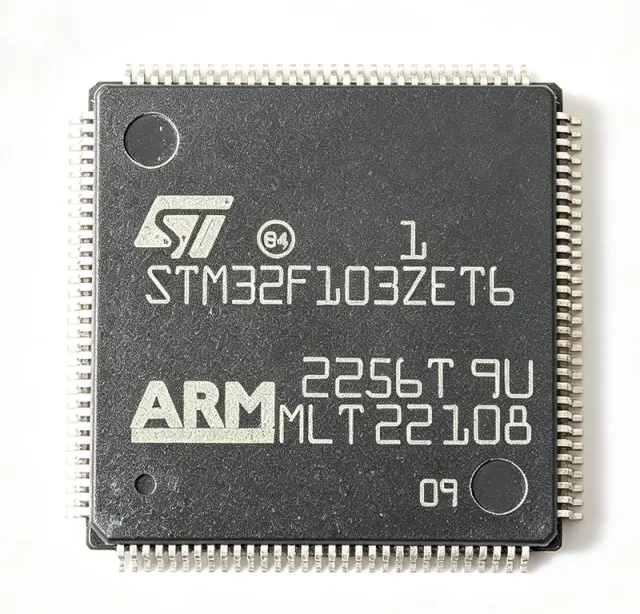
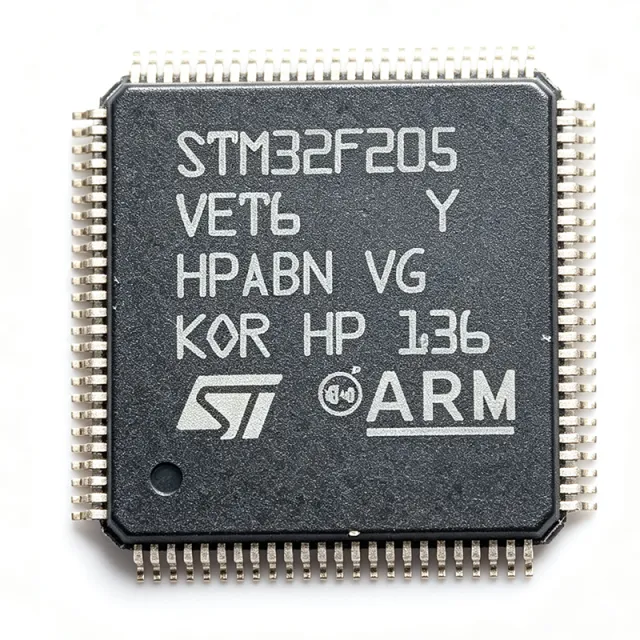
STM32F103ZGH6
STM32F103ZGH6 - 72MHz 1MB Cortex-M3 MCU | STMicroelectronics
The STMicroelectronics STM32F103ZGH6 is a 32-bit ARM Cortex-M3 microcontroller operating at up to 72 MHz, with 1 MB of Flash memory in a 144-pin LQFP package. Designed as an XL-density member of the STM32F1 series, it combines a high-performance 32-bit RISC core with extensive embedded connectivity and control peripherals. Its 2.5 V and 3.3 V operating references make it suitable for conventional embedded systems, while the large pin count exposes substantial I/O and peripheral connectivity.
A microcontroller is a programmable semiconductor system that integrates a CPU core, memory, communication interfaces, timers, analog inputs, and I/O on one package. In the STM32 hierarchy, the STM32F103ZGH6 belongs to the STM32F1 mainstream family, the Cortex-M3 performance class, and the broader category of embedded-system microcontrollers. This position explains its combination of a 72 MHz clock, substantial Flash storage, and a large surface-mount package.
The verified product data identifies an ARM Cortex-M3 core, 1 MB Flash, a 72 MHz maximum operating frequency, and 2.5 V or 3.3 V supply references. It also identifies the STM32F103 series as supporting USB, CAN, timer, ADC, and communication functions, although exact peripheral counts, SRAM capacity, pin functions, electrical limits, and timing values require confirmation in the manufacturer datasheet. These unverified quantities are therefore not inferred on this page.
The 144-pin LQFP package provides a large number of external connections relative to smaller 32-, 48-, and 64-pin MCUs. That makes the STM32F103ZGH6 suitable when a design needs substantial GPIO availability alongside USB, CAN, analog, timer, and serial-interface resources. The tradeoff is a larger board footprint, more fine-pitch routing, and more complex assembly than a smaller LQFP package.
Typical applications include industrial control equipment, USB-connected data acquisition, CAN-based supervisory systems, medical monitoring equipment, consumer electronics, and communication modules. In these systems, the MCU can execute control logic, supervise sensors, drive digital outputs, and exchange data through its integrated interfaces. Firmware should be validated at the intended clock and supply settings before deployment.
Designers must confirm the complete pin assignment, absolute maximum ratings, decoupling requirements, clock limits, and peripheral electrical conditions from the manufacturer datasheet. Because the available search data does not expose a complete verified pin map, the page does not fabricate individual pin names. A large-package PCB should also provide short ground-return paths, controlled clock routing, and adequate decoupling close to the device.
This page consolidates verified distributor specifications, practical application guidance, pricing-data gaps, and qualification-aware drop-in comparisons. It is intended to help engineers identify whether the STM32F103ZGH6 fits their PCB and firmware requirements while clearly separating confirmed facts from information that still requires datasheet validation.
RFQ
تماس