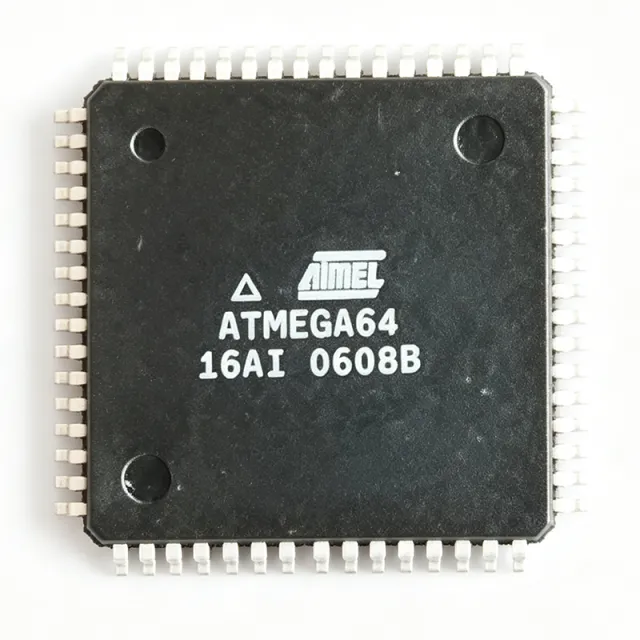
ATMEGA128L-8MNR
ATMEGA128L-8MNR - 8-bit AVR MCU 128KB Flash 64-QFN | Microchip
The Microchip Technology ATMEGA128L-8MNR is a high-performance, low-power 8-bit AVR RISC microcontroller with 128 KB of In-System Programmable Flash memory, 4 KB SRAM, 4 KB EEPROM, an 8-channel 10-bit ADC, and a JTAG interface for on-chip debugging, executing at up to 8 MHz across a 2.7 V to 5.5 V supply range in a 64-QFN (9x9 mm, MLF with exposed pad) package.
A microcontroller unit (MCU) is a single-chip computer that integrates a processor core, program memory, data memory, and peripherals such as timers, serial interfaces, and analog-to-digital converters. Within the semiconductor hierarchy, this device belongs to the AVR ATmega family of 8-bit microcontrollers under the broader power-management and embedded-processing category. Its Advanced RISC architecture provides 133 powerful instructions, most of which execute in a single clock cycle, delivering high code efficiency and MIPS-per-megahertz performance.
Key features include 64 K x 16 organization of Flash program memory supporting both ISP (In-System Programming) and IAP (In-Application Programming), 53 general-purpose I/O lines, and an 8-channel 10-bit A/D converter. The JTAG boundary-scan and on-chip debug capability simplify development, while the extended industrial temperature range of the MNR suffix (up to 105C per distributor listings) suits harsh environments.
Architecturally, the AVR core uses a Harvard structure with separate program and data buses, 32 general-purpose working registers directly connected to the ALU, allowing two independent registers to be accessed in one instruction executed in one clock cycle. The device supports boot-code sections with write-protect, an 8-bit and a 16-bit timer/counter with PWM, two USARTs, SPI, TWI (I2C-compatible), and an analog comparator.
Typical applications include industrial automation and control nodes, building and HVAC controllers, sensor data acquisition systems, battery-powered instrumentation (leveraging the 2.7 V low-voltage operation), and legacy ATmega103 board upgrades, since the ATmega128 is 100% pin compatible with ATmega103.
When designing with this part, note that the MLF/QFN exposed pad should be soldered to a grounded PCB land pattern for both thermal dissipation and mechanical reliability, and that the 8 MHz speed grade with the L suffix allows full functionality down to 2.7 V, whereas the 16 MHz ATMEGA128 variants require 4.5 V to 5.5 V.
This page synthesizes distributor pricing (as of 2026-09-16), verified drop-in alternatives within the AVR ATmega MLF-64 family, and practical design guidance not found in the manufacturer datasheet, providing procurement and engineering teams a single citable reference.
USD $4,55
En stock