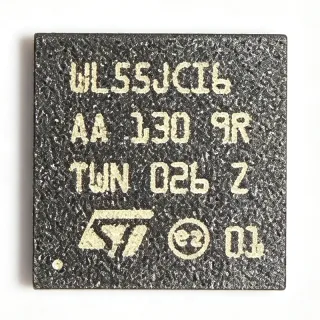
DW1000SB - IEEE 802.15.4 UWB Transceiver IC 10cm | Qorvo
Référence : DW1000SB ✓ Actif| Qté | Prix unitaire | Total |
|---|---|---|
| 1 | $9.95 | $9,95 |
| 10 | $8.95 | $89,50 |
| 100 | $7.95 | $795,00 |
| 500 | $7.25 | $3 625,00 |
| 1 000 | $6.85 | $6 850,00 |
DW1000SB Présentation
An Ultra Wideband transceiver is a short-range, high-bandwidth radio device that transmits data using very short nanosecond-duration pulses spread across a wide spectrum (several GHz). Within the wireless communication hierarchy, UWB sits alongside narrowband technologies such as Bluetooth Low Energy, Zigbee, and Wi-Fi, but occupies its own niche: impulse-radio UWB enables centimeter-level time-of-flight measurement that narrowband radios cannot achieve, making it the physical layer of choice for indoor positioning, asset tracking, and secure ranging systems.
Key features of the DW1000SB include full compliance with the IEEE 802.15.4-2011 UWB physical layer standard, two-way ranging (TWR) and time-difference-of-arrival (TDoA) location support to 10 cm accuracy, and high-rate data transfer for concurrent communication and ranging. The single-chip integration minimizes the external bill of materials, requiring only a few passives plus an antenna to form a complete UWB node.
Architecturally, the DW1000 integrates the analog RF front end, pulse generator, digital baseband, and MAC-level hardware in one die. Its receiver captures extremely narrow pulses with high time-resolution, which is what underpins the precise timestamping that yields centimeter-accurate distance calculations. The IC communicates with a host microcontroller over a standard SPI interface.
Typical applications include real-time location systems (RTLS) for warehouses and factories, asset tracking tags and anchors, autonomous robot and drone navigation in GPS-denied indoor environments, and secure keyless entry systems where distance bounding prevents relay attacks.
Design consideration: accurate timestamping performance depends heavily on crystal oscillator quality and antenna delay calibration; budget for per-unit antenna delay calibration in production to preserve the 10 cm ranging precision.
This page synthesizes distributor sourcing data, drop-in alternatives, and practical design notes not found in the manufacturer datasheet, giving engineers a complete selection view in one place.
Alternatives de remplacement direct pour DW1000SB — même boîtier, compatible broche à broche. Les références à boîtier différent nécessitant une retouche du PCB sont exclues.
Outil de comparaison rapide — sélectionnez des références alternatives pour une comparaison côte à côte :
DW1000
✅ Remplacement direct ⚠️ Spécifications non vérifiées📋 Alternative de référence (hors catalogue)
DW3110
✅ Remplacement direct ⚠️ Spécifications non vérifiées📋 Alternative de référence (hors catalogue)
DW3210
✅ Remplacement direct ⚠️ Spécifications non vérifiées📋 Alternative de référence (hors catalogue)
DW1000SB Spécifications
| Product Type | Ultra Wideband (UWB) Transceiver IC |
| Standard Compliance | IEEE 802.15.4-2011 (UWB PHY) |
| Ranging Precision | 10 cm (2-way ranging / TDoA) |
| Location Systems Supported | 2-way ranging (TWR), TDoA |
| Integration | Single chip |
| Boîtier | QFN-48 |
| Type de montage | Surface Mount |
| Host Interface | SPI |
| Datasheet Length | 53 pages |
Guide de configuration des broches du DW1000SB qfn-48
Configuration des broches du DW1000SB (boîtier qfn-48). La numérotation des broches, les fonctions et les schémas de connexion sont définis dans la fiche technique du fabricant. Consultez-la pour l'empreinte exacte et les directives de soudage.
Aucune donnée de brochage détaillée disponible pour DW1000SB.
Consultez la fiche technique pour la configuration complète des broches.
Applications typiques
DW1000SB convient pour 6 applications: Industrial Real-Time Location Systems (RTLS), Warehouse Asset Tracking Tags, Autonomous Mobile Robots and Drones, Secure Keyless Entry and Access Control, Sports and Athlete Performance Tracking, Smart Building and IoT Presence Sensing.
Industrial Real-Time Location Systems (RTLS)
The DW1000SB is the canonical radio for factory and warehouse RTLS because its 10 cm ranging precision, achieved via two-way ranging between tags and anchors, is roughly 30-50x better than BLE RSSI positioning. In a typical TDoA deployment, fixed anchors timestamp UWB pulses from mobile tags, and a location engine solves for position with centimeter accuracy. The IC's concurrent data transfer also carries sensor telemetry (battery state, motion flags) inside the same UWB bursts, so no second radio is needed. The main trade-off is anchor infrastructure density: rooms typically need 3-4 anchors for 3D coverage, but per-tag cost stays low since the DW1000SB is a single-chip solution requiring only a few passives and an antenna.
Recommandé
Warehouse Asset Tracking Tags
Battery-powered tracking tags built around the DW1000SB leverage its low-power UWB architecture to deliver multi-year operation from a coin cell when the radio is duty-cycled: the tag sleeps, wakes on a timer, exchanges a short ranging burst with anchors, and sleeps again. The 10 cm location precision enables use cases RSSI cannot serve, such as finding a specific pallet slot or verifying tool return to the correct crib. Data transfer capability lets the tag report its own battery and shock status within the ranging exchange. The SPI host interface connects to any low-cost Cortex-M MCU handling the tag protocol stack, keeping tag BOM cost minimal at scale.
Recommandé
Autonomous Mobile Robots and Drones
In GPS-denied indoor environments, the DW1000SB provides the relative-positioning backbone for autonomous mobile robots (AMRs) and drones. Using two-way ranging between the vehicle and fixed beacons, a robot can compute position to 10 cm - precise enough for dock docking, aisle navigation, and geofenced safety zones - without vision systems or floor markings. Nanosecond-level timestamping resilience also means performance is unaffected by lighting conditions, dust, orRF-reflective environments where optical methods fail. Because the IC supports high-rate data transfer, the same UWB link can relay vehicle telemetry to fleet infrastructure concurrently, reducing system complexity and radio congestion in industrial 2.4 GHz bands.
Recommandé
Secure Keyless Entry and Access Control
UWB distance bounding prevents relay attacks that defeat conventional keyless entry: the DW1000SB measures the true time-of-flight of challenge-response exchanges, so a physically distant attacker relaying signals cannot fake proximity. With 10 cm ranging precision, a vehicle or door can enforce a hard proximity threshold that cryptographic framing alone cannot provide. The IC's IEEE 802.15.4-2011 compliance gives a standardized PHY on which secure protocols are layered, and its data transfer support carries authentication payloads within the same UWB exchange. Designs should combine UWB ranging with BLE for low-power discovery, waking the DW1000SB only for the final secure ranging confirmation.
Recommandé
Sports and Athlete Performance Tracking
The DW1000SB enables high-precision player and ball tracking in sports analytics: UWB tags worn by athletes, located via TDoA through arena anchor grids, deliver 10 cm positional accuracy and high update rates suitable for speed, distance, and tactical analysis. Unlike GPS, UWB works indoors and in stadiums, and unlike camera systems it requires no line-of-sight. The IC's low power allows full-match tag operation on small batteries, and concurrent data transfer carries biometric sensor data (heart rate, load) within the positioning exchange. Qorvo's DW1000 ecosystem, with mature open-source location engines, has made it the de facto UWB radio in commercial sports RTLS deployments worldwide.
Recommandé
Smart Building and IoT Presence Sensing
For smart buildings, the DW1000SB provides room-level and furniture-level presence detection far more precise than PIR or BLE proximity: UWB tags in badges, tools, or assets are located to 10 cm through TDoA, enabling HVAC and lighting control per zone, automated meeting-room occupancy, and wayfinding. The SPI interface integrates with standard IoT gateway MCUs, and Qorvo's DW1000 driver ecosystem shortens firmware development. Because UWB pulses coexist cleanly with Wi-Fi and Zigbee spectrum, dense anchor networks can share a ceiling without interference. The trade-off is initial anchor installation cost, amortized over the large number of passive, battery-powered tags the infrastructure can serve simultaneously.
Recommandé
Récapitulatif des produits recommandés
Données de référence d'ingénierie pour DW1000SB — comparaison, recommandations de conception et informations de conformité.
Guide de sélection
Comparaison avec les alternatives
| Paramètre | Ce produit | DW1000 | DW3110 | DW3210 |
|---|---|---|---|---|
| Package | QFN-48 | QFN-48 - same | QFN-48 - same | QFN-48 - same |
| Brand | Qorvo | Qorvo | Qorvo | Qorvo |
| Standard Compliance | IEEE 802.15.4-2011 | IEEE 802.15.4-2011 | IEEE 802.15.4-2011 + 802.15.4z | IEEE 802.15.4-2011 + 802.15.4z |
| Channel | Multi-channel UWB | Multi-channel UWB | Channel 5 | Channel 9 |
| Location Methods | TWR, TDoA | TWR, TDoA | TWR, TDoA | TWR, TDoA |
| Host Interface | SPI | SPI | SPI | SPI |
| Software Ecosystem | Mature, large open-source driver base | Identical (same die) | Newer stack, 802.15.4z, FiRa-oriented | Newer stack, 802.15.4z, FiRa-oriented |
Principaux différenciateurs
- Mature ecosystem with extensive open-source driver and location-engine support (vs DW3110)
- 10 cm ranging precision standardized on IEEE 802.15.4-2011 UWB PHY (vs DW1000 (base))
- Single-chip integration minimizes BOM (vs DW3210)
Notes de conception
UWB ranging accuracy is only as good as the clock that timestamps the pulses. Use a high-quality TCXO or a crystal with tight tolerance and low phase jitter as the DW1000SB reference; clock offset and drift directly translate into ranging error. Perform per-unit antenna delay calibration in production - even identical PCBs exhibit a few centimeters of variation due to component tolerances. Qorvo's application notes describe a two-step calibration procedure using a known-distance reference setup that recovers full 10 cm specification accuracy.
Follow the Qorvo reference design for the DW1000SB RF front end: keep the antenna matching network components close to the RF pin, maintain an unbroken ground plane beneath the RF section, and use controlled-impedance traces for the antenna feed. Place the 48-pin QFN exposed pad on a solid via-stitched ground pour for both electrical and thermal performance. Decouple each supply pin with 100 nF ceramics placed within 2 mm of the pin, plus bulk capacitance per the datasheet. SPI traces should be kept short (<10 cm) with series termination if the host clock exceeds the datasheet recommendation for trace length.
Battery-powered tag designs should aggressively duty-cycle the DW1000SB: put the IC to sleep between ranging exchanges and use the wake-up pin or SPI wake from the host MCU. Average current is dominated by receiver-on time, so minimize preamble length where range allows - shorter preambles cut receive time substantially at a small cost in maximum range and timestamp precision. Estimated: for a tag exchanging 10 ranging bursts per minute with short preambles, average current stays in the low microamp range, giving multi-year coin-cell life; verify against the datasheet current-consumption tables for your exact configuration.
Informations de conformité
Compliance statuses were not present in the verified web data retrieved for this part; consult the official Qorvo product page and datasheet for RoHS/REACH declarations.