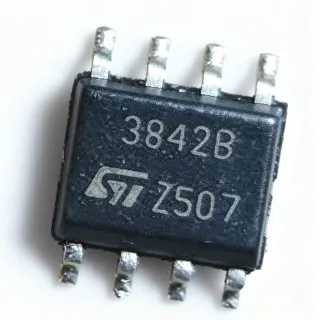
LM2576D-ADJRG - 3A Adjustable Buck Regulator 52kHz | HANSCHIP
Référence : LM2576D-ADJRG ✓ Actif| Qté | Prix unitaire | Total |
|---|---|---|
| 1 | $0.2509 | $0,25 |
| 10 | $0.22 | $2,20 |
| 100 | $0.18 | $18,00 |
| 500 | $0.15 | $75,00 |
| 1 000 | $0.13 | $130,00 |
| 3 000 | $0.11 | $330,00 |
LM2576D-ADJRG Présentation
A buck switching regulator is a DC-DC converter topology that uses a power switch, an inductor, and a synchronous or freewheeling diode to step a higher input voltage down to a lower regulated output. Compared with linear regulators, a buck converter achieves much higher efficiency (typically 75-88% for the LM2576) because the switch dissipates only a small fraction of the input power, rather than dropping the surplus as heat. The LM2576 family sits in the power management hierarchy between simple linear regulators (LDO) and modern synchronous buck controllers, and is widely used where a low-component-count, robust asynchronous buck is acceptable. The LM2576 retains the SIMPLE SWITCHER legacy of needing only four external components (inductor, catch diode, input capacitor, output capacitor) to assemble a complete DC-DC converter.
Key specifications include a 3 A continuous output current capability, an input voltage range of 8 V to 40 V, a 52 kHz fixed switching frequency that allows use of small magnetic components, and a 5 mA typical quiescent current. Housed in the SOP-8L (TO-252-style surface-mount) package, the device supports operation from -40 C to +125 C junction temperature and includes built-in thermal shutdown and current-limit protection. The PSIP/SOP-8L footprint gives the same pinout as the industry-standard TO-263 D2PAK-5 and improves thermal performance versus smaller SOIC packages.
Internally, the LM2576D-ADJRG uses a voltage-mode control loop with an internal 1.23 V reference, an error amplifier, a 52 kHz oscillator, and a high-current NPN output switch. The architecture intentionally uses an NPN switch (not synchronous MOSFETs) to keep the design simple, with the trade-off of a freewheeling Schottky diode requirement and slightly lower efficiency than synchronous alternatives. The 52 kHz oscillator is internally trimmed so external frequency-setting components are not required.
Typical applications include distributed power systems with 12 V or 24 V input buses, battery chargers for lead-acid or Li-ion cells, LED drivers, hobby electronics, and step-down supplies for embedded boards and industrial controllers. The wide input and output ranges support industrial 24 V bus rails as well as 12 V automotive systems with adequate transient headroom.
When designing with this part, choose a Schottky diode with sufficient current and voltage rating, and select an inductor value that maintains continuous conduction mode at the minimum expected load. Verify thermal dissipation with the worst-case VIN and full 3 A load - at VIN=24 V to VOUT=5 V at 3 A efficiency is roughly 80%, so about 3.8 W is dissipated in the IC, which the SOP-8L tab and copper pour must absorb.
This page synthesizes distributor pricing, drop-in cross-brand equivalents, and a pin-by-pin replacement view for the SOP-8L footprint, providing engineering context not found in any single datasheet.
Alternatives de remplacement direct pour LM2576D-ADJRG — même boîtier, compatible broche à broche. Les références à boîtier différent nécessitant une retouche du PCB sont exclues.
Variantes de cette série
Modèles de la même série directement compatibles avec LM2576D-ADJRG (même facteur de forme et même empreinte) — différant par Efficiency, Input Voltage Range, Package, Quiescent Current, RoHS Status.
Outil de comparaison rapide — sélectionnez des références alternatives pour une comparaison côte à côte :
LM2576D2T-ADJG
✅ Remplacement direct📋 Alternative de référence (hors catalogue)
LM2576S-ADJ
✅ Remplacement direct📋 Alternative de référence (hors catalogue)
LM2596S-ADJ
✅ Remplacement direct✓ En stock
$0.8203 / unité
Voir la fiche technique →LM2576HVS-ADJ
✅ Remplacement direct📋 Alternative de référence (hors catalogue)
XL2576
✅ Remplacement direct📋 Alternative de référence (hors catalogue)
XL2596
✅ Remplacement direct📋 Alternative de référence (hors catalogue)
LM2576D-ADJRG Valeurs maximales et caractéristiques électriques
| Topologie | Buck (step-down) |
| Tension de sortie | Adjustable 1.23 V to 37 V |
| Output Current | 3 A |
| Plage de tension d'entrée | 8 V to 40 V |
| Fréquence de commutation | 52 kHz (typ) |
| Courant de repos | 5 mA (typ) |
| Tension de référence | 1.23 V |
| Rendement | Up to ~88% (buck topology, application-dependent) |
| Température de jonction en fonctionnement | -40 C to +125 C |
| Boîtier | SOP-8L (TO-252-style surface-mount) |
| Type de montage | Surface Mount |
| Switch Type | Internal NPN |
| Redresseur synchrone | No (external Schottky required) |
| Built-in Protection | Thermal shutdown, current limit, ON/OFF control |
| Statut RoHS | Compliant |
Configuration des broches de LM2576D-ADJRG
| Broche 1 | VIN — Input supply voltage (8 V to 40 V); connect to bulk input capacitor. |
| Broche 2 | OUTPUT / VSW — Internal NPN switch collector; connect to catch diode cathode and inductor. |
| Broche 3 | GND — Ground return and tab thermal pad. |
| Broche 4 | FB — Feedback input; connect to VOUT via resistor divider (1.23 V internal reference). |
| Broche 5 | ON/OFF — Enable input; tie high (>2.2 V) to enable, ground to disable. |
| Broche 6 | NC — Not connected (per datasheet); routable to GND. |
| Broche 7 | GND — Ground return and tab thermal pad. |
| Broche 8 | NC — Not connected (per datasheet); routable to GND for thermal copper pour. |
Applications typiques
LM2576D-ADJRG convient pour 6 applications: Industrial 24 V Bus Distributed Power, Lead-Acid / Li-Ion Battery Charger Subsystem, LED Driver Constant-Current Supply, Embedded Board Auxiliary 5 V / 12 V Rail, Automotive Aftermarket Accessory Power, Hobby / Maker Point-of-Load Buck Module.
Industrial 24 V Bus Distributed Power
The LM2576D-ADJRG is well suited to step a 24 V industrial supply down to 5 V, 12 V, or 15 V rails for PLC I/O, sensor signal conditioning, and embedded controller boards. The 8 V to 40 V input range comfortably covers 24 V nominal plus the 10% undervoltage and load-dump transients commonly specified on factory-automation rails. Designers favor the part because the SIMPLE SWITCHER architecture needs only an inductor, Schottky diode, and two capacitors, which speeds DIN-rail and panel-mount design cycles. At VIN=24 V to VOUT=5 V at 2 A, expected efficiency is roughly 80%, so the 8-pin SOP-8L tab tied to a 1 square inch copper pour keeps the junction rise well within the -40 C to +125 C operating envelope. For designs with stricter transient headroom, the LM2576HV variant extends the maximum input to 60 V, which is another pin-compatible option in the same footprint.
Recommandé
Lead-Acid / Li-Ion Battery Charger Subsystem
The LM2576D-ADJRG drives multi-stage chargers for 6 V / 12 V lead-acid packs and 2-4 cell Li-ion battery packs by stepping a higher DC bus down to the precise battery float voltage. The 1.23 V internal reference and adjustable output (1.23 V to 37 V) allow voltage setpoints from a single Li-ion cell up to a 24 V battery string. Its 3 A continuous output current suits 1-2 A charge profiles common in mobility scooters, e-bikes, and uninterruptible-power supplies. Because the part is current-mode-derivative and switches at 52 kHz, designers must choose an inductor that maintains continuous conduction mode for the minimum CC charge current, but the thermal headroom and 5 mA quiescent draw keep the standby losses of a maintenance charge low. The SOP-8L footprint pads cleanly on PCB chargers where space is constrained and through-hole TO-220 parts would not fit.
Recommandé
LED Driver Constant-Current Supply
Because the LM2576D-ADJRG output is constant-voltage regulated but the FB pin can be driven by an external current-sense resistor, the part builds an inexpensive high-power LED driver for industrial and architectural lighting. Driving a string of 5 to 12 high-brightness LEDs from a 24 V or 36 V bus yields 700 mA to 1.5 A per string with the LM2576 operating in its sweet spot. The 52 kHz switching frequency keeps the buck output ripple above the flicker-perception band, which is important for video and broadcast studio lighting. Bulb and down-light designs value the SOP-8L package because it integrates directly inside the metal housing, eliminating the through-hole TO-220 mounting step. The thermal shutdown and 3 A cycle-by-cycle current limit give robust protection against LED open or short-circuit faults.
Recommandé
Embedded Board Auxiliary 5 V / 12 V Rail
Embedded SBCs, Raspberry-Pi-class compute modules, and MCU development boards frequently need a 5 V or 12 V auxiliary rail from a higher-voltage battery or wall adapter. The LM2576D-ADJRG delivers 3 A at 5 V from a 12 V adapter with 88% typical efficiency, making it more efficient and cooler-running than a 7805-style linear regulator at the same current. The SIMPLE SWITCHER four-component BOM (input cap, inductor, catch diode, output cap) keeps the auxiliary supply section under 1 cm^2 of PCB area and well within a hobbyist or low-cost industrial bill of materials. Board designers pair it with a 1 A linear LDO downstream for noise-sensitive analog sensors. The exposed-pad SOP-8L solder footprint is friendly to hand-solder rework, which matters for prototype-stage embedded systems.
Recommandé
Automotive Aftermarket Accessory Power
The LM2576D-ADJRG is widely used in aftermarket 12 V automotive accessories such as USB chargers, radio power supplies, fan controllers, and auxiliary lighting relays where the OEM electrical bus ranges from roughly 9 V to 16 V under nominal conditions. While the part is not itself AEC-Q100 qualified, its 40 V absolute-max input covers cold-crank transient dip and load-dump peaks up to about 35 V; an upstream TVS diode is still recommended for ISO 7637-2 compliance. The 3 A output comfortably drives a 36 W accessory such as a heated seat or auxiliary work light. The SOP-8L footprint lets the supply section fit on the back of a fuse-box-style accessory module. Designers often choose it for cost-sensitive aftermarket parts where AEC-Q100 is not contractually required.
Recommandé
Hobby / Maker Point-of-Load Buck Module
Hobby power supplies, drone flight-controller boards, and DIY bench-rail kits benefit from the LM2576D-ADJRG's four-component simplicity. Builders wire the part into a small breakout PCB along with a 100 uH inductor, an SS34 Schottky, a 100 uF input cap, and a 220 uF output cap to obtain an adjustable 1.23 V to 37 V bench rail rated at 3 A. Modules commonly pair it with a USB-C PD trigger IC and a small digital voltmeter to form a complete $5 hobby power kit. The exposed-pad SOP-8L surface-mount package is easier to solder than the through-hole TO-220, which is a plus for hobby PCB assembly. The 52 kHz switching frequency is quiet enough to avoid radio interference in audio and AM broadcast bands.
Recommandé
Récapitulatif des produits recommandés
Données de référence d'ingénierie pour LM2576D-ADJRG — comparaison, recommandations de conception et informations de conformité.
Guide de sélection
Comparaison avec les alternatives
| Paramètre | Ce produit | LM2576D2T-ADJG | LM2576S-ADJ | LM2596S-ADJ | LM2576HVS-ADJ | XL2576 | XL2596 |
|---|---|---|---|---|---|---|---|
| Brand | HANSCHIP | onsemi | Texas Instruments | Texas Instruments | Texas Instruments | HANSCHIP | HANSCHIP |
| Package | SOP-8L (exposed-pad) | TO-263-5 (D2PAK) - same footprint | TO-263-5 (D2PAK) - same footprint | TO-263-5 (D2PAK) - same footprint | TO-263-5 (D2PAK) - same footprint | TO-263-5 (D2PAK) - same footprint | TO-263-5 (D2PAK) - same footprint |
| Output Current | 3 A | 3 A | 3 A | 3 A | 3 A | 3 A | 3 A |
| Input Voltage Range | 8 V to 40 V | 8 V to 40 V | 8 V to 40 V | 8 V to 40 V | 8 V to 60 V | 8 V to 40 V | 8 V to 40 V |
| Switching Frequency | 52 kHz | 52 kHz | 52 kHz | 150 kHz | 52 kHz | 52 kHz | 150 kHz |
| Reference Voltage | 1.23 V | 1.23 V | 1.23 V | 1.23 V | 1.23 V | 1.23 V | 1.23 V |
| Quiescent Current (typ) | 5 mA | 5 mA | 5 mA | 5 mA | 5 mA | 5 mA | 5 mA |
| Output Voltage Range | 1.23 V to 37 V | 1.23 V to 37 V | 1.23 V to 37 V | 1.23 V to 37 V | 1.23 V to 57 V | 1.23 V to 37 V | 1.23 V to 37 V |
| Built-in Switch | Internal NPN | Internal NPN | Internal NPN | Internal NPN | Internal NPN | Internal NPN | Internal NPN |
| Sync Rectifier | No | No | No | No | No | No | No |
Principaux différenciateurs
- Lowest-cost 3 A adjustable buck in the SOP-8L/TO-263-5 SIMPLE SWITCHER family (vs Texas Instruments LM2576S-ADJ)
- Pin-compatible upgrade path to 150 kHz without PCB rework (vs Texas Instruments LM2596S-ADJ)
- Optional 60 V HV upgrade for transient headroom (vs Texas Instruments LM2576HVS-ADJ)
Notes de conception
At VIN=24 V to VOUT=5 V at full 3 A load, the LM2576D-ADJRG dissipates roughly 3.8 W when efficiency is 80%. Estimated: with theta_JA of approximately 50 C/W (JEDEC EIA/JESD51 1-oz 1-sq-in copper pour), junction temperature rise is roughly 190 C over ambient, which exceeds the 125 C limit. In practice this means the 3 A rating is only achievable across the full input range when the SOP-8L tab is soldered to a copper pour of at least 1 square inch on a 4-layer board, or with an active cooling strategy at higher VIN. Derate current proportionally as VIN rises; at VIN=40 V to VOUT=5 V, derate to roughly 1.5 A continuous for safe thermal operation.
Place the input capacitor as close as possible to the VIN and GND pins with short, wide traces to minimize switching-loop inductance. Solder the SOP-8L exposed thermal pad directly to a continuous copper pour, ideally with thermal vias to inner-layer planes. Keep the FB resistor divider traces short and away from the inductor and catch-diode switching node to prevent noise injection. A small 100 nF ceramic bypass capacitor at VIN placed within 2-3 mm of the IC suppresses high-frequency ringing that would otherwise couple into the FB node.
Do not omit the catch diode - the LM2576 internal NPN switch sees inductive flyback voltage exceeding 40 V without one, which can destroy the device. Use a Schottky diode rated at least 3 A and at least 1.3x VIN maximum to avoid reverse-recovery losses; 1N5822 (3 A, 40 V) works to about 24 V input, while SS34 (3 A, 40 V) or SS54 (5 A, 40 V) is recommended for 24 V or higher inputs. Also, never load the OUTPUT pin with a capacitor exceeding 1000 uF without a soft-start ramp, because the inrush current can trip the current limit or damage the switch.
Informations de conformité
RoHS compliance per HANSCHIP LCSC listing 2026-10-20. AEC-Q100 not qualified by HANSCHIP; for automotive builds choose a separately AEC-Q100-listed buck regulator. Halogen-free and conflict-mineral declarations not provided by HANSCHIP in the verified data - set to unknown.