TPS82130SILR - Module abaisseur MicroSiP 17V 3A | Texas Instruments
Référence : TPS82130SILR ✓ Actif| Qté | Prix unitaire | Total |
|---|---|---|
| 1 | $3.44 | $3,44 |
| 10 | $3.1 | $31,00 |
| 100 | $2.75 | $275,00 |
| 500 | $2.45 | $1 225,00 |
| 1 000 | $2.18 | $2 180,00 |
TPS82130SILR Présentation
Un convertisseur abaisseur, également appelé convertisseur buck, est un régulateur de tension DC-DC à découpage qui convertit une tension d'entrée plus élevée en une tension de sortie plus basse avec un rendement élevé. Les convertisseurs buck constituent un bloc de construction essentiel des hiérarchies de circuits intégrés de gestion d'alimentation, aux côtés des LDO, des pompes de charge et des modules d'alimentation. Le TPS82130 regroupe en outre les FET de commutation discrets, l'inductance et la compensation de boucle dans un seul micro-module, réduisant considérablement le nombre de composants externes et la surface de PCB par rapport aux conceptions de régulateurs discrets qui nécessitent des FET externes, une inductance de puissance et des composants de compensation.
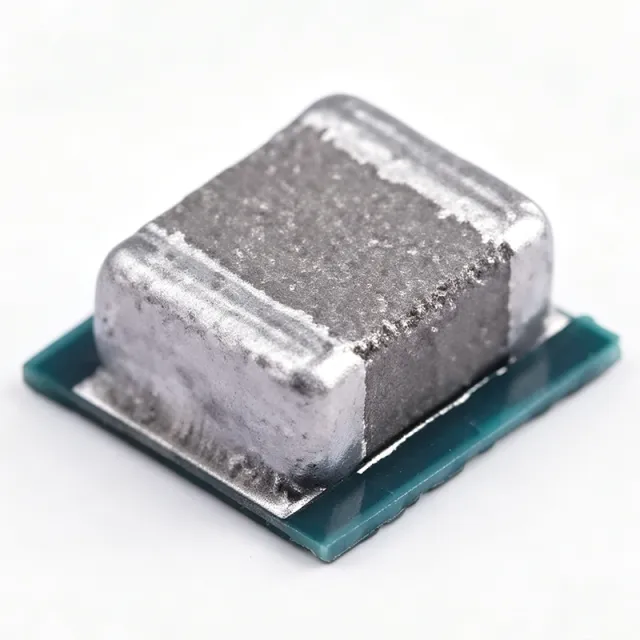
Les principales caractéristiques incluent la large plage d'entrée 3V-17V qui prend en charge les systèmes à bus 12V et 5V, une sortie continue de 3A, une sortie réglable de 0,9V à 5V via un diviseur de résistances externe, une fréquence de commutation fixe de 2,2 MHz qui permet de petits condensateurs externes, un démarrage progressif interne pour limiter le courant d'appel, une sortie power-good pour le séquencement, une broche enable pour le contrôle d'arrêt et une protection par arrêt thermique. Le boîtier MicroSiP expose un pad thermique inférieur qui évacue la chaleur directement dans le plan de cuivre du PCB.
Techniquement, le TPS82130 utilise une commande en mode courant crête à fréquence fixe, offrant une réponse transitoire rapide et une stabilité avec une capacité de sortie minimale (typiquement 22uF céramique). Il prend en charge un fonctionnement à rapport cyclique de 100 % pour une faible chute de tension à des rapports VIN/VOUT élevés. L'inductance blindée intégrée réduit les EMI rayonnées tout en simplifiant la conception du PCB, et le profil bas de 1,5 mm convient à l'assemblage automatisé avec des équipements de montage en surface standard.
Les applications typiques incluent l'alimentation point-of-load (POL) pour les FPGA, DSP et ASIC dans les systèmes industriels, les alimentations de capteurs d'automatisation d'usine, la distribution d'énergie sur rail 12V dans les nœuds de périphérie IoT et les équipements de test portables où une petite taille de solution est critique.
Lors de la conception, suivez les recommandations de la fiche technique pour les capacités céramiques d'entrée et de sortie, placez le module près de la charge et prévoyez une surface de cuivre généreuse sous le pad thermique, en particulier à courants de sortie élevés. Les références de prix s'appliquent au 2026-08-28.
Cette page synthétise les prix des distributeurs, les alternatives compatibles et des notes de conception pratiques introuvables dans la fiche technique du fabricant.
Alternatives de remplacement direct pour TPS82130SILR — même boîtier, compatible broche à broche. Les références à boîtier différent nécessitant une retouche du PCB sont exclues.
Variantes de cette série
Modèles de la même série directement compatibles avec TPS82130SILR (même facteur de forme et même empreinte) — différant par Continuous Output Current, MSL Level, Output Voltage Range, Package, Switching Frequency.
Outil de comparaison rapide — sélectionnez des références alternatives pour une comparaison côte à côte :
TPS82140SILR
✅ Remplacement direct✓ En stock
$2.45 / unité
Voir la fiche technique →TPS82150SILR
✅ Remplacement direct📋 Alternative de référence (hors catalogue)
TPS82130SILT
✅ Remplacement direct📋 Alternative de référence (hors catalogue)
TPS82130SILR Valeurs maximales et caractéristiques électriques
| Topologie | Synchronous Buck (Step-Down) |
| Module Type | MicroSiP Power Module (integrated inductor and FETs) |
| Plage de tension d'entrée | 3 V to 17 V |
| Plage de tension de sortie | 0.9 V to 5 V (adjustable) |
| Continuous Output Current | 3 A |
| Fréquence de commutation | 2.2 MHz (typical, fixed) |
| Control Mode | Peak Current Mode |
| Efficiency (typical) | >90% at moderate load |
| Démarrage progressif | Internal |
| Sortie Power Good | Yes |
| Broche d'activation | Yes (active-high) |
| Arrêt thermique | Yes |
| Plage de température de fonctionnement | -40C to +125C |
| Boîtier | 8-pin uSIP (SIL) 3.0mm x 2.8mm x 1.5mm |
| Type de montage | Surface Mount |
| Niveau MSL | 2 (1 year floor life) |
| Statut RoHS | Compliant |
Configuration des broches de TPS82130SILR
| Broche 1 | VIN — Input supply voltage |
| Broche 2 | GND — Signal ground |
| Broche 3 | EN — Enable input (active high) |
| Broche 4 | PGND — Power ground |
| Broche 5 | FB — Feedback voltage input |
| Broche 6 | VOUT — Regulated output voltage |
| Broche 7 | PG — Power good output flag |
| Broche 8 | AGND — Analog ground |
Applications typiques
TPS82130SILR convient pour 6 applications: FPGA Point-of-Load Power, Industrial Sensor and PLC Supplies, IoT Edge Devices and Gateway Nodes, Portable Test and Measurement Equipment, DSP and ASIC Core Power, Communication Equipment Power.
FPGA Point-of-Load Power
The TPS82130SILR is an ideal point-of-load supply for FPGA core and auxiliary rails in industrial embedded systems. With 3A continuous output, 0.9V to 5V adjustable output range, and a 3.0mm x 2.8mm uSIP footprint, it can power the FPGA core (typically 1.0V-1.2V), auxiliary (1.8V), and I/O (2.5V or 3.3V) rails from a single 12V bus. The 2.2MHz switching frequency avoids interfering with common FPGA clock harmonics around 100-500MHz, eliminating beat-frequency noise issues that plague lower-frequency regulators. Integrated synchronous FETs and shielded inductor eliminate 6-8 discrete components, dramatically reducing PCB area versus discrete buck designs.
Recommandé
Industrial Sensor and PLC Supplies
The TPS82130SILR powers industrial 4-20mA loop transmitters, PLC analog input modules, and 24V-bus sensor conditioning circuits. Its 3V-17V input range directly accepts the 24V industrial bus (after protection/regulation) and 12V backplane rails commonly used in factory automation. The wide operating temperature range of -40C to +125C supports deployment in unconditioned factory environments. With internal thermal shutdown, power-good output, and enable pin for power sequencing, the TPS82130 provides the robustness required for industrial IEC 61010 environments. Typical efficiency above 90% minimizes thermal dissipation in sealed enclosures.
Recommandé
IoT Edge Devices and Gateway Nodes
The TPS82130SILR fits compact IoT edge nodes and gateway designs that require multiple voltage rails in a small footprint. The integrated MicroSiP package occupies 75% less PCB area than equivalent discrete buck designs, freeing space for wireless modules, sensors, and battery management. With 3A peak capability, the TPS82130 can power a small SoC plus Wi-Fi/BLE radio module directly from a 12V or USB-C input. The 2.2MHz switching frequency enables small ceramic output capacitors (typically 22uF), and the internal soft-start limits inrush current that could trip upstream USB current-limit switches.
Recommandé
Portable Test and Measurement Equipment
Handheld oscilloscopes, data loggers, and field test equipment benefit from the TPS82130SILR's compact size, high efficiency, and wide input range. Battery-powered instruments often use a 2-cell or 3-cell Li-ion pack (6V-12.6V) that maps directly to the TPS82130 input range. The 3A continuous capability powers analog front-end ADCs, FPGAs, and display backlight drivers simultaneously. The 1.5mm low-profile uSIP package allows the entire power tree to fit on the back side of small PCBs, leaving the top side for analog signal paths and user interface components. High efficiency above 90% extends battery runtime.
Recommandé
DSP and ASIC Core Power
The TPS82130SILR is well-suited as a POL supply for DSP, ASIC, and high-performance microcontroller core rails. Modern DSPs often require 1.0V to 1.2V at 2-3A peak current with tight transient response - the TPS82130's peak-current-mode control delivers fast transient response with minimal output capacitance. The adjustable output from 0.9V to 5V covers virtually all DSP/ASIC core voltage requirements. The integrated power-good output enables sequencing with other system rails, and the enable pin allows shutdown to microampere-level quiescent current for sleep-mode applications. According to TI datasheet, the device supports 100% duty cycle for low-dropout operation at high VIN-VOUT deltas.
Recommandé
Communication Equipment Power
Networking switches, wireless base stations, and small cell radio units can use the TPS82130SILR to power digital signal processors and baseband chips from 12V backplane rails. The 2.2MHz switching frequency and integrated shielded inductor minimize radiated EMI - critical for communication equipment that must meet FCC and CE conducted/radiated emissions limits. With 3A output capability, the TPS82130 powers baseband SoCs and DDR memory termination rails simultaneously. The small MicroSiP footprint allows power circuits to be placed directly beneath or adjacent to the load IC, minimizing parasitic inductance and improving transient response.
Recommandé
Récapitulatif des produits recommandés
Données de référence d'ingénierie pour TPS82130SILR — comparaison, recommandations de conception et informations de conformité.
Guide de sélection
Comparaison avec les alternatives
| Paramètre | Ce produit | TPS82140SILR | TPS82150SILR | TPS82130SILT |
|---|---|---|---|---|
| Package | 8-pin uSIP (SIL) 3.0x2.8mm | 8-pin uSIP (SIL) 3.0x2.8mm - same | 8-pin uSIP (SIL) 3.0x2.8mm - same | 8-pin uSIP (SIL) 3.0x2.8mm - same |
| Brand | Texas Instruments | Texas Instruments | Texas Instruments | Texas Instruments |
| Output Current | 3 A | 2 A | 1 A | 3 A |
| Input Voltage Range | 3 V to 17 V | 3 V to 17 V | 3 V to 17 V | 3 V to 17 V |
| Output Voltage Range | 0.9 V to 5 V | 0.9 V to 5 V | 0.9 V to 5 V | 0.9 V to 5 V |
| Switching Frequency | 2.2 MHz | 2.2 MHz | 2.2 MHz | 2.2 MHz |
| Module Type | MicroSiP (integrated inductor) | MicroSiP (integrated inductor) | MicroSiP (integrated inductor) | MicroSiP (integrated inductor) |
Principaux différenciateurs
- Courant de sortie le plus élevé de la famille uSIP TPS821xx (vs TPS82140SILR)
- Même empreinte, courant inférieur pour les conceptions économiques (vs TPS82150SILR)
- Le boîtier MicroSiP intégré élimine 6 à 8 composants discrets (vs Conception buck discrète TPS54360)
Notes de conception
Estimation : à VIN=12V, VOUT=3,3V et charge de 3A, le TPS82130SILR dissipe environ (12-3,3) x 3 = 26,1 W de puissance. Avec un plan de cuivre adéquat pour le pad thermique inférieur (la fiche technique recommande un motif d'empreinte minimal), la résistance thermique jonction-ambiante est typiquement d'environ 30-40 C/W, entraînant une élévation de température de 50-80 C au-dessus de l'ambiante. Pour un fonctionnement continu à 3A, suivez exactement le motif de disposition de référence de la fiche technique et utilisez plusieurs vias thermiques sous le pad exposé du boîtier pour transférer la chaleur vers les couches internes du PCB.
Placez le module TPS82130SILR près du circuit intégré de charge, idéalement à moins de 5-10 mm, pour minimiser l'inductance parasite dans la boucle de sortie. Utilisez des plans de cuivre larges (au moins 50 mil) sur VIN, VOUT, PGND et le pad thermique exposé. Selon les directives de disposition de la fiche technique TI, placez le condensateur céramique d'entrée (typiquement 22uF X7R) aussi près que possible de la broche VIN, et placez le condensateur céramique de sortie (typiquement 22uF X7R) directement sur la broche VOUT. La broche AGND doit être reliée au plan PGND en un seul point près du retour de masse du condensateur de sortie.
Ne faites pas fonctionner le TPS82130SILR au-dessus du VIN maximal absolu de 17V - les transitoires sur les bus industriels 12V peuvent le dépasser lors d'événements de connexion à chaud. Ajoutez une diode TVS ou un limiteur de tension d'entrée si la conception se connecte à de longs câbles externes. N'omettez pas le condensateur d'entrée : la commutation à fort di/dt du TPS82130 nécessite un condensateur d'entrée céramique à faible ESR pour éviter les oscillations de VIN. Selon la fiche technique, utilisez des condensateurs céramiques X7R/X5R - ne remplacez pas par du Y5V qui perd 60-80 % de sa capacité nominale sous polarisation DC et en température.
Éloignez la trace FB (rétroaction) des nœuds de commutation bruyants (VIN, PGND, VOUT) et acheminez-la directement du haut du condensateur de sortie à la broche FB à l'aide d'une trace courte et étroite entourée de plan de masse. Ne placez pas les résistances du diviseur de rétroaction près de l'inductance - le couplage magnétique peut injecter du bruit dans le chemin de rétroaction et provoquer une ondulation de sortie ou une instabilité. La sortie PG (power-good) est un signal à drain ouvert et nécessite une résistance de tirage externe (typiquement 10k-100k) vers VOUT ou un rail logique.
Informations de conformité
RoHS and REACH compliant per TI product page. Not AEC-Q100 qualified; choose TPS62150A-Q1 or similar -Q1 part for automotive applications.