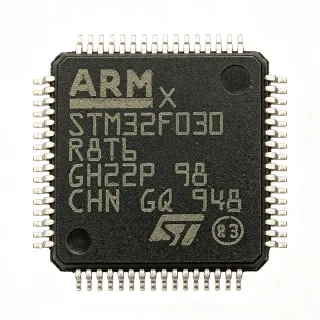
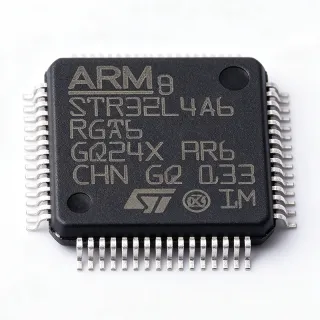
LPC2132FBD64/01151 - ARM7 64KB Flash MCU | NXP 64-LQFP
Référence : LPC2132FBD64/01151 ✓ Actif| Qté | Prix unitaire | Total |
|---|---|---|
| 1 | $4.5 | $4,50 |
| 10 | $3.96 | $39,60 |
| 100 | $3.42 | $342,00 |
| 500 | $2.96 | $1 480,00 |
| 1 000 | $2.55 | $2 550,00 |
LPC2132FBD64/01151 Présentation
Key specifications include a 60 MHz maximum CPU clock from the on-chip PLL, 128-bit wide memory interface with a unique accelerator enabling 32-bit code execution at maximum clock rate, single 3.3 V power supply operation, and on-chip integrated oscillator. The MCU targets embedded control, industrial networking, and USB device applications where deterministic real-time behavior is required.
The LPC2132 belongs to the LPC2131/32/34/36/38 family which scales flash memory from 32 KB to 512 KB. Its 64 KB flash and 16 KB SRAM position it as a mid-density member of the family, suitable for applications requiring modest program and data memory plus USB connectivity. The peripheral mix (USB, ADC, DAC, RTC, multiple timers) provides a complete system-on-chip solution for industrial, medical, and consumer products.
Typical applications include industrial control and automation, USB peripherals and bridges, point-of-sale terminals, medical instrumentation, smart card readers, and general embedded control. The on-chip USB 2.0 full-speed device controller simplifies USB device designs by eliminating external PHY and reducing BOM cost.
When designing with this device, ensure the JTAG and Embedded Trace Macrocell (ETM) debug access is preserved for development and field updates; the ARM7TDMI-S supports both real-time emulation and embedded trace. ISP/IAP flash programming via UART enables in-system firmware updates without removing the part from board-level access.
This page synthesizes distributor pricing, drop-in alternative MPNs, and practical design notes for the LPC2132FBD64/01151 that are not found in the manufacturer datasheet, enabling engineers to make faster component selection decisions.
Alternatives de remplacement direct pour LPC2132FBD64/01151 — même boîtier, compatible broche à broche. Les références à boîtier différent nécessitant une retouche du PCB sont exclues.
Outil de comparaison rapide — sélectionnez des références alternatives pour une comparaison côte à côte :
LPC2131FBD64/01,15
✅ Remplacement direct📋 Alternative de référence (hors catalogue)
LPC2134FBD64/01,15
✅ Remplacement direct📋 Alternative de référence (hors catalogue)
LPC2136FBD64/01EL
✅ Remplacement direct📋 Alternative de référence (hors catalogue)
LPC2138FBD64/01EL
✅ Remplacement direct📋 Alternative de référence (hors catalogue)
LPC2132FBD64/01,15
✅ Remplacement direct📋 Alternative de référence (hors catalogue)
LPC2132FBD64/01151 Valeurs maximales et caractéristiques électriques
| Core | ARM7TDMI-S (16/32-bit) |
| CPU Family | LPC2100 (LPC2131/32/34/36/38) |
| Maximum CPU Clock | 60 MHz |
| Flash Memory | 64 KB |
| SRAM | 16 KB |
| Memory Interface Width | 128-bit with accelerator |
| Tension d'alimentation | 3.0 V to 3.6 V (single 3.3 V supply) |
| ADC | 10-bit, multi-channel |
| DAC | 10-bit |
| Timers | Two 32-bit timers + watchdog |
| RTC | Real-Time Clock with battery backup domain |
| USB | USB 2.0 Full-Speed Device |
| Serial Interfaces | UART (x2), SPI (x2), I2C (x2) |
| Boîtier | LQFP-64 (10x10 mm) |
| Température de fonctionnement | -40C to +85C (industrial) |
| Type de montage | Surface Mount |
| Statut RoHS | Compliant |
| Debug Interface | JTAG + Embedded Trace Macrocell (ETM) |
| ISP/IAP | In-System / In-Application Programming via UART |
| On-chip Oscillator | Yes (integrated) |
Guide de configuration des broches du LPC2132FBD64/01151 lqfp-64 (10x10 mm)
Configuration des broches du LPC2132FBD64/01151 (boîtier lqfp-64 (10x10 mm)). Ce circuit intégré numérique comprend des GPIO, des interfaces de communication (UART, SPI, I2C) et des broches d'alimentation. Consultez la fiche technique du fabricant pour les fonctions alternatives des broches et les options de configuration. Indispensable pour la conception de systèmes embarqués et la conception de circuits imprimés.
Aucune donnée de brochage détaillée disponible pour LPC2132FBD64/01151.
Consultez la fiche technique pour la configuration complète des broches.
Applications typiques
LPC2132FBD64/01151 convient pour 6 applications: Industrial Control and Automation, USB Peripherals and Bridges, Point-of-Sale Terminals, Medical Instrumentation, Smart Card Readers, General Embedded Control.
Industrial Control and Automation
The LPC2132FBD64/01151 fits industrial control applications requiring deterministic real-time execution. Its 60 MHz ARM7TDMI-S core with 128-bit memory interface delivers 32-bit code execution at peak throughput, ideal for PLC modules, motor controllers, and HMI front-ends. The 10-bit ADC samples analog sensor inputs (temperature, pressure, position) at rates sufficient for industrial loop control. Two UARTs support RS-232/422/485 communication with industrial sensors and motor drives via external transceivers, while the SPI and I2C interfaces connect to digital sensors, EEPROMs, and display drivers. The -40C to +85C industrial temperature range and 3.3 V single-supply design simplify integration into factory floor equipment with standard 24V-to-3.3V DC-DC rails.
Recommandé
USB Peripherals and Bridges
The LPC2132FBD64/01151 integrates a USB 2.0 full-speed (12 Mbps) device controller with on-chip PHY and dedicated PLL, eliminating the external transceiver and crystal typically required for USB implementations. This makes the part ideal for USB-to-serial bridges, USB HID devices (keyboards, mice, game controllers), USB mass-storage devices, and USB vendor-class peripherals. The 64 KB flash accommodates USB class drivers plus application logic, while 16 KB SRAM handles USB endpoint buffers and protocol stacks. Multiple UARTs enable USB-to-UART bridge products, and the I2C/SPI ports support USB-to-I2C/SPI bridges for legacy equipment connectivity.
Recommandé
Point-of-Sale Terminals
Point-of-sale (POS) terminals benefit from the LPC2132FBD64/01151's integrated USB device controller (for PC connectivity), 10-bit ADC (for battery voltage monitoring and analog sensor inputs), 10-bit DAC (for audio feedback tones), and RTC with battery backup domain (for transaction timestamping). The 64 KB flash stores payment terminal firmware, encryption libraries, and display drivers, while 16 KB SRAM handles transaction buffers and display frame buffers. Two UARTs support magnetic stripe readers and external peripherals. The compact 64-LQFP package fits handheld POS form factors, and the 60 MHz ARM7 core executes cryptographic operations (AES, DES) fast enough for sub-second payment authorization cycles.
Recommandé
Medical Instrumentation
Medical instrumentation such as portable patient monitors, diagnostic instruments, and home-care devices leverage the LPC2132FBD64/01151's low-power 3.3 V operation, integrated USB for data transfer to PCs/hospital networks, 10-bit ADC for vital-sign sensors (SpO2, temperature, ECG), and RTC for time-stamped measurement records. The ARM7TDMI-S deterministic real-time execution supports critical measurement loops and safety interrupt routines. The 64 KB flash and 16 KB SRAM accommodate device firmware plus measurement algorithm libraries. The -40C to +85C operating range suits clinical environments, and the LQFP-64 package is compatible with standard medical-grade PCB manufacturing processes.
Recommandé
Smart Card Readers
Smart card readers benefit from the LPC2132FBD64/01151's USB device controller (for PC host connectivity), multiple UARTs (for contact smart card interfaces via external UART-to-ISO7816 bridges), I2C/SPI ports (for contactless/NFC front-ends), and RTC (for transaction logging). The 64 KB flash stores smart card reader firmware with multiple card protocol stacks (T=0, T=1), while 16 KB SRAM handles cryptographic operations and protocol buffers. The integrated peripherals reduce BOM cost for compact USB smart card readers used in banking, identification, and access control applications.
Recommandé
General Embedded Control
General embedded control applications (printers, scanners, appliance controllers, HVAC interfaces, building automation) leverage the LPC2132FBD64/01151's balance of flash (64 KB), SRAM (16 KB), peripherals, and connectivity. The dual UARTs support Modbus or DMX512 industrial protocols, while SPI and I2C connect to sensors, motor drivers, and display modules. The 10-bit DAC generates analog control signals for lighting dimmers or motor speed control, and the 10-bit ADC reads analog feedback signals. The RTC with battery backup enables scheduled operation and time-stamped event logging, ideal for HVAC thermostats and access control panels.
Recommandé
Récapitulatif des produits recommandés
Données de référence d'ingénierie pour LPC2132FBD64/01151 — comparaison, recommandations de conception et informations de conformité.
Guide de sélection
Comparaison avec les alternatives
| Paramètre | Ce produit | LPC2131FBD64/01,15 | LPC2134FBD64/01,15 | LPC2136FBD64/01EL | LPC2138FBD64/01EL | LPC2132FBD64/01,15 |
|---|---|---|---|---|---|---|
| Package | LQFP-64 (10x10 mm) | LQFP-64 (10x10 mm) | LQFP-64 (10x10 mm) | LQFP-64 (10x10 mm) | LQFP-64 (10x10 mm) | LQFP-64 (10x10 mm) |
| Brand | NXP Semiconductors | NXP Semiconductors | NXP Semiconductors | NXP Semiconductors | NXP Semiconductors | NXP Semiconductors |
| Core | ARM7TDMI-S | ARM7TDMI-S | ARM7TDMI-S | ARM7TDMI-S | ARM7TDMI-S | ARM7TDMI-S |
| Flash Memory | 64 KB | 32 KB | 128 KB | 256 KB | 512 KB | 64 KB |
| SRAM | 16 KB | 8 KB | 16 KB | 32 KB | 32 KB | 16 KB |
| Max CPU Clock | 60 MHz | 60 MHz | 60 MHz | 60 MHz | 60 MHz | 60 MHz |
| USB Controller | USB 2.0 FS Device | USB 2.0 FS Device | USB 2.0 FS Device | USB 2.0 FS Device | USB 2.0 FS Device | USB 2.0 FS Device |
| ADC / DAC | 10-bit / 10-bit | 10-bit / 10-bit | 10-bit / 10-bit | 10-bit / 10-bit | 10-bit / 10-bit | 10-bit / 10-bit |
Principaux différenciateurs
- Balanced mid-density memory in 64-LQFP family (vs LPC2131FBD64 (32 KB flash) and LPC2134FBD64 (128 KB flash))
- Integrated USB 2.0 full-speed device controller eliminates external PHY (vs LPC2129FBD64 (no USB controller))
- ISP/IAP flash programming via UART enables field firmware updates (vs Older ARM7 microcontrollers without bootloader)
Notes de conception
The LPC2132FBD64/01151 requires a stable 3.3 V supply within 3.0-3.6 V tolerance. Place 100 nF decoupling capacitors close to each VDD/VSS pin pair, plus a bulk 10 uF tantalum or ceramic capacitor at the supply input. The analog supply (VDDA) and digital supply (VDD) should be tied to the same 3.3 V rail but filtered separately - place a ferrite bead between VDD and VDDA and decouple VDDA with 100 nF + 10 nF caps near the pin. The RTC domain (VBAT) requires its own decoupling if a backup battery is used.
Route the JTAG signals (TCK, TMS, TDI, TDO, TRST) away from high-speed switching signals and keep trace lengths under 50 mm to ensure reliable debug access. The Embedded Trace Macrocell (ETM) port adds 4-12 additional output pins for instruction tracing - allocate board space for the Mictor/TRACE connector if real-time trace is required during development. The USB DP/DM traces must be 90-ohm differential and matched within 2 mm of length; route them on the top layer only with a continuous ground plane beneath.
Do not exceed 60 MHz CPU clock - the on-chip PLL multiplies the 1-25 MHz external crystal by an integer ratio and over-clocking causes flash memory access failures. The crystal oscillator requires an external load capacitor matching the crystal's CL specification (typically 10-33 pF) - incorrect values cause startup failures or frequency error. When using ISP programming via UART0, ensure the bootloader entry sequence (ISP pin high on reset) is accessible in production hardware for field firmware updates.
Informations de conformité
RoHS and REACH compliant per NXP product page. Industrial temperature grade (-40C to +85C). Not AEC-Q100 qualified - this part targets industrial and consumer markets, not automotive.