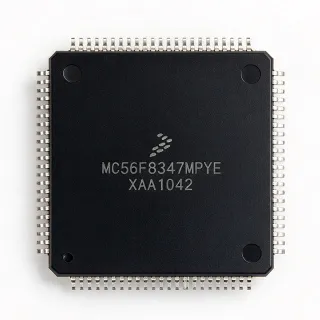
MC56F8357MPYE - 16-bit DSC, 56800E Core, 256KB Flash, 60MHz
Référence : MC56F8357MPYE ✓ Actif| Qté | Prix unitaire | Total |
|---|---|---|
| 1 | $27.12 | $27,12 |
| 10 | $24.85 | $248,50 |
| 100 | $22.1 | $2 210,00 |
| 500 | $19.95 | $9 975,00 |
| 1 000 | $17.8 | $17 800,00 |
MC56F8357MPYE Présentation
A Digital Signal Controller (DSC) is a hybrid processor class that combines the deterministic real-time control of a microcontroller (MCU) with the high-throughput mathematical capabilities of a Digital Signal Processor (DSP). In the broader taxonomy, the MC56F8357MPYE sits within: DSC -> microcontroller -> embedded processor -> semiconductor IC. The 56800E core introduced a unified instruction set that lets C code call DSP-style MAC operations without context switches, simplifying motor-control and audio firmware.
Key features include up to 60 MIPS performance, on-chip Flash program memory, on-chip data RAM, multiple timers, PWM modules suitable for 3-phase motor drive, dual 12-bit ADCs, quadrature decoder interfaces, and communication peripherals (SCI, SPI, I2C, CAN). The 56F8357 variant adds the full peripheral set, while the lower-cost 56F8157 omits certain features. A JTAG/OnCE debug port enables in-circuit emulation and flash programming.
Architecturally, the 56800E core is a Harvard-style dual-bus design with separate program and data paths, allowing simultaneous fetch and memory access. The unified instruction set treats peripheral registers, data RAM, and program memory in a common address space, which simplifies compiler code generation and lowers interrupt latency for closed-loop control loops operating at kHz rates.
Typical applications include AC induction and BLDC/PMSM motor drives, digital power conversion (PFC + LLC), solar inverters, industrial automation controllers, and audio/speech processing front ends. The combination of PWM and ADC synchronization makes the device particularly suited to field-oriented control (FOC) of three-phase motors.
When designing with this device, ensure that the JTAG/OnCE pins are reserved for debug access or production programming, and pay close attention to decoupling on the analog supply pins to preserve ADC linearity. Migration from 56F8157 is straightforward for code that does not use features marked in italics in the datasheet.
This page synthesizes distributor pricing, datasheet PDF location, family-variant drop-in alternatives, and design notes not consolidated on the NXP product page.
Alternatives de remplacement direct pour MC56F8357MPYE — même boîtier, compatible broche à broche. Les références à boîtier différent nécessitant une retouche du PCB sont exclues.
Variantes de cette série
Modèles de la même série directement compatibles avec MC56F8357MPYE (même facteur de forme et même empreinte) — différant par ADC, Package, Core, Data Bus Width, Debug Interface.
Outil de comparaison rapide — sélectionnez des références alternatives pour une comparaison côte à côte :
MC56F8357VPYE
✅ Remplacement direct✓ En stock
$13.85 / unité
Voir la fiche technique →MC56F8367MPYE
✅ Remplacement direct✓ En stock
$17.1 / unité
Voir la fiche technique →MC56F8367VPYE
✅ Remplacement direct📋 Alternative de référence (hors catalogue)
MC56F8357MPYE Valeurs maximales et caractéristiques électriques
| Core | 56800E (16-bit hybrid DSC core) |
| Largeur du bus de données | 16 bit |
| Instruction Set | C-efficient 56800E unified instruction set |
| Maximum Core Frequency | 60 MHz |
| Performance | 60 MIPS |
| Program Memory | 256 KB (128K x 16) Flash |
| Tension d'alimentation | 3.3 V |
| Boîtier | 160-LQFP (24 x 24 mm) |
| Type de montage | Surface Mount |
| ADC | Dual 12-bit ADC (peripherals integrated) |
| PWM Modules | Yes (suitable for 3-phase motor drive) |
| Communication Peripherals | SCI, SPI, I2C, CAN |
| Quadrature Decoder | Yes |
| Timers | Multiple general-purpose timers |
| Debug Interface | JTAG/OnCE |
| Family | 56F835X / 56F815X (56800E DSC) |
| Statut RoHS | Compliant (details per distributor page) |
Guide de configuration des broches du MC56F8357MPYE 160-lqfp (24 x 24 mm)
Configuration des broches du MC56F8357MPYE (boîtier 160-lqfp (24 x 24 mm)). Ce circuit intégré numérique comprend des GPIO, des interfaces de communication (UART, SPI, I2C) et des broches d'alimentation. Consultez la fiche technique du fabricant pour les fonctions alternatives des broches et les options de configuration. Indispensable pour la conception de systèmes embarqués et la conception de circuits imprimés.

Aucune donnée de brochage détaillée disponible pour MC56F8357MPYE.
Consultez la fiche technique pour la configuration complète des broches.
Applications typiques
MC56F8357MPYE convient pour 6 applications: Three-Phase AC Induction Motor Drive, BLDC / PMSM Servo Drive, Digital Power Conversion (PFC + LLC), Solar Micro-Inverter, Industrial Automation Controller, Audio / Speech Processing Front End.
Three-Phase AC Induction Motor Drive
The MC56F8357MPYE is purpose-built for field-oriented control (FOC) of three-phase AC induction motors. Its 60 MIPS 56800E core runs a vector-control loop within a typical 10-20 kHz PWM update rate, while the integrated PWM modules generate the six complementary gate signals needed for a 3-phase inverter. The dual 12-bit ADCs sample phase currents synchronously to the PWM center, minimizing distortion. On-chip 256 KB Flash stores motor-parameter identification routines and commutation tables, removing the need for external memory. Compared with a discrete MCU+DSP partition, the unified 56800E core lowers interrupt latency and shrinks the BOM by eliminating a second processor.
Recommandé
BLDC / PMSM Servo Drive
Brushless DC and permanent-magnet synchronous motor (PMSM) servo drives benefit from the MC56F8357MPYE's quadrature decoder and PWM/ADC synchronization. The 56800E core executes the FOC inner current loop in microseconds, leaving headroom for cascaded velocity and position loops. Quadrature decoder interfaces directly to incremental encoders, eliminating external logic. On-chip CAN enables integration into multi-axis industrial servo networks. The 160-LQFP package exposes ample GPIO for hall-sensor inputs, brake control, and fault flags typical of servo architectures.
Recommandé
Digital Power Conversion (PFC + LLC)
Digital power supplies require deterministic switching-frequency execution with sub-microsecond control loops. The MC56F8357MPYE's 60 MIPS throughput drives both power-factor correction (PFC) and LLC resonant converter control loops in a single device. High-resolution PWM modules enable fine duty-cycle adjustments needed for soft-start and synchronous rectification, while the 12-bit ADCs monitor input voltage, output voltage, and primary current with sub-1% accuracy. 256 KB Flash holds multi-mode firmware (CCM, DCM, burst) for digital-telecom rectifier designs.
Recommandé
Solar Micro-Inverter
Solar micro-inverters convert a single PV module's DC output to grid-tied AC. The MC56F8357MPYE's 56800E core executes MPPT, anti-islanding, and grid-synchronization algorithms at the kHz rates required by 50/60 Hz grid cycles while simultaneously driving a high-frequency DC-DC stage. CAN or SCI interfaces connect to module-level monitoring networks. On-chip 256 KB Flash stores grid-code firmware variants for worldwide certification. The 3.3 V supply simplifies integration with low-voltage analog front ends measuring PV current and voltage.
Recommandé
Industrial Automation Controller
PLC-style industrial controllers benefit from the MC56F8357MPYE's mix of CAN, SCI, SPI, and I2C peripherals plus its 16-bit DSP-style arithmetic for closed-loop control. The 56800E core executes IEC 61131-3 style logic and motion blocks, while 256 KB Flash stores ladder-logic or structured-text programs. JTAG/OnCE enables in-circuit firmware updates on the production line. The 160-LQFP package provides enough GPIO for digital I/O expansion and encoder feedback typical of multi-axis controllers.
Recommandé
Audio / Speech Processing Front End
Audio front ends running FFT-based pitch detection, noise suppression, or speech-recognition pre-processing leverage the MC56F8357MPYE's 56800E MAC instructions and 60 MIPS throughput. On-chip 256 KB Flash stores codec firmware and small reference templates, while the dual 12-bit ADCs digitize microphone arrays. SCI/SPI connect to external audio CODECs. Compared with a generic MCU, the unified 56800E architecture executes FFT kernels 5-10x faster while keeping interrupt response deterministic for low-latency audio pipelines.
Recommandé
Récapitulatif des produits recommandés
Données de référence d'ingénierie pour MC56F8357MPYE — comparaison, recommandations de conception et informations de conformité.
Guide de sélection
Comparaison avec les alternatives
| Paramètre | Ce produit | MC56F8357VPYE | MC56F8367MPYE | MC56F8367VPYE |
|---|---|---|---|---|
| Brand | NXP Semiconductors | NXP Semiconductors | NXP Semiconductors | NXP Semiconductors |
| Package | 160-LQFP (24x24) | 160-LQFP (24x24) - same | 160-LQFP (24x24) - same | 160-LQFP (24x24) - same |
| Core | 56800E (16-bit DSC) | 56800E (16-bit DSC) | 56800E (16-bit DSC) | 56800E (16-bit DSC) |
| Maximum Core Frequency | 60 MHz | 60 MHz | 60 MHz | 60 MHz |
| Supply Voltage | 3.3 V | 3.3 V | 3.3 V | 3.3 V |
| Operating Temperature Grade | Industrial -40C to +105C (MPYE) | Extended (VPYE) - typically -40C to +125C | Industrial -40C to +105C | Extended (VPYE) - typically -40C to +125C |
| Sub-family | 56F8357 | 56F8357 (same) | 56F8367 (higher integration) | 56F8367 (higher integration) |
| Pin Count | 160 | 160 - same | 160 - same | 160 - same |
| RoHS Status | Compliant | Compliant | Compliant | Compliant |
Principaux différenciateurs
- Drop-in extended-temperature variant available on same 160-LQFP footprint (vs MC56F8357VPYE)
- Pin-compatible upgrade path to 56F8367 sub-family (vs MC56F8367MPYE)
- Unified 56800E core eliminates MCU+DSP partition (vs Generic MCU + external DSP architecture)
Notes de conception
Decouple the MC56F8357MPYE's 3.3 V supply with a 10 uF bulk + 0.1 uF high-frequency ceramic pair placed within 5 mm of each VDD pin group per the NXP 56800E hardware design guide. Separate analog AVDD from digital VDD with a ferrite bead to keep switching noise out of the dual 12-bit ADC reference; this is critical for motor-current sensing where 1 LSB of noise translates to measurable torque ripple.
Route the JTAG/OnCE pins (TDI, TDO, TMS, TCK, TRST, DE) directly to a header or test-point array with no series resistors, and avoid sharing these traces with PWM outputs. The 56800E core uses these pins for both debug and in-circuit flash programming; layout mistakes here can lock production programming. Reference NXP application note AN1930 for boundary-scan-friendly routing.
PWM outputs on the 160-LQFP should be routed with matched lengths within each complementary pair (top/bottom switch of one phase leg). Add 22-33 ohm series resistors close to the MC56F8357MPYE to dampen ringing into the gate-driver capacitive load. For motor-phase lines carrying both PWM and analog current feedback, maintain at least 3x dielectric spacing between analog traces and PWM traces to avoid capacitive coupling into ADC samples.
Do not confuse the MC56F8357MPYE suffix with the lower-cost 56F8157 - the NXP datasheet lists 56F8157 features in italics as 'NOT available in the 56F8157 device'. Designers migrating from 56F8357 prototype code to 56F8157 must remove references to those italicized peripherals or compilation will fail. Estimated RAM differences from datasheet footnotes: 56F8357 offers the full peripheral set.
Estimated: at 60 MHz full-activity with all peripherals enabled, core current is approximately 80-100 mA at 3.3 V, dissipating 0.3-0.4 W. The 160-LQFP (24x24) theta_JA is roughly 35-40 C/W on a standard 4-layer JEDEC test board, yielding a 14-16 C junction temperature rise above ambient - well within the 105 C industrial limit without a heatsink, but provision copper pour around the exposed thermal land if available.
Informations de conformité
RoHS and lead-free status confirmed via distributor listings; REACH and halogen-free status not explicitly published in the provided data and require manufacturer declaration.