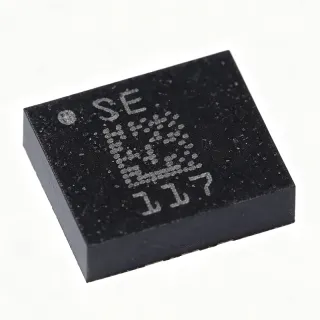
MMA2202EG - ±56.3g X-Axis Analog Accelerometer | NXP | 16-SOIC
Référence : MMA2202EG ✗ Fin de vie| Qté | Prix unitaire | Total |
|---|---|---|
| 1 | $18.4 | $18,40 |
| 10 | $16.55 | $165,50 |
| 100 | $14.2 | $1 420,00 |
| 500 | $12.1 | $6 050,00 |
| 1 000 | $10.85 | $10 850,00 |
MMA2202EG Présentation
What is an accelerometer? An accelerometer is a sensor that measures proper acceleration along one or more axes, converting mechanical motion into an electrical signal. The MMA series from NXP (originally Freescale / Motorola) uses a silicon capacitive micromachined (MEMS) sense element combined with CMOS signal conditioning, making it a member of the broader MEMS sensor hierarchy: accelerometer -> inertial sensor -> motion sensor -> semiconductor sensor. This integration places the part firmly in the Sensors > Motion Sensors product family.
Key features of the MMA2202EG include a factory-set zero-g offset, full-scale span, and filter cut-off frequency, eliminating the need for external trim components. A self-test pin verifies mechanical element integrity in application, and on-chip temperature compensation maintains sensitivity and offset across the -40 °C to +125 °C automotive temperature range. The 4-pole low-pass filter limits aliasing into downstream ADCs and reduces high-frequency mechanical noise.
From an architecture perspective, the MMA2202EG uses a differential capacitive sense cell whose deflection under acceleration is read out by a switched-capacitor charge amplifier. The CMOS ASIC includes a precision bandgap reference and a temperature compensation block, giving the device a sensitivity tolerance of ±5 % over temperature. Because the output is ratiometric to VDD, ADC measurements that share the same 5 V rail as the sensor are immune to supply-rail drift.
Typical applications include automotive airbag crash detection, electronic stability control (ESC) supplemental sensing, industrial vibration monitoring, and appliance tilt/inclination detection. The wide ±56.3 g range is well-matched to high-shock events such as frontal collision pulses. In drop-test rigs and machine health monitoring, the part's integrated filter reduces post-processing burden on the host microcontroller.
When designing with this device, route the analog output through a low-pass RC (typically 1 kΩ / 1 nF) to limit RF pickup before the host ADC, and add 100 nF decoupling close to VDD and GND. Because the output is ratiometric, sharing the ADC reference with the sensor supply is essential for absolute accuracy.
This page synthesizes distributor pricing, drop-in alternatives, and practical design notes not found on a typical distributor product page, including a side-by-side comparison with same-package NXP MMA22xx family variants and cross-package alternatives engineers actually evaluate for retrofit designs.
Alternatives de remplacement direct pour MMA2202EG — même boîtier, compatible broche à broche. Les références à boîtier différent nécessitant une retouche du PCB sont exclues.
Variantes de cette série
Modèles de la même série directement compatibles avec MMA2202EG (même facteur de forme et même empreinte) — différant par Bandwidth, Lead Free Status, Package, RoHS Status, Technology.
Outil de comparaison rapide — sélectionnez des références alternatives pour une comparaison côte à côte :
Aucune alternative de remplacement direct disponible pour ce produit.
Demander des alternativesMMA2202EG Valeurs maximales et caractéristiques électriques
| Type de capteur | Accelerometer, single-axis (X) |
| Technology | MEMS, capacitive sense element |
| Acceleration Range | ±56.3 g |
| Sensitivity | 38 mV/g to 42 mV/g |
| Type de sortie | Analog, ratiometric voltage |
| Zero-g Output (typ.) | 2.5 V (mid-supply) |
| Bandwidth | 400 Hz (4-pole low-pass filter) |
| Supply Voltage (VDD) | 4.75 V to 5.25 V |
| Self-Test Pin | Yes (logic input) |
| Plage de température de fonctionnement | -40 °C to +125 °C |
| Boîtier | 16-pin SOIC |
| Type de montage | Surface Mount |
| Temperature Compensation | On-chip, factory trimmed |
| Statut RoHS | Compliant |
| Lead Free Status | Lead Free |
Configuration des broches de MMA2202EG
| Broche 1 | TP1 — Test pin 1 (factory use, no-connect in application per datasheet) |
| Broche 2 | TP2 — Test pin 2 (factory use, no-connect in application per datasheet) |
| Broche 3 | ST — Self-test input (logic high activates electrostatic self-test) |
| Broche 4 | NC — Not connected |
| Broche 5 | NC — Not connected |
| Broche 6 | VREF — Voltage reference (nominally 2.5 V at 5 V supply) |
| Broche 7 | VOUT — Analog ratiometric output (sensitivity 38-42 mV/g) |
| Broche 8 | GND — Ground (0 V) |
| Broche 9 | VDD — Supply voltage (4.75 V to 5.25 V) |
| Broche 10 | NC — Not connected |
| Broche 11 | NC — Not connected |
| Broche 12 | NC — Not connected |
| Broche 13 | NC — Not connected |
| Broche 14 | NC — Not connected |
| Broche 15 | NC — Not connected |
| Broche 16 | TP3 — Test pin 3 (factory use, no-connect in application per datasheet) |
Applications typiques
MMA2202EG convient pour 6 applications: Automotive Airbag Crash Detection, Electronic Stability Control (ESC) Supplemental Sensing, Industrial Vibration Monitoring, Drop-Test and Shock Recorder Systems, Appliance Tilt and Inclination Sensing, Motorcycle and Powersport Black-Box Recorders.
Automotive Airbag Crash Detection
The MMA2202EG's ±56.3 g full-scale range and 400 Hz low-pass filter make it well-matched to airbag crash-sensing applications, where peak accelerations during a side-impact or rear-impact event can reach 30-50 g for tens of milliseconds. The on-chip 4-pole filter reduces high-frequency mechanical noise that could falsely trigger a deployment decision, while the ratiometric analog output lets the host ADC share the 5 V supply as its reference, minimizing absolute scale error. Compared with mechanical crash sensors, the MMA2202EG's small 16-SOIC footprint simplifies mounting on distributed satellite sensor modules. The factory-trimmed zero-g offset (nominally 2.5 V at 5 V) and on-chip temperature compensation across -40 °C to +125 °C eliminate per-unit calibration, a key advantage over earlier generations of MEMS accelerometers. NXP recommends the MMA26xx digital-output family for new airbag platforms, but existing designs can continue to use the MMA2202EG while inventory is available.
Recommandé
Electronic Stability Control (ESC) Supplemental Sensing
In an ESC system, the MMA2202EG serves as a supplemental high-g sensor for detecting wheel-lift events and extreme chassis dynamics that exceed the range of the primary low-g ESC sensor (typically ±2 g). Its ±56.3 g range and 400 Hz bandwidth capture the fast transients associated with rollover precursors, while the 5 V ratiometric output feeds directly into a 5 V ADC input channel on the ESC microcontroller. The 16-SOIC package is small enough to be placed near each wheel hub, reducing wiring harness length and improving signal integrity. On-chip temperature compensation maintains sensitivity across underhood temperatures, and the self-test pin lets the host microcontroller verify mechanical element integrity at every power-on. Engineers designing ESC systems should consult the NXP ESC reference designs for proper sensor placement and mounting torque specifications to avoid bias errors from PCB stress.
Recommandé
Industrial Vibration Monitoring
The MMA2202EG's ±56.3 g range and 400 Hz analog bandwidth make it suitable for industrial vibration monitoring on rotating machinery, where it can capture bearing-fault signatures and shock events that exceed ±10 g. The 5 V ratiometric output connects directly to a 4-20 mA transmitter front-end or a panel-meter ADC, simplifying field wiring. The on-chip 4-pole low-pass filter removes aliasing components above 400 Hz, allowing direct sampling at 1 kSPS without additional external filtering. Its -40 °C to +125 °C operating range covers most industrial environments, and the 16-SOIC package is compatible with hand-soldered prototypes and SMT production lines. The self-test pin can be driven periodically to detect sensor-element failure in unattended installations. For low-frequency vibration analysis (below 1 Hz), an external AC-coupling capacitor and DC-blocking stage are recommended.
Recommandé
Drop-Test and Shock Recorder Systems
The MMA2202EG is well-suited to drop-test rigs and shock data recorders used in packaging qualification, where it captures the acceleration pulse that a product experiences during a free-fall drop onto a hard surface. The ±56.3 g range accommodates drops of 1-2 m onto concrete, while the 400 Hz bandwidth is sufficient to capture the dominant spectral content of the impact pulse. The ratiometric analog output feeds directly into a data-logger ADC, and the on-chip filter reduces high-frequency mechanical ringing that could saturate the downstream amplifier. The 16-SOIC package can be soldered onto a small daughterboard that mounts inside the test article. For drops exceeding 100 g peak, the MMA2204EG or MMA2206EG are recommended drop-in alternatives sharing the same 16-SOIC footprint.
Recommandé
Appliance Tilt and Inclination Sensing
Although the MMA2202EG's ±56.3 g range is much wider than the ~1 g signal of a static tilt sensor, it can still be used in dynamic-tilt applications such as washing-machine imbalance detection and refrigerator-door-ajar alarms. At rest, the 1 g gravitational component produces a 38-42 mV shift, and large dynamic tilt events (e.g., a washer entering an off-balance spin cycle) can produce multi-g signals that the MMA2202EG captures without saturating. The on-chip temperature compensation keeps the zero-g offset stable across the appliance's operating environment, and the 5 V analog output interfaces directly to most appliance microcontrollers. For purely static tilt measurement where resolution matters more than range, the MMA1220EG Z-axis part is a better drop-in choice in the same 16-SOIC package.
Recommandé
Motorcycle and Powersport Black-Box Recorders
The MMA2202EG's wide ±56.3 g range captures the high-shock events that occur during motorcycle crashes, making it a candidate sensor for powersport black-box data recorders that document ride dynamics for insurance and accident reconstruction. Its 400 Hz bandwidth is sufficient to capture the impact signature, and the 5 V ratiometric output feeds directly into a low-cost 10-bit or 12-bit ADC on a black-box microcontroller. The 16-SOIC surface-mount package is small enough to fit inside a handlebar-mounted or under-seat enclosure, and the -40 °C to +125 °C operating range covers storage and operating temperatures in most climates. Engineers should add mechanical isolation (rubber mounts) to prevent high-frequency PCB vibration from coupling into the MEMS element above the filter cutoff. For higher-g events (racing crashes), the MMA2301EG in the same 16-SOIC footprint provides ±225 g range.
Recommandé
Récapitulatif des produits recommandés
Données de référence d'ingénierie pour MMA2202EG — comparaison, recommandations de conception et informations de conformité.
Guide de sélection
Comparaison avec les alternatives
| Paramètre | Ce produit | MMA2204EG | MMA2206EG | MMA2200EG | MMA2301EG |
|---|---|---|---|---|---|
| Brand | NXP Semiconductors | NXP Semiconductors | NXP Semiconductors | NXP Semiconductors | NXP Semiconductors |
| Package | 16-SOIC | 16-SOIC (same) | 16-SOIC (same) | 16-SOIC (same) | 16-SOIC (same) |
| Full-Scale Range | ±56.3 g | ±112.6 g | ±169.3 g | ±40 g | ±225 g |
| Sensitivity | 38-42 mV/g | 20 mV/g | 12.5 mV/g | 50 mV/g | 10 mV/g |
| Bandwidth | 400 Hz | 400 Hz | 400 Hz | 400 Hz | 400 Hz |
| Supply Voltage | 4.75 V to 5.25 V | 4.75 V to 5.25 V | 4.75 V to 5.25 V | 4.75 V to 5.25 V | 4.75 V to 5.25 V |
| Axis | X | X | X | X | X |
| Output Type | Analog ratiometric | Analog ratiometric | Analog ratiometric | Analog ratiometric | Analog ratiometric |
| Self-Test Pin | Yes | Yes | Yes | Yes | Yes |
| Operating Temperature | -40 °C to +125 °C | -40 °C to +125 °C | -40 °C to +125 °C | -40 °C to +125 °C | -40 °C to +125 °C |
Principaux différenciateurs
- Optimized range for side-impact airbag crash sensing (vs MMA2204EG)
- Higher sensitivity (mV/g) for low-amplitude events (vs MMA2206EG)
- Single-axis X-axis orientation (vs MMA1220EG (Z-axis))
Notes de conception
The MMA2202EG requires a clean 5.0 V supply. Place a 100 nF ceramic decoupling capacitor as close as possible to VDD (pin 9) and GND (pin 8), with a 10 µF bulk capacitor at the supply rail. Because the analog output is ratiometric to VDD, supply noise couples directly into the acceleration reading; an RC filter (10 Ω + 10 µF) on VDD is recommended in noisy automotive environments.
Route the analog VOUT trace as a short, guarded trace away from digital switching lines and from the self-test pin. Place a 1 kΩ series resistor plus 1 nF capacitor to GND at the host ADC input to form a low-pass filter (fc ≈ 160 kHz) that limits RF pickup without affecting the 400 Hz signal bandwidth. Use a ground plane on the layer beneath the SOIC, and avoid placing vias in the sense-element area to minimize mechanical stress coupling.
Three common pitfalls when designing with the MMA2202EG: (1) using a separate ADC reference that drifts relative to VDD - this destroys ratiometric accuracy, so share VDD with the ADC reference; (2) driving the self-test pin high continuously - this applies an electrostatic force to the sense element and should be pulsed only briefly; (3) PCB stress on the SOIC package - mechanical strain from over-tightened mounting screws can shift the zero-g offset, so use the recommended mounting hardware and torque values from the datasheet.
Informations de conformité
Per DigiKey product page and NXP/Freescale datasheet: RoHS compliant, lead-free, qualified to automotive temperature grade -40 °C to +125 °C (AEC-Q100 qualified per the 'EG' suffix designation in the MMA family).