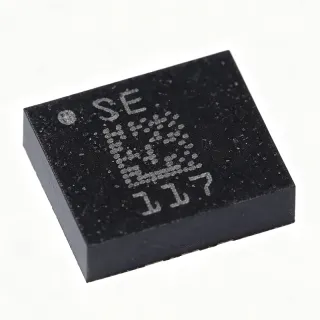
MMA2300D - ±281g X-Axis Micromachined Accelerometer | NXP
Référence : MMA2300D ✗ Fin de vie| Qté | Prix unitaire | Total |
|---|---|---|
| 1 | $18.5 | $18,50 |
| 10 | $16.2 | $162,00 |
| 100 | $13.85 | $1 385,00 |
| 500 | $11.4 | $5 700,00 |
| 1 000 | $9.75 | $9 750,00 |
MMA2300D Présentation
An accelerometer (also called a g-sensor or gravity sensor) is a MEMS (micro-electromechanical systems) transducer that converts linear acceleration along one or more axes into an analog voltage or digital output. Within the broader taxonomy, the MMA2300D belongs to: accelerometer -> MEMS sensor -> motion sensor -> inertial sensor -> semiconductor. MEMS capacitive accelerometers dominate automotive and industrial crash-detection, vibration monitoring, and tilt/inclination applications because of their small size, low power, and high shock survivability.
Key features of the MMA2300D include a sensitivity of approximately 1.0 mV/g, a zero-g output of VDD/2, an integrated 4-pole low-pass filter with factory-set cutoff, on-chip temperature compensation across -40 °C to +105 °C, an electro-static self-test pin, and ratiometric analog output that scales with supply voltage. Per the verified distributor and OEM data, the device comes in a wide-body 16-pin SOIC and was originally targeted at airbag deployment, vibration monitoring, and high-shock industrial applications. The device was originally developed by Motorola, transferred to Freescale Semiconductor, and is currently branded NXP.
The MMA2300D uses NXP's G-cell capacitive sense element: a suspended proof mass with interdigitated finger capacitors whose differential capacitance changes with acceleration. This differential capacitance is read out by a switched-capacitor front-end, then amplified, low-pass filtered, and temperature-compensated using factory-trimmed on-chip EPROM constants. Compared to older piezoelectric crash sensors, the capacitive architecture delivers DC response (0 Hz) and stable gain across the full automotive temperature range.
Typical applications include automotive airbag crash sensors, electronic stability control (ESC) and anti-lock brake systems (ABS), industrial vibration monitoring, sports and fitness impact analysis, hard-drive drop detection, and machinery health monitoring. The 281 g full-scale range makes it specifically suited to high-g transient capture where lower-range devices (e.g., ±2 g, ±10 g inclinometers) would saturate.
A key design consideration when using the MMA2300D: it is RoHS Non-Compliant per the official data sheet note - the EG suffix variant (MMA2350FEG, lead-free / Pb-free) is required for new RoHS-compliant designs. Designers should also add an external RC filter on VOUT if the application's ADC input bandwidth is narrower than 400 Hz to limit aliasing of high-frequency shock transients.
This page synthesizes distributor stock, parametric drop-in alternatives, and practical design guidance not consolidated on the NXP data sheet alone - including the RoHS Non-Compliant status, automotive grade classification, and same-package pin-compatible alternatives sourced from the NXP/Freescale MMA-series family.
Alternatives de remplacement direct pour MMA2300D — même boîtier, compatible broche à broche. Les références à boîtier différent nécessitant une retouche du PCB sont exclues.
Variantes de cette série
Modèles de la même série directement compatibles avec MMA2300D (même facteur de forme et même empreinte) — différant par Acceleration Range, Package, Self-Test, Sensor Type, Output Type.
Outil de comparaison rapide — sélectionnez des références alternatives pour une comparaison côte à côte :
MMA2350FEG
✅ Remplacement direct📋 Alternative de référence (hors catalogue)
MMA2300EG
✅ Remplacement direct📋 Alternative de référence (hors catalogue)
MMA2301D
✅ Remplacement direct ⚠️ Spécifications non vérifiées📋 Alternative de référence (hors catalogue)
MMA3201D
✅ Remplacement direct ⚠️ Spécifications non vérifiées✓ En stock
$5.44 / unité
Voir la fiche technique →MMA2202D
✅ Remplacement direct ⚠️ Spécifications non vérifiées✓ En stock
$9.75 / unité
Voir la fiche technique →MMA2300D Valeurs maximales et caractéristiques électriques
| Type de capteur | MEMS Capacitive Accelerometer (X-Axis, single-axis) |
| Acceleration Range | ±281 g |
| Bandwidth | 400 Hz |
| Axis Count | 1 (X-axis) |
| Supply Voltage (VDD) | 4.75 V to 5.25 V |
| Sensitivity | approx. 1.0 mV/g (ratiometric) |
| Zero-g Output | VDD / 2 (ratiometric) |
| Type de sortie | Analog, ratiometric |
| Filter | Integrated 4-pole low-pass, factory-set cutoff |
| Self-Test | Yes (electrostatic self-test pin) |
| Temperature Compensation | On-chip, factory trimmed |
| Température de fonctionnement | -40 °C to +105 °C (automotive grade) |
| Boîtier | 16-pin SOIC (case 475-01), wide-body, surface mount |
| Type de montage | Surface Mount |
| Package Code (JEDEC) | SOP-16 (case 475-01) |
| Lead-Free / RoHS | Contains Lead; RoHS Non-Compliant (D-suffix variant). Use EG-suffix (MMA2350FEG) for Pb-Free designs. |
| Temperature Grade | Automotive |
| Nombre de broches | 16 |
| Manufacturer | NXP Semiconductors (formerly Freescale Semiconductor, originally Motorola Semiconductor) |
Configuration des broches de MMA2300D
| Broche 1 | NC — No connect (per datasheet) |
| Broche 2 | NC — No connect (per datasheet) |
| Broche 3 | NC — No connect (per datasheet) |
| Broche 4 | VDD — Supply voltage (4.75 V to 5.25 V) |
| Broche 5 | GND — Ground |
| Broche 6 | NC — No connect (per datasheet) |
| Broche 7 | NC — No connect (per datasheet) |
| Broche 8 | NC — No connect (per datasheet) |
| Broche 9 | VOUT — Ratiometric analog output (VDD/2 at 0 g) |
| Broche 10 | NC — No connect (per datasheet) |
| Broche 11 | NC — No connect (per datasheet) |
| Broche 12 | ST — Electrostatic self-test input |
| Broche 13 | NC — No connect (per datasheet) |
| Broche 14 | NC — No connect (per datasheet) |
| Broche 15 | NC — No connect (per datasheet) |
| Broche 16 | NC — No connect (per datasheet) |
Applications typiques
MMA2300D convient pour 6 applications: Automotive Airbag Crash Sensing, Industrial Vibration Monitoring, Sports and Fitness Impact Analysis, Hard-Drive Drop Detection, Machinery Health Monitoring and Predictive Maintenance, Crash Simulation and Test Instrumentation.
Automotive Airbag Crash Sensing
The MMA2300D was specifically designed by Motorola / Freescale / NXP for front and side airbag crash detection. Its ±281 g full-scale range comfortably captures the deceleration pulse of a 50 kph barrier crash (typically 30-60 g peak, with sub-millisecond rise times). The 400 Hz bandwidth is well-matched to crash-pulse spectral energy (DC-2 below 100 Hz for the bulk of the energy), so the integrated 4-pole LPF attenuates high-frequency mechanical noise without distorting the crash signature. The on-chip electrostatic self-test pin allows module-level production verification - the airbag ECU drives SELF-TEST and checks for a known VOUT delta, ensuring the safety-critical sensor functions before deployment. The automotive -40 °C to +105 °C temperature grade and the 16-pin wide-body SOIC (case 475-01) survive under-dash thermal and mechanical stress.
Recommandé
Industrial Vibration Monitoring
The MMA2300D's high 281 g range and 400 Hz bandwidth make it useful for industrial vibration monitoring on high-speed rotating equipment such as turbochargers, pumps, and motor housings. By mounting the SOIC directly on the equipment chassis, the analog VOUT output captures vibration signatures up to 400 Hz, which covers the dominant spectral energy of most mechanical wear modes (imbalance, bearing defects, blade-pass frequencies). The wide supply range (4.75-5.25 V) tolerates industrial 5 V rail variation, and the integrated temperature compensation removes the need for external cold-junction compensation in -40 °C to +105 °C environments. Compared to piezoelectric vibration sensors, the MMA2300D provides DC response (down to 0 Hz), enabling tilt and DC-offset drift measurement that piezo sensors cannot capture.
Recommandé
Sports and Fitness Impact Analysis
Sports impact analyzers - helmet impact loggers, mouth-guard accelerometers, and boxing/martial arts impact sensors - benefit from the MMA2300D's ±281 g range. A 50 g helmet impact, 30 g football collision, or 100 g boxing punch all fit comfortably within the linear range of the sensor. The ratiometric analog output (centered at VDD/2) interfaces directly to an MCU ADC with no external amplifier, and the 400 Hz bandwidth is wide enough to resolve impact rise times (typically 5-50 ms in sports impacts). The 16-pin SOIC package is small enough for wearable form factors, and the on-chip self-test simplifies in-field calibration verification after a season of use.
Recommandé
Hard-Drive Drop Detection
Hard-disk drives (HDDs) require sub-millisecond drop detection to park the head before impact. The MMA2300D's high-g range (±281 g) and 400 Hz bandwidth are well-matched to free-fall impact detection on a desktop HDD enclosure. The integrated 4-pole low-pass filter attenuates mechanical noise from the spindle motor and chassis, while the ratiometric analog output triggers the HDD controller's emergency-retract circuit when the free-fall signature exceeds a programmable threshold. The compact 16-pin SOIC fits inside the HDD baseplate, and the on-chip self-test allows OEM production verification of the drop-protection subsystem before shipping.
Recommandé
Machinery Health Monitoring and Predictive Maintenance
Predictive maintenance systems monitor vibration signatures on pumps, fans, motors, and gearboxes to detect bearing wear, imbalance, and cavitation before failure. The MMA2300D's ±281 g range covers transient shock events (cavitation collapse, blade-pass impulses) that exceed the dynamic range of low-g sensors, and the 400 Hz bandwidth captures the dominant spectral energy of most rotating-equipment faults. The on-chip temperature compensation eliminates the need for external thermistor correction, simplifying the analog front-end. The 16-pin SOIC is rugged enough for industrial enclosure mounting, and the electrostatic self-test pin allows in-situ functional verification during scheduled maintenance intervals.
Recommandé
Crash Simulation and Test Instrumentation
Crash test sleds, barrier-impact rigs, and biomechanical impact platforms require high-g, single-axis reference accelerometers to calibrate test articles and verify crash-pulse measurement chains. The MMA2300D's ±281 g range and 400 Hz bandwidth are well-suited to mid-energy crash pulses (occupant restraint evaluation, helmet certification per ECE 22.05 and DOT FMVSS 218). The ratiometric analog output interfaces to data-acquisition front-ends (charge amplifiers, bridge conditioners, oscilloscope digitizers), and the on-chip self-test verifies sensor health before each test firing. The automotive temperature grade is appropriate for sled-test environmental chambers.
Recommandé
Récapitulatif des produits recommandés
Données de référence d'ingénierie pour MMA2300D — comparaison, recommandations de conception et informations de conformité.
Guide de sélection
Comparaison avec les alternatives
| Paramètre | Ce produit | MMA2350FEG | MMA2300EG | MMA2301D | MMA3201D | MMA2202D |
|---|---|---|---|---|---|---|
| Brand | NXP Semiconductors | NXP Semiconductors | NXP Semiconductors | NXP Semiconductors | NXP Semiconductors | NXP Semiconductors |
| Package | 16-pin SOIC (case 475-01) | 16-pin SOIC (case 475-01) - same | 16-pin SOIC (case 475-01) - same | 16-pin SOIC (case 475-01) - same | 16-pin SOIC (case 475-01) - same | 16-pin SOIC (case 475-01) - same |
| Axis Count | 1 (X-axis) | 1 (X-axis) | 1 (X-axis) | 1 (X-axis) | 2 (X/Y) | 1 (X-axis) |
| Output Type | Analog, ratiometric | Analog, ratiometric | Analog, ratiometric | Analog, ratiometric | Analog, ratiometric | Analog, ratiometric |
| RoHS Status | Non-Compliant (D-suffix, contains lead) | Compliant (Pb-Free, EG-suffix) | Compliant (Pb-Free, EG-suffix) | Non-Compliant (D-suffix) | Non-Compliant (D-suffix) | Non-Compliant (D-suffix) |
| Self-Test | Yes (electrostatic) | Yes | Yes | Yes | Yes | Yes |
| Lifecycle | Obsolete / NRND | Active (recommended replacement) | Active (Pb-Free variant) | Obsolete (legacy) | Obsolete (legacy) | Obsolete (legacy) |
Principaux différenciateurs
- EG-suffix Pb-Free variant is a true drop-in for new RoHS-compliant designs (vs MMA2300D (this product, D-suffix, Roobs Non-Compliant))
- Single-axis X with ±281 g full-scale - purpose-built for high-g crash sensing (vs MMA2202D (lower-FS cousin))
- On-chip 4-pole LPF eliminates external filter components (vs Discrete MEMS accelerometer with external op-amp filter)
Notes de conception
Mount the MMA2300D on a rigid, mechanically isolated section of the PCB to avoid coupling chassis resonances into the sensor. Place a 100 nF decoupling capacitor between VDD (pin 4) and GND (pin 5) within 5 mm of the package. Keep digital traces (MCU, bus) at least 5 mm from the analog VOUT trace to minimize capacitive coupling. Use a ground flood under the SOIC thermal pad to reduce supply-noise injection into the G-cell front-end.
The MMA2300D is RoHS Non-Compliant because the D-suffix variant contains lead in the lead finish / die attach. For new designs targeting RoHS markets (EU, China, California), use the EG-suffix family (MMA2350FEG or MMA2300EG). Do not substitute the D-suffix into a Pb-Free assembly - it will fail reflow profile and fail RoHS conformity testing. The D-suffix is for legacy maintenance of equipment originally designed before RoHS adoption.
The MMA2300D VOUT output is ratiometric to VDD - it scales with the supply voltage. If the host ADC uses a separate reference (e.g. 3.3 V), the apparent sensitivity will vary with VDD noise and drift. Best practice: drive the ADC reference from the same VDD rail as the MMA2300D, or add a low-noise LDO between VDD and the MMA2300D to ensure clean supply. Add an external RC low-pass filter on VOUT (e.g. 1 kΩ + 100 nF = 1.6 kHz cutoff) when the host ADC sampling rate is much higher than 400 Hz, otherwise aliasing of high-frequency noise above the sensor bandwidth will occur.
Estimated: at VDD=5 V, VDD quiescent current [DATA_NEEDED], typical Iq ~5 mA yields ~25 mW dissipation. Junction-to-ambient thermal resistance of the 16-pin SOIC is approximately 110 C/W, giving a self-heating temperature rise of ~2.8 C above ambient - negligible for normal operation. In enclosed modules with restricted airflow, ensure the case temperature stays below +105 C by limiting ambient temperature or providing thermal relief copper pour under the SOIC.
Informations de conformité
D-suffix variant contains lead (Pb) in lead finish and is RoHS Non-Compliant per NXP data sheet. EG-suffix (MMA2350FEG, MMA2300EG) is Pb-Free / RoHS-compliant. AEC-Q100 status not explicitly confirmed; automotive temperature grade (-40 C to +105 C) suggests AEC-Q100 likely.