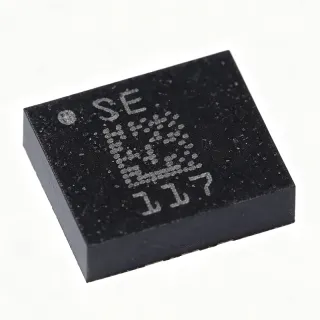
MMA6280QR2 - ±1.5g/2g/4g/6g Dual-Axis Accelerometer | NXP
Référence : MMA6280QR2 ⚠ Dernier achat| Qté | Prix unitaire | Total |
|---|---|---|
| 1 | $9.5 | $9,50 |
| 10 | $8.55 | $85,50 |
| 100 | $7.6 | $760,00 |
| 500 | $6.84 | $3 420,00 |
| 1 000 | $6.08 | $6 080,00 |
MMA6280QR2 Présentation
A MEMS accelerometer is a micro-electromechanical sensor that converts gravitational or inertial acceleration into a proportional analog voltage. The MMA6280QR2 belongs to the capacitive micromachined accelerometer family, which uses a suspended proof-mass whose deflection changes a set of sense-plate capacitances. This technology is the hypernym parent of automotive airbag sensors, tilt/inclination sensors, and motion-detection devices, occupying the broader hierarchy of motion sensor -> inertial sensor -> MEMS device -> semiconductor. The g-Select feature makes the device a 4-in-1 part, reducing BOM count for designs that span multiple acceleration ranges.
Key features include ±1.5g/2g/4g/6g selectable ranges, 350 Hz (X) / 150 Hz (Z) bandwidth, ratiometric analog output, on-chip temperature compensation, and a low 1-pole LPF. The 16-QFN (6x6) HQCCN package provides a small footprint and a thermal pad for stable operation across the -20C to +85C industrial range. Typical sensitivities are 800 mV/g (1.5g), 600 mV/g (2g), 300 mV/g (4g), and 200 mV/g (6g), with zero-g output near Vdd/2.
The architecture combines a MEMS proof-mass with a CMOS ASIC containing charge-pamp, demodulator, low-pass filter, and gain stages. The g-Select pins (g-SEL1, g-SEL2) are sampled at power-up, latching one of four pre-set gains into the analog chain. This eliminates external op-amps and simplifies the design for cost-sensitive, high-volume applications.
Typical applications include tilt/orientation sensing, vibration monitoring, free-fall detection, HDD shock detection, and motion-enabled user interfaces in appliances, gaming peripherals, and consumer electronics. The dual X/Z axis orientation is particularly well suited to vertical-tilt applications such as washing-machine imbalance detection and electronic level tools.
A key design consideration: because the g-Select inputs are latched at power-up only, designers needing to switch ranges dynamically must power-cycle the device or use a logic-level translator on the g-SEL pins and toggle Vdd. Decoupling capacitors (0.1 uF) must be placed within 5 mm of the supply pin.
This page synthesizes distributor pricing, pin-compatible NXP alternatives, and practical design notes not consolidated in the manufacturer datasheet, providing engineers a single reference for selection, sourcing, and layout.
Alternatives de remplacement direct pour MMA6280QR2 — même boîtier, compatible broche à broche. Les références à boîtier différent nécessitant une retouche du PCB sont exclues.
Outil de comparaison rapide — sélectionnez des références alternatives pour une comparaison côte à côte :
MMA8451Q
✅ Remplacement direct📋 Alternative de référence (hors catalogue)
MMA8452Q
✅ Remplacement direct📋 Alternative de référence (hors catalogue)
MMA8453Q
✅ Remplacement direct📋 Alternative de référence (hors catalogue)
MMA6280QT
✅ Remplacement direct📋 Alternative de référence (hors catalogue)
MMA6280QR2 Valeurs maximales et caractéristiques électriques
| Type de capteur | Accelerometer, Dual-Axis (X, Z) |
| Sensing Axis | X, Z |
| Acceleration Range | ±1.5g, ±2g, ±4g, ±6g (selectable via g-Select) |
| Sensitivity (1.5g mode) | 800 mV/g |
| Sensitivity (2g mode) | 600 mV/g |
| Sensitivity (4g mode) | 300 mV/g |
| Sensitivity (6g mode) | 200 mV/g |
| Bandwidth (X axis) | 350 Hz |
| Bandwidth (Z axis) | 150 Hz |
| Type de sortie | Analog, Ratiometric |
| Zero-g Output | Vdd/2 (typ) |
| Tension d'alimentation | 2.7 V to 3.6 V |
| Température de fonctionnement | -20 C to +85 C |
| Boîtier | 16-QFN (HQCCN, 6x6 mm) |
| Type de montage | Surface Mount |
| Filter | 1-pole Low-Pass (on-chip) |
| Statut RoHS | Compliant |
| Lead-Free | Yes |
Configuration des broches de MMA6280QR2
| Broche 1 | g-SEL1 — g-Select input 1 (latched at power-up) |
| Broche 2 | g-SEL2 — g-Select input 2 (latched at power-up) |
| Broche 3 | NC — Not connected (per datasheet) |
| Broche 4 | NC — Not connected (per datasheet) |
| Broche 5 | Vdd — Power supply (2.7 V to 3.6 V) |
| Broche 6 | GND — Ground |
| Broche 7 | NC — Not connected (per datasheet) |
| Broche 8 | NC — Not connected (per datasheet) |
| Broche 9 | XOUT — X-axis analog output |
| Broche 10 | NC — Not connected (per datasheet) |
| Broche 11 | NC — Not connected (per datasheet) |
| Broche 12 | ZOUT — Z-axis analog output |
| Broche 13 | NC — Not connected (per datasheet) |
| Broche 14 | NC — Not connected (per datasheet) |
| Broche 15 | GND — Ground |
| Broche 16 | GND — Ground (thermal pad internally bonded) |
Applications typiques
MMA6280QR2 convient pour 6 applications: Tilt and Inclination Sensing, Vibration Monitoring, Free-Fall and Drop Detection, HDD Shock Detection, White Goods Imbalance Detection, Gaming and Motion UI.
Tilt and Inclination Sensing
The MMA6280QR2's dual X/Z axis alignment and selectable ±1.5g/±2g ranges make it well suited to inclination measurement. The X-axis detects tilt to ±90 degrees when mounted vertically, while the Z-axis captures tilt about the perpendicular plane, enabling 2-axis electronic levels, solar-panel sun-tracking, and HVAC vent position feedback. Per the NXP datasheet, the 800 mV/g sensitivity in 1.5g mode yields about 1.6 V of signal swing at full tilt, giving 12-bit ADC systems roughly 1.3 mV/LSB resolution. The on-chip 1-pole LPF attenuates mechanical vibration above 350 Hz so that small DC tilt changes remain visible. Designers should place the device near the center of the platform to minimize centrifugal artifacts from rotating mounts.
Recommandé
Vibration Monitoring
With 350 Hz X-axis and 150 Hz Z-axis analog bandwidth, the MMA6280QR2 captures vibration signatures on rotating equipment such as pumps, fans, and small motors. The 4g and 6g selectable ranges extend the dynamic range to industrial vibration amplitudes, while the ratiometric output interfaces directly to a 3.3 V SAR ADC for FFT analysis. Per the NXP datasheet, the integrated 1-pole LPF suppresses aliasing above 350 Hz, allowing the host MCU to run longer FFT windows. The on-chip temperature compensation holds sensitivity stable across the -20 C to +85 C industrial range, important for outdoor enclosures. For predictive-maintenance firmware, sample at >=2 kS/s on the X axis to capture harmonics up to 1 kHz.
Recommandé
Free-Fall and Drop Detection
The MMA6280QR2's ±1.5g low-g mode detects near-zero acceleration events such as drop detection in laptops, hard-disk drives, and portable medical devices. When the device reads zero-g on both axes for more than 50 ms, the host MCU can trigger a head-park or write-protect sequence to prevent data loss. According to the NXP datasheet, the 1.5g range combined with the ratiometric output delivers a clean 0 to 1.5 V signal centered at Vdd/2, simplifying threshold detection with a comparator. Bandwidth (150 Hz Z, 350 Hz X) is sufficient to capture a 50 cm drop's acceleration transient. Designers should debounce the trigger in firmware to reject brief lift-off artifacts.
Recommandé
HDD Shock Detection
External HDDs and SSDs benefit from the MMA6280QR2's ±6g range for shock detection during operation. A measured shock above 6g indicates a drop or impact, prompting the drive controller to park the heads and protect the platters. Per the NXP datasheet, the 200 mV/g sensitivity at 6g provides a 2.4 V peak-peak signal swing, well above most MCU ADC noise floors. The 16-QFN (6x6) HQCCN package fits on the small PCB real estate available inside 2.5-inch enclosures. The ratiometric output eliminates the need for a precision reference voltage in low-cost designs. For high-shock environments, pair with a software high-pass filter to reject low-frequency vibration.
Recommandé
White Goods Imbalance Detection
Washing machines, dryers, and dishwashers use the MMA6280QR2 to detect drum imbalance before high-speed spin cycles. The Z-axis senses vertical drum motion, while the X-axis captures radial swing; the on-chip 1-pole LPF removes the high-frequency motor PWM noise. Per the NXP datasheet, the 0-6g range covers the worst-case imbalance transient without saturation. The 16-QFN (6x6) package withstands the +85 C ambient inside a sealed appliance. The ratiometric output interfaces to the appliance's main 3.3 V microcontroller without a level shifter. Designers should mount the device on the chassis, not the drum, to isolate it from direct motor vibration.
Recommandé
Gaming and Motion UI
Game controllers, remote controls, and pointer devices use the MMA6280QR2's dual-axis output to detect tilt gestures. The ±2g range is ideal for handheld tilt, while ±6g covers sudden flicks and shakes. Per the NXP datasheet, the 800 mV/g sensitivity in 1.5g mode provides strong signal swing for low-cost MCUs without external amplification. The on-chip temperature compensation maintains calibration across indoor operating conditions. The 16-QFN (6x6) package is small enough to fit inside AA-battery-powered enclosures. For gesture-recognition firmware, sample at 100 Hz with the 1-pole LPF providing 350 Hz anti-aliasing on the X axis.
Recommandé
Récapitulatif des produits recommandés
Données de référence d'ingénierie pour MMA6280QR2 — comparaison, recommandations de conception et informations de conformité.
Guide de sélection
Comparaison avec les alternatives
| Paramètre | Ce produit | MMA8451Q | MMA8452Q | MMA8453Q | MMA6280QT |
|---|---|---|---|---|---|
| Brand | NXP Semiconductors | NXP Semiconductors | NXP Semiconductors | NXP Semiconductors | NXP Semiconductors |
| Package | 16-QFN (6x6) | 16-QFN (6x6) - same | 16-QFN (6x6) - same | 16-QFN (6x6) - same | 16-QFN (6x6) - same |
| Output Type | Analog, ratiometric | Digital I2C (14-bit) | Digital I2C (12-bit) | Digital I2C (10-bit) | Analog, ratiometric |
| Acceleration Range | ±1.5g, ±2g, ±4g, ±6g | ±2g, ±4g, ±8g | ±2g, ±4g, ±8g | ±2g, ±4g, ±8g | ±1.5g, ±2g, ±4g, ±6g |
| Axis | X, Z | X, Y, Z | X, Y, Z | X, Y, Z | X, Z |
| Supply Voltage | 2.7 V to 3.6 V | 1.95 V to 3.6 V | 1.95 V to 3.6 V | 1.95 V to 3.6 V | 2.7 V to 3.6 V |
| Bandwidth (X) | 350 Hz | ODR up to 800 Hz | ODR up to 800 Hz | ODR up to 800 Hz | 350 Hz |
| Operating Temperature | -20 C to +85 C | -40 C to +85 C | -40 C to +85 C | -40 C to +85 C | -20 C to +85 C |
| Lifecycle Status | Last time buy | Active | Active | Active | Last time buy |
Principaux différenciateurs
- Selectable 4-in-1 range via g-Select pins (vs MMA8451Q)
- Analog ratiometric output (vs MMA8451Q)
- Cost-effective for high-volume legacy designs (vs MMA6280QT)
Notes de conception
Place a 0.1 uF decoupling capacitor within 5 mm of the Vdd pin and a 4.7 uF bulk capacitor near the supply trace. Per the NXP datasheet, the analog output is ratiometric with Vdd, so use a clean, low-noise regulator such as the NCP1117 or LP2985; switching regulators with >50 mV ripple will inject acceleration noise through the supply rail. Estimated: at Vdd=3.3 V the part draws a few mA, so total power dissipation is well under 50 mW.
Route the XOUT and ZOUT analog traces over a continuous ground plane to minimize crosstalk. The 16-QFN HQCCN package has a central thermal pad that must be soldered to a ground-pour pad of at least 25 mm^2 to provide mechanical stability and thermal relief. Avoid routing digital signals directly beneath the analog outputs. The g-SEL1 and g-SEL2 pins should be tied to Vdd or GND with 100 kohm pull resistors - do not leave them floating, as a floating pin selects an unspecified range.
The g-Select pins are sampled at power-up and latched; the device will not respond to a range change after the first 100 ms of operation. To switch ranges dynamically, briefly pull Vdd below 0.5 V to reset the latch. Also, the MMA6280QR2's ±1.5g low-g mode is sensitive to mechanical noise - mount the device on the chassis, not the moving part, to minimize vibration pickup. Do not apply >3.6 V to Vdd or reverse polarity, as the device lacks reverse-battery protection.
Informations de conformité
RoHS and lead-free compliant per the NXP product page; AEC-Q100 not qualified (industrial temperature grade only); halogen-free status not confirmed in the provided data.