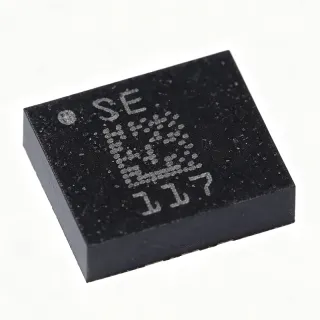
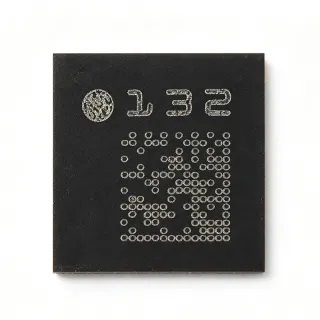
MMA7260QT - ±1.5/2/4/6g 3-Axis MEMS Accelerometer | NXP
Référence : MMA7260QT ✗ Fin de vie| Qté | Prix unitaire | Total |
|---|---|---|
| 1 | $5.95 | $5,95 |
| 10 | $5.2 | $52,00 |
| 100 | $4.45 | $445,00 |
| 500 | $3.8 | $1 900,00 |
| 1 000 | $3.25 | $3 250,00 |
MMA7260QT Présentation
An accelerometer is a MEMS (micro-electromechanical systems) sensor that measures proper acceleration along one or more axes. Capacitive micromachined accelerometers use a suspended proof structure whose capacitance changes with deflection; on-board ASIC converts this change to an analog or digital output proportional to g-force. The MMA7260QT belongs to the broader category of inertial sensors (accelerometer -> MEMS motion sensor -> inertial measurement unit -> semiconductor sensor), and is one of the early sub-1g-noise floor/low-g consumer accelerometers that made tilt-based UI and HDD free-fall detection practical in volume products.
Key features include four selectable sensitivities (800 mV/g at 1.5g, 600 mV/g at 2g, 300 mV/g at 4g, and 200 mV/g at 6g), an analog ratiometric output, 1-pole low-pass filter with selectable bandwidth, low 0.95 mA typical supply current, sleep mode under 3 µA, fast power-on response, and self-test capability. The g-Select inputs (g-SEL1, g-SEL2) allow dynamic switching between two preset ranges. The QFN-16 package is small (6 mm x 6 mm) and supports hand or reflow soldering.
The MMA7260QT employs a surface-micromachined capacitor structure with an ASIC that includes a charge amplifier, temperature-compensation network, low-pass filter, and g-Select decoding. The 1.5 g internal sensor noise floor is approximately 350 µg/√Hz. Self-test verifies mechanical and electrical integrity via electrostatic deflection of the proof mass. The device operates from a 2.2 V to 3.6 V analog supply and supports 3.3V or 5V digital logic when paired with a level shifter.
Typical applications include HDD free-fall protection, tilt and orientation sensing, motion-activated user interfaces, vibration analysis in industrial equipment, 3-axis gaming controllers, and robotics tilt feedback. Its selectable sensitivity makes it suitable both for high-resolution 1.5g tilt sensing and broader-range shock detection.
When designing with this part, use low-ESR decoupling on VDD, place the device away from vibration sources (speakers, fans) and keep the g-Select lines tied to known logic levels to avoid transient range changes. Pololu and other module vendors pair this IC with an on-board 3.3V regulator to ease 5V host integration. The part is reported as obsolete/EOL by multiple distributors as of 2026-10-15; new designs should consider the recommended drop-in successors MMA7331L/MMA7361L/MMA7455L/MMA8451Q/MMA8452Q/MMA8453Q where pin-compatibility allows.
This page synthesizes distributor stock and lifecycle data, parametric alternatives, and application context not aggregated in a single manufacturer document.
Alternatives de remplacement direct pour MMA7260QT — même boîtier, compatible broche à broche. Les références à boîtier différent nécessitant une retouche du PCB sont exclues.
Variantes de cette série
Modèles de la même série directement compatibles avec MMA7260QT (même facteur de forme et même empreinte) — différant par Output Type, Package, Sensor Type, RoHS Status, Acceleration Range.
Outil de comparaison rapide — sélectionnez des références alternatives pour une comparaison côte à côte :
MMA7260Q
✅ Remplacement direct✓ En stock
$4.75 / unité
Voir la fiche technique →MMA7261QT
✅ Remplacement direct📋 Alternative de référence (hors catalogue)
MMA7361L
✅ Remplacement direct📋 Alternative de référence (hors catalogue)
MMA7331L
✅ Remplacement direct📋 Alternative de référence (hors catalogue)
MMA7455L
✅ Remplacement direct📋 Alternative de référence (hors catalogue)
MMA7260QT Valeurs maximales et caractéristiques électriques
| Type de capteur | 3-axis capacitive micromachined accelerometer (MEMS) |
| Acceleration Range (selectable) | ±1.5g / ±2g / ±4g / ±6g (g-Select) |
| Sensitivity @ 1.5g | 800 mV/g (typical, at VDD = 3.3 V) |
| Sensitivity @ 2g | 600 mV/g (typical) |
| Sensitivity @ 4g | 300 mV/g (typical) |
| Sensitivity @ 6g | 200 mV/g (typical) |
| Type de sortie | Analog, ratiometric to VDD |
| Supply Voltage (VDD) | 2.2 V to 3.6 V |
| Supply Current (active, typical) | 0.95 mA |
| Sleep Mode Current | < 3 µA |
| Bandwidth | 1-pole low-pass filter, configurable via external capacitor |
| g-Select Inputs | 2 (g-SEL1, g-SEL2) |
| Self-Test | Yes (ST pin) |
| Zero-g Offset (initial) | ±1.0 g max (ratiometric) |
| Température de fonctionnement | -20 °C to +85 °C |
| Boîtier | QFN-16 (HQCCN), 6 mm x 6 mm |
| Type de montage | Surface Mount |
| Statut RoHS | RoHS Compliant (per DigiChip) |
| Lead Status | Contains Lead (per DigiChip listing) |
Configuration des broches de MMA7260QT
| Broche 1 | NC — Not connected (per datasheet) |
| Broche 2 | NC — Not connected (per datasheet) |
| Broche 3 | NC — Not connected (per datasheet) |
| Broche 4 | g-SEL1 — g-Select input 1 (range selection, see datasheet logic table) |
| Broche 5 | g-SEL2 — g-Select input 2 (range selection) |
| Broche 6 | EN — Enable (active high, sleep mode when low) |
| Broche 7 | VDD — Supply voltage 2.2 V to 3.6 V |
| Broche 8 | GND — Ground |
| Broche 9 | XOUT — X-axis analog output |
| Broche 10 | YOUT — Y-axis analog output |
| Broche 11 | ZOUT — Z-axis analog output |
| Broche 12 | NC — Not connected (per datasheet) |
| Broche 13 | NC — Not connected (per datasheet) |
| Broche 14 | ST — Self-test input (apply VLogic high to perform self-test) |
| Broche 15 | NC — Not connected (per datasheet) |
| Broche 16 | NC — Not connected (per datasheet) |
Applications typiques
MMA7260QT convient pour 6 applications: HDD Free-Fall Detection, Tilt and Orientation Sensing, Motion-Activated User Interface, Vibration Analysis in Industrial Equipment, Robotics Tilt Feedback, Portable Activity and Step Monitors.
HDD Free-Fall Detection
The MMA7260QT is purpose-built for HDD free-fall protection in notebook computers, where the head must park within milliseconds of detecting a drop. Its ±1.5g range provides high-resolution tilt and modest acceleration detection, and the analog ratiometric output interfaces directly to the disk controller's ADC. Pololu and other module vendors still recommend this part for legacy HDD designs and educational projects, though digital successors like MMA8451Q are preferred for new designs. Power-on settling is fast enough to detect the first g-event after system boot.
Recommandé
Tilt and Orientation Sensing
The ±1.5g range with 800 mV/g sensitivity makes the MMA7260QT ideal for tilt-based user interfaces and orientation detection in handheld devices, e-readers, and industrial displays. The ratiometric analog output connects to a microcontroller ADC, where the 0g reading identifies level and deviation-from-level translates directly to tilt angle. Place the IC away from speakers and fans to avoid mechanical noise coupling; for high-precision tilt (under ±0.1°), apply software temperature compensation in firmware.
Recommandé
Motion-Activated User Interface
Consumer devices (TV remotes, game controllers, smart pens) use the MMA7260QT to wake on motion and recognize gestures. Its fast power-on and selectable g-Select ranges allow designers to switch from a low-g sensitivity mode (tap detection) to a higher-g mode (shake or throw detection). The 0.95 mA active current is acceptable for short-burst operation, and the <3 µA sleep current supports long battery standby. Modern alternatives like MMA8452Q add FIFO and tap-detection interrupts that simplify firmware.
Recommandé
Vibration Analysis in Industrial Equipment
In industrial machinery and predictive-maintenance systems, the MMA7260QT captures vibration signatures in the 0-1.5g band, allowing FFT analysis to detect bearing wear or imbalance. The 1-pole low-pass filter can be tuned with an external capacitor to limit aliasing, and the analog output drives an op-amp/ADC chain. For high-frequency vibration (>500 Hz), the MMA7361L or ADXL335 family offers better bandwidth. Expect a noise floor around 350 µg/√Hz on the MMA7260QT at sensitivity bands - adequate for slow-rotating machinery.
Recommandé
Robotics Tilt Feedback
Balance robots, two-wheeled vehicles, and self-balancing platforms use the MMA7260QT for real-time tilt feedback in control loops. The ±1.5g range offers fine angular resolution near horizontal, and the 1 kHz analog bandwidth is plenty for slow-control servo loops. Mount the sensor near the center of gravity with the Z axis vertical to minimize coupling. Hobbyists typically pair it with an MPU or microcontroller and run a complementary filter in firmware to combine accelerometer and gyroscope data.
Recommandé
Portable Activity and Step Monitors
Wearable fitness devices and medical step counters use the MMA7260QT for activity classification and step counting. Its selectable ±2g/±4g modes accommodate walking and running, while the ratiometric output is read by a low-power microcontroller ADC. Sleep mode under 3 µA keeps battery drain minimal between samples. Newer digital accelerometers (MMA8451Q, MMA8452Q) include built-in step-detection interrupts that offload this from the host MCU, but the MMA7260QT remains a workable choice when the host has spare cycles.
Recommandé
Récapitulatif des produits recommandés
Données de référence d'ingénierie pour MMA7260QT — comparaison, recommandations de conception et informations de conformité.
Guide de sélection
Comparaison avec les alternatives
| Paramètre | Ce produit | MMA7260Q | MMA7261QT | MMA7361L | MMA7331L | MMA7455L |
|---|---|---|---|---|---|---|
| Brand | NXP Semiconductors | NXP Semiconductors | NXP Semiconductors | NXP Semiconductors | NXP Semiconductors | NXP Semiconductors |
| Package | QFN-16 (6x6 mm) | QFN-16 (6x6 mm) - same | QFN-16 (6x6 mm) - same | LGA-14 - DIFFERENT (PCB rework) | LGA-14 - DIFFERENT (PCB rework) | LGA-14 - DIFFERENT (PCB rework) |
| Acceleration Range | ±1.5/2/4/6g (4 ranges) | ±1.5/2/4/6g (4 ranges) - same | ±1.5/4/6g (3 ranges) | ±1.5/3/6g (3 ranges) | ±2/4/6g (3 ranges) | ±2/4/8g (3 ranges, digital) |
| Output Type | Analog ratiometric | Analog ratiometric | Analog ratiometric | Analog ratiometric | Analog ratiometric | Digital I2C/SPI - DIFFERENT |
| Supply Current (active) | 0.95 mA | 0.95 mA | 0.95 mA | 0.4 mA (lower) | 0.4 mA (lower) | 0.4 mA |
| Operating Temperature | -20 °C to +85 °C | -20 °C to +85 °C | -20 °C to +85 °C | -20 °C to +85 °C | -20 °C to +85 °C | -40 °C to +85 °C |
| Lifecycle Status (as of 2026-10-15) | Obsolete | Obsolete | Obsolete | Obsolete | Obsolete | Obsolete |
| RoHS Compliant | Yes (per DigiChip) | Yes | Yes | Yes | Yes | Yes |
Principaux différenciateurs
- Four selectable g-ranges via g-Select pins (vs MMA7361L)
- QFN-16 package with 6x6 mm footprint (vs MMA7361L (LGA-14))
- Analog ratiometric output (no firmware stack required) (vs MMA7455L)
Notes de conception
Decouple VDD with a 0.1 µF ceramic capacitor placed as close as possible to the VDD pin (pin 7) and the GND pin (pin 8). Add a bulk 1 µF to 10 µF capacitor on the same rail if the supply is shared with switching regulators. The MMA7260QT draws 0.95 mA active and <3 µA in sleep; assert the EN pin low during sleep to extend battery life in portable applications.
Tie g-SEL1 and g-SEL2 to fixed logic levels (GND or VDD) using 100 kΩ resistors - never leave them floating, as a floating logic input can cause the device to select an unintended range. Verify with a multimeter that the logic levels settle within 100 µs of power-on to avoid range transients during startup.
Mount the MMA7260QT on a rigid section of the PCB with the Z-axis (out of package) oriented vertically for typical tilt applications. Avoid mounting near speakers, fans, or PCB flexure points that can introduce vibration coupling. Use a continuous ground plane under and around the device to shield against EMI, and keep the analog X/Y/Z traces short and away from switching nodes (DC-DC, clock lines).
The MMA7260QT outputs are ratiometric to VDD - the zero-g output sits at VDD/2 (1.65 V at 3.3 V). Use a ratiometric ADC reference (also tied to VDD) so temperature and supply variations cancel out. Add a unity-gain buffer (e.g., MCP6002) on each output if the ADC input is more than 10 cm away, to prevent capacitive loading from distorting the analog signal.
Informations de conformité
RoHS compliance per DigiChip datasheet listing; lead status reported as 'Contains Lead' by DigiChip. Reach and conflict-mineral declarations not in provided data. AEC-Q100 not applicable - this is a consumer/industrial sensor, not automotive-grade.