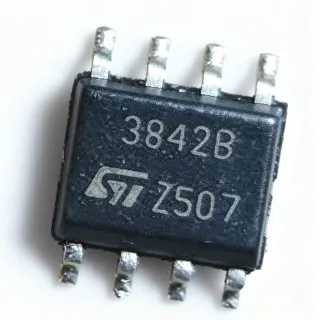
MPQ4420GJ-Z - 2A 36V Sync Buck Converter | Monolithic Power Systems
Référence : MPQ4420GJ-Z ✓ Actif| Qté | Prix unitaire | Total |
|---|---|---|
| 1 | $2.5 | $2,50 |
| 10 | $2.25 | $22,50 |
| 100 | $1.95 | $195,00 |
| 500 | $1.7 | $850,00 |
| 1 000 | $1.48 | $1 480,00 |
MPQ4420GJ-Z Présentation
A synchronous step-down (buck) converter is a type of DC-DC switching regulator that uses internal high-side and low-side MOSFETs instead of an external Schottky diode to step a higher input voltage down to a lower output voltage. Within the power management hierarchy, the buck converter sits under switching regulators, which themselves belong to the broader family of voltage regulators and power management ICs. Synchronous rectification improves efficiency, especially at light-to-medium loads.
Key features include integrated power MOSFETs that minimize external component count, synchronous mode operation for higher efficiency across the full load range, current-mode control for fast transient response and easy loop stabilization, and a compact 8-pin TSOT23 footprint. Full protection features include over-current protection and thermal shutdown.
Technically, the MPQ4420 uses current-mode architecture, which simplifies compensation and gives excellent load and line regulation over the wide 4 V to 30 V input supply range. The internal MOSFETs and 410 kHz switching frequency allow small inductors and capacitors, enabling very compact power solutions. The adjustable feedback pin supports output voltages from 0.8 V up to 27 V.
Typical applications include automotive infotainment and auxiliary power rails, industrial 24 V bus point-of-load conversion, and distributed power systems in networking and telecom equipment where a wide input range and 2 A output are required.
Design consideration: at 410 kHz, keep the SW node loop area small and place the input ceramic capacitor close to the IN and GND pins; verify thermal performance when running 2 A at high input-to-output differential.
This page synthesizes distributor pricing context, drop-in alternatives, cross-reference data, and practical design notes not found in the manufacturer datasheet.
Alternatives de remplacement direct pour MPQ4420GJ-Z — même boîtier, compatible broche à broche. Les références à boîtier différent nécessitant une retouche du PCB sont exclues.
Outil de comparaison rapide — sélectionnez des références alternatives pour une comparaison côte à côte :
MP4420GJ-P
✅ Remplacement direct📋 Alternative de référence (hors catalogue)
MPQ4420GJ-AEC1-Z
✅ Remplacement direct📋 Alternative de référence (hors catalogue)
MPQ4420HGJ-AEC1-Z
✅ Remplacement direct📋 Alternative de référence (hors catalogue)
MPQ4420GJ-AEC1-P
✅ Remplacement direct📋 Alternative de référence (hors catalogue)
MP4420GJ-Z
✅ Remplacement direct ⚠️ Spécifications non vérifiées📋 Alternative de référence (hors catalogue)
MPQ4420GJ-Z Valeurs maximales et caractéristiques électriques
| Topologie | Synchronous Step-Down (Buck) Converter |
| Plage de tension d'entrée | 4 V to 30 V |
| Plage de tension de sortie | 0.8 V to 27 V (adjustable) |
| Courant de sortie maximal | 2 A continuous |
| Fréquence de commutation | 410 kHz |
| Control Mode | Current-mode |
| Built-in Power MOSFETs | Yes (synchronous rectified) |
| Nombre de sorties | 1 |
| Output Polarity | Positive |
| Protection Features | Over-current protection, thermal shutdown |
| Boîtier | 8-pin TSOT23 (SOT-23-8 Thin) |
| Type de montage | Surface Mount |
| Qualification | AEC-Q100 Qualified |
Guide de configuration des broches du MPQ4420GJ-Z 8-pin tsot23 (sot-23-8 thin)
Configuration des broches du MPQ4420GJ-Z (boîtier 8-pin tsot23 (sot-23-8 thin)). Ce composant de puissance comporte des bornes de grille, de drain et de source. Pour les boîtiers non polarisés, consultez la fiche technique du fabricant pour l'orientation exacte de la broche 1 et les détails de l'empreinte. Les applications courantes incluent la conception d'alimentations, la commande de moteurs et la commutation de charges.

Aucune donnée de brochage détaillée disponible pour MPQ4420GJ-Z.
Consultez la fiche technique pour la configuration complète des broches.
Applications typiques
MPQ4420GJ-Z convient pour 6 applications: Automotive Infotainment and Cluster Power, Industrial 24V Bus Point-of-Load Conversion, Networking and Telecom Distributed Power, Battery-Powered and Portable Instrumentation, LED Lighting and Driver Auxiliary Rails, Surveillance and Security Camera Power.
Automotive Infotainment and Cluster Power
The MPQ4420GJ-Z is AEC-Q100 qualified, making it a natural fit for powering infotainment SoCs, display panels, and cluster modules from the automotive 12 V battery rail. Its 4 V to 30 V input range tolerates normal battery excursions, cold-crank sags, and most transients within ratings, while the 2 A continuous output comfortably supplies MCU, memory, and display backlight sub-rails. The synchronous architecture with integrated MOSFETs reaches high efficiency at typical 12 V-to-5 V or 12 V-to-3.3 V conversion points, reducing heat in sealed dash enclosures. The 410 kHz fixed switching frequency keeps EMI within manageable bounds for CISPR-oriented automotive EMC test plans, and current-mode control gives fast transient response when displays and processors change load abruptly. Place it between the battery feed connector and downstream LDOs or point-of-load converters.
Recommandé
Industrial 24V Bus Point-of-Load Conversion
Industrial control cabinets and factory automation systems commonly distribute power at 24 V, and the MPQ4420GJ-Z steps this rail down efficiently to 5 V, 3.3 V, or lower for PLC I/O modules, sensor interfaces, and communication boards. The 4 V to 30 V input range covers 24 V nominal rails with margin for regulation tolerance, and the adjustable 0.8 V to 27 V output supports virtually any logic voltage. The integrated synchronous MOSFETs eliminate the external catch diode, shrinking the power section on dense I/O cards, while the 8-pin TSOT23 package fits tight board areas. Over-current protection and thermal shutdown provide robust fault behavior for unattended industrial equipment. Current-mode control eases loop compensation so a single design scales across multiple output voltage variants of the same module family.
Recommandé
Networking and Telecom Distributed Power
Routers, switches, and telecom line cards distribute an intermediate 12 V or 24 V bus to many point-of-load converters; the MPQ4420GJ-Z serves these slots with 2 A of clean, regulated output and high conversion efficiency. Its synchronous rectification reduces conduction losses compared with diode-based bucks, which matters in always-on telecom equipment where every watt affects thermal budget and energy cost. The 410 kHz switching frequency permits compact inductors and low-profile output capacitors, fitting the constrained heights of switch and SFP-module layouts. Current-mode control delivers fast transient response to the bursty load profiles of PHYs and packet processors, and the wide 4 V to 30 V input accepts intermediate-bus variations. The 8-pin TSOT23 keeps per-rail cost and board area low when the converter is replicated dozens of times per card.
Recommandé
Battery-Powered and Portable Instrumentation
Portable test instruments, handheld meters, and battery-backed data loggers benefit from the MPQ4420GJ-Z's wide 4 V input floor, which lets designs run down to a nearly depleted 2S lithium or multi-cell alkaline stack while still regulating. The synchronous buck topology maintains high efficiency across the load range, directly extending battery runtime relative to asynchronous alternatives. Its 2 A capacity covers motorized elements, displays, and wireless radios in the same instrument, and the adjustable output down to 0.8 V supports modern low-voltage processors and ADCs. Integrated over-current and thermal protection guard against faults in the field, important for battery-powered products. The compact TSOT23-8 footprint and minimal external component count keep handheld PCB areas small, preserving space for batteries and connectors in the enclosure.
Recommandé
LED Lighting and Driver Auxiliary Rails
In LED drivers and lighting controllers, the MPQ4420GJ-Z efficiently generates the low-voltage logic and gate-drive rails that power the controller MCU, dimming interface, and communication transceiver from a 12 V or 24 V lighting bus. The 0.8 V to 27 V adjustable output covers virtually all logic-level auxiliary needs, and the wide 4 V to 30 V input absorbs wiring-harness voltage drop and supply variation typical of lighting installations. Synchronous operation minimizes wasted power in enclosures with limited airflow, and the 410 kHz fixed frequency keeps switching noise out of sensitive dimming circuits when the SW loop is kept tight on the layout. Thermal shutdown and over-current protection give safe behavior under shorted or overloaded auxiliary outputs. The small TSOT23 package fits directly on LED module PCBs.
Recommandé
Surveillance and Security Camera Power
IP cameras and security systems often run from 12 V or 24 V PoE-derived or adapter-fed supplies, and the MPQ4420GJ-Z steps these down to the 3.3 V and 1.8 V rails consumed by image sensors, IR illuminator controllers, and network PHYs. Its 2 A output supports cameras with pan-tilt motors or heaters, and current-mode control maintains regulation through the current surges when IR LEDs and motors switch on at night. The wide input range tolerates long cable runs with significant voltage drop, and high synchronous efficiency limits internal heating inside sealed outdoor camera housings. Over-current protection isolates shorted accessory loads from the main rail. The 8-pin TSOT23 footprint suits the compact mainboards typical of dome and bullet camera form factors, leaving room for the image sensor optics path.
Recommandé
Récapitulatif des produits recommandés
Données de référence d'ingénierie pour MPQ4420GJ-Z — comparaison, recommandations de conception et informations de conformité.
Guide de sélection
Comparaison avec les alternatives
| Paramètre | Ce produit | MP4420GJ-P | MPQ4420GJ-AEC1-Z | MPQ4420HGJ-AEC1-Z | MP4420GJ-Z |
|---|---|---|---|---|---|
| Package | TSOT23-8 | TSOT23-8 - same | TSOT23-8 - same | TSOT23-8 - same | TSOT23-8 - same |
| Brand | Monolithic Power Systems | Monolithic Power Systems | Monolithic Power Systems | Monolithic Power Systems | Monolithic Power Systems |
| Input Voltage Range | 4 V to 30 V | 4 V to 30 V | 4 V to 30 V | 4 V to 30 V | 4 V to 30 V |
| Output Voltage Range | 0.8 V to 27 V | 0.8 V to 27 V | 0.8 V to 27 V | 0.8 V to 27 V | 0.8 V to 27 V |
| Output Current | 2 A | 2 A | 2 A | 2 A | 2 A |
| Switching Frequency | 410 kHz | 410 kHz | 410 kHz | 410 kHz | 410 kHz |
| Automotive Qualification | Yes (AEC-Q100, MPQ prefix) | No (commercial grade) | Yes (AEC-Q100, AEC1 flow) | Yes (AEC-Q100, H-grade AEC1) | No (commercial grade) |
| Protection Features | OCP, thermal shutdown | OCP, thermal shutdown | OCP, thermal shutdown | OCP, thermal shutdown | OCP, thermal shutdown |
Principaux différenciateurs
- AEC-Q100 automotive qualification in a compact 8-pin package (vs MP4420GJ-P)
- Fully integrated synchronous MOSFETs - no external catch diode (vs MPQ4423GQ-Z)
- Trade-off: 30 V continuous input below the 36 V family rating (vs MPQ4420HGJ-AEC1-Z)
Notes de conception
Keep the high-frequency switching loop as small as possible: place the input ceramic capacitor (typically 10 uF) directly across the IN and GND pins of the MPQ4420GJ-Z, and route the SW node trace to the inductor with minimal area to contain radiated EMI at 410 kHz. The MPS datasheet layout guidelines recommend a solid ground plane under the converter and short, wide traces for the power path. Because the MOSFETs are integrated, the IC die itself dissipates switching and conduction losses - use the ground pins and any thermal relief in the TSOT23-8 footprint to conduct heat into the PCB copper.
Select a power inductor whose saturation current exceeds the 2 A peak current limit of the MPQ4420 with margin - if the inductor saturates, current-mode control loses slope information and ripple/overshoot increases. Use the inductor selection table in the MPS datasheet for your exact VIN/VOUT combination. Estimated guideline: for 24 V to 5 V at 2 A and 410 kHz, inductors in the 10-22 uH range with 3 A+ saturation ratings are typical starting points (verify against the datasheet equations). Pair with a low-ESR ceramic output capacitor (typically 22 uF) to control output ripple and transient undershoot.
Do not exceed the 30 V continuous input range; although the family is marketed as a 36 V part, design transient suppression (TVS or input clamp) so automotive load-dump and inductive spikes stay within the datasheet absolute maximum. Another common mistake is treating the MPQ4423GQ-Z as a substitute - the GQ package differs from the GJ TSOT23-8 and is not pin-compatible. Finally, the MP prefix denotes commercial grade; if your end product requires AEC-Q100 documentation, order only MPQ-prefixed variants such as the MPQ4420GJ-AEC1-Z and retain the qualification certificates from MPS.
Informations de conformité
AEC-Q100 qualification confirmed by MPS datasheet title and part nomenclature. RoHS/REACH/lead-free/halogen statuses were not stated in the verified data for this specific ordering suffix; a PartGenie listing for the AEC1 variant notes RoHS Y, but per-part confirmation from MPS should be obtained before compliance-critical use.