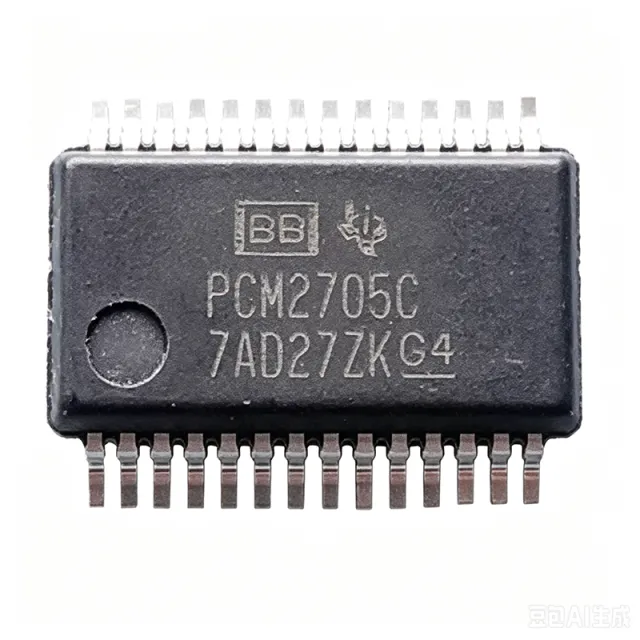
PCM2705C - 98dB SNR Stereo USB DAC with S/PDIF | Texas Instruments
Référence : PCM2705C ✓ Actif| Qté | Prix unitaire | Total |
|---|---|---|
| 1 | $6.5455 | $6,55 |
| 10 | $4.7273 | $47,27 |
| 100 | $4.1818 | $418,18 |
| 500 | $4 | $2 000,00 |
| 1 000 | $3.8182 | $3 818,20 |
PCM2705C Présentation
A USB audio DAC is a digital-to-analog converter that receives digital audio data from a USB host and converts it to analog audio signals. It integrates the USB interface, protocol controller, and DAC core into a single chip, simplifying system design. The PCM2705C sits in the hierarchy of audio converters, specifically as a USB audio interface IC, which is a subset of audio data converters within the broader category of mixed-signal ICs.
Key features include a 98dB SNR stereo DAC, S/PDIF output, and support for both bus-powered and self-powered modes. The device also features partially programmable USB descriptors, allowing customization of vendor ID and product ID via an external SPI host. The integrated USB transceiver eliminates the need for external PHY, reducing BOM cost and board space.
Technically, the PCM2705C uses adaptive isochronous transfer for audio data, ensuring synchronized playback. The S/PDIF output supports digital audio transmission to external decoders or amplifiers. The device operates from a 3.3V supply and includes an internal PLL for clock generation, minimizing external components. The SSOP-28 package provides a compact footprint suitable for portable and space-constrained designs.
Typical applications include USB sound cards, docking stations, gaming headsets, and portable audio interfaces. The device's plug-and-play capability makes it ideal for consumer audio products where driver installation is undesirable. Its low power consumption and small size also suit battery-powered devices.
When designing with the PCM2705C, ensure proper decoupling of the 3.3V supply and careful layout of the USB differential pair to maintain signal integrity. The SPI interface for descriptor programming should be configured during initial setup, and the PSEL and HOST pins must be set correctly for the desired operating mode.
Alternatives de remplacement direct pour PCM2705C — même boîtier, compatible broche à broche. Les références à boîtier différent nécessitant une retouche du PCB sont exclues.
Outil de comparaison rapide — sélectionnez des références alternatives pour une comparaison côte à côte :
PCM2705
📋 Alternative de référence (hors catalogue)
PCM2704C
📋 Alternative de référence (hors catalogue)
PCM2706C
📋 Alternative de référence (hors catalogue)
PCM2707C
📋 Alternative de référence (hors catalogue)
PCM2902
📋 Alternative de référence (hors catalogue)
PCM2705C Valeurs maximales et caractéristiques électriques
| SNR (DAC) | 98 dB |
| USB Interface | USB 2.0 Full-Speed |
| USB Compliance | USB 2.0, USB Audio Class |
| Type de sortie | Line-out, S/PDIF |
| Power Supply | 3.3 V |
| Power Mode | Bus-powered or Self-powered |
| Control Interface | SPI (for descriptor programming) |
| Boîtier | SSOP-28 |
| Température de fonctionnement | -25C to +85C |
| Type de montage | Surface Mount |
| Statut RoHS | Compliant |
| Number of Channels | 2 (Stereo) |
Configuration des broches de PCM2705C
| Broche 1 | VCC — Power supply (3.3V) |
| Broche 2 | GND — Ground |
| Broche 3 | D+ — USB data plus |
| Broche 4 | D- — USB data minus |
| Broche 5 | VOUTL — Left analog output |
| Broche 6 | VOUTR — Right analog output |
| Broche 7 | S/PDIF — S/PDIF digital output |
| Broche 8 | SPI_CLK — SPI clock |
| Broche 9 | SPI_CS — SPI chip select |
| Broche 10 | SPI_DIN — SPI data in |
| Broche 11 | SPI_DOUT — SPI data out |
| Broche 12 | PSEL — Power select |
| Broche 13 | HOST — Host select |
| Broche 14 | XTAL_IN — Crystal oscillator input |
| Broche 15 | XTAL_OUT — Crystal oscillator output |
Applications typiques
PCM2705C convient pour 6 applications: USB Sound Cards, Docking Stations, Gaming Headsets, Portable Audio Interfaces, Consumer Audio Electronics, Automotive Infotainment.
USB Sound Cards
The PCM2705C is ideal for USB sound cards, providing plug-and-play audio without dedicated drivers. Its 98dB SNR ensures high-fidelity audio output, while the integrated USB controller simplifies design. The S/PDIF output allows digital audio transmission to external DACs or amplifiers, making it versatile for various audio systems.
Recommandé
Docking Stations
In docking stations, the PCM2705C provides USB audio connectivity for laptops and tablets. Its bus-powered mode eliminates the need for external power, simplifying design. The S/PDIF output can route digital audio to home theater systems, while the stereo DAC drives analog outputs for speakers or headphones. The compact SSOP-28 package fits space-constrained docking designs.
Recommandé
Gaming Headsets
The PCM2705C is well-suited for gaming headsets, offering high SNR for immersive audio. Its USB interface ensures compatibility with PCs and consoles without driver installation. The device supports both bus-powered and self-powered modes, allowing flexible power design. The S/PDIF output can be used for virtual surround sound processing, enhancing the gaming experience.
Recommandé
Portable Audio Interfaces
For portable audio interfaces, the PCM2705C offers low power consumption and a small footprint. Its USB bus-powered mode allows operation directly from a laptop or mobile device. The 98dB SNR ensures high-quality audio recording and playback. The SPI interface enables descriptor customization for branding, making it suitable for OEM products.
Recommandé
Consumer Audio Electronics
The PCM2705C is used in consumer audio devices like sound bars and AV receivers. Its S/PDIF output allows digital audio routing to external decoders, while the stereo DAC provides analog outputs. The device's USB compliance ensures easy connectivity with TVs and media players. The compact package and low power consumption make it ideal for consumer electronics.
Recommandé
Automotive Infotainment
In automotive infotainment systems, the PCM2705C provides USB audio playback from smartphones and media players. Its robust USB interface ensures reliable operation in automotive environments. The S/PDIF output can interface with external audio processors, while the stereo DAC drives analog audio signals. The device's small package is suitable for head units and rear-seat entertainment systems.
Recommandé
Récapitulatif des produits recommandés
Données de référence d'ingénierie pour PCM2705C — comparaison, recommandations de conception et informations de conformité.
Guide de sélection
Comparaison avec les alternatives
| Paramètre | Ce produit | PCM2705 | PCM2704C | PCM2706C | PCM2707C |
|---|---|---|---|---|---|
| Package | SSOP-28 | SSOP-28 | SSOP-28 | SSOP-28 | SSOP-28 |
| Brand | Texas Instruments | Texas Instruments | Texas Instruments | Texas Instruments | Texas Instruments |
| SNR | 98 dB | 98 dB | 98 dB | 98 dB | 98 dB |
| USB Interface | USB 2.0 Full-Speed | USB 2.0 Full-Speed | USB 2.0 Full-Speed | USB 2.0 Full-Speed | USB 2.0 Full-Speed |
| Descriptor Programming | SPI | Fixed | External ROM | External ROM | SPI |
| S/PDIF Output | Yes | Yes | Yes | Yes | Yes |
| Power Mode | Bus/Self-powered | Bus/Self-powered | Bus/Self-powered | Bus/Self-powered | Bus/Self-powered |
| Operating Temperature | -25C to +85C | -25C to +85C | -25C to +85C | -25C to +85C | -25C to +85C |
Principaux différenciateurs
- SPI-based descriptor programming (vs PCM2704C)
- 98dB SNR (vs PCM2902)
- Integrated S/PDIF output (vs PCM2705)
Notes de conception
The PCM2705C operates from a 3.3V supply. Use a low-noise LDO, such as the TPS7A4700, to power the analog section and minimize noise. Decouple the VCC pin with a 10uF ceramic capacitor and a 0.1uF capacitor close to the pin. Ensure the ground plane is solid to reduce noise coupling.
For USB signal integrity, route the D+ and D- traces as a differential pair with controlled impedance (90 ohms). Keep the traces short and avoid vias. Place the crystal oscillator close to the XTAL_IN and XTAL_OUT pins, and ensure proper grounding around it to prevent EMI.
When using the SPI interface for descriptor programming, ensure the PSEL and HOST pins are configured correctly. Incorrect settings may cause the device to enter an unintended mode. Also, verify that the external ROM or SPI host is properly initialized before the device enumerates on the USB bus.
Informations de conformité
RoHS compliant per TI product page. Other compliance data not specified in provided sources.







