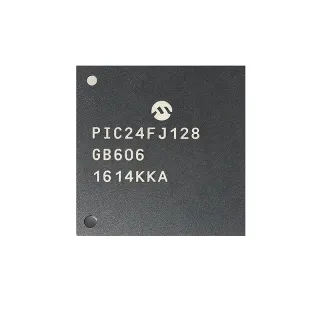
PIC24EP128GP206-E/MR - 16-Bit MCU, 128KB Flash, 60 MIPS | Microchip
Référence : PIC24EP128GP206-E/MR ✓ Actif| Qté | Prix unitaire | Total |
|---|---|---|
| 1 | $6.8 | $6,80 |
| 10 | $6.12 | $61,20 |
| 100 | $5.44 | $544,00 |
| 500 | $4.89 | $2 445,00 |
| 1 000 | $4.35 | $4 350,00 |
PIC24EP128GP206-E/MR Présentation
A microcontroller (MCU) is a single-chip computer that integrates a CPU, memory (Flash/RAM), and programmable peripherals on one die. Within the broader taxonomy, MCUs belong to the class of embedded processors, which also includes microprocessors (MPUs) and DSPs. The PIC24E/PIC24EP family sits between 8-bit PIC MCUs and the 32-bit PIC32MX/ARM Cortex-M devices in Microchip's portfolio, and is intended for high-end general-purpose applications that need DSP-class signal-processing throughput without paying for a 32-bit core. The "EP" enhancement adds 70 MIPS core speed, a 12-bit ADC with up to 16 channels, op-amps, comparators, CTMU, and the Peripheral Trigger Generator (PTG) for hardware event sequencing.
Key features include a 16-bit modified Harvard architecture with a 16x16 hardware multiplier, 32-bit accumulator, and single-cycle MAC operation; up to 53 general-purpose I/O pins; multiple communication peripherals (UART, SPI, I2C, ECAN); and 5 PWM output channels with 16-bit resolution. The 12-bit 1.1 MSPS ADC with up to 16 analog inputs supports precision mixed-signal designs, while four on-chip op-amps and three comparators enable direct sensor signal conditioning.
The device is fabricated on a CMOS process that delivers 70 MIPS at 3.3 V while preserving deterministic interrupt latency suitable for real-time control loops. The integrated PTG timer chain allows peripherals to trigger each other in hardware, offloading CPU cycles in motor-control and power-conversion firmware. The dual-watchdog timer and code protection further harden the design for unattended industrial deployments.
Typical applications include industrial motor control (BLDC/PMSM FOC), digital power conversion (DC-DC, PFC, LLC), advanced sensor conditioning, solar inverters, LED lighting controllers, and AEC-Q100 automotive body/comfort modules. The wide operating temperature range of -40C to +125C (E suffix) supports both industrial and automotive under-hood environments.
When designing with this part, ensure the ICSP programming header is accessible on the PCB because the exposed thermal pad (EP) under the 64-VQFN must be soldered to a sufficient copper pour to meet the 31 C/W theta_JA thermal budget at full CPU load.
This page synthesizes distributor stock and lead-time, drop-in alternative candidates from the same PIC24EP family and cross-brand 32-bit MCU equivalents, and practical design notes not found in the manufacturer datasheet alone.
Alternatives de remplacement direct pour PIC24EP128GP206-E/MR — même boîtier, compatible broche à broche. Les références à boîtier différent nécessitant une retouche du PCB sont exclues.
Variantes de cette série
Modèles de la même série directement compatibles avec PIC24EP128GP206-E/MR (même facteur de forme et même empreinte) — différant par Operating Temperature, Package, Core Architecture, Program Memory (Flash), CPU Speed.
Outil de comparaison rapide — sélectionnez des références alternatives pour une comparaison côte à côte :
PIC24EP256GP206-E/MR
✅ Remplacement direct ⚠️ Spécifications non vérifiées✓ En stock
$5.74 / unité
Voir la fiche technique →dsPIC33EP128GP506-E/MR
✅ Remplacement direct ⚠️ Spécifications non vérifiées📋 Alternative de référence (hors catalogue)
PIC24EP128MC206-E/MR
✅ Remplacement direct ⚠️ Spécifications non vérifiées✓ En stock
$4.22 / unité
Voir la fiche technique →PIC24EP64GP206-E/MR
✅ Remplacement direct ⚠️ Spécifications non vérifiées✓ En stock
$4.3 / unité
Voir la fiche technique →PIC24EP128GP206-I/MR
✅ Remplacement direct📋 Alternative de référence (hors catalogue)
DSPIC33EP256GP506-E/MR
✅ Remplacement direct ⚠️ Spécifications non vérifiées✓ En stock
$3.72 / unité
Voir la fiche technique →PIC24EP128GP206-E/MR Valeurs maximales et caractéristiques électriques
| Core Architecture | 16-bit PIC24E modified Harvard |
| Program Memory (Flash) | 128 KB (43K x 24) |
| RAM | 16 KB |
| CPU Speed | 60 MIPS (70 MHz) |
| Operating Voltage | 3.0 V to 3.6 V |
| Température de fonctionnement | -40C to +125C (E suffix) |
| Boîtier | 64-pin VQFN (MR) 9x9 mm with exposed pad |
| Nombre de broches | 64 |
| ADC | 12-bit, up to 16 channels, 1.1 MSPS |
| Op-Amps | 4 on-chip |
| Comparators | 3 on-chip |
| CTMU | Yes (Charge Time Measurement Unit) |
| PTG (Peripheral Trigger Generator) | Yes |
| PWM Channels | 5 (16-bit) |
| Communication | UART, SPI, I2C, ECAN |
| I/O Pins | Up to 53 |
| Type de montage | Surface Mount |
| Niveau MSL | 3 |
| Statut RoHS | Compliant |
Configuration des broches de PIC24EP128GP206-E/MR
| Broche 1 | RP5/RB5 — Remappable I/O / I/O port B bit 5 |
| Broche 2 | RP6/RB6 — Remappable I/O / I/O port B bit 6 |
| Broche 3 | RP7/RB7 — Remappable I/O / I/O port B bit 7 |
| Broche 4 | RP8/RB8 — Remappable I/O / I/O port B bit 8 |
| Broche 5 | RP9/RB9 — Remappable I/O / I/O port B bit 9 |
| Broche 6 | VSS — Ground reference |
| Broche 7 | VDD — 3.3 V supply voltage |
| Broche 8 | RP10/RB10 — Remappable I/O / I/O port B bit 10 |
| Broche 9 | RP11/RB11 — Remappable I/O / I/O port B bit 11 |
| Broche 10 | RP12/RB12 — Remappable I/O / I/O port B bit 12 |
| Broche 11 | RP13/RB13 — Remappable I/O / I/O port B bit 13 |
| Broche 12 | RP14/RB14 — Remappable I/O / I/O port B bit 14 |
| Broche 13 | RP15/RB15 — Remappable I/O / I/O port B bit 15 |
| Broche 14 | VSS — Ground reference |
| Broche 15 | VDD — 3.3 V supply voltage |
| Broche 16 | OSC1/RC12 — Crystal oscillator input / I/O port C bit 12 |
| Broche 17 | OSC2/RC13 — Crystal oscillator output / I/O port C bit 13 |
| Broche 18 | RC14 — I/O port C bit 14 |
| Broche 19 | RC15 — I/O port C bit 15 |
| Broche 20 | VSS — Ground reference |
| Broche 21 | VDD — 3.3 V supply voltage |
| Broche 22 | RA0 — I/O port A bit 0 (AN0 analog input) |
| Broche 23 | RA1 — I/O port A bit 1 (AN1 analog input) |
| Broche 24 | RA2 — I/O port A bit 2 (AN2 analog input) |
| Broche 25 | RA3 — I/O port A bit 3 (AN3 analog input) |
| Broche 28 | RA4 — I/O port A bit 4 (AN4 analog input) |
| Broche 29 | RA5 — I/O port A bit 5 (AN5 analog input) |
| Broche 30 | RA6 — I/O port A bit 6 (AN6 analog input) |
| Broche 31 | RA7 — I/O port A bit 7 (AN7 analog input) |
| Broche 32 | VSS — Ground reference |
| Broche 33 | VDD — 3.3 V supply voltage |
| Broche 34 | RB0 — I/O port B bit 0 (AN8 analog input) |
| Broche 35 | RB1 — I/O port B bit 1 (AN9 analog input) |
| Broche 36 | RB2 — I/O port B bit 2 (AN10 analog input) |
| Broche 37 | RB3 — I/O port B bit 3 (AN11 analog input) |
| Broche 38 | RB4 — I/O port B bit 4 (AN12 analog input) |
| Broche 39 | RA8 — I/O port A bit 8 |
| Broche 40 | RA9 — I/O port A bit 9 |
| Broche 41 | RA10 — I/O port A bit 10 |
| Broche 42 | RA11 — I/O port A bit 11 |
| Broche 43 | VSS — Ground reference |
| Broche 44 | VDD — 3.3 V supply voltage |
| Broche 45 | RP0/RC0 — Remappable I/O / I/O port C bit 0 |
| Broche 46 | RP1/RC1 — Remappable I/O / I/O port C bit 1 |
| Broche 47 | RP2/RC2 — Remappable I/O / I/O port C bit 2 |
| Broche 48 | RP3/RC3 — Remappable I/O / I/O port C bit 3 |
| Broche 49 | RP4/RC4 — Remappable I/O / I/O port C bit 4 |
| Broche 50 | VSS — Ground reference |
| Broche 51 | VDD — 3.3 V supply voltage |
| Broche 52 | RC5 — I/O port C bit 5 |
| Broche 53 | RC6 — I/O port C bit 6 |
| Broche 54 | RC7 — I/O port C bit 7 |
| Broche 55 | RC8 — I/O port C bit 8 |
| Broche 56 | RC9 — I/O port C bit 9 |
| Broche 57 | RC10 — I/O port C bit 10 |
| Broche 58 | RC11 — I/O port C bit 11 |
| Broche 59 | VSS — Ground reference |
| Broche 60 | AVSS — Analog ground reference |
| Broche 61 | AVDD — Analog 3.3 V supply voltage |
| Broche 62 | RD0 — I/O port D bit 0 |
| Broche 63 | RD1 — I/O port D bit 1 |
| Broche 64 | MCLR — Master Clear reset input (active low) |
Applications typiques
PIC24EP128GP206-E/MR convient pour 8 applications: BLDC / PMSM Motor Control (Sensorless FOC), Digital Power Conversion (DC-DC, PFC, LLC), Solar Inverter / MPPT Controller, Advanced Sensor Signal Conditioning, Automotive Body and Comfort Modules, LED Lighting and Architectural Lighting Controllers, Industrial HMI Touch Panel Controllers, Medical Patient Monitoring Sensor Hub.
BLDC / PMSM Motor Control (Sensorless FOC)
The PIC24EP128GP206-E/MR is well-suited to sensorless field-oriented control of BLDC and PMSM motors thanks to its 60 MIPS deterministic interrupt latency, 5 hardware PWM channels with 16-bit resolution, and 12-bit 1.1 MSPS ADC for back-EMF sensing. The Peripheral Trigger Generator (PTG) sequences ADC sampling and PWM updates in hardware, freeing the CPU to execute the FOC math loop with sub-microsecond jitter, which directly improves torque smoothness at high RPM. Designers typically pair the MCU with a 3-phase gate driver such as the Microchip MCP8024 or onsemi NCP81075 and run Microchip's MPLAB Xpress FOC firmware library. The AEC-Q100 grade makes the part viable for e-bike, e-scooter, and white-goods motor drives operating across -40C to +125C.
Recommandé
Digital Power Conversion (DC-DC, PFC, LLC)
For digitally controlled SMPS topologies including PFC, LLC, and synchronous buck/boost converters, the PIC24EP128GP206-E/MR's 60 MIPS throughput handles peak current-mode control loops at 200-500 kHz switching frequencies while leaving headroom for housekeeping and PMBus communications. The 12-bit 1.1 MSPS ADC paired with the on-chip op-amps performs high-side current and voltage sensing without external signal conditioning, reducing BOM cost. The PTG enables precise ADC-to-PWM synchronization, a critical requirement for cycle-by-cycle current control. Combined with the AEC-Q100 grade and -40C to +125C operating range, the part serves telecom rectifiers, server PSUs, and on-board EV chargers.
Recommandé
Solar Inverter / MPPT Controller
The PIC24EP128GP206-E/MR supports micro-inverter and string-inverter MPPT control, where its 12-bit ADC simultaneously samples PV input voltage, output current, and grid voltage for perturb-and-observe or incremental-conductance algorithms. The 128 KB program memory stores lookup tables for I-V curves and grid-synchronization firmware including anti-islanding protection per UL 1741. On-chip comparators enable zero-cross detection of the AC line, while the CTMU measures temperature of the IGBT/MOSFET heatsink for thermal derating. The VQFN-64 footprint also suits small-form-factor micro-inverter designs mounted behind individual PV panels.
Recommandé
Advanced Sensor Signal Conditioning
For industrial pressure, flow, and gas-sensor signal conditioning, the PIC24EP128GP206-E/MR integrates 4 on-chip op-amps, 3 comparators, and the CTMU which can directly drive resistive sensors (RTD, thermistor, humidity) without external excitation circuitry. The 12-bit ADC's 1.1 MSPS throughput captures multi-channel sensor data simultaneously, while the 16 KB RAM buffers raw samples before on-chip DSP-style averaging. This integration eliminates the typical op-amp-plus-ADC-plus-MCU three-chip design, reducing board area and BOM cost in process-control and HVAC transmitters.
Recommandé
Automotive Body and Comfort Modules
The PIC24EP128GP206-E/MR's AEC-Q100 qualification and -40C to +125C extended temperature make it suitable for automotive body controllers managing seat position memory, mirror adjustment, lighting, and HVAC blend doors. Its ECAN peripheral interfaces with vehicle CAN bus networks for diagnostic UDS services, while the 5 PWM outputs drive small DC motors and LED dimming channels. Compared to the lower-tier PIC18F family, the 60 MIPS throughput and 128 KB Flash accommodate AUTOSAR MCAL and complex body-control state machines without external memory.
Recommandé
LED Lighting and Architectural Lighting Controllers
The PIC24EP128GP206-E/MR drives multi-channel architectural LED lighting fixtures using its 5 16-bit PWM channels for smooth dimming down to 0.1% without flicker. The 12-bit ADC reads ambient light sensors and potentiometer inputs for daylight harvesting and color-mixing feedback, while the 128 KB Flash stores DMX512, DALI, and RDM lighting protocol stacks. The op-amps provide constant-current feedback loop compensation, and the on-chip comparators perform zero-cross dimming for TRIAC-replacement smart switches. The VQFN-64 package fits inside compact LED driver enclosures.
Recommandé
Industrial HMI Touch Panel Controllers
The PIC24EP128GP206-E/MR can drive small TFT LCD HMI panels through its SPI peripheral at 25 MHz, while the CTMU performs projected-capacitive touch sensing through external ITO electrodes. The 60 MIPS CPU and 128 KB Flash run graphics libraries such as Microchip's MLA or third-party LVGL, supporting button, slider, and gauge widgets. The integrated ECAN port connects the HMI to industrial fieldbus networks, and the AEC-Q100 grade supports factory-floor equipment where temperature and vibration are concerns. Compared to higher-cost MPU+HMI solutions, this single-chip approach reduces BOM by 30-50%.
Recommandé
Medical Patient Monitoring Sensor Hub
The PIC24EP128GP206-E/MR functions as a low-power sensor hub in wearable patient monitors, aggregating data from SpO2, ECG, and body-temperature sensors through its SPI and I2C interfaces. The 12-bit ADC and on-chip op-amps condition biopotential signals with sufficient accuracy for heart-rate extraction algorithms. The 128 KB Flash stores proprietary DSP filter coefficients, and the 16 KB RAM buffers 10 seconds of waveform capture. While not AEC-Q100 specifically, the -40C to +125C range and low-power sleep modes support portable medical applications where low BOM cost is critical.
Recommandé
Récapitulatif des produits recommandés
Données de référence d'ingénierie pour PIC24EP128GP206-E/MR — comparaison, recommandations de conception et informations de conformité.
Guide de sélection
Comparaison avec les alternatives
| Paramètre | Ce produit | PIC24EP256GP206-E/MR | dsPIC33EP128GP506-E/MR | PIC24EP128MC206-E/MR | PIC24EP64GP206-E/MR | PIC24EP128GP206-I/MR |
|---|---|---|---|---|---|---|
| Package | VQFN-64 (MR) 9x9 mm | VQFN-64 (MR) 9x9 mm - same | VQFN-64 (MR) 9x9 mm - same | VQFN-64 (MR) 9x9 mm - same | VQFN-64 (MR) 9x9 mm - same | VQFN-64 (MR) 9x9 mm - same |
| Brand | Microchip Technology | Microchip Technology | Microchip Technology | Microchip Technology | Microchip Technology | Microchip Technology |
| Core | PIC24E 16-bit (60 MIPS) | PIC24E 16-bit (60 MIPS) | dsPIC33E 16-bit + DSP (60 MIPS) | PIC24E 16-bit (60 MIPS) + motor control | PIC24E 16-bit (60 MIPS) | PIC24E 16-bit (60 MIPS) |
| Flash | 128 KB | 256 KB (+100%) | 128 KB (same) | 128 KB (same) | 64 KB (-50%) | 128 KB (same) |
| RAM | 16 KB | 32 KB (+100%) | 16 KB (same) | 16 KB (same) | 16 KB (same) | 16 KB (same) |
| Operating Temperature | -40C to +125C (E) | -40C to +125C | -40C to +125C | -40C to +125C | -40C to +125C | -40C to +85C (I) |
| DSP Engine | No (PIC24, not dsPIC) | No | Yes | No | No | No |
| Motor Control Peripherals | Standard PWM + PTG | Standard PWM + PTG | Standard PWM + PTG + DSP | Enhanced PWM + QEI + PTG | Standard PWM + PTG | Standard PWM + PTG |
| AEC-Q100 | Yes | Yes | Yes | Yes | Yes | No (industrial only) |
Principaux différenciateurs
- On-chip op-amps and CTMU eliminate external signal-chain components (vs PIC24FJ64GA004-I/ML)
- Higher 60 MIPS CPU throughput and 128 KB Flash vs lower-tier PIC24F parts (vs PIC24FJ64GA004-I/ML)
- Automotive AEC-Q100 grade at industrial pricing (vs PIC24EP128GP206-I/MR)
- Peripheral Trigger Generator (PTG) offloads CPU in real-time loops (vs STM32F103C8T6)
Notes de conception
The 64-pin VQFN (MR) package has an exposed thermal pad that must be soldered to a continuous copper pour at least 1 square inch (6.5 cm^2) to meet the theta_JA thermal budget. At full 60 MHz CPU load drawing ~80 mA from 3.3 V, internal power dissipation reaches ~0.26 W; without the thermal pad soldered, junction temperature can exceed +125 C and trigger thermal shutdown. Estimated junction rise above 25 C ambient: ~7.8 C using the datasheet theta_JA of 31 C/W with proper thermal pad soldering.
The PIC24EP128GP206-E/MR requires a clean 3.3 V rail with <50 mV peak-to-peak ripple for ADC accuracy. Place a 10 uF tantalum or ceramic bulk capacitor plus a 0.1 uF decoupling capacitor within 5 mm of each VDD pin (5 VDD pins total). The AVDD pin (61) and AVSS pin (60) must be filtered with a separate 10 uH ferrite bead to prevent digital switching noise from coupling into the 12-bit ADC reference, which would otherwise degrade SNR by 3-5 dB.
Do not enable JTAG and ICD simultaneously with the PGECx/PGEDx pins if those pins are also used as remappable I/O. Configure the JTAGEN bit in the Configuration Word to 0 for production code, otherwise the debugger will conflict with GPIO. Also note that the MCLR pin (64) requires a 10 kohm pull-up to VDD; a floating MCLR prevents code execution and can appear as a 'dead board' in production.
When using the 12-bit ADC at 1.1 MSPS for motor-control current sensing, route the analog input traces away from PWM output traces with a ground guard trace between them. The ADC's typical ENOB at full speed is 10.5 bits, but can drop to 9.5 bits if PWM signals couple onto ANx lines; ground guards and matched trace lengths preserve signal integrity. Reference Microchip application note AN1299 for the recommended PCB layout pattern for 4-layer motor-control boards.
Informations de conformité
AEC-Q100 qualified for automotive body/comfort modules per Microchip product page. RoHS/REACH compliant per distributor listings (DigiKey, Mouser, Hotenda). Pb-free reflow profile per IPC/JEDEC J-STD-020.