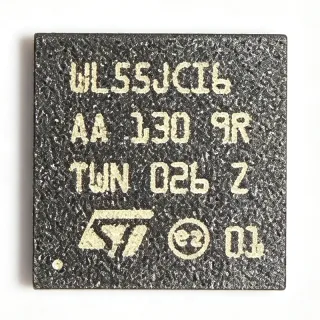
RS9116W-DB00-CC1-B2A - Dual-Band Wi-Fi + BT5 Module | Silicon Labs
Référence : RS9116W-DB00-CC1-B2A ✓ Actif| Qté | Prix unitaire | Total |
|---|---|---|
| 1 | $19.5 | $19,50 |
| 10 | $17.8 | $178,00 |
| 100 | $16.2 | $1 620,00 |
| 500 | $14.9 | $7 450,00 |
| 1 000 | $13.6 | $13 600,00 |
RS9116W-DB00-CC1-B2A Présentation
A Wi-Fi module is a self-contained wireless subsystem that integrates the radio transceiver, RF front end, baseband, and protocol stacks on a certified PCB module, sitting within the broader hierarchy of RF transceivers, wireless connectivity ICs, and embedded networking components. Certified modules such as the RS9116W family dramatically shorten regulatory approval cycles because module-level certifications (FCC, IC, ETSI/CE) can be leveraged by the end product.
Key features of the RS9116W-DB00-CC1-B2A include dual-band operation covering 2412 MHz to 2484 MHz and 4900 MHz to 5975 MHz, 802.11n high-throughput modes, and Bluetooth 5 dual-mode (BR/EDR and LE) concurrency. The module offers high throughput with power-optimized performance and extended range, making it suitable for battery-sensitive IoT designs.
Technically, the RS9116W operates as an NCP: the host MCU sends commands over UART, SPI, or SDIO while the module runs the TCP/IP and security stacks, freeing host flash and RAM. Alternatively, the networking stack can be bypassed for raw-packet operation when the host runs its own stack.
Typical applications include industrial gateways, smart meters, connected home hubs, and asset-tracking devices that need robust dual-band Wi-Fi alongside Bluetooth LE provisioning or beaconing.
Design consideration: because this variant does not include an antenna, the RF layout requires a well-controlled 50-ohm feed to an external antenna connector or PCB antenna; follow the Silicon Labs reference design for matching network placement.
This page synthesizes distributor pricing, drop-in same-family alternatives, and practical design notes not found in the manufacturer datasheet.
Alternatives de remplacement direct pour RS9116W-DB00-CC1-B2A — même boîtier, compatible broche à broche. Les références à boîtier différent nécessitant une retouche du PCB sont exclues.
Variantes de cette série
Modèles de la même série directement compatibles avec RS9116W-DB00-CC1-B2A (même facteur de forme et même empreinte) — différant par Bluetooth Version.
Outil de comparaison rapide — sélectionnez des références alternatives pour une comparaison côte à côte :
RS9116W-DB00-CC1-B2B
✅ Remplacement direct📋 Alternative de référence (hors catalogue)
RS9116W-DB00-CC0-B2A
✅ Remplacement direct📋 Alternative de référence (hors catalogue)
RS9116W-DB00-CC1-B2A Spécifications
| RF Protocol | 802.11 a/b/g/n, Bluetooth 5 dual-mode |
| Frequency Band | 2.4 GHz and 5 GHz (dual band) |
| Operating Frequencies | 2412 MHz to 2484 MHz / 4900 MHz to 5975 MHz |
| Wi-Fi Standard | 802.11 a/b/g/n |
| Bluetooth Version | Bluetooth 5 (dual-mode BR/EDR + LE) |
| Host Interfaces | UART, SPI, SDIO |
| Antenna | Not included (external antenna required) |
| Boîtier | 155-pin LGA, surface mount |
| Type de montage | Surface Mount |
| Packaging | Tray |
| Type | Transceiver Module (Network Co-Processor) |
| Certifications | FCC, IC, ETSI/CE |
Guide de configuration des broches du RS9116W-DB00-CC1-B2A 155-pin lga, surface mount
Configuration des broches du RS9116W-DB00-CC1-B2A (boîtier 155-pin lga, surface mount). La numérotation des broches, les fonctions et les schémas de connexion sont définis dans la fiche technique du fabricant. Consultez-la pour l'empreinte exacte et les directives de soudage.

Aucune donnée de brochage détaillée disponible pour RS9116W-DB00-CC1-B2A.
Consultez la fiche technique pour la configuration complète des broches.
Applications typiques
RS9116W-DB00-CC1-B2A convient pour 6 applications: Industrial IoT Gateways, Smart Metering and Utilities, Smart Home Hubs and Controllers, Asset Tracking and Telematics, Medical and Health Monitoring Devices, Security Cameras and Surveillance.
Industrial IoT Gateways
The RS9116W-DB00-CC1-B2A fits industrial gateways where 2.4 GHz spectrum is congested by machinery and legacy Wi-Fi. Its dual-band 802.11 a/b/g/n operation lets the gateway use the cleaner 5 GHz band (4900-5975 MHz) for backhaul while Bluetooth 5 LE handles local provisioning from a phone. As a Network Co-Processor running full TCP/IP and security stacks over UART, SPI, or SDIO, it lets designers use a low-cost MCU instead of a Linux-class processor, cutting BOM cost and power. Silicon Labs' FCC, IC, and ETSI/CE module certifications also shorten the end product's regulatory approval, a significant factor in industrial release schedules.
Recommandé
Smart Metering and Utilities
Smart meters benefit from the RS9116W-DB00-CC1-B2A's power-optimized performance and extended range, both highlighted by Silicon Labs for this module. Metering deployments often sit in basements or metal cabinets where 2.4 GHz propagation is poor; the 5 GHz band's wider channels and 802.11n throughput compensate with faster, more reliable bursts that let the radio return to sleep sooner, directly extending battery life. The dual-mode Bluetooth 5 radio enables field commissioning via smartphone without opening the enclosure. With the networking stack offloaded to the module via SDIO or UART, the metering SoC retains its resources for metrology and encryption tasks.
Recommandé
Smart Home Hubs and Controllers
Home hubs need both radios: Wi-Fi to the router and Bluetooth 5 LE for device onboarding, beaconing, and phone app connectivity. The RS9116W-DB00-CC1-B2A integrates both in one FCC/IC/ETSI-certified package, so hub makers avoid a second radio module, a second antenna, and duplicate certification costs. Dual-band Wi-Fi matters in homes saturated with 2.4 GHz devices (cameras, bulbs, speakers); connecting the hub at 5 GHz keeps cloud latency low. The module's SDIO host interface supports higher-throughput hub applications, while the bypassable network stack lets hubs running their own Linux stack use the radio as a raw MAC/PHY.
Recommandé
Asset Tracking and Telematics
Asset trackers deployed in warehouses and vehicles use the RS9116W-DB00-CC1-B2A to report location and telemetry over facility Wi-Fi while Bluetooth 5 LE tags nearby infrastructure for indoor positioning. The module's extended-range, power-optimized RF profile suits battery-powered trackers that transmit in short bursts. Silicon Labs' docs confirm the host link options (UART, SPI, SDIO) that map cleanly onto low-power MCU tracker designs. Because the module is pre-certified (FCC, IC, ETSI/CE), tracker vendors avoid per-SKU radio recertification when shipping globally - a major cost advantage in high-volume, low-margin tracking hardware.
Recommandé
Medical and Health Monitoring Devices
Connected health devices such as patient monitors and portable diagnostic instruments use the RS9116W-DB00-CC1-B2A to stream vitals over hospital Wi-Fi networks, which increasingly operate at 5 GHz to escape crowded 2.4 GHz bands. The module's NCP architecture keeps patient-data encryption and networking on the module while the medical-grade host MCU focuses on signal acquisition and safety logic via UART or SPI. Dual-mode Bluetooth 5 supports wearable pairing and bedside configuration. Certified module-level FCC/IC/ETSI approvals simplify compliance for devices that already face lengthy medical regulatory cycles, saving weeks in overall time-to-market.
Recommandé
Security Cameras and Surveillance
Wireless security cameras require sustained video uplink throughput, making the RS9116W-DB00-CC1-B2A's 802.11n high-throughput modes and 5 GHz band (4900-5975 MHz) a strong fit: the 5 GHz band offers wider channels and less interference in camera-dense installations. Silicon Labs describes this module as offering high throughput with power-optimized performance - valuable for battery or PoE-bud cameras. The SDIO host interface provides the bandwidth camera SoCs need, and the bypassable network stack allows camera firmware to manage streams directly. Bluetooth 5 LE enables setup via smartphone app without wired Ethernet.
Recommandé
Récapitulatif des produits recommandés
Données de référence d'ingénierie pour RS9116W-DB00-CC1-B2A — comparaison, recommandations de conception et informations de conformité.
Guide de sélection
Comparaison avec les alternatives
| Paramètre | Ce produit | RS9116W-DB00-CC1-B2B | RS9116W-DB00-CC0-B2A |
|---|---|---|---|
| Package | 155-pin LGA, surface mount | 155-pin LGA - same | 155-pin LGA - same |
| Brand | Silicon Labs | Silicon Labs | Silicon Labs |
| Wi-Fi Standard | 802.11 a/b/g/n | 802.11 a/b/g/n | 802.11 b/g/n |
| Bluetooth | Bluetooth 5 dual-mode | Bluetooth 5.0 | Bluetooth 5 dual-mode |
| Host Interfaces | UART, SPI, SDIO | UART, SPI, SDIO | UART, SPI, SDIO |
Principaux différenciateurs
- True dual-band 5 GHz coverage (vs RS9116W-DB00-CC0-B2A)
- Fresher product revision (vs RS9116W-DB00-CC1-B2B)
- Single certified package for two radios (vs Qualcomm QCA9377 (functional equivalent))
Notes de conception
This variant ships with antenna not included, so the RF feed is fully the designer's responsibility. Route a controlled 50-ohm microstrip from the module RF pad to the external antenna connector (U.FL or SMA), with a ground keep-out directly under the trace and a pi-matching network (series 0 ohm plus two shunt pads) reserved even if the datasheet matching is used unmodified. Follow the Silicon Labs RS9116 reference design land pattern for the 155 LGA pads; module certification is only transferable to the end product when the antenna and layout match the reference conditions.
Dual-band 802.11n transmit bursts draw high peak currents from the module supply. Place a bulk capacitor (at least 10 uF ceramic) close to the module supply pins plus 0.1 uF decoupling at each power pad, and ensure the upstream regulator can handle peak transmit current without drooping - supply sag during TX bursts manifests as Wi-Fi disconnects or degraded sensitivity. Verify the exact peak current figures in the RS9116 CC1 datasheet (login required on silabs.com) before finalizing the regulator selection and decoupling budget.
When using the SDIO host interface for high-throughput 802.11n traffic, keep SDIO traces short (under 50 mm), match clock to data within the controller spec, and route away from the RF feed to avoid desense. For SPI/UART designs the constraints are looser, but ground the host interface return path properly. Silicon Labs documentation at docs.silabs.com/rs9116 confirms all three host interfaces (UART, SPI, SDIO) run the full command set; choose SDIO only if your throughput budget requires it.
Informations de conformité
Module is FCC, IC, and ETSI/CE certified per Silicon Labs product page. RoHS/REACH status not stated in provided data - verify on Silicon Labs product page.