SC1113 - Raspberry Pi 5 16GB SBC, 2.4GHz Cortex-A76 | Raspberry Pi | Edge AI
Référence : SC1113 ✓ Actif| Qté | Prix unitaire | Total |
|---|---|---|
| Contactez-nous pour un tarif sur volume | ||
SC1113 Présentation
A single-board computer (SBC) is a complete computer system fabricated on a single printed circuit board, integrating the processor, memory, power management, storage interface, and I/O connectors on one board. SBCs sit within the broader category of embedded computers and are widely used where a full PC is unnecessary but general-purpose computing, networking, and expandable I/O are still required.
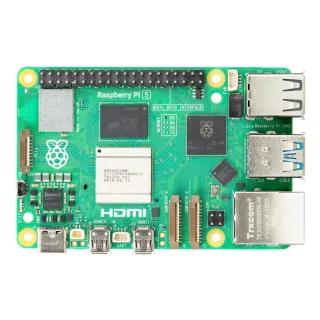
Key features of the SC1113 include the largest memory option in the Raspberry Pi 5 family (16GB LPDDR4X, shared as system and GPU memory), dual 4Kp60-capable HDMI outputs, USB 3.0 and USB 2.0 ports, a PCI Express interface for NVMe storage, dual-band Wi-Fi and Bluetooth, Gigabit Ethernet, and the 40-pin GPIO header that supports HAT expansion boards. The updated power management IC integrates a real-time clock and charging circuitry, and heat dissipation was improved over the Raspberry Pi 4 generation.
On the technical side, the VideoCore VII GPU supports OpenGL ES 3.1 and Vulkan 1.2, enabling modern graphics stacks and compute workloads. The faster BCM2712, camera/display interfaces (MIPI), and USB improvements over the predecessor make the Raspberry Pi 5 the most capable board in the Raspberry Pi lineup. The PCIe 2.0 x1 lane allows high-speed NVMe SSDs for storage-heavy applications, while the 40-pin header retains compatibility with the broad HAT ecosystem.
Typical applications for the 16GB variant include edge AI inference where large models benefit from higher RAM, desktop computing with many open applications, lightweight virtualization or container hosting, media servers, and industrial gateways aggregating multiple data streams.
A practical design consideration: use the recommended 5V/5A USB-C power supply; under sustained multi-core load the board draws significant power, and undervoltage from weak supplies is the most common cause of instability and SD card filesystem corruption.
This page adds value beyond the datasheet by cross-referencing SC1113 against other Raspberry Pi 5 memory variants (SC1111 8GB, SC1112 4GB), detailing the 40-pin GPIO terminal map, and giving selection guidance for choosing between RAM tiers based on workload and budget.
Alternatives de remplacement direct pour SC1113 — même boîtier, compatible broche à broche. Les références à boîtier différent nécessitant une retouche du PCB sont exclues.
Variantes de cette série
Modèles de la même série directement compatibles avec SC1113 (même facteur de forme et même empreinte) — différant par Processor, Form Factor, GPIO, Memory, OS Support.
Outil de comparaison rapide — sélectionnez des références alternatives pour une comparaison côte à côte :
SC1111
✅ Remplacement direct✓ En stock
$68.56 / unité
Voir la fiche technique →SC1112
✅ Remplacement direct✓ En stock
Contactez-nous pour le prix
Voir la fiche technique →ORANGEPI5-16G
⚡ Même boîtier ⚠️ Spécifications non vérifiées📋 Alternative de référence (hors catalogue)
Raspberry Pi 4 Model B 8GB
⚡ Même boîtier ⚠️ Spécifications non vérifiées📋 Alternative de référence (hors catalogue)
SC1113 Spécifications (publiées par le fabricant)
| Processor | Broadcom BCM2712, 4x Arm Cortex-A76, 2.4 GHz |
| GPU | VideoCore VII (OpenGL ES 3.1, Vulkan 1.2) |
| Memory | 16GB LPDDR4X |
| Storage | microSD; NVMe SSD via PCIe interface |
| Wi-Fi | Dual-band 802.11ac |
| Bluetooth | Bluetooth 5.0 / BLE |
| Ethernet | Gigabit Ethernet |
| Video Output | 2x HDMI, up to 4Kp60 |
| Camera/Display Interface | MIPI camera and display interfaces (improved over Raspberry Pi 4) |
| GPIO | 40-pin GPIO header |
| Expansion | PCI Express interface (x1) |
| Power Management IC | Integrated PMIC with real-time clock and charging circuitry |
| OS Support | Raspberry Pi OS (64-bit recommended); Linux distributions |
| Thermal | Improved heat dissipation vs Raspberry Pi 4 |
Configuration des broches de SC1113
| Broche 1 | 3.3V — 3.3V power rail (from onboard regulator) |
| Broche 2 | 5V — 5V power rail (direct from USB-C supply via PMIC) |
| Broche 3 | GPIO2 (I2C1 SDA) — I2C1 data line |
| Broche 4 | 5V — 5V power rail |
| Broche 5 | GPIO3 (I2C1 SCL) — I2C1 clock line |
| Broche 6 | GND — Ground |
| Broche 7 | GPIO4 (GPCLK0) — General-purpose clock output |
| Broche 8 | GPIO14 (UART TXD) — UART transmit |
| Broche 9 | GND — Ground |
| Broche 10 | GPIO15 (UART RXD) — UART receive |
| Broche 19 | GPIO10 (SPI0 MOSI) — SPI0 master-out slave-in |
| Broche 21 | GPIO9 (SPI0 MISO) — SPI0 master-in slave-out |
Applications typiques
SC1113 convient pour 6 applications: Edge AI Inference, Industrial IoT Gateway, Desktop Computing / Thin Client, Media Server / Streaming, Robotics and Automation Prototyping, Network Appliances / Home Lab Server.
Edge AI Inference
The 16GB LPDDR4X memory and 2.4GHz 4-core Arm Cortex-A76 CPU allow the SC1113 to run larger neural network models fully on-device than lower-RAM Pi 5 variants, keeping vision and audio inference local without cloud round-trips. The VideoCore VII GPU (OpenGL ES 3.1, Vulkan 1.2) can offload certain workloads, and PCIe-connected NVMe storage handles model assets and logging. Typical deployments include smart-camera nodes, anomaly detection on production lines, and voice assistants.
Recommandé
Industrial IoT Gateway
With Gigabit Ethernet, dual-band Wi-Fi, Bluetooth 5.0, and a 40-pin GPIO header, the SC1113 aggregates Modbus/RS-485, CAN, and sensor data in factory environments, then forwards processed telemetry over wired or wireless links. The 16GB RAM accommodates local buffering, MQTT brokers, and containerized protocol converters, while the real-time clock in the PMIC keeps timestamps accurate during power loss. The improved heat dissipation of Pi 5 helps in sealed enclosures when paired with passive cooling.
Recommandé
Desktop Computing / Thin Client
Dual HDMI outputs at up to 4Kp60, USB 3.0 peripherals, and 16GB of RAM make the SC1113 a capable desktop replacement for office, education, and browser-heavy workloads where many tabs and applications stay open simultaneously. Compared with the 4GB SC1112, the doubled-to-quadrupled memory headroom materially reduces swap pressure under multitasking, delivering a smoother desktop experience at the same power envelope.
Recommandé
Media Server / Streaming
The VideoCore VII GPU with 4Kp60 dual-HDMI output, hardware video decode, and Gigabit Ethernet make the SC1113 well suited to media center and streaming applications. The PCIe interface supports NVMe SSDs for large local libraries, and 16GB RAM allows transcoding pipelines and caching without memory exhaustion. Kodi, Plex, and Jellyfin class software all run on the Raspberry Pi 5 platform under Raspberry Pi OS.
Recommandé
Robotics and Automation Prototyping
The 40-pin GPIO header exposes I2C, SPI, UART, and PWM for motor drivers, encoders, and sensor arrays, while the 16GB CPU memory supports ROS 2 middleware, sensor fusion, and camera processing in one board. The BCM2712's higher clock rate versus Raspberry Pi 4 improves control-loop headroom, and the improved camera interface benefits vision-guided robots. The PMIC's real-time clock aids deterministic logging during field trials.
Recommandé
Network Appliances / Home Lab Server
Gigabit Ethernet, NVMe-via-PCIe storage, and 16GB RAM let the SC1113 run lightweight virtualization, Docker Compose stacks, Pi-hole/DNS, VPN endpoints, and small NAS duties. The memory tier is the key differentiator here: multiple simultaneous services that would exhaust the 4GB SC1112 run comfortably, and NVMe SSDs survive the constant small writes that degrade SD cards.
Recommandé
Récapitulatif des produits recommandés
Données de référence d'ingénierie pour SC1113 — comparaison, recommandations de conception et informations de conformité.
Guide de sélection
Comparaison avec les alternatives
| Paramètre | Ce produit | SC1112 | SC1111 | ORANGEPI5-16G |
|---|---|---|---|---|
| Package / Form Factor | Raspberry Pi 5 (85.6 x 56.5mm, 40-pin header) | Identical Raspberry Pi 5 form factor | Identical Raspberry Pi 5 form factor | 85 x 56mm, different connector layout |
| Brand | Raspberry Pi | Raspberry Pi | Raspberry Pi | Orange Pi |
| RAM | 16GB | 8GB | 4GB | 16GB |
| CPU | Broadcom BCM2712, 4x Cortex-A76 @ 2.4GHz | BCM2712, 4x Cortex-A76 @ 2.4GHz | BCM2712, 4x Cortex-A76 @ 2.4GHz | Rockchip RK3588S octa-core |
| GPU | VideoCore VII (OpenGL ES 3.1, Vulkan 1.2) | VideoCore VII | VideoCore VII | ARM Mali-G610 |
| Drop-in Compatibility | Reference product | Yes - same board, RAM only difference | Yes - same board, RAM only difference | No - functional alternative only |
Principaux différenciateurs
- 16GB LPDDR4X - the largest memory option in the Raspberry Pi 5 family (vs SC1111 (8GB) / SC1112 (4GB))
- PCIe interface enabling NVMe SSD storage (vs Raspberry Pi 4 Model B 8GB)
- VideoCore VII with Vulkan 1.2 and OpenGL ES 3.1 (vs Raspberry Pi 4 Model B 8GB)
- Trade-off: highest price in the Pi 5 family (vs SC1112 (4GB))
Notes de conception
Power the SC1113 from a 5V USB-C supply rated for 5A when using USB 3.0 peripherals, NVMe HATs, or HATs that draw from the 5V rail. The PMIC negotiates current capability with the supply; with an under-rated supply the board limits peripheral current and may report undervoltage throttling under sustained multi-core Cortex-A76 load. Estimated: 5V x 5A = 25W budget ceiling minus SoC consumption leaves roughly 10-15W for peripherals depending on workload; verify against your HAT stack's sum of draw.
The Raspberry Pi 5 generation improved heat dissipation over the Raspberry Pi 4, but the 2.4GHz BCM2712 still benefits from a heatsink or the official cooling solutions in enclosed products. For fanless industrial enclosures, size conduction paths to the case and validate sustained-load SoC temperature; thermal throttling reduces the 2.4GHz clock advantage over Raspberry Pi 4.
Do not hot-swap HATs or connect loads exceeding the 3.3V rail's current capability to the 40-pin header. Note that search results for 'SC1113' can also return an unrelated 2SC1113 NPN power transistor and an SC1113 audio amplifier IC; always order by the full Raspberry Pi part number and manufacturer to avoid the wrong component.
Use a microSD card rated for high endurance, or preferably NVMe via the PCIe interface, for 24/7 duty. The onboard real-time clock (in the PMIC) requires a backup battery to retain time across power loss; without it, timestamps reset on boot unless NTP is reachable.
Informations de conformité
Raspberry Pi products are generally RoHS/CE/FCC/UKCA compliant per the manufacturer's compliance documentation, but the verified search data did not include explicit declarations for SC1113; confirm via official Raspberry Pi compliance documents.