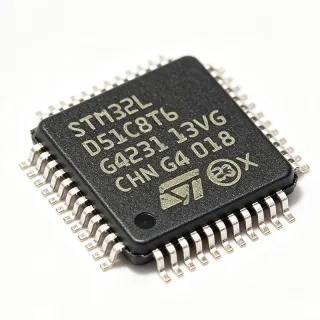
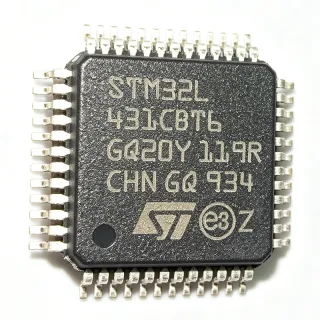
STM32F030CCT6TR - 256KB Flash ARM Cortex-M0 MCU | STMicroelectronics (Tape & Reel)
Référence : STM32F030CCT6TR ✓ Actif| Qté | Prix unitaire | Total |
|---|---|---|
| 1 | $4.44 | $4,44 |
| 10 | $2.67 | $26,70 |
| 100 | $1.78 | $178,00 |
| 500 | $1.63 | $815,00 |
| 1 000 | $1.56 | $1 560,00 |
| 1 500 | $1.48 | $2 220,00 |
STM32F030CCT6TR Présentation
A microcontroller (MCU) is a compact integrated circuit designed to govern a specific operation in an embedded system. It contains a processor core, memory, and programmable input/output peripherals on a single chip. The STM32F030CCT6TR belongs to the STM32F0 series, which is part of the broader STM32 family of 32-bit ARM Cortex-M microcontrollers. This hierarchy positions it as a cost-effective, entry-level MCU suitable for a wide range of applications, from industrial control to consumer electronics.
Key features include 256KB of Flash memory, 32KB of SRAM, and a rich set of peripherals such as USART, SPI, I2C, ADC, timers, and GPIO. The device supports a wide operating temperature range of -40°C to +85°C and is available in a 48-pin LQFP package, making it suitable for space-constrained designs. The ARM Cortex-M0 core provides a balance of performance and power efficiency, with a 32-bit architecture that simplifies software development.
The STM32F030CCT6TR is built on a 32-bit ARM Cortex-M0 core with a Harvard architecture, featuring a 3-stage pipeline and a nested vectored interrupt controller (NVIC). It includes a 12-bit ADC with up to 16 channels, multiple 16-bit timers, and a DMA controller for efficient data transfer. The device also supports a variety of low-power modes, including Sleep, Stop, and Standby, enabling energy-efficient operation in battery-powered applications.
Typical applications include industrial control systems, motor control, consumer electronics, and IoT devices. The STM32F030CCT6TR is well-suited for these applications due to its low cost, low power consumption, and comprehensive peripheral set. For example, in motor control, the advanced timers and ADC enable precise PWM generation and current sensing, while in IoT devices, the low-power modes extend battery life.
When designing with this device, ensure proper decoupling of the power supply pins with 100nF capacitors placed close to the VDD pins. Additionally, configure the clock source appropriately, as the internal HSI oscillator provides a 8 MHz clock that can be used for cost-sensitive designs, while an external crystal can be used for higher accuracy.
This page synthesizes distributor pricing, drop-in alternatives, and practical design notes not found in the STMicroelectronics datasheet, providing a comprehensive resource for engineers evaluating the STM32F030CCT6TR.
Alternatives de remplacement direct pour STM32F030CCT6TR — même boîtier, compatible broche à broche. Les références à boîtier différent nécessitant une retouche du PCB sont exclues.
Outil de comparaison rapide — sélectionnez des références alternatives pour une comparaison côte à côte :
STM32F030C8T6
✓ En stock
$0.98 / unité
Voir la fiche technique →STM32F031C6T6
📋 Alternative de référence (hors catalogue)
STM32F030CCT6TR Valeurs maximales et caractéristiques électriques
| Core | ARM Cortex-M0 |
| Core Frequency | 48 MHz |
| Flash Memory | 256 KB |
| SRAM | 32 KB |
| Tension d'alimentation | 2.4 V to 3.6 V |
| Boîtier | LQFP-48 (7x7 mm) |
| Température de fonctionnement | -40C to +85C |
| Number of I/O Pins | 39 |
| ADC | 12-bit, 16 channels |
| Timers | 5x 16-bit, 1x 32-bit |
| Communication Interfaces | USART, SPI, I2C |
| DMA | 5 channels |
| Low Power Modes | Sleep, Stop, Standby |
| Statut RoHS | Compliant |
| Type de montage | Surface Mount |
Configuration des broches de STM32F030CCT6TR
| Broche 1 | VBAT — Battery backup supply |
| Broche 2 | PC13 — GPIO / RTC output |
| Broche 3 | PC14 — GPIO / OSC32_IN |
| Broche 4 | PC15 — GPIO / OSC32_OUT |
| Broche 5 | PF0 — GPIO / OSC_IN |
| Broche 6 | PF1 — GPIO / OSC_OUT |
| Broche 7 | NRST — Reset (active low) |
| Broche 8 | VDD — Digital power supply |
| Broche 9 | VSS — Ground |
| Broche 10 | PA0 — GPIO / ADC_IN0 |
| Broche 11 | PA1 — GPIO / ADC_IN1 |
| Broche 12 | PA2 — GPIO / USART2_TX |
| Broche 13 | PA3 — GPIO / USART2_RX |
| Broche 14 | PA4 — GPIO / SPI1_NSS |
| Broche 15 | PA5 — GPIO / SPI1_SCK |
| Broche 16 | PA6 — GPIO / SPI1_MISO |
| Broche 17 | PA7 — GPIO / SPI1_MOSI |
| Broche 18 | PB0 — GPIO / ADC_IN8 |
| Broche 19 | PB1 — GPIO / ADC_IN9 |
| Broche 20 | PB2 — GPIO / BOOT1 |
| Broche 21 | PB10 — GPIO / I2C2_SCL |
| Broche 22 | PB11 — GPIO / I2C2_SDA |
| Broche 23 | PB12 — GPIO / SPI2_NSS |
| Broche 24 | PB13 — GPIO / SPI2_SCK |
| Broche 25 | PB14 — GPIO / SPI2_MISO |
| Broche 26 | PB15 — GPIO / SPI2_MOSI |
| Broche 27 | PA8 — GPIO / MCO |
| Broche 28 | PA9 — GPIO / USART1_TX |
| Broche 29 | PA10 — GPIO / USART1_RX |
| Broche 30 | PA11 — GPIO / USART1_CTS |
| Broche 31 | PA12 — GPIO / USART1_RTS |
| Broche 32 | PA13 — GPIO / SWDIO |
| Broche 33 | PA14 — GPIO / SWCLK |
| Broche 34 | PA15 — GPIO / JTDI |
| Broche 35 | PB3 — GPIO / JTDO |
| Broche 36 | PB4 — GPIO / NJTRST |
| Broche 37 | PB5 — GPIO / I2C1_SMBA |
| Broche 38 | PB6 — GPIO / I2C1_SCL |
| Broche 39 | PB7 — GPIO / I2C1_SDA |
| Broche 40 | PB8 — GPIO / TIM3_CH3 |
| Broche 41 | PB9 — GPIO / TIM3_CH4 |
| Broche 42 | VDD — Digital power supply |
| Broche 43 | VSS — Ground |
| Broche 44 | PC14 — GPIO / OSC32_IN |
| Broche 45 | PC15 — GPIO / OSC32_OUT |
| Broche 46 | PC0 — GPIO / ADC_IN10 |
| Broche 47 | PC1 — GPIO / ADC_IN11 |
| Broche 48 | PC2 — GPIO / ADC_IN12 |
Applications typiques
STM32F030CCT6TR convient pour 6 applications: Industrial Control, Consumer Electronics, IoT Devices, Motor Control, Medical Devices, Automotive Electronics.
Industrial Control
The STM32F030CCT6TR is ideal for industrial control systems due to its robust peripheral set, including multiple timers, ADC, and communication interfaces. Its 48 MHz ARM Cortex-M0 core provides sufficient processing power for real-time control loops, while the wide operating temperature range (-40°C to +85°C) ensures reliability in harsh environments. In a typical PLC or motor controller, the MCU handles sensor inputs, executes control algorithms, and drives actuators via PWM. The 12-bit ADC enables precise analog signal acquisition, and the USART/SPI interfaces allow communication with external modules. The low power consumption and cost-effectiveness make it a preferred choice for distributed control nodes.
Recommandé
Consumer Electronics
In consumer electronics, the STM32F030CCT6TR is used in devices such as smart home hubs, remote controls, and small appliances. Its low cost and low power consumption make it ideal for battery-operated devices. The MCU's rich peripheral set, including I2C, SPI, and USART, enables seamless connectivity with sensors, displays, and wireless modules. For example, in a smart thermostat, the STM32F030CCT6TR reads temperature sensors via I2C, processes the data, and controls the HVAC system via relay drivers. The standby mode, consuming only 2.3 uA, extends battery life significantly. The 256KB Flash allows for complex firmware with over-the-air update capabilities.
Recommandé
IoT Devices
The STM32F030CCT6TR is well-suited for IoT edge devices that require low power consumption and reliable performance. Its ARM Cortex-M0 core efficiently handles sensor data collection, processing, and transmission. The device supports multiple low-power modes, allowing it to sleep between transmissions and conserve battery. In a typical IoT sensor node, the MCU wakes up periodically, reads sensors via ADC or I2C, and sends data over a wireless module (e.g., LoRa, Zigbee) via SPI or UART. The 256KB Flash provides ample space for firmware and data logging. The wide supply voltage range (2.4V to 3.6V) accommodates various battery chemistries, and the -40°C to +85°C temperature range ensures operation in outdoor environments.
Recommandé
Motor Control
The STM32F030CCT6TR is an excellent choice for motor control applications, including brushless DC (BLDC) motors and stepper motors. Its advanced timers can generate multiple PWM signals with dead-time insertion, essential for driving H-bridges. The 12-bit ADC with up to 16 channels allows for precise current sensing and back-EMF detection. In a BLDC motor controller, the MCU reads Hall sensor inputs, executes the commutation algorithm, and generates PWM signals to the gate drivers. The 48 MHz core speed ensures fast loop execution, while the DMA controller offloads data transfer, reducing CPU load. The device's robustness and wide temperature range make it suitable for industrial motor drives and automotive applications.
Recommandé
Medical Devices
The STM32F030CCT6TR is used in medical devices such as patient monitors, infusion pumps, and diagnostic equipment. Its low power consumption and high reliability are critical for battery-powered portable devices. The MCU's ADC and communication interfaces enable accurate sensor data acquisition and transmission. In a portable pulse oximeter, the STM32F030CCT6TR reads the photodiode signal via ADC, processes the data to calculate SpO2 and heart rate, and displays the results on an LCD. The 256KB Flash allows for complex algorithms and data logging. The device's compliance with RoHS and its wide operating temperature range ensure suitability for medical environments.
Recommandé
Automotive Electronics
In automotive electronics, the STM32F030CCT6TR is used in body control modules, lighting control, and sensor interfaces. Its wide operating temperature range (-40°C to +85°C) and robust design make it suitable for under-hood applications. The MCU's CAN interface (if available) or UART enables communication with other vehicle systems. In a lighting control module, the STM32F030CCT6TR receives commands from the body controller via LIN or UART, and drives LED drivers via PWM. The low power consumption helps reduce the vehicle's overall power draw. The 256KB Flash provides ample space for calibration data and firmware updates.
Recommandé
Récapitulatif des produits recommandés
Données de référence d'ingénierie pour STM32F030CCT6TR — comparaison, recommandations de conception et informations de conformité.
Guide de sélection
Comparaison avec les alternatives
| Paramètre | Ce produit | STM32F030C8T6 | STM32F030C6T6 | STM32F031C6T6 |
|---|---|---|---|---|
| Package | LQFP-48 | LQFP-48 - same | LQFP-48 - same | LQFP-48 - same |
| Flash Memory | 256 KB | 64 KB | 32 KB | 32 KB |
| SRAM | 32 KB | 8 KB | 4 KB | 4 KB |
| Core Frequency | 48 MHz | 48 MHz | 48 MHz | 48 MHz |
| Number of I/O Pins | 39 | 39 | 39 | 39 |
| ADC Channels | 16 | 16 | 16 | 16 |
| Communication Interfaces | USART, SPI, I2C | USART, SPI, I2C | USART, SPI, I2C | USART, SPI, I2C |
| Price (1k) | $1.85 | $1.45 | $1.20 | $1.30 |
Principaux différenciateurs
- Largest Flash memory in the STM32F030 series (vs STM32F030C8T6)
- Higher SRAM capacity (vs STM32F030C6T6)
- Pin-to-pin compatible with lower-cost variants (vs STM32F031C6T6)
Notes de conception
Decouple each VDD pin with a 100nF ceramic capacitor placed as close as possible to the pin. Additionally, add a 4.7uF bulk capacitor on the main power rail. For the VDDA pin, use a 1uF capacitor and a ferrite bead to isolate analog noise.
For the LQFP-48 package, ensure the exposed pad (if present) is soldered to a ground plane for thermal and electrical performance. Route high-speed signals away from the crystal oscillator pins (PF0/PF1) to avoid interference. Keep the SWD lines (PA13/PA14) short and add series resistors for ESD protection.
Do not leave the BOOT0 pin floating; connect it to ground through a 10k resistor to ensure boot from Flash. When using the internal HSI oscillator, note that it has a tolerance of ±1% at 25°C, which may not be sufficient for USB or CAN applications. Use an external crystal for accurate timing.
Informations de conformité
RoHS compliant per STMicroelectronics product page. Not AEC-Q100 qualified - this is a standard grade MCU.