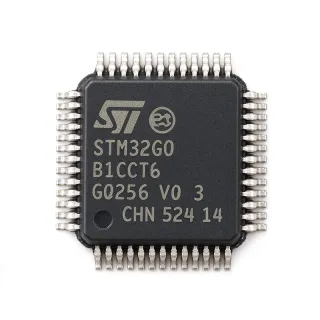
STM32F205RCT7 - 120MHz Cortex-M3 256KB MCU | STMicroelectronics
Référence : STM32F205RCT7 ✓ ActifSTM32F205RCT7 Présentation
A microcontroller is a programmable semiconductor that integrates a processor core, memory, and peripherals into one device. The STM32F20x family combines an Arm Cortex-M3 RISC core with embedded flash and SRAM, allowing firmware to control sensors, communication interfaces, actuators, and user interfaces. The STM32F205RCT7 is therefore positioned between a general-purpose embedded processor and a compact dedicated controller.
The principal specifications include a 32-bit Arm Cortex-M3 core, a maximum operating frequency of 120 MHz, 256 KB of program flash, and a 64-pin LQFP package. STMicroelectronics identifies the device as a high-performance MCU and lists an adaptive real-time accelerator for improving flash-based execution performance. Its 2.5 V and 3.3 V operating options support conventional embedded control boards.
The 120 MHz Cortex-M3 architecture is intended for control loops, protocol handling, and real-time embedded processing. Compared with lower-frequency microcontrollers, the available processing headroom can reduce the complexity of multitasking, signal processing, or communication firmware. The 256 KB flash capacity provides room for application code, bootloader functions, configuration data, and field-update logic within one package.
Typical uses include industrial embedded controllers, USB-connected products, communication equipment, consumer devices, and compact control systems. The 64-pin LQFP package exposes a greater peripheral-pin count than smaller 32-pin or 48-pin alternatives, making it useful when a design requires multiple I/O functions while retaining a leaded package that is practical for assembly and inspection.
Designers should review the manufacturer datasheet for the complete pin list, electrical limits, decoupling requirements, clock configuration, and programming interface. Board implementation should preserve the recommended power, ground, reset, and clock layouts, particularly when high-speed communication or timing-sensitive control is required.
This product overview consolidates the manufacturer family information, package details, source listings, drop-in alternatives, and application guidance into one engineering-focused reference. It helps designers evaluate the STM32F205RCT7 before moving to the full datasheet, reference manual, and device-specific hardware guidance.
Alternatives de remplacement direct pour STM32F205RCT7 — même boîtier, compatible broche à broche. Les références à boîtier différent nécessitant une retouche du PCB sont exclues.
Variantes de cette série
Modèles de la même série directement compatibles avec STM32F205RCT7 (même facteur de forme et même empreinte) — différant par Flash Memory, Package.
STM32F205RCT6
✅ Remplacement directContactez-nous pour le prix
Voir la fiche technique →STM32F205RCT6TR
✅ Remplacement direct ⚠️ Spécifications non vérifiées📋 Alternative de référence (hors catalogue)
STM32F205RCT7 Valeurs maximales et caractéristiques électriques
| Product Type | 32-bit Arm Cortex-M3 microcontroller |
| Processor Core | Arm Cortex-M3 RISC |
| CPU Word Size | 32-bit |
| Maximum CPU Frequency | 120 MHz |
| Flash Memory | 256 KB |
| Flash Organization | 256K x 8 bits |
| Operating Voltage | 2.5 V or 3.3 V |
| Boîtier | 64-pin LQFP, 10 x 10 mm |
| Type de montage | Surface mount |
| Performance Feature | Adaptive real-time accelerator |
| Program Memory Type | Flash |
| Manufacturer Family | STM32F20x |
| Core Architecture | Arm Cortex-M3, 32-bit RISC |
| Temperature Grade Code | T7 grade code |
| Reel Variant | STM32F205RCT7TR |
| Packaging Form | Tray for STM32F205RCT7 |
Guide de configuration des broches du STM32F205RCT7 64-pin lqfp, 10 x 10 mm
Configuration des broches du STM32F205RCT7 (boîtier 64-pin lqfp, 10 x 10 mm). Ce circuit intégré numérique comprend des GPIO, des interfaces de communication (UART, SPI, I2C) et des broches d'alimentation. Consultez la fiche technique du fabricant pour les fonctions alternatives des broches et les options de configuration. Indispensable pour la conception de systèmes embarqués et la conception de circuits imprimés.

Aucune donnée de brochage détaillée disponible pour STM32F205RCT7.
Consultez la fiche technique pour la configuration complète des broches.
Applications typiques
STM32F205RCT7 convient pour 6 applications: Industrial Embedded Controller, USB-Compatible Connected Device, Communication Equipment, Consumer Control Module, Precision Timing and Data Acquisition, Battery-Powered Monitoring Device.
Industrial Embedded Controller
The STM32F205RCT7 fits industrial embedded-control boards that combine deterministic control with communications and local data handling. Its Arm Cortex-M3 core operates at up to 120 MHz, providing useful processing headroom for control loops, state machines, protocol stacks, and supervisory logic. The 256 KB of flash can accommodate application firmware, configuration parameters, a bootloader, and update routines. Its 64-pin LQFP package provides a broad selection of external I/O for sensors, actuators, status indicators, and communication transceivers. The 2.5 V or 3.3 V operating options align with conventional embedded power architectures. Design validation should confirm peripheral availability, pin multiplexing, timing margins, and environmental limits against the complete STM32F205RC documentation.
Recommandé
USB-Compatible Connected Device
The STM32F205RCT7 is well suited to compact connected equipment in which a USB interface, local user controls, and application processing share one microcontroller. The 120 MHz Cortex-M3 core can support protocol handling and application tasks, while 256 KB of flash provides space for firmware and configuration storage. A 64-pin LQFP package offers more signal access than smaller controllers and can accommodate USB routing, status functions, displays, and digital sensors. Because board-level USB performance depends on correct routing and power implementation, use the manufacturer electrical and layout guidance. Firmware should also be tested with the intended USB host, cable, operating system, bus-power conditions, and suspend or resume requirements.
Recommandé
Communication Equipment
STM32F205RCT7 can serve as the central controller in communication equipment requiring predictable embedded processing and a moderate package footprint. Its 32-bit Cortex-M3 architecture operates up to 120 MHz, giving designers additional processing margin for framing, protocol management, diagnostics, and user-interface handling. The 256 KB flash capacity is useful for firmware plus configuration, while the 64-pin LQFP package provides connections for transceivers, indicators, controls, and status monitoring. The device should be selected only after checking the exact STM32F205RC peripheral configuration and interface requirements. PCB layout should separate sensitive communication paths from switching circuitry and preserve the recommended grounding, decoupling, clock, and reset arrangements to minimize signal-integrity risk.
Recommandé
Consumer Control Module
The STM32F205RCT7 can be used in compact consumer control modules that combine multiple inputs, status outputs, and local processing. Its 120 MHz Cortex-M3 core supports responsive menu logic, communication, timing, and peripheral control, while 256 KB of flash accommodates structured application code and calibration data. The 64-pin LQFP package gives the designer access to numerous GPIO and alternate-function options without moving to a very large land pattern. For battery- or USB-powered products, engineers should review the device's operating modes and external regulator strategy in the manufacturer documentation. Firmware development should include brownout handling, wake behavior, flash-update protection, and validation across the voltage and temperature conditions required by the finished product.
Recommandé
Precision Timing and Data Acquisition
The STM32F205RCT7 offers sufficient Cortex-M3 processing capability for compact timing, measurement, and local data-acquisition subsystems. Operating at up to 120 MHz supports responsive sampling control, filtering, calibration sequences, and communication with higher-level equipment. Its 256 KB flash capacity can hold acquisition firmware, configuration tables, and diagnostic routines, while the 64-pin LQFP package supplies a generous pin count for sensors and converters. Accuracy still depends on the selected STM32F205RC peripheral set, clock source, analog front end, and reference design. Engineers should evaluate conversion timing, interrupt latency, input thresholds, grounding, and signal conditioning rather than treating processor speed as a substitute for careful analog and layout design.
Recommandé
Battery-Powered Monitoring Device
The STM32F205RCT7 is applicable to battery-powered monitoring equipment that needs more processing capability than a simple low-power controller. Its 120 MHz Cortex-M3 core can handle sensor management, local filtering, event logging, and communication, while 256 KB of flash supports firmware and stored parameters. The 64-pin LQFP package offers enough external connections for sensing inputs, status outputs, and a communications interface. Power efficiency must be evaluated through the device's operating modes rather than inferred from maximum clock speed. Use the manufacturer guidance for clock selection, sleep behavior, regulator configuration, decoupling, and startup. A production design should also verify battery chemistry, peak-load behavior, low-voltage thresholds, and the full temperature range required during operation.
Recommandé
Récapitulatif des produits recommandés
Données de référence d'ingénierie pour STM32F205RCT7 — comparaison, recommandations de conception et informations de conformité.
Guide de sélection
Comparaison avec les alternatives
| Paramètre | Ce produit | STM32F205RCT6 | STM32F205RCT6TR |
|---|---|---|---|
| Package | 64-LQFP (10 x 10 mm) | 64-LQFP (10 x 10 mm) | 64-LQFP (10 x 10 mm) |
| Brand | STMicroelectronics | STMicroelectronics | STMicroelectronics |
| Processor Core | Arm Cortex-M3 | Arm Cortex-M3 | Arm Cortex-M3 |
| Maximum CPU Frequency | 120 MHz | 120 MHz | 120 MHz |
| Flash Memory | 256 KB | 256 KB | 256 KB |
| CPU Word Size | 32-bit | 32-bit | 32-bit |
| Operating Voltage | 2.5 V or 3.3 V | 2.5 V or 3.3 V | 2.5 V or 3.3 V |
| Temperature Grade Suffix | T7 | T6 | T6 |
| Ordering Form | Tray | Tray | Tape and reel |
Principaux différenciateurs
- T7 temperature-grade ordering option (vs STM32F205RCT6)
- Identical package-level reuse (vs STM32F205RCT6TR)
- High-performance processing with substantial flash (vs STM32F205RCT6)
Notes de conception
Assign every one of the 64 LQFP positions from the STM32F205RC pin-description table before releasing the PCB. Verify alternate-function routing, 5 V-tolerant limitations where applicable, debug access, clock inputs, and communication pins against the exact suffix. Keep the footprint dimensions and land pattern consistent with the manufacturer's package drawing, and maintain clear assembly clearance around the perimeter for inspection and rework.
Implement the supply network with the decoupling values and placement specified in the manufacturer hardware guidance, placing each required capacitor adjacent to its intended power pin. Validate startup, brownout, reset, and shutdown behavior at the system's 2.5 V or 3.3 V operating condition. Power sequencing and any external regulator interaction should be checked in hardware because incorrect rail ramping can cause unreliable reset or flash operation.
Route clock, high-speed communication, and sensitive control signals with short return paths and continuous ground references. Apply the manufacturer guidance for oscillator placement, input filtering, and signal integrity, and keep switching nodes and inductors away from sensitive inputs. For USB-connected products, use the applicable reference layout and verify the complete channel with impedance-controlled equipment rather than relying only on visual inspection.
Do not treat STM32F205RCT7 and STM32F205RCT6 as unconditional equivalents. Although both occupy the same 64-pin LQFP footprint and share the core platform, the temperature-grade suffix changes the environmental rating. Review the ordering information, temperature limits, peripheral configuration, and errata for the exact replacement before approving it for production, especially in industrial, automotive, or outdoor equipment.
Informations de conformité
No definitive compliance statements or automotive qualification statement for the exact STM32F205RCT7 ordering code were included in the manufacturer or distributor material. Confirm RoHS, REACH, lead-free, halogen-free, conflict-minerals, and AEC-Q100 status with STMicroelectronics for the specific order code.