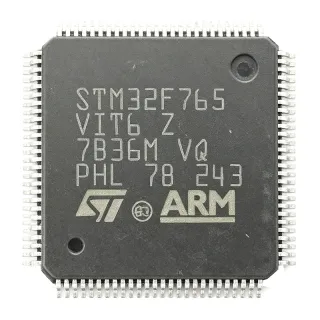
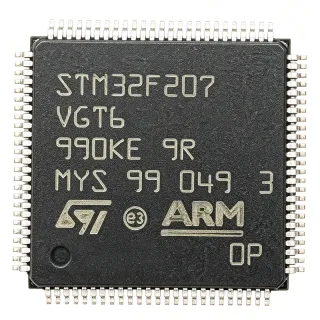
STM32L072VZT6 - Ultra-Low-Power ARM Cortex-M0+ MCU | STMicroelectronics
Référence : STM32L072VZT6 ✓ Actif| Qté | Prix unitaire | Total |
|---|---|---|
| 1 | $8.5 | $8,50 |
| 10 | $7.65 | $76,50 |
| 100 | $6.8 | $680,00 |
| 500 | $6.12 | $3 060,00 |
| 1 000 | $5.44 | $5 440,00 |
STM32L072VZT6 Présentation
What is an ARM Cortex-M0+ microcontroller? It is a 32-bit processor core designed for ultra-low-power and cost-sensitive embedded applications. The Cortex-M0+ is the smallest and most energy-efficient ARM processor, featuring a two-stage pipeline that reduces power consumption while maintaining deterministic interrupt handling. In the system hierarchy, the STM32L072VZT6 sits at the application processor level, managing sensors, actuators, and communication interfaces, while the Cortex-M0+ core executes user firmware. This category of microcontrollers is widely used in IoT nodes, wearable devices, and industrial sensors where battery life is critical.
Key features of the STM32L072VZT6 include multiple low-power modes (Sleep, Low-power Run, Low-power Sleep, Stop with RTC, Standby with RTC, and Shutdown), a 12-bit ADC with hardware oversampling, two 12-bit DACs, a USB 2.0 full-speed device controller, and multiple communication interfaces including I2C, SPI, USART, and LPUART. The device also integrates a real-time clock (RTC) with calendar and alarm functions, and a true random number generator (RNG) for security applications. The operating voltage range is 1.8V to 3.6V, with a typical power consumption of 84 uA/MHz in Run mode and 0.29 uA in Standby mode with RTC.
From a technical depth perspective, the STM32L072VZT6 is built on ST's ultra-low-power technology platform, which includes a flexible clock gating and power management scheme. The device features a 12-bit ADC with up to 16 external channels and a conversion rate of 1 Msps, along with a 12-bit DAC with output buffer. The USB controller supports battery charging detection and link power management, making it suitable for portable devices. The device also includes a hardware CRC calculation unit and a unique 96-bit ID for device identification.
Typical applications include smart meters, fitness trackers, medical monitoring devices, and industrial sensor nodes. The ultra-low-power modes and rich analog peripherals make it particularly well-suited for applications that require long battery life and precise analog measurements. For example, in a smart meter, the STM32L072VZT6 can read current and voltage sensors, compute energy consumption, and communicate via wireless modules while spending most of its time in low-power sleep modes.
When designing with this device, pay attention to the power supply decoupling: place a 100 nF capacitor close to each VDD pin and a 4.7 uF capacitor on the main VDD rail. For the VDDA analog supply, use a dedicated 1 uF capacitor and a ferrite bead to isolate digital noise. The VBAT pin should be connected to a backup battery or tied to VDD if not used. Also, ensure the BOOT0 pin is properly configured to select the desired boot mode.
Alternatives de remplacement direct pour STM32L072VZT6 — même boîtier, compatible broche à broche. Les références à boîtier différent nécessitant une retouche du PCB sont exclues.
Variantes de cette série
Modèles de la même série directement compatibles avec STM32L072VZT6 (même facteur de forme et même empreinte) — différant par Communication Interfaces, Package.
Outil de comparaison rapide — sélectionnez des références alternatives pour une comparaison côte à côte :
STM32L073VZT6
✅ Remplacement direct ⚠️ Spécifications non vérifiées✓ En stock
$4.16 / unité
Voir la fiche technique →STM32L072VCT6
✅ Remplacement direct ⚠️ Spécifications non vérifiées📋 Alternative de référence (hors catalogue)
STM32L071VZT6
✅ Remplacement direct ⚠️ Spécifications non vérifiées📋 Alternative de référence (hors catalogue)
STM32L082VZT6
✅ Remplacement direct ⚠️ Spécifications non vérifiées📋 Alternative de référence (hors catalogue)
STM32L072VZT6 Valeurs maximales et caractéristiques électriques
| Core | ARM Cortex-M0+ |
| Max Clock Frequency | 32 MHz |
| Flash Memory | 192 KB |
| SRAM | 20 KB |
| Operating Voltage | 1.8 V to 3.6 V |
| Boîtier | LQFP100 (14x14 mm) |
| GPIO Pins | 84 |
| ADC | 12-bit, 16 channels, 1 Msps |
| DAC | 12-bit, 2 channels |
| Communication Interfaces | I2C, SPI, USART, LPUART, USB 2.0 FS |
| Timers | 8x 16-bit, 2x 32-bit |
| RTC | Yes, with calendar and alarm |
| Low-Power Modes | Sleep, Low-power Run, Low-power Sleep, Stop, Standby, Shutdown |
| Power Consumption (Run) | 84 uA/MHz |
| Power Consumption (Standby) | 0.29 uA with RTC |
| Température de fonctionnement | -40C to +85C |
| Statut RoHS | Compliant |
Configuration des broches de STM32L072VZT6
| Broche 1 | PE2 — GPIO or alternate function |
| Broche 2 | PE3 — GPIO or alternate function |
| Broche 3 | PE4 — GPIO or alternate function |
| Broche 4 | PE5 — GPIO or alternate function |
| Broche 5 | PE6 — GPIO or alternate function |
| Broche 6 | VBAT — Backup battery supply |
| Broche 7 | PC13 — GPIO or RTC output |
| Broche 8 | PC14 — GPIO or OSC32_IN |
| Broche 9 | PC15 — GPIO or OSC32_OUT |
| Broche 10 | PF0 — GPIO or OSC_IN |
| Broche 11 | PF1 — GPIO or OSC_OUT |
| Broche 12 | PF2 — GPIO |
| Broche 13 | VSSA — Analog ground |
| Broche 14 | VDDA — Analog power supply |
| Broche 15 | PA0 — GPIO or ADC input |
| Broche 16 | PA1 — GPIO or ADC input |
| Broche 17 | PA2 — GPIO or USART2_TX |
| Broche 18 | PA3 — GPIO or USART2_RX |
| Broche 19 | PA4 — GPIO or DAC_OUT1 |
| Broche 20 | PA5 — GPIO or DAC_OUT2 |
| Broche 21 | PA6 — GPIO or SPI1_MISO |
| Broche 22 | PA7 — GPIO or SPI1_MOSI |
| Broche 23 | PA8 — GPIO or USB_DP |
| Broche 24 | PA9 — GPIO or USB_DM |
| Broche 25 | PA10 — GPIO or USART1_RX |
| Broche 26 | PA11 — GPIO or USART1_TX |
| Broche 27 | PA12 — GPIO or SPI1_NSS |
| Broche 28 | PA13 — GPIO or SWDIO |
| Broche 29 | PA14 — GPIO or SWCLK |
| Broche 30 | PA15 — GPIO or JTDI |
| Broche 31 | VDD — Digital power supply |
| Broche 32 | VSS — Digital ground |
| Broche 33 | PB0 — GPIO or ADC input |
| Broche 34 | PB1 — GPIO or ADC input |
| Broche 35 | PB2 — GPIO or BOOT1 |
| Broche 36 | PB3 — GPIO or SPI1_SCK |
| Broche 37 | PB4 — GPIO or SPI1_MISO |
| Broche 38 | PB5 — GPIO or I2C1_SMBA |
| Broche 39 | PB6 — GPIO or I2C1_SCL |
| Broche 40 | PB7 — GPIO or I2C1_SDA |
| Broche 41 | PB8 — GPIO or I2C1_SCL |
| Broche 42 | PB9 — GPIO or I2C1_SDA |
| Broche 43 | PB10 — GPIO or I2C2_SCL |
| Broche 44 | PB11 — GPIO or I2C2_SDA |
| Broche 45 | PB12 — GPIO or SPI2_NSS |
| Broche 46 | PB13 — GPIO or SPI2_SCK |
| Broche 47 | PB14 — GPIO or SPI2_MISO |
| Broche 48 | PB15 — GPIO or SPI2_MOSI |
| Broche 49 | PC0 — GPIO or ADC input |
| Broche 50 | PC1 — GPIO or ADC input |
| Broche 51 | PC2 — GPIO or ADC input |
| Broche 52 | PC3 — GPIO or ADC input |
| Broche 53 | PC4 — GPIO or ADC input |
| Broche 54 | PC5 — GPIO or ADC input |
| Broche 55 | PC6 — GPIO or USART6_TX |
| Broche 56 | PC7 — GPIO or USART6_RX |
| Broche 57 | PC8 — GPIO or USART6_CK |
| Broche 58 | PC9 — GPIO or USART6_CTS |
| Broche 59 | PC10 — GPIO or USART4_TX |
| Broche 60 | PC11 — GPIO or USART4_RX |
| Broche 61 | PC12 — GPIO or USART5_TX |
| Broche 62 | PD0 — GPIO or OSC_IN |
| Broche 63 | PD1 — GPIO or OSC_OUT |
| Broche 64 | PD2 — GPIO or USART5_RX |
| Broche 65 | PD3 — GPIO or USART2_CTS |
| Broche 66 | PD4 — GPIO or USART2_RTS |
| Broche 67 | PD5 — GPIO or USART2_TX |
| Broche 68 | PD6 — GPIO or USART2_RX |
| Broche 69 | PD7 — GPIO or USART2_CK |
| Broche 70 | PD8 — GPIO or USART3_TX |
| Broche 71 | PD9 — GPIO or USART3_RX |
| Broche 72 | PD10 — GPIO or USART3_CK |
| Broche 73 | PD11 — GPIO or USART3_CTS |
| Broche 74 | PD12 — GPIO or USART3_RTS |
| Broche 75 | PD13 — GPIO |
| Broche 76 | PD14 — GPIO |
| Broche 77 | PD15 — GPIO |
| Broche 78 | VDD — Digital power supply |
| Broche 79 | VSS — Digital ground |
| Broche 80 | PE0 — GPIO |
| Broche 81 | PE1 — GPIO |
| Broche 82 | PE7 — GPIO |
| Broche 83 | PE8 — GPIO |
| Broche 84 | PE9 — GPIO |
| Broche 85 | PE10 — GPIO |
| Broche 86 | PE11 — GPIO |
| Broche 87 | PE12 — GPIO |
| Broche 88 | PE13 — GPIO |
| Broche 89 | PE14 — GPIO |
| Broche 90 | PE15 — GPIO |
| Broche 91 | PB8 — GPIO or I2C1_SCL |
| Broche 92 | PB9 — GPIO or I2C1_SDA |
| Broche 93 | VDD — Digital power supply |
| Broche 94 | VSS — Digital ground |
| Broche 95 | PD8 — GPIO or USART3_TX |
| Broche 96 | PD9 — GPIO or USART3_RX |
| Broche 97 | PD10 — GPIO or USART3_CK |
| Broche 98 | PD11 — GPIO or USART3_CTS |
| Broche 99 | PD12 — GPIO or USART3_RTS |
| Broche 100 | PD13 — GPIO |
Applications typiques
STM32L072VZT6 convient pour 6 applications: Smart Meters, Wearable Fitness Trackers, Industrial Sensor Nodes, Medical Monitoring Devices, IoT Smart Home Devices, Portable Test and Measurement Equipment.
Smart Meters
The STM32L072VZT6 is ideal for smart meters due to its ultra-low-power operation and integrated analog peripherals. In a typical smart meter, the MCU reads current and voltage sensors via the 12-bit ADC, computes energy consumption, and communicates via a wireless module. The low-power modes allow the device to sleep between measurements, extending battery life to several years. The 192 KB Flash provides ample space for calibration data and communication protocols. The RTC ensures accurate time-stamping of energy usage. The USB interface can be used for local configuration and firmware updates. The wide operating voltage range (1.8V to 3.6V) accommodates battery voltage variations. The device's robust temperature range (-40C to +85C) suits outdoor installations. The multiple communication interfaces (I2C, SPI, USART) connect to various sensors and displays. The 12-bit DAC can generate analog outputs for testing or control. The low-power run mode allows continuous operation at reduced clock speeds, further saving energy. The STM32L072VZT6's combination of low power, rich peripherals, and large memory makes it a cost-effective choice for smart metering applications.
Recommandé
Wearable Fitness Trackers
The STM32L072VZT6 is well-suited for wearable fitness trackers due to its ultra-low-power consumption and small footprint. In a fitness tracker, the MCU interfaces with an accelerometer and heart rate sensor via I2C or SPI, processes the data, and displays it on an OLED or LED display. The device spends most of its time in Stop mode, waking periodically to sample sensors and update the display. The 20 KB SRAM is sufficient for sensor data buffering. The USB interface enables charging and data transfer. The low-power modes ensure a battery life of several weeks on a small coin cell. The 12-bit ADC can monitor battery voltage. The RTC provides time and date for activity logging. The multiple timers can generate PWM signals for haptic feedback. The device's small LQFP100 package fits into compact wearable designs. The wide operating voltage range allows direct battery connection. The STM32L072VZT6's low power and rich peripherals make it an excellent choice for wearable applications.
Recommandé
Industrial Sensor Nodes
The STM32L072VZT6 is perfect for industrial sensor nodes that monitor temperature, pressure, or humidity. In such a node, the MCU reads analog sensors via the 12-bit ADC, processes the data, and transmits it over a wireless protocol like LoRa or Zigbee. The low-power modes allow the node to run on batteries for years. The device's robust temperature range (-40C to +85C) suits harsh industrial environments. The multiple communication interfaces connect to various sensors and actuators. The 192 KB Flash stores firmware and calibration data. The 12-bit DAC can generate analog control signals. The RTC enables scheduled wake-ups for periodic reporting. The device's low power consumption in Run mode (84 uA/MHz) is critical for energy efficiency. The STM32L072VZT6's combination of low power, analog peripherals, and communication options makes it ideal for industrial IoT applications.
Recommandé
Medical Monitoring Devices
The STM32L072VZT6 is suitable for medical monitoring devices such as portable glucose meters or pulse oximeters. These devices require low power consumption for battery operation and precise analog measurements. The MCU's 12-bit ADC with hardware oversampling provides accurate sensor readings. The low-power modes extend battery life, which is critical for patient convenience. The USB interface allows data transfer to a PC or smartphone. The device's small package fits into handheld designs. The 192 KB Flash stores patient data and firmware. The RTC provides timestamps for measurements. The multiple timers can generate alarms. The device's wide operating voltage range accommodates battery voltage variations. The STM32L072VZT6's low power and analog performance make it an excellent choice for medical monitoring applications.
Recommandé
IoT Smart Home Devices
The STM32L072VZT6 is ideal for smart home devices like smart thermostats, door locks, and environmental sensors. These devices require low power consumption, wireless connectivity, and reliable operation. The MCU's multiple communication interfaces (I2C, SPI, USART) connect to Wi-Fi or Zigbee modules. The low-power modes allow battery operation for extended periods. The 12-bit ADC reads temperature and humidity sensors. The RTC enables scheduled events. The device's small package fits into compact enclosures. The 192 KB Flash stores firmware and user settings. The USB interface can be used for configuration. The STM32L072VZT6's combination of low power, connectivity, and memory makes it a popular choice for smart home applications.
Recommandé
Portable Test and Measurement Equipment
The STM32L072VZT6 is well-suited for portable test and measurement equipment such as handheld multimeters or data loggers. These devices require high accuracy, low power, and a user interface. The MCU's 12-bit ADC with oversampling provides precise measurements. The low-power modes extend battery life. The multiple timers can generate PWM for waveform generation. The USB interface allows data transfer to a PC. The device's small package fits into handheld designs. The 192 KB Flash stores measurement data and firmware. The RTC provides time-stamping. The STM32L072VZT6's combination of analog performance, low power, and memory makes it an excellent choice for portable test equipment.
Recommandé
Récapitulatif des produits recommandés
Données de référence d'ingénierie pour STM32L072VZT6 — comparaison, recommandations de conception et informations de conformité.
Guide de sélection
Comparaison avec les alternatives
| Paramètre | Ce produit | STM32L073VZT6 | STM32L072VCT6 | STM32L071VZT6 | STM32L082VZT6 |
|---|---|---|---|---|---|
| Package | LQFP100 | LQFP100 | LQFP100 | LQFP100 | LQFP100 |
| Brand | STMicroelectronics | STMicroelectronics | STMicroelectronics | STMicroelectronics | STMicroelectronics |
| Core | ARM Cortex-M0+ | ARM Cortex-M0+ | ARM Cortex-M0+ | ARM Cortex-M0+ | ARM Cortex-M0+ |
| Max Clock Frequency | 32 MHz | 32 MHz | 32 MHz | 32 MHz | 32 MHz |
| Flash Memory | 192 KB | 192 KB | 128 KB | 192 KB | 192 KB |
| SRAM | 20 KB | 20 KB | 20 KB | 20 KB | 20 KB |
| USB | Yes | Yes | Yes | No | Yes |
| LCD Controller | No | Yes | No | No | No |
| AES Encryption | No | No | No | No | Yes |
Principaux différenciateurs
- Ultra-low power consumption with multiple low-power modes (vs STM32L073VZT6)
- 192 KB Flash memory in a 100-pin package (vs STM32L072VCT6)
- Integrated USB 2.0 full-speed device controller (vs STM32L071VZT6)
Notes de conception
Decouple each VDD pin with a 100 nF ceramic capacitor placed as close as possible to the pin. Additionally, place a 4.7 uF capacitor on the main VDD rail. For VDDA, use a dedicated 1 uF capacitor and a ferrite bead to isolate analog noise. If VBAT is not used, connect it to VDD. Ensure the power supply can handle the peak current during flash programming or USB activity.
For the LQFP100 package, use a 4-layer PCB with a solid ground plane. Route high-speed signals (USB, SPI) with controlled impedance if possible. Keep analog and digital grounds separate and connect them at a single point. Place the crystal oscillator close to the OSC_IN/OSC_OUT pins and ensure proper load capacitors. Avoid routing high-current traces near the analog input pins.
Ensure the BOOT0 pin is correctly configured to select the desired boot mode. If using the USB, ensure the USB_DP and USB_DM pins are properly terminated with 22 ohm resistors. Do not exceed the absolute maximum ratings for VDD (3.6V) and VDDA. When using the ADC, ensure the sampling time is sufficient for the source impedance. Also, note that the STM32L072VZT6 does not have a built-in LCD controller, so an external driver is needed if an LCD is required.
Informations de conformité
RoHS compliant per STMicroelectronics product page. Not AEC-Q100 qualified. Halogen-free status not specified in the provided data.