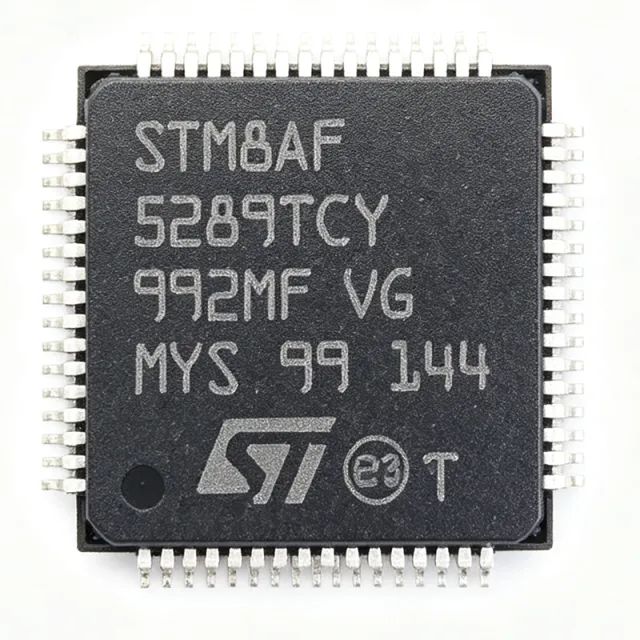
STM8AF5289TCY - 8-bit Automotive MCU, 128KB Flash | STMicroelectronics
Référence : STM8AF5289TCY ✓ Actif| Qté | Prix unitaire | Total |
|---|---|---|
| 1 | $4.9091 | $4,91 |
| 10 | $3.5455 | $35,46 |
| 100 | $3.1364 | $313,64 |
| 500 | $3 | $1 500,00 |
| 960 | $2.8636 | $2 749,06 |
STM8AF5289TCY Présentation
An 8-bit microcontroller (MCU) is a single-chip computer with an 8-bit data bus, typically used for embedded control applications. It integrates a CPU, memory (Flash, RAM, EEPROM), and peripherals such as timers, ADCs, and communication interfaces. In the automotive domain, 8-bit MCUs like the STM8AF series provide a cost-effective solution for real-time control tasks, bridging the gap between simple logic ICs and more complex 32-bit processors. They are part of the broader microcontroller hierarchy: 8-bit MCU -> microcontroller -> embedded processor -> integrated circuit.
Key features of the STM8AF5289TCY include a 24 MHz maximum CPU frequency, 128 KB Flash with read-while-write capability, 6 KB SRAM, and 2 KB true EEPROM with up to 300k write/erase cycles. It offers a rich set of peripherals: two 16-bit timers, one 8-bit timer, a 12-bit ADC with up to 16 channels, and multiple communication interfaces including SPI, I2C, UART, and LIN. The device is AEC-Q100 qualified, ensuring reliability for automotive environments, and operates over a temperature range of -40°C to +150°C.
Technically, the STM8A core is based on a Harvard architecture with a 3-stage pipeline, achieving up to 20 MIPS at 24 MHz. The Flash memory supports in-application programming (IAP) and in-circuit programming (ICP), enabling firmware updates in the field. The EEPROM is separate from Flash, allowing data storage without affecting program memory. The device includes a comprehensive set of safety features, such as a watchdog timer, clock security system, and low-voltage detection, which are essential for automotive safety-critical applications.
Typical applications include automotive body control modules (BCM), window lift and mirror control, HVAC control, and motor control for pumps and fans. The STM8AF5289TCY's robust communication interfaces (LIN, SPI, I2C, UART) make it ideal for in-vehicle networking, while its high-temperature rating and AEC-Q100 qualification ensure reliable operation under harsh conditions.
When designing with this MCU, ensure proper decoupling of the VDD and VDDA pins with 100nF capacitors placed close to the pins. The NRST pin requires a 100nF capacitor to ground for reliable reset. For automotive applications, consider using the internal watchdog and clock security system to enhance system reliability. The device supports low-power modes (Wait, Active-Halt, Halt) to reduce current consumption in standby conditions.
Alternatives de remplacement direct pour STM8AF5289TCY — même boîtier, compatible broche à broche. Les références à boîtier différent nécessitant une retouche du PCB sont exclues.
Outil de comparaison rapide — sélectionnez des références alternatives pour une comparaison côte à côte :
STM8AF5288TCY
✓ En stock
$1.65 / unité
Voir la fiche technique →STM8AF5289TCX
📋 Alternative de référence (hors catalogue)
STM8AF5289TDY
📋 Alternative de référence (hors catalogue)
R5F10BBF
📋 Alternative de référence (hors catalogue)
PIC18F46K80
📋 Alternative de référence (hors catalogue)
STM8AF5289TCY Valeurs maximales et caractéristiques électriques
| Core | STM8A 8-bit |
| Maximum CPU Frequency | 24 MHz |
| Flash Memory | 128 KB |
| RAM | 6 KB |
| EEPROM | 2 KB |
| Supply Voltage Range | 3.0 V to 5.5 V |
| Plage de température de fonctionnement | -40C to +150C |
| Boîtier | LQFP-64 |
| ADC Resolution | 12-bit |
| Number of ADC Channels | 16 |
| Timers | 2x 16-bit, 1x 8-bit |
| Communication Interfaces | SPI, I2C, UART, LIN |
| AEC-Q100 Qualification | Yes |
| RoHS Compliance | Compliant |
| Type de montage | Surface Mount |
Configuration des broches de STM8AF5289TCY
| Broche 1 | VSS — Ground |
| Broche 2 | VDD — Power supply |
| Broche 3 | PA0 — General purpose I/O |
| Broche 4 | PA1 — General purpose I/O |
| Broche 5 | PA2 — General purpose I/O |
| Broche 6 | PA3 — General purpose I/O |
| Broche 7 | NRST — Reset (active low) |
| Broche 8 | VSS — Ground |
| Broche 9 | VDD — Power supply |
| Broche 10 | PB0 — General purpose I/O |
| Broche 11 | PB1 — General purpose I/O |
| Broche 12 | PB2 — General purpose I/O |
| Broche 13 | PB3 — General purpose I/O |
| Broche 14 | PB4 — General purpose I/O |
| Broche 15 | PB5 — General purpose I/O |
| Broche 16 | PB6 — General purpose I/O |
| Broche 17 | PB7 — General purpose I/O |
| Broche 18 | VSS — Ground |
| Broche 19 | VDD — Power supply |
| Broche 20 | PC0 — General purpose I/O |
| Broche 21 | PC1 — General purpose I/O |
| Broche 22 | PC2 — General purpose I/O |
| Broche 23 | PC3 — General purpose I/O |
| Broche 24 | PC4 — General purpose I/O |
| Broche 25 | PC5 — General purpose I/O |
| Broche 26 | PC6 — General purpose I/O |
| Broche 27 | PC7 — General purpose I/O |
| Broche 28 | VSS — Ground |
| Broche 29 | VDD — Power supply |
| Broche 30 | PD0 — General purpose I/O |
| Broche 31 | PD1 — General purpose I/O |
| Broche 32 | PD2 — General purpose I/O |
| Broche 33 | PD3 — General purpose I/O |
| Broche 34 | PD4 — General purpose I/O |
| Broche 35 | PD5 — General purpose I/O |
| Broche 36 | PD6 — General purpose I/O |
| Broche 37 | PD7 — General purpose I/O |
| Broche 38 | VSS — Ground |
| Broche 39 | VDD — Power supply |
| Broche 40 | PE0 — General purpose I/O |
| Broche 41 | PE1 — General purpose I/O |
| Broche 42 | PE2 — General purpose I/O |
| Broche 43 | PE3 — General purpose I/O |
| Broche 44 | PE4 — General purpose I/O |
| Broche 45 | PE5 — General purpose I/O |
| Broche 46 | PE6 — General purpose I/O |
| Broche 47 | PE7 — General purpose I/O |
| Broche 48 | VSS — Ground |
| Broche 49 | VDD — Power supply |
| Broche 50 | PF0 — General purpose I/O |
| Broche 51 | PF1 — General purpose I/O |
| Broche 52 | PF2 — General purpose I/O |
| Broche 53 | PF3 — General purpose I/O |
| Broche 54 | PF4 — General purpose I/O |
| Broche 55 | PF5 — General purpose I/O |
| Broche 56 | PF6 — General purpose I/O |
| Broche 57 | PF7 — General purpose I/O |
| Broche 58 | VSS — Ground |
| Broche 59 | VDD — Power supply |
| Broche 60 | PG0 — General purpose I/O |
| Broche 61 | PG1 — General purpose I/O |
| Broche 62 | PG2 — General purpose I/O |
| Broche 63 | PG3 — General purpose I/O |
| Broche 64 | PG4 — General purpose I/O |
Applications typiques
STM8AF5289TCY convient pour 6 applications: Automotive Body Control Module, Motor Control for Pumps and Fans, HVAC Control, Window Lift and Mirror Control, Lighting Control, Industrial Automation.
Automotive Body Control Module
The STM8AF5289TCY is ideal for body control modules (BCM) that manage lighting, windows, mirrors, and central locking. Its 128 KB Flash allows storing complex control algorithms, while the LIN interface enables communication with other ECUs. The AEC-Q100 qualification ensures reliability in harsh automotive environments. In a typical BCM, the MCU reads inputs from switches and sensors, processes them, and drives outputs such as relays and LEDs. The 12-bit ADC monitors analog signals like temperature and voltage. The device's low-power modes help reduce battery drain when the vehicle is off. Compared to 32-bit MCUs, the STM8AF5289TCY offers a cost-effective solution with sufficient performance for BCM tasks, while its wide temperature range (-40°C to +150°C) ensures operation in extreme conditions.
Recommandé
Motor Control for Pumps and Fans
The STM8AF5289TCY is well-suited for controlling brushless DC (BLDC) motors in automotive pumps and fans. Its 24 MHz core and 16-bit timers generate PWM signals for motor drive, while the 12-bit ADC senses back-EMF for sensorless control. The device's robust communication interfaces (LIN, SPI) allow integration with vehicle networks. In a typical application, the MCU runs a field-oriented control (FOC) algorithm, requiring significant Flash and RAM, which the 128 KB Flash and 6 KB RAM provide. The high-temperature rating and AEC-Q100 qualification ensure reliable operation under hood. Compared to dedicated motor control ICs, this MCU offers flexibility for custom algorithms and reduces BOM cost by integrating multiple functions.
Recommandé
HVAC Control
The STM8AF5289TCY is used in automotive HVAC (Heating, Ventilation, and Air Conditioning) control units to manage temperature, fan speed, and air distribution. Its multiple UART and LIN interfaces enable communication with sensors and actuators. The 12-bit ADC reads temperature sensors and potentiometers for user settings. The device's low-power modes are beneficial for maintaining settings when the ignition is off. The 128 KB Flash allows storing complex control algorithms for climate regulation. The AEC-Q100 qualification ensures reliability over the vehicle's lifetime. Compared to 16-bit MCUs, the STM8AF5289TCY provides sufficient performance at a lower cost, making it a popular choice for HVAC modules.
Recommandé
Window Lift and Mirror Control
The STM8AF5289TCY is ideal for window lift and mirror control modules, where it manages DC motors with position feedback. Its 16-bit timers generate PWM for motor speed control, and the ADC reads potentiometers for position sensing. The device's LIN interface allows communication with the body control module. The 128 KB Flash stores anti-pinch algorithms that detect obstacles. The AEC-Q100 qualification ensures reliable operation in door modules exposed to temperature extremes. The device's small LQFP-64 package fits in compact door modules. Compared to dedicated motor driver ICs, this MCU offers flexibility for custom features like auto-close and memory positions.
Recommandé
Lighting Control
The STM8AF5289TCY is used in automotive lighting control modules for headlamps, taillights, and interior lighting. Its PWM timers control LED brightness, and the LIN interface enables communication with the BCM. The 12-bit ADC monitors current for fault detection. The 128 KB Flash stores lighting patterns and diagnostics. The AEC-Q100 qualification ensures reliability in harsh conditions. The device's low-power modes help reduce battery drain when lights are off. Compared to dedicated LED driver ICs, this MCU provides flexibility for dynamic lighting effects and adaptive headlamps.
Recommandé
Industrial Automation
The STM8AF5289TCY is also suitable for industrial automation applications such as PLCs, sensors, and motor drives. Its robust communication interfaces (SPI, I2C, UART) enable connectivity with industrial networks. The 12-bit ADC interfaces with analog sensors, and the timers generate precise PWM for control. The wide temperature range and AEC-Q100 qualification (though automotive-focused) indicate high reliability. The 128 KB Flash allows storing complex control algorithms. Compared to 32-bit MCUs, the STM8AF5289TCY offers a cost-effective solution for applications that do not require high computational power.
Recommandé
Récapitulatif des produits recommandés
Données de référence d'ingénierie pour STM8AF5289TCY — comparaison, recommandations de conception et informations de conformité.
Guide de sélection
Comparaison avec les alternatives
| Paramètre | Ce produit | STM8AF5288TCY | STM8AF5289TCX | STM8AF5289TDY | R5F10BBF | PIC18F46K80 |
|---|---|---|---|---|---|---|
| Package | LQFP-64 | LQFP-64 - same | LQFP-64 - same | LQFP-64 - same | LQFP-64 - same | LQFP-64 - same |
| Brand | STMicroelectronics | STMicroelectronics | STMicroelectronics | STMicroelectronics | Renesas Electronics | Microchip Technology |
| Flash Memory | 128 KB | 64 KB | 128 KB | 128 KB | 128 KB | 64 KB |
| RAM | 6 KB | 6 KB | 6 KB | 6 KB | 8 KB | 3.6 KB |
| EEPROM | 2 KB | 2 KB | 2 KB | 2 KB | 8 KB | 1 KB |
| Max CPU Frequency | 24 MHz | 24 MHz | 24 MHz | 24 MHz | 32 MHz | 64 MHz |
| ADC Resolution | 12-bit | 12-bit | 12-bit | 12-bit | 12-bit | 12-bit |
| AEC-Q100 | Yes | Yes | Yes | Yes | Yes | No |
Principaux différenciateurs
- Larger Flash memory (128 KB) compared to STM8AF5288TCY (vs STM8AF5288TCY)
- AEC-Q100 qualified for automotive use (vs PIC18F46K80)
- True EEPROM with 300k write/erase cycles (vs PIC18F46K80)
Notes de conception
Decouple the VDD and VDDA pins with 100nF ceramic capacitors placed as close to the pins as possible. Additionally, use a 4.7uF bulk capacitor on the main supply rail. For automotive applications, consider adding a reverse polarity protection diode and a transient voltage suppressor (TVS) on the power input to handle load dump and other transients.
For the LQFP-64 package, ensure proper grounding by connecting the exposed pad (if present) to the ground plane. Use a solid ground plane under the MCU to minimize noise. Keep high-speed traces (e.g., SPI, UART) short and away from analog signals. For the ADC, use separate analog ground and power planes if possible to reduce noise.
Do not leave unused I/O pins floating; configure them as outputs or enable internal pull-ups. Ensure the NRST pin has a 100nF capacitor to ground for reliable reset. When using the LIN interface, ensure proper termination and bus biasing. Also, verify that the firmware fits within the Flash memory size; if using the STM8AF5288TCY as a replacement, ensure code size is under 64 KB.
Informations de conformité
AEC-Q100 qualified per STMicroelectronics. RoHS compliant. REACH compliance assumed based on ST's general compliance.