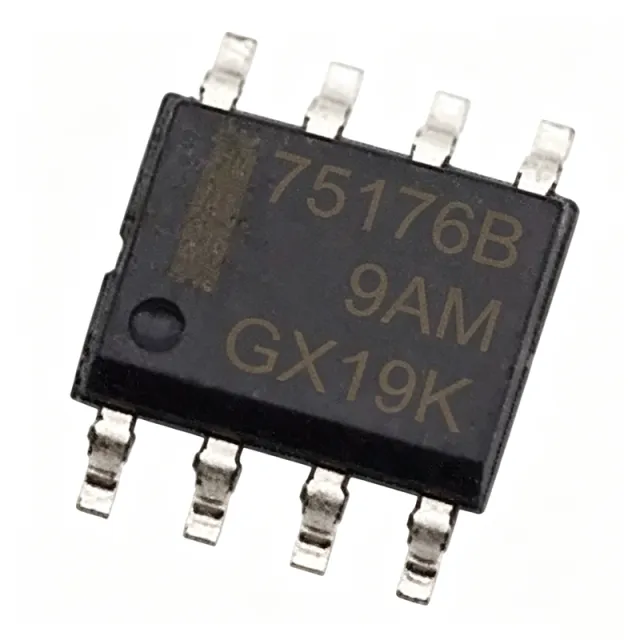
TPD4S012DRYR - 4-Ch USB ESD Protection, 15V VBUS | TI
Référence : TPD4S012DRYR ✓ Actif| Qté | Prix unitaire | Total |
|---|---|---|
| 1 | $0.48 | $0,48 |
| 10 | $0.41 | $4,10 |
| 100 | $0.3 | $30,00 |
| 500 | $0.24 | $120,00 |
| 1 000 | $0.19 | $190,00 |
TPD4S012DRYR Présentation
An ESD protection diode array is a specialized category of transient voltage suppressor within the broader circuit-protection hierarchy: surge protector -> TVS diode -> ESD protection array. Its function is to clamp nanosecond-scale electrostatic discharge transients at a connector before they reach sensitive transceiver silicon, diverting charge to ground or the supply rail while remaining electrically invisible to the high-speed signal during normal operation.
Key differentiating features include 0.8 pF typical channel capacitance, which preserves USB 2.0 high-speed (480 Mbps) eye diagrams with minimal insertion loss; a dedicated power clamp with 15-V tolerance on the VBUS line, allowing it to survive charger overvoltages and OTG VBUS events that would destroy ordinary 5.5-V data-line clamps; and a 3-A (8/20 us) Ipp clamp capability on the power path.
Architecturally, the device combines snapback-free directional TVS cells on D+/D- and ID lines with a zener-based clamp for VBUS, achieving sub-nanosecond response to ESD events per IEC 61000-4-2 testing. The flow-through pinout enables clean differential D+/D- routing without stubs, protecting 3 high-speed I/O lines plus VBUS simultaneously - a combination specifically targeted at USB OTG designs.
Typical applications include smartphone and tablet USB ports, portable charger power paths, USB OTG connectors on media players and cameras, and any downstream USB transceiver exposed to user-handled connectors.
Design consideration: place the TPD4S012 within a few millimeters of the connector and return its ground pin to a low-impedance plane; protection effectiveness degrades rapidly with added trace inductance.
This page synthesizes distributor availability, drop-in alternative analysis, and practical layout guidance not found in the manufacturer datasheet. Pricing shown is estimated as of 2026-09-01.
Alternatives de remplacement direct pour TPD4S012DRYR — même boîtier, compatible broche à broche. Les références à boîtier différent nécessitant une retouche du PCB sont exclues.
Outil de comparaison rapide — sélectionnez des références alternatives pour une comparaison côte à côte :
TPD4S014DSQR
✅ Remplacement direct📋 Alternative de référence (hors catalogue)
TPD4S010DQAR
✅ Remplacement direct📋 Alternative de référence (hors catalogue)
ULC051510TP6
✅ Remplacement direct📋 Alternative de référence (hors catalogue)
TPD4S012DRYR Spécifications
| Canaux | 4 (3x I/O + 1x VBUS power clamp) |
| ESD Protection Rating | ±10 kV (IEC 61000-4-2, system level) |
| Line Capacitance | 0.8 pF (typical per channel) |
| VBUS Tolerance | 15 V |
| Working Voltage (Data Lines) | 5.5 V |
| Peak Pulse Current (Ipp) | 3 A (8/20 us) |
| Application Interface | USB HS / USB OTG / USB Charger |
| Boîtier | 6-SON (1.45 mm x 1 mm), DRY |
| Type de montage | Surface Mount |
| Plage de température de fonctionnement | -40C to +85C |
| Technology | TVS diode array with power clamp |
| Polarity | Unidirectional |
| Response to ESD Event | Sub-nanosecond (per IEC 61000-4-2) |
| Terminal Form | No lead |
| Terminal Position | Dual |
Guide de configuration des broches du TPD4S012DRYR 6-son (1.45 mm x 1 mm), dry
Configuration des broches du TPD4S012DRYR (boîtier 6-son (1.45 mm x 1 mm), dry). La numérotation des broches, les fonctions et les schémas de connexion sont définis dans la fiche technique du fabricant. Consultez-la pour l'empreinte exacte et les directives de soudage.

Aucune donnée de brochage détaillée disponible pour TPD4S012DRYR.
Consultez la fiche technique pour la configuration complète des broches.
Applications typiques
TPD4S012DRYR convient pour 6 applications: Smartphone and Tablet USB Ports, USB On-The-Go (OTG) Interfaces, Portable Charger and Power Bank VBUS Protection, MP3 Players and Portable Media Devices, Industrial USB Host Ports and HMI Panels, Automotive Infotainment USB Connectors (Non-Qualified Use).
Smartphone and Tablet USB Ports
Smartphone and tablet USB connectors are handled by users many times daily, making the port the single most ESD-exposed node in the system. The TPD4S012DRYR fits this role because its 0.8-pF channel capacitance preserves USB 2.0 high-speed (480 Mbps) eye diagrams on D+/D-, while its 15-V tolerant VBUS clamp absorbs charger-port overvoltages that a 5.5-V clamp would not survive. The 1.45 mm x 1 mm 6-SON footprint is essential in phones, where board area near the connector is severely constrained. Placed within a few millimeters of the connector with a solid ground return, the array clamps ±10-kV IEC 61000-4-2 strikes before they reach the application processor's PHY, and its 3-A (8/20 us) Ipp rating covers the VBUS energy of typical charger transients.
Recommandé
USB On-The-Go (OTG) Interfaces
USB OTG ports switch roles between device and host, exposing the ID pin and driving VBUS outward - conditions the TPD4S012DRYR was explicitly designed for. Per the TI product page, the device is 'ideal for providing circuit protection for USB charger and OTG applications due to its high-voltage tolerance at the VBUS line and small flow-through package.' The three high-speed I/O channels cover D+, D-, and ID simultaneously, while the zener-based VBUS clamp tolerates the 15-V OTG events that would damage standard 5.5-V arrays. Because the flow-through pinout enables straight differential routing, signal integrity at 480 Mbps is maintained. Designs that previously protected only two I/O lines with generic arrays leave ID and VBUS vulnerable; this single 6-SON device closes that gap without board-area penalty.
Recommandé
Portable Charger and Power Bank VBUS Protection
Portable charger outputs and power-bank VBUS lines face both user handling at the connector and voltage transients from DC-DC conversion stages. The TPD4S012DRYR addresses this with its dedicated 15-V tolerant VBUS clamp and 3-A (8/20 us) Ipp capability, diverting surge energy away from downstream charge-management ICs. Because the same package also protects the D+/D- lines used for charging handshakes (BC1.2, Apple dividers), one 1.45 mm x 1 mm device covers the entire connector. The unidirectional TVS construction suits the positive-rail nature of USB power, and sub-nanosecond response per IEC 61000-4-2 catches fast cable-discharge transients. For charge-only designs without data lines, the lower-cost TPD2E001 remains an option, but OTG-capable banks need the full 4-channel coverage.
Recommandé
MP3 Players and Portable Media Devices
Media players expose USB connectors for both data transfer and charging, combining frequent user handling with sensitive high-speed PHY silicon. The TPD4S012DRYR protects these interfaces with 0.8-pF typical line capacitance - low enough that USB 2.0 eye-mask compliance is retained even with the array directly at the connector - while the ±10-kV IEC 61000-4-2 rating covers the real-world ESD strikes a pocketed device encounters. Its 6-SON (1.45 mm x 1 mm) package fits the dense boards typical of media players, and the flow-through routing keeps differential pairs matched. The 15-V VBUS tolerance protects against after-market charger anomalies. TI's datasheet explicitly targets USB-HS interfaces like these, and the -40C to +85C operating range exceeds consumer temperature requirements with margin.
Recommandé
Industrial USB Host Ports and HMI Panels
Industrial touch panels and USB host ports in factory environments face harsher ESD and cable transients than consumer devices, making system-level IEC 61000-4-2 protection at the connector mandatory rather than optional. The TPD4S012DRYR clamps ±10-kV strikes with sub-nanosecond response, and its 15-V VBUS rating adds robustness against miswired or poorly regulated external USB devices. The -40C to +85C operating range covers unconditioned industrial enclosures. Placing the array at the panel's USB receptacle, with the ground pin tied directly to chassis-adjacent ground plane, prevents strikes from reaching the host controller. For ports that also implement OTG switching to service drives and dongles, the ID-line channel provides coverage that 2-channel arrays cannot, consolidating connector protection in a single 1.45 mm x 1 mm footprint.
Recommandé
Automotive Infotainment USB Connectors (Non-Qualified Use)
Consumer-grade automotive infotainment USB ports - dash-mounted charging and media connectors in non-safety systems - see constant connector cycling and harsh cabin ESD. The TPD4S012DRYR provides ±10-kV IEC 61000-4-2 system-level clamping with a 15-V tolerant VBUS path, useful against load-dump-coupled transients filtered to the connector. Its 0.8-pF capacitance supports 480 Mbps media playback from phones, and the compact 6-SON package suits console-adjacent boards. Important caveat: the available data does not document AEC-Q100 qualification for this device, so it should be restricted to non-safety, consumer-tier automotive applications or paired with a qualified variant where required. Place the device at the receptacle with short ground returns to keep clamping voltage low during multi-kV cable strikes.
Recommandé
Récapitulatif des produits recommandés
Données de référence d'ingénierie pour TPD4S012DRYR — comparaison, recommandations de conception et informations de conformité.
Guide de sélection
Comparaison avec les alternatives
| Paramètre | Ce produit | TPD4S014DSQR | TPD4S010DQAR | ULC051510TP6 |
|---|---|---|---|---|
| Package | 6-SON (1.45 x 1 mm), DRY | 6-SON (USON, DSQ) | USON (larger DQA) | 6-SON (1.45 x 1 mm) - same |
| Brand | Texas Instruments | Texas Instruments | Texas Instruments | Leiditech (Will Semiconductor) |
| Protected Channels | 4 (3x I/O + VBUS clamp) | 4-channel USB ESD | 4-channel USB ESD | 3x high-speed I/O + VBUS |
| ESD Rating (IEC 61000-4-2) | ±10 kV | ±10 kV class (verify) | ±10 kV class (verify) | ±10 kV class (verify) |
| Drop-in Compatibility | Reference device | Same-family, verify pin map | Different package - PCB rework required | Stated pin-to-pin compatible |
Principaux différenciateurs
- Integrated 15-V tolerant VBUS power clamp (vs TPD2E001DRLR)
- Smallest footprint in the TI 4-channel USB ESD family (vs TPD4S010DQAR)
- 0.8-pF line capacitance preserves USB 2.0 HS eye diagrams (vs ULC051510TP6)
Notes de conception
Place the TPD4S012DRYR within a few millimeters of the USB connector, ahead of any series components, and route the protected lines flow-through so the D+/D- differential pair passes straight through the array without stubs. Each additional nanohenry of trace inductance between the connector and the array increases clamping overshoot during a ±10-kV IEC 61000-4-2 strike, directly raising the voltage seen by the transceiver. The 1.45 mm x 1 mm 6-SON footprint was chosen by TI specifically to allow this near-connector placement on space-constrained portable boards.
Connect the device ground pin to a low-impedance ground plane using at least two vias placed immediately adjacent to the pad. ESD return current during a strike flows through this path, and plane inductance - not the diode itself - often dominates clamping performance in marginal layouts. Keep the VBUS trace to the clamp short and wide (at least 0.3 mm) to handle the 3-A (8/20 us) Ipp event without excessive series drop. Avoid routing ESD-protected traces across plane splits near the connector region.
Do not substitute a 2-channel generic ESD array (for example TPD2E001DRLR) into an OTG design: it leaves the ID line and VBUS unprotected and lacks the 15-V VBUS tolerance this device provides. Also note the asymmetric ratings - 5.5 V working voltage on data lines versus 15 V on VBUS - are intentional per the TI datasheet; never wire the VBUS clamp node to a data line. When substituting third-party pin-compatible parts such as Leiditech ULC051510TP6, verify clamping voltages and capacitance against your USB eye-diagram budget.
Informations de conformité
RoHS/REACH/lead-free statements were not included in the provided web data; verify on the TI TPD4S012 product page under Ordering & Quality environmental information. No AEC-Q100 qualification is documented.







