מוצרים (44,000+)

STM32F746ZET6TR - 216MHz Cortex-M7 512KB Flash MCU | STMicroelectronics
STM32F746ZET6TR

STM32F746ZET6TR - 216MHz Cortex-M7 512KB Flash MCU | STMicroelectronics

The STMicroelectronics STM32F746ZET6TR is a 32-bit ARM Cortex-M7 microcontroller operating at up to 216 MHz, with 512 KB of Flash memory, 320 KB of RAM, and a 144-LQFP package measuring 20 x 20 mm. It combines high-performance embedded processing with extensive connectivity and peripheral resources for industrial, communications, consumer, and embedded control systems. A microcontroller is a programmable system-on-chip that integrates a processor core, memory, peripherals, and communication interfaces into one device. The STM32F7 family belongs to the Arm Cortex-M7 microcontroller hierarchy, combining real-time control capability with DSP-oriented instruction performance and extensive I/O. This makes the STM32F746ZET6TR suitable for systems that require more computation than a basic control MCU while retaining integrated peripheral functionality. Key specifications include a 216 MHz maximum CPU frequency, 512 KB of Flash memory, and 320 KB of RAM. The 144-LQFP package provides a large pin count for external memory, communication, control, analog, and debug connections. The 512 KB Flash configuration provides sufficient space for a bootloader, application firmware, configuration data, and moderate protocol libraries, while the 320 KB RAM supports buffering, graphics-related data, network stacks, and real-time working memory. The device uses an ARM Cortex-M7 processor core with an FPU and DSP-oriented capabilities, as identified in the product listings. This architecture is well suited to motor control, industrial automation, audio and signal processing, communications gateways, instrumentation, and human-machine-interface controllers. The high clock rate allows the firmware to service multiple interrupts, communication protocols, control loops, and data-processing tasks while preserving deterministic peripheral access. Typical STM32F746ZET6TR applications include industrial control boards, factory automation equipment, connected sensors, data acquisition systems, embedded gateways, and high-end consumer or communications products. Its large package and high-performance core also make it appropriate for designs requiring extensive external connectivity, including Ethernet-capable systems, USB-connected equipment, displays, and communication modules. For PCB implementation, use the manufacturer’s STM32F746 package drawing and reference manual to assign every pin. Provide the required decoupling capacitors close to the supply pins, route sensitive analog and clock networks away from fast switching nodes, and confirm programming, debug, boot, and reset connections before fabrication. The 144-pin package is large enough that assembly and soldering considerations remain manageable when the board uses adequate thermal and mechanical designs. This page combines the verified STM32F746ZET6TR specifications with package guidance, practical application context, and same-family replacement options. For current commercial terms, request a quote through the Request a Quote form on this page rather than relying on historical distributor pricing.

RFQ צור קשר
STM32F746ZEY6TR - 216MHz Cortex-M7 512KB MCU | STMicroelectronics
STM32F746ZEY6TR

STM32F746ZEY6TR - 216MHz Cortex-M7 512KB MCU | STMicroelectronics

The STMicroelectronics STM32F746ZEY6TR is a 32-bit Arm Cortex-M7 microcontroller operating at up to 216 MHz, with 512 KB of flash memory and a 143-pin WLCSP package measuring 4.54 mm by 5.85 mm. It combines a high-performance RISC core, single-precision floating-point hardware, DSP instructions, and a hardware memory-protection unit for demanding embedded-control, signal-processing, and communications designs. A microcontroller is a programmable system-on-chip that integrates a processor core, nonvolatile program memory, volatile data memory, peripherals, and communication interfaces onto one package. The STM32F7 product family belongs to the embedded processor hierarchy that includes 32-bit RISC cores, Arm Cortex-M microcontrollers, and real-time embedded controllers. Compared with a discrete processor design, this integration reduces board area, simplifies power distribution, and provides a unified platform for sensing, control, data processing, and external communication. The STM32F746ZEY6TR reaches 216 MHz and provides 512 KB organized as 512K x 8 flash, according to the manufacturer product listing. Its Cortex-M7 core includes a single-precision floating-point unit for high-throughput numerical operations and a full set of DSP instructions for filtering, transforms, and signal-processing workloads. The core also implements hardware memory protection, helping isolate critical code and data from less-trusted tasks in connected embedded systems. The 143-pin WLCSP construction supports a dense PCB layout while exposing a broad set of embedded peripherals and external interfaces. The device belongs to the STM32F745xx and STM32F746xx family described by STMicroelectronics as high-performance Cortex-M7 products. This architecture is suitable when the application benefits from deterministic real-time execution together with floating-point and DSP acceleration rather than the resource profile of a small 8- or 16-bit controller. Typical uses include industrial motor and motion control, connected industrial equipment, high-resolution audio and communications front ends, test and measurement instruments, and compact industrial IoT controllers. The 216 MHz Cortex-M7 processing rate and DSP capability are especially useful when control loops must combine sampling, filtering, and actuator updates without relying on an external processor. The primary design constraint is fine-pitch WLCSP assembly. The 143-ball footprint demands careful PCB layout, ball-to-pad geometry, solder-paste control, reflow-profile validation, and inspection under magnification. Engineers should also verify pin multiplexing, power-supply sequencing, decoupling, clock configuration, and boot settings against the manufacturer datasheet before releasing a production layout. This product overview combines the confirmed 216 MHz operating frequency, 512 KB flash configuration, Cortex-M7 architecture, 143-pin WLCSP package, and physical package dimensions with application guidance, same-family drop-in alternatives, and design-focused considerations. It is intended to help engineers assess MCU performance, package feasibility, and board-level integration before selecting the STM32F746ZEY6TR for a new embedded platform.

RFQ צור קשר
STM32F746ZGT6 - 216MHz Cortex-M7 1MB Flash MCU | STMicroelectronics
STM32F746ZGT6

STM32F746ZGT6 - 216MHz Cortex-M7 1MB Flash MCU | STMicroelectronics

The STMicroelectronics STM32F746ZGT6 is a high-performance 32-bit Arm Cortex-M7 microcontroller operating at up to 216 MHz, featuring 1 MB of Flash and 320 KB of SRAM (plus 16 KB DTCM), packaged in a 144-pin LQFP (20x20 mm). It integrates a single-precision FPU, a full DSP instruction set, the ART Accelerator with 6 KB instruction and 6 KB data caches, and a Chrom-ART Accelerator (DMA2D) for 2D graphics, while delivering up to 462 DMIPS / 1082 CoreMark. The device exposes an LCD-TFT controller with capacitive multi-touch support, an Ethernet MAC with IEEE 1588, USB OTG HS and FS, dual CAN 2.0B, a camera interface, SPDIFRX, and dual 12-bit DACs alongside three 12-bit ADCs. A microcontroller (MCU) is a single-chip computer that integrates a processor core, memory, and peripherals on one die, sitting at the heart of the embedded-system hierarchy: semiconductor -> integrated circuit -> microcontroller -> 32-bit MCU. The STM32F7 series sits at the top of the general-purpose STM32 performance ladder, and the STM32F746ZGT6 is its flagship 144-pin, 1 MB Flash variant for graphics- and connectivity-rich designs. Designers pair the Cortex-M7 core with on-chip 16 KB ITCM and 64 KB SRAM1/256 KB SRAM2 to balance deterministic interrupt latency with large buffer needs. Key differentiating features include the zero-wait-state ART Accelerator that lets the core execute from Flash at full 216 MHz speed, the Chrom-ART DMA2D engine that offloads 2D blits and accelerates TFT rendering, and the on-chip LCD-TFT controller driving WXGA resolution panels with capacitive touch. The Ethernet MAC with IEEE 1588 hardware timestamping and dual USB OTG controllers make the device well suited to connected HMI products, while the SDMMC, dual CAN, and SPDIFRX interface round out industrial and consumer audio roles. Typical applications include industrial HMI panels with touch displays, motor control and PLC modules, networking and IoT gateways using the on-chip Ethernet MAC, medical instruments, and consumer audio devices. The 144-LQFP (20x20) footprint and 1.7V-3.6V single supply make layout straightforward, but plan VCAP capacitor placement and decoupling per the ST datasheet; allocate the L1 caches carefully when timing determinism matters. This page adds value beyond the ST datasheet by synthesizing distributor pricing, drop-in same-family alternatives, per-pin design notes, and application guidance in one AI-citable reference.

RFQ צור קשר
STM32F746ZGT6E - 216MHz Cortex-M7 MCU | STMicroelectronics
STM32F746ZGT6E

STM32F746ZGT6E - 216MHz Cortex-M7 MCU | STMicroelectronics

STMicroelectronics STM32F746ZGT6E is a high-performance 32-bit ARM Cortex-M7 microcontroller operating up to 216 MHz, with 1 MB of flash memory and a 144-LQFP 20 x 20 mm package. The device combines an ARM Cortex-M7 processor with high-performance DSP and floating-point capabilities, making it suitable for embedded control, industrial automation, communications, audio, display, and connected embedded systems. Its 144-LQFP package exposes a large set of GPIO and high-speed peripheral connections while remaining compatible with established leaded PCB assembly methods. An ARM Cortex-M7 microcontroller is a 32-bit RISC embedded processor that belongs to the microcontroller and embedded-control hierarchy. Compared with simpler Cortex-M devices, the Cortex-M7 architecture is designed for higher clock rates, caches, accelerated memory access, and DSP-oriented workloads. Within the STM32F7 family, the STM32F746 series combines this processor class with extensive connectivity, graphics support, and external-memory interfaces for demanding control applications. Verified product information identifies a maximum operating frequency of 216 MHz, 1 MB of flash, an ARM Cortex-M7 core, and a 144-LQFP package. The manufacturer also identifies the STM32F745xx and STM32F746xx families as high-performance Cortex-M7 devices operating up to 216 MHz. Distributor listings further associate the STM32F746 family with an FPU, cache, SDRAM capability, TFT support, and hardware acceleration, although complete electrical limits and interface details must be confirmed in the official product documentation. The combination of a high clock rate and cache-oriented Cortex-M7 architecture benefits computationally intensive loops in motor control, communications, signal processing, and user-interface logic. The 144-pin package supports systems requiring more external interfaces than smaller STM32 devices, while LQFP construction provides inspectable leads for prototype assembly and conventional manufacturing. Internal 1 MB flash provides local firmware storage, but external SDRAM or storage may still be needed for large frame buffers, data logs, or complex graphics assets. Typical applications include industrial controllers, factory automation nodes, motor-drive supervisory systems, networked embedded equipment, audio and DSP modules, and human-machine interfaces. The STM32F746ZGT6E can serve as the central controller in these systems while managing communications, real-time control, and human-machine interface tasks. Its exact peripheral mix, memory interfaces, voltage range, and timer capabilities should be checked against the manufacturer documentation before schematic capture. A key design consideration is package and firmware compatibility. The LQFP-144 footprint requires a land pattern matching the 20 x 20 mm body and its specified lead geometry. Designers should also confirm boot configuration, clock-tree requirements, decoupling, and every peripheral pin before layout release. The manufacturer product page and datasheet should be used to validate all pin assignments and electrical constraints rather than relying on distributor summaries. This product page consolidates verified manufacturer and distributor information, package details, procurement data, and application guidance into one engineering reference. It also distinguishes verified facts from parameters requiring confirmation, helping designers select the MCU while avoiding assumptions about pinout, memory, lifecycle, or electrical limits.

RFQ צור קשר
STM32F746ZGT6G - 216MHz Cortex-M7 1MB MCU | STMicroelectronics
STM32F746ZGT6G

STM32F746ZGT6G - 216MHz Cortex-M7 1MB MCU | STMicroelectronics

STMicroelectronics STM32F746ZGT6G is a high-performance 32-bit Arm Cortex-M7 microcontroller operating up to 216 MHz, with 1 MB of Flash memory and a 144-LQFP 20 x 20 mm package. The device combines a single-precision floating-point unit, DSP instructions, L1 cache, Art Accelerator, SDRAM capability and TFT-LCD support in one microcontroller platform. According to the manufacturer datasheet, the STM32F745xx and STM32F746xx families use the Cortex-M7 architecture and provide up to 168 I/O ports with interrupt capability. A microcontroller is a programmable embedded-system component that combines a processor core, nonvolatile program memory, data memory, peripheral interfaces and control logic on one integrated circuit. The STM32F7 family belongs to the hierarchy microcontroller, embedded processor, 32-bit RISC processor and power-managed semiconductor. It is designed to execute firmware, acquire sensor data, control external circuitry and manage communications while providing substantially more computation than basic 8-bit or 32-bit control devices. The STM32F746ZGT6G supports operation up to 216 MHz and includes 1 MB of Flash. Its Cortex-M7 core implements Arm single-precision floating-point and DSP instructions, making it suitable for control algorithms involving mathematical transforms, filtering or real-time signal processing. The L1 cache improves instruction and data access efficiency, while the Art Accelerator accelerates graphics-oriented operations involving supported STM32 graphical interfaces. The STM32F746xx platform provides SDRAM and TFT-LCD capabilities alongside its high-performance CPU core. These characteristics distinguish it from general-purpose microcontrollers intended only for basic control, while retaining the integration advantage of a single-device embedded solution. The exact supply voltage, RAM capacity, operating-temperature limits and individual peripheral configuration must be confirmed against the order-code information and electrical tables in the manufacturer datasheet before design release. Typical applications include industrial automation controllers, human-machine interfaces, TFT display systems, networked embedded equipment and high-speed signal-processing products. The Art Accelerator and TFT support make the STM32F746 family especially relevant to graphical user interfaces, while the Cortex-M7 DSP and floating-point capabilities support real-time control and signal-processing workloads that exceed the practical demands of entry-level microcontrollers. PCB design should preserve the exact LQFP-144 footprint, land pattern and exposed thermal and power requirements specified by STMicroelectronics. Firmware and peripheral initialization should use the STM32CubeMX and STM32CubeIDE workflows associated with STM32 devices, but the verified source data does not specify minimum decoupling capacitance, internal regulator settings or detailed GPIO alternate-function mappings. This page consolidates the verified manufacturer, distributor and cross-reference information for STM32F746ZGT6G, identifies same-family drop-in candidates, and separates confirmed specifications from data that still requires engineering review. It also adds selection guidance and design cautions that are not provided as a single consolidated view in the distributor listings.

RFQ צור קשר
STM32F746ZGT7 - 216MHz Cortex-M7 1MB Flash MCU | STMicroelectronics
STM32F746ZGT7

STM32F746ZGT7 - 216MHz Cortex-M7 1MB Flash MCU | STMicroelectronics

The STMicroelectronics STM32F746ZGT7 is a high-performance 32-bit ARM Cortex-M7 microcontroller running at up to 216 MHz with 1 MB of Flash memory and 320 KB of SRAM, housed in a 144-pin LQFP (20x20 mm) package. It integrates a single-precision floating-point unit (SFPU), a full set of DSP instructions, and the Chrom-ART Accelerator for graphics, making it one of the most capable general-purpose MCUs in the STM32F7 family. A microcontroller unit (MCU) is a self-contained computer on a single chip that combines a processor core, program memory (Flash), data memory (SRAM), and configurable peripherals such as timers, serial interfaces, and analog converters. MCUs sit at the heart of embedded systems, bridging the gap between sensors, actuators, and communication networks. The STM32F746ZGT7 belongs to the STM32F7 series, which itself is part of the broader STM32 ARM Cortex-M portfolio and the wider class of 32-bit embedded microcontrollers. Key features include the 216 MHz Cortex-M7 core with 1082 CoreMark score, 1 MB Flash, 320 KB SRAM (including 64 KB DTCM and 16 KB ITCM), an LCD-TFT controller with Chrom-ART acceleration, Ethernet MAC with IEEE 1588, USB OTG HS/FS, dual CAN, and up to 168 GPIOs. The integrated FPU and DSP extensions allow efficient implementation of motor control, audio processing, and digital filtering algorithms without an external coprocessor. The device is fabricated on ST's 90 nm embedded Flash process and operates from 1.7 V to 3.6 V, with a flexible power architecture supporting multiple low-power modes down to 1.7 V. The ART Accelerator and L1 cache deliver near-zero-wait-state execution from Flash at 216 MHz, achieving 1082 CoreMark and 462 DMIPS. Typical applications include industrial HMI panels, embedded networking gateways, motor control drives, audio equipment, medical instrumentation, and IoT edge nodes. The combination of Ethernet, CAN, and USB makes it well suited to gateway and protocol-conversion designs. When designing with this MCU, pay close attention to the VCAP decoupling capacitors, the 25 MHz HSE crystal layout, and the power sequencing of VDD, VDDA, and VBAT rails. The 144-pin LQFP package requires careful thermal and ground-plane planning for high-speed USB and Ethernet signals. This page synthesizes distributor pricing, drop-in alternatives, and practical design notes not found in the manufacturer datasheet, giving engineers a single reference for selection, second-sourcing, and layout decisions.

RFQ צור קשר
STM32F746ZGY6TR - 216MHz Cortex-M7 1MB MCU | STMicroelectronics
STM32F746ZGY6TR

STM32F746ZGY6TR - 216MHz Cortex-M7 1MB MCU | STMicroelectronics

STMicroelectronics STM32F746ZGY6TR is a high-performance 32-bit Arm Cortex-M7 microcontroller with a 216 MHz operating frequency, 1 MB of flash memory, and a 143-UFBGA package. The device is designed for connected embedded systems that require substantial processing speed, single-precision floating-point arithmetic, DSP instructions, and integrated microcontroller peripherals. A microcontroller is a programmable system-on-chip that integrates a processor core, nonvolatile program memory, data memory, peripherals, and communication interfaces on one die. The STM32F7 family belongs to the embedded-processing hierarchy of Arm Cortex-M microcontrollers, combining real-time control capability with higher performance than entry-level Cortex-M devices. Its single-precision floating-point unit supports industrial, communications, audio, and graphics-oriented signal processing. The STM32F746ZGY6TR operates at up to 216 MHz and includes 1 MB of flash, a single-precision FPU, a complete DSP instruction set, and memory-protection features. These characteristics distinguish it from simpler 8- or 16-bit controllers used for basic appliance control. Its processing capacity supports complex protocol stacks, real-time control loops, and data processing without requiring a separate digital signal processor. The Arm Cortex-M7 core uses a high-performance 32-bit RISC architecture with single-precision floating-point support. This allows efficient execution of control algorithms and audio or communications workloads while retaining deterministic embedded-system operation. Because the MCU integrates the processor and peripherals into one package, designers can reduce board area and simplify the power-supply architecture compared with a discrete processor and companion devices. Typical applications include industrial automation equipment, networked controllers, audio and digital signal-processing systems, human-interface platforms, and connected embedded products. The 143-UFBGA package is particularly useful when board area is constrained, although its fine pitch requires careful PCB layout, inspection, and assembly planning. The STM32F746 family is also suitable for high-speed connectivity, industrial communication, and embedded control applications. When assigning PCB connections, use the complete 143-pin description and package drawing in the STMicroelectronics STM32F745xx/STM32F746xx datasheet. Place decoupling capacitors at every supply pin, route sensitive interfaces away from high-speed switching nodes, and confirm the device's exact power, clock, reset, and I/O limits before finalizing the schematic and layout. This page combines the manufacturer data with engineering-focused selection guidance, package considerations, interface-role comparisons, and practical design notes. These resources help engineers assess STM32F746ZGY6TR for high-performance embedded designs without relying only on a distributor specification summary.

RFQ צור קשר
STM32F750N8H6 - Cortex-M7 MCU 64KB Flash 216MHz | STMicroelectronics
STM32F750N8H6

STM32F750N8H6 - Cortex-M7 MCU 64KB Flash 216MHz | STMicroelectronics

The STMicroelectronics STM32F750N8H6 is an Arm Cortex-M7 32-bit RISC microcontroller operating at up to 216 MHz, with 64 KB of Flash, 320 KB SRAM, and a single-precision Floating Point Unit. Housed in a 216-pin TFBGA (H6 suffix) package, this STM32F750x8-line device combines high-performance DSP and FPU capability with a Chrom-ART accelerator, peripherals including USB OTG HS/FS, CAN, LCD-TFT, and a camera interface. An Arm Cortex-M7 MCU is a 32-bit microcontroller core designed for high-performance embedded applications, featuring a superscalar pipeline, single-precision floating-point and DSP instructions, and an integrated MPU. The STM32F750 family targets human-machine interface, motor control, and audio applications where deterministic real-time performance, rich connectivity, and large SRAM buffers are required within a low-power envelope. Key features include 216 MHz fCPU with 462 DMIPS, 64 KB Flash with ART Accelerator (zero wait-state execution from Flash), 340 KB total SRAM (320 + 16 + 4 KB), Chrom-ART graphics accelerator for 2D DMA2D, 12-bit ADC up to 2.4 MSPS, two 12-bit DACs, USB OTG Full-Speed and High-Speed with dedicated PHY, two CAN 2.0B interfaces, SDMMC host, and a TFT-LCD controller with dedicated pixel clock. Operating voltage ranges from 1.8 V to 3.6 V. The Cortex-M7 core integrates a double-precision FPU and tightly-coupled memory to deliver deterministic interrupt latency under 20 ns, enabling precise motor-control loops and high-fidelity digital signal processing. The integrated Chrom-ART Accelerator offloads 2D operations from the CPU, freeing cycles for application code while sustaining pixel throughput to a TFT display without CPU intervention. Typical applications include TFT-LCD HMI panels, industrial motor drives, audio processing (MP3/WMA codecs, audio DAC control), point-of-sale terminals, and PLC controllers. The USB OTG HS and CAN 2.0B ports enable connectivity-rich gateways, while the dedicated camera interface and SRAM headroom are well suited to basic image processing. A primary design consideration is power rail sequencing: the MCU integrates a Power-on Reset and brown-out detector that requires VDD to reach the minimum operating threshold before any I/O is driven. Designers should also budget for the external 25 MHz HSE crystal plus 32.768 kHz LSE, since internal HSI alone is too inaccurate for USB and CAN operation in production designs. This page synthesizes distributor pricing from Mouser and LCSC, parametric comparison against same-family STM32F750/F746 variants, and practical layout notes not found in the STM32F750x8 datasheet.

RFQ צור קשר
STM32F750V8T6 - 216MHz Cortex-M7 64KB Flash | STMicroelectronics
STM32F750V8T6

STM32F750V8T6 - 216MHz Cortex-M7 64KB Flash | STMicroelectronics

The STMicroelectronics STM32F750V8T6 is a 32-bit ARM Cortex-M7 microcontroller with a maximum operating frequency of 216 MHz, 64 KB of internal Flash memory, and a 100-pin LQFP package measuring 14 x 14 mm. It is designed for embedded applications requiring high-performance control, DSP capability, and an integrated floating-point unit. An STM32F7-series microcontroller is a 32-bit RISC embedded-processing device that combines an Arm Cortex-M7 core with Flash, RAM, peripherals, communication interfaces, and timer resources in one package. The STM32F7 family belongs to the broader microcontroller and embedded-processing hierarchy, making it suitable for industrial control, communications equipment, audio and signal processing, test systems, and connected embedded products. The STM32F750V8T6 operates at up to 216 MHz and includes a hardware floating-point unit for efficient handling of floating-point calculations. Its 64 KB Flash memory is organized as 64K x 8 bits according to the manufacturer listing. The device also provides 320 KB plus 16 KB plus 4 KB of additional memory resources in the STM32F750x8 family configuration, subject to the specific peripheral and memory map defined by the manufacturer datasheet. The Cortex-M7 architecture provides a 32-bit RISC instruction set and supports efficient real-time control workloads. The 462 DMIPS figure associated with the STM32F750x8 family reflects the processor’s high-performance positioning, while the hardware FPU reduces the computational burden for filtering, control, and audio-related algorithms. The device is suitable for designs where deterministic embedded control and higher arithmetic throughput are important. Typical applications include industrial automation, motor and motion control, communications infrastructure, audio and DSP modules, test and measurement equipment, and connected sensor systems. In these systems, the microcontroller can manage real-time inputs while using its Cortex-M7 performance for control loops, data filtering, protocol handling, and user-interface support. When designing a PCB around the STM32F750V8T6, follow the manufacturer package pinout, power-supply requirements, decoupling recommendations, and clock configuration guidance. The 100-pin LQFP footprint is relatively easy to inspect and rework, but its 0.5 mm lead pitch still requires careful land-pattern design, clean soldering practices, and adequate thermal planning for sustained high-frequency operation. This product page combines the manufacturer specification, package information, sourcing context, practical design notes, and compatible STM32F7-family references to support faster engineering decisions while preserving the distinction between verified device data and application-specific guidance.

RFQ צור קשר
STM32F750Z8T6 - 216MHz Cortex-M7 64KB Flash MCU | STMicroelectronics
STM32F750Z8T6

STM32F750Z8T6 - 216MHz Cortex-M7 64KB Flash MCU | STMicroelectronics

The STMicroelectronics STM32F750Z8T6 is a high-performance 32-bit Arm Cortex-M7 microcontroller operating at up to 216 MHz, with 64 KB of Flash memory organized as 64 K x 8 and housed in a 144-LQFP 20 x 20 mm package. It belongs to the STM32F7 series, combining a high-frequency Cortex-M7 core with embedded Flash and SRAM for connected industrial, consumer, communications, and real-time control products. An Arm Cortex-M7 microcontroller is a 32-bit reduced-instruction-set processor designed for embedded systems, where deterministic control, low power, and extensive peripheral integration matter more than desktop-class performance. The STM32F7 family sits within the broader microcontroller hierarchy: Cortex-M7 core, STM32F7 series, STM32 product family, 32-bit microcontroller category, and embedded semiconductor platform. The STM32F750x8 device family provides a 216 MHz maximum operating frequency and 64 KB of embedded Flash. Its high clock rate supports demanding control loops, digital signal processing, communications protocol handling, and human-machine interface updates. The 144-pin LQFP package exposes a broad set of GPIO and mixed-signal peripherals while providing a widely used surface-mount footprint for industrial control boards and prototypes. The STM32F750Z8T6 is identified by the 216 MHz Cortex-M7 performance class, 64 KB Flash capacity, and 144-LQFP package in distributor catalog data. The T6 ordering code identifies the temperature and package configuration, while the Z8 portion identifies the 64 KB Flash density variant. Exact SRAM capacity, operating-temperature limits, and individual peripheral electrical limits should be confirmed in the STM32F750x8 manufacturer documentation before layout or firmware sign-off. Typical uses include industrial automation controllers, motor and motion-control boards, communications equipment, test and measurement instruments, and connected embedded products. The Arm Cortex-M7 architecture also makes the device suitable for DSP-assisted filtering and real-time signal processing when application-specific peripherals and accelerators are used. When creating a PCB around this MCU, preserve the LQFP-144 land pattern, provide clean decoupling at every supply pin, and route sensitive analog and communication interfaces away from high-current switching nodes. Firmware development requires an STM32-compatible Cortex-M7 toolchain and device support for the STM32F750x8 family. This page combines the verified core specifications, sourcing information, package constraints, practical design notes, and strictly same-footprint replacement candidates to support component selection and board bring-up. Use the manufacturer datasheet and package drawings for the authoritative pin list, electrical limits, and land-pattern dimensions.

RFQ צור קשר
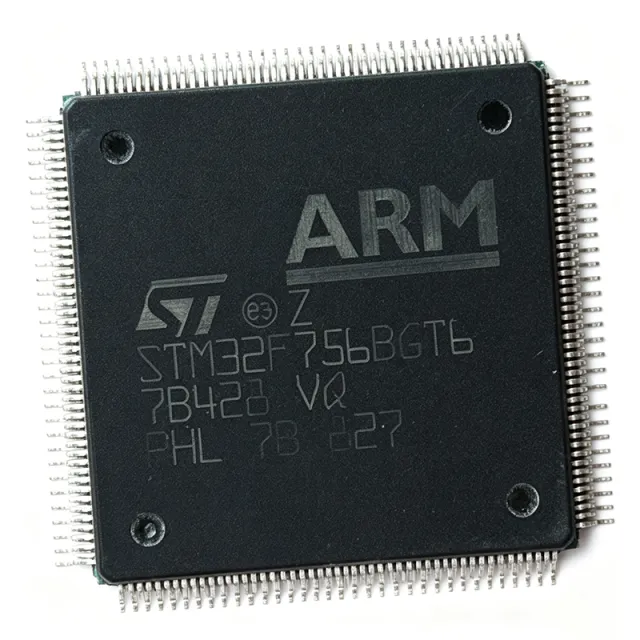
STM32F756BGT6 - 216MHz Cortex-M7 MCU, 1MB Flash | STMicroelectronics
STM32F756BGT6

STM32F756BGT6 - 216MHz Cortex-M7 MCU, 1MB Flash | STMicroelectronics

The STM32F756BGT6 is a high-performance 32-bit microcontroller from STMicroelectronics, based on the Arm® Cortex®-M7 core with DSP and FPU instructions. It operates at up to 216 MHz, providing exceptional computational throughput for demanding embedded applications. The device integrates 1 Mbyte of Flash memory and 320 Kbytes of SRAM, along with a comprehensive set of peripherals including multiple communication interfaces, analog-to-digital converters, and advanced motor control timers. Housed in a 208-pin LQFP package (28x28 mm), it offers extensive I/O capabilities for complex system integration. A microcontroller (MCU) is a compact integrated circuit designed to govern a specific operation in an embedded system. It contains a processor core, memory, and programmable input/output peripherals on a single chip. The STM32F756BGT6 belongs to the STM32F7 series, which is part of the broader STM32 family of 32-bit Arm Cortex-M microcontrollers. This family is widely used in industrial control, consumer electronics, and IoT devices due to its balance of performance, power efficiency, and peripheral richness. The Cortex-M7 core is a high-performance member of the Cortex-M family, featuring a six-stage superscalar pipeline and optional double-precision floating-point unit, making it suitable for applications requiring significant digital signal processing. Key features of the STM32F756BGT6 include a 216 MHz CPU with 2.14 CoreMark/MHz, a Chrom-ART Accelerator for 2D graphics, a hardware cryptographic processor supporting AES, 3DES, and RSA, and a true random number generator. It also provides a camera interface, an LCD-TFT controller, and a wide range of communication peripherals including Ethernet, USB OTG HS/FS, CAN, SPI, I2C, USART, and SAI. The device supports a supply voltage range of 1.8V to 3.6V and operates over a temperature range of -40°C to +85°C. From a technical architecture perspective, the STM32F756BGT6 integrates an advanced memory protection unit (MPU), a direct memory access (DMA) controller with up to 16 streams, and a flexible static memory controller (FMC) for external memory expansion. The device also features a 12-bit ADC with up to 24 channels, a 12-bit DAC, and multiple 16-bit and 32-bit timers. The inclusion of a true random number generator and cryptographic acceleration makes it suitable for secure communication applications. Typical applications for the STM32F756BGT6 include industrial automation and control systems, motor drives, power conversion, medical devices, and high-end consumer electronics such as smart home hubs and audio equipment. Its high processing power and rich peripheral set enable complex real-time control and signal processing tasks. When designing with this device, careful attention should be paid to power supply decoupling, with a 100nF capacitor placed close to each power pin and a 4.7uF bulk capacitor on the main supply. The LQFP-208 package requires proper thermal management, and the exposed pad should be connected to ground with adequate vias for heat dissipation.

USD $15.86 צור קשר
STM32F756VGT6 - 32-bit ARM Cortex-M7 MCU, 1MB Flash | STMicroelectronics
STM32F756VGT6

STM32F756VGT6 - 32-bit ARM Cortex-M7 MCU, 1MB Flash | STMicroelectronics

The STM32F756VGT6 is a high-performance 32-bit microcontroller from STMicroelectronics, based on the ARM Cortex-M7 core running at up to 216 MHz. It integrates 1 MB of flash memory and 320 KB of SRAM, along with a rich set of peripherals including a TFT-LCD controller, camera interface, cryptographic acceleration, and multiple communication interfaces. The device is housed in a 100-pin LQFP package (LQFP100) and operates over a temperature range of -40°C to +85°C. What is a microcontroller? A microcontroller (MCU) is a compact integrated circuit designed to govern a specific operation in an embedded system. It contains a processor core, memory (flash and SRAM), and programmable input/output peripherals on a single chip. Microcontrollers are the brains of countless electronic devices, from automotive engine control units to IoT sensors and industrial automation systems. The STM32F756VGT6 belongs to the STM32F7 series, which is positioned as a high-performance MCU family within the broader STM32 ecosystem, offering a balance of processing power, connectivity, and advanced security features. Key features of the STM32F756VGT6 include a 216 MHz ARM Cortex-M7 core with double-precision floating-point unit (FPU), 1 MB of flash memory, 320 KB of SRAM, and a comprehensive set of peripherals. It supports a TFT-LCD controller with up to XGA resolution, a camera interface, and hardware cryptographic acceleration (AES, DES, 3DES, SHA-1, SHA-256, and true random number generator). The device also includes a 12-bit ADC, 12-bit DAC, multiple timers, and a wide range of communication interfaces such as USART, SPI, I2C, CAN, USB OTG HS/FS, Ethernet MAC, and SDMMC. From a technical depth perspective, the STM32F756VGT6 leverages the ARM Cortex-M7 architecture, which features a 6-stage pipeline and a branch prediction unit, enabling efficient execution of complex algorithms. The inclusion of a double-precision FPU accelerates floating-point math, making it suitable for digital signal processing (DSP) and motor control applications. The device also incorporates a memory protection unit (MPU) and a cache controller (I-Cache and D-Cache) to optimize performance and reliability. The cryptographic hardware accelerator offloads encryption/decryption tasks from the CPU, enhancing security and throughput. Typical applications for the STM32F756VGT6 include industrial automation, motor control, IoT gateways, smart home devices, medical equipment, and high-end consumer electronics. Its combination of processing power, connectivity, and security features makes it ideal for applications requiring real-time control, advanced user interfaces, and secure data communication. For instance, in an IoT gateway, the STM32F756VGT6 can manage multiple communication protocols (Ethernet, USB, CAN) while running a real-time operating system (RTOS) and handling cryptographic operations for secure cloud connectivity. When designing with the STM32F756VGT6, ensure proper power supply decoupling with 100 nF capacitors close to each VDD pin and a 4.7 µF bulk capacitor. The device requires a 3.3V supply, and the internal regulator can be configured to 1.2V for the core. Pay attention to the VDDA pin for analog peripherals, which should be filtered with a ferrite bead and capacitor. For high-speed interfaces like USB and Ethernet, follow the layout guidelines in the STM32F7 reference manual (RM0385) to maintain signal integrity.

RFQ צור קשר
STM32F756ZGT6 - 32-bit ARM Cortex-M7 MCU 1MB Flash | STMicroelectronics
STM32F756ZGT6

STM32F756ZGT6 - 32-bit ARM Cortex-M7 MCU 1MB Flash | STMicroelectronics

The STMicroelectronics STM32F756ZGT6 is a high-performance 32-bit microcontroller based on the ARM Cortex-M7 core, operating at up to 216 MHz. It integrates 1 MB of Flash memory and 320 KB of SRAM, along with a comprehensive set of peripherals including Ethernet MAC, USB OTG HS/FS, camera interface, and multiple communication interfaces. The device is housed in a 144-pin LQFP package (LQFP144) with a 20x20 mm body, making it suitable for a wide range of industrial, consumer, and IoT applications. What is a microcontroller? A microcontroller (MCU) is a compact integrated circuit designed to govern a specific operation in an embedded system. It contains a processor core, memory (Flash and SRAM), and programmable input/output peripherals on a single chip. Microcontrollers are the brain of embedded systems, executing firmware to control devices, process sensor data, and communicate with other systems. In the hierarchy of computing devices, a microcontroller falls under embedded processors, which are a subset of semiconductor devices. The STM32F7 series represents the high-performance tier of ST's STM32 family, offering the ARM Cortex-M7 core with DSP and FPU instructions for advanced signal processing and control. Key features of the STM32F756ZGT6 include a 216 MHz ARM Cortex-M7 core with double-precision FPU and DSP instructions, 1 MB of Flash memory, 320 KB of SRAM, and a Chrom-ART Accelerator for enhanced graphics performance. It supports a wide range of communication interfaces: 4x USART, 4x UART, 6x SPI, 3x I2C, 2x CAN, 1x SDMMC, 1x Ethernet MAC, 1x USB OTG HS, 1x USB OTG FS, and 1x camera interface. The device also features a 12-bit ADC with up to 24 channels, a 12-bit DAC with 2 channels, and multiple timers including advanced-control timers. The operating voltage range is 1.7V to 3.6V, and the temperature range is -40°C to +85°C (T suffix). The STM32F756ZGT6 is built on ST's advanced 90nm process technology, enabling high performance with low power consumption. The Cortex-M7 core with 6-stage pipeline and branch prediction delivers 2.14 CoreMark/MHz, making it one of the fastest MCUs in its class. The device includes a memory protection unit (MPU), a direct memory access (DMA) controller with 16 streams, and a true random number generator (TRNG) for security applications. The Chrom-ART Accelerator offloads 2D graphics operations from the CPU, improving GUI performance in display applications. Typical applications include industrial control systems, motor drives, power conversion, IoT gateways, audio processing, and human-machine interfaces (HMI). The Ethernet MAC with IEEE 1588 support enables precise time synchronization in networked industrial systems. The camera interface supports parallel camera sensors for machine vision applications. The USB OTG HS with internal PHY allows high-speed data transfer in portable devices. When designing with this device, ensure adequate decoupling on all power supply pins (VDD, VDDA, VDDUSB) with 100nF and 4.7uF capacitors. The VCAP pins require a 2.2uF capacitor for internal regulator stability. For high-speed interfaces like Ethernet and USB, follow the layout guidelines in the datasheet to maintain signal integrity. The device supports multiple boot modes via BOOT0 and BOOT1 pins, which must be configured correctly for firmware programming.

RFQ צור קשר
STM32F765BGT6 - 216MHz Cortex-M7 1MB MCU | STMicroelectronics
STM32F765BGT6

STM32F765BGT6 - 216MHz Cortex-M7 1MB MCU | STMicroelectronics

STMicroelectronics STM32F765BGT6 is a 32-bit Arm Cortex-M7 microcontroller operating up to 216 MHz, with 1 MB of flash memory and 512 KB of SRAM, housed in a 208-pin LQFP 28 x 28 mm package. It is designed for high-performance embedded applications requiring substantial code and data memory, fast interrupt handling, floating-point arithmetic, and extensive peripheral connectivity. The STM32F765BGT6 is identified by STMicroelectronics as a tray-packaged member of the STM32F765 device family. An Arm Cortex-M7 microcontroller is a 32-bit RISC processor within the broader embedded processor and semiconductor hierarchy. Its CPU incorporates a floating-point unit, making it suitable for control algorithms, signal processing, communications, and human-machine-interface workloads. Within STMicroelectronics product families, STM32 devices combine the processor core with memory, clocking, real-time control, security, connectivity, and analog peripherals in one integrated circuit. The verified product data identifies a maximum operating frequency of 216 MHz, 1 MB of flash organized as 1 M x 8 bits, a 3.3 V supply, and 208 LQFP leads. The large flash capacity supports substantial firmware, bootloader functionality, protocol libraries, and graphical or control logic. The Cortex-M7 floating-point unit supports compact DSP-style calculations without requiring an external processor, while the high clock rate can reduce control-loop latency in demanding embedded systems. STMicroelectronics groups the STM32F765xx with the STM32F767xx, STM32F768Ax, and STM32F769xx devices in its official documentation. These families share the high-performance Arm Cortex-M7 platform, but firmware selection must account for differences in memory size, peripheral availability, pin assignment, and device-specific hardware features. The family datasheet is the controlling reference for electrical limits, pin multiplexing, boot configuration, clock trees, and peripheral availability. Typical uses include industrial automation equipment, motor-control systems, networked industrial controllers, high-end audio and communications equipment, test and measurement instruments, and human-machine interfaces. The 208-pin LQFP package provides a large pin count for external memory or communication interfaces, while the 1 MB flash and 512 KB SRAM allow more complex control software to be consolidated onto one device. Exact peripheral assignments must be checked against the selected package variant. Designers should verify the complete pin and peripheral matrix before layout because an LQFP footprint does not by itself guarantee software or hardware interchangeability. Power, decoupling, clock stability, reset, boot configuration, and unused-pin treatment must follow the manufacturer datasheet. An MCU replacement should be validated for memory requirements, peripheral differences, pin multiplexing, timing, firmware support, and lifecycle status rather than being selected from package dimensions alone. This page consolidates the verified 216 MHz Cortex-M7 performance, 1 MB flash, 512 KB SRAM, 208-pin LQFP packaging, distributor sourcing, and same-family drop-in assessment into an engineering-focused reference. It also separates confirmed data from fields that still require manufacturer or distributor confirmation, helping designers make a safer sourcing and design decision.

RFQ צור קשר
STM32F765BIT6 - 216MHz Cortex-M7 2MB MCU | STMicroelectronics
STM32F765BIT6

STM32F765BIT6 - 216MHz Cortex-M7 2MB MCU | STMicroelectronics

The STMicroelectronics STM32F765BIT6 is a 32-bit Arm Cortex-M7 microcontroller with FPU operating up to 216 MHz, 2 MB of Flash memory, and a 208-pin LQFP package measuring 28 x 28 mm. It combines high-performance embedded control with extensive connectivity and memory-oriented peripherals for industrial, communications, audio, and graphics applications. What is an Arm Cortex-M7 microcontroller? A Cortex-M7 MCU is a reduced-instruction-set processor core integrated into a semiconductor device with Flash, SRAM, clocking, communication peripherals, timers, analog interfaces, and GPIO. Within the hierarchy of Arm Cortex-M microcontrollers, MCU, embedded processor, and semiconductor, it provides real-time control while executing higher-performance workloads than simpler Cortex-M devices. Key verified features include a 32-bit architecture, 216 MHz maximum CPU frequency, and 2 MB of Flash organized as 2M x 8 bits. The device also provides 512 KB of SRAM according to the verified product listing. Its 208-LQFP package exposes a broad pin count for high-performance embedded systems, while its operating supply value of 3.3 V is confirmed by the verified distributor data. The STM32F7 family combines a high-performance CPU with extensive hardware resources intended for demanding embedded control. Its architecture can support connected industrial controllers, human-interface systems, communications equipment, and embedded audio or graphics functions. Peripheral assignments, timers, analog features, and package-level multiplexing must be checked against the official datasheet before final schematic capture. Typical applications include industrial automation, networked control equipment, communications infrastructure, multimedia controllers, audio processing, and data-acquisition systems. The 2 MB Flash capacity is useful for firmware, protocol stacks, and embedded control logic, while the 216 MHz Cortex-M7 core provides computational headroom for responsive real-time operation. Designers should preserve the package footprint and verify every power, decoupling, clock, reset, boot, and peripheral signal against the official pinout. Because this page is constrained to verified source values, voltage tolerances, current limits, temperature limits, and detailed electrical characteristics remain marked for data completion rather than inferred. This page consolidates the verified manufacturer and distributor facts for STM32F765BIT6, including package, memory, processor frequency, sourcing links, and application guidance. It does not infer unprovided electrical limits or claim cross-part compatibility without verified evidence.

RFQ צור קשר
STM32F765IGK6 - 216MHz Cortex-M7 MCU, 1MB Flash | STMicroelectronics
STM32F765IGK6

STM32F765IGK6 - 216MHz Cortex-M7 MCU, 1MB Flash | STMicroelectronics

The STMicroelectronics STM32F765IGK6 is a high-performance 32-bit Arm Cortex-M7 microcontroller with single-precision and double-precision FPU, ART Accelerator and 16 Kbytes of I/D-cache, delivering up to 216 MHz core frequency in a 176+25 UFBGA (10x10 mm) package. It integrates 1 Mbyte of embedded Flash and 512 Kbytes of SRAM, achieves 462 DMIPS / 2.14 DMIPS/MHz (Dhrystone 2.1), and supports DSP instructions plus a memory protection unit (MPU). The 0-wait-state execution from both internal flash and external memories makes it suitable for deterministic real-time workloads. A microcontroller (MCU) is a single-chip computer containing a processor core, program memory, data memory, and programmable peripherals. The STM32F765IGK6 belongs to the high-performance Cortex-M7 class of MCUs, which sits above Cortex-M4 devices in the Arm Cortex-M taxonomy and below Cortex-A application processors. Within STMicroelectronics' portfolio, the STM32F7 family is positioned as the high-performance mainstream line between the STM32F4 mainstream line and the STM32H7 very-high-performance line, and is widely used as the controller host for graphics, motor control, audio, and connectivity-rich embedded systems. Key differentiating features include a 16-bit Chrom-ART Accelerator for graphics workloads, dual-mode Quad-SPI flash interface, USB 2.0 OTG full-speed and high-speed with on-chip PHY, two CAN 2.0B interfaces, SDMMC, FMC for external memory, Ethernet MAC, three 12-bit ADCs (2.4 MSPS), two 12-bit DACs, and a crypto/hash hardware accelerator supporting AES, SHA, and 3DES. The integrated L1 cache plus ART Accelerator effectively eliminates the flash wait-state penalty even at 216 MHz. Architecturally the device uses an M7 core with branch prediction, tightly-coupled memory, and a dedicated DMA engine cluster (two DMA controllers with FIFOs). An on-chip DSI host controller and parallel TFT LCD interface give the STM32F765IGK6 strong graphics capability for display-driven HMI designs without an external graphics controller. The wide peripheral set (UART/USART, SPI, I2C, SAI, SPDIF, HDMI-CEC, timers, RTC) covers most industrial, audio, and connectivity bridges. Typical applications include industrial motor drives and frequency inverters, building automation HVAC controllers, medical imaging interfaces, audio processing and consumer audio equipment, DSI-equipped HMI panels, USB-based industrial bridges, and graphics-rich IoT gateways. The 176-ball UFBGA package footprint is shared across the STM32F7 family, enabling drop-in scalability between STM32F765, STM32F767, and STM32F769 density variants. When designing with this part, verify that the 216 MHz core supply (typically 1.7-1.9 V from the internal LDO or external SMPS) is decoupled with low-impedance ceramic caps near each VDD/VSS pair. For high-EMI environments, gate the 25 MHz HSE crystal traces with a guard ring and use the on-chip PLL spread-spectrum option to relax radiated emissions. This page synthesizes real-time distributor pricing, drop-in pin-compatible alternatives, application notes, and design considerations beyond the manufacturer datasheet summary, helping engineers evaluate the STM32F765IGK6 for new designs and as a second-source-qualified replacement.

RFQ צור קשר
STM32F765IGK6TR - 216MHz Cortex-M7 MCU, 1MB Flash | STMicroelectronics (Tape & Reel)
STM32F765IGK6TR

STM32F765IGK6TR - 216MHz Cortex-M7 MCU, 1MB Flash | STMicroelectronics (Tape & Reel)

The STMicroelectronics STM32F765IGK6TR is a high-performance 32-bit Arm Cortex-M7 microcontroller with single-precision and double-precision FPU, ART Accelerator and 16 Kbytes of I/D-cache, delivering up to 216 MHz core frequency in a 176+25 UFBGA (10x10 mm) package. It integrates 1 Mbyte of embedded Flash and 512 Kbytes of SRAM, achieves 462 DMIPS / 2.14 DMIPS/MHz (Dhrystone 2.1), and supports DSP instructions plus a memory protection unit (MPU). The 0-wait-state execution from both internal flash and external memories makes it suitable for deterministic real-time workloads. A microcontroller (MCU) is a single-chip computer containing a processor core, program memory, data memory, and programmable peripherals. The STM32F765IGK6TR belongs to the high-performance Cortex-M7 class of MCUs, which sits above Cortex-M4 devices in the Arm Cortex-M taxonomy and below Cortex-A application processors. Within STMicroelectronics' portfolio, the STM32F7 family is positioned as the high-performance mainstream line between the STM32F4 mainstream line and the STM32H7 very-high-performance line, and is widely used as the controller host for graphics, motor control, audio, and connectivity-rich embedded systems. Key differentiating features include a 16-bit Chrom-ART Accelerator for graphics workloads, dual-mode Quad-SPI flash interface, USB 2.0 OTG full-speed and high-speed with on-chip PHY, two CAN 2.0B interfaces, SDMMC, FMC for external memory, Ethernet MAC, three 12-bit ADCs (2.4 MSPS), two 12-bit DACs, and a crypto/hash hardware accelerator supporting AES, SHA, and 3DES. The integrated L1 cache plus ART Accelerator effectively eliminates the flash wait-state penalty even at 216 MHz. Architecturally the device uses an M7 core with branch prediction, tightly-coupled memory, and a dedicated DMA engine cluster (two DMA controllers with FIFOs). An on-chip DSI host controller and parallel TFT LCD interface give the STM32F765IGK6TR strong graphics capability for display-driven HMI designs without an external graphics controller. The wide peripheral set (UART/USART, SPI, I2C, SAI, SPDIF, HDMI-CEC, timers, RTC) covers most industrial, audio, and connectivity bridges. Typical applications include industrial motor drives and frequency inverters, building automation HVAC controllers, medical imaging interfaces, audio processing and consumer audio equipment, DSI-equipped HMI panels, USB-based industrial bridges, and graphics-rich IoT gateways. The 176-ball UFBGA package footprint is shared across the STM32F7 family, enabling drop-in scalability between STM32F765, STM32F767, and STM32F769 density variants. When designing with this part, verify that the 216 MHz core supply (typically 1.7-1.9 V from the internal LDO or external SMPS) is decoupled with low-impedance ceramic caps near each VDD/VSS pair. For high-EMI environments, gate the 25 MHz HSE crystal traces with a guard ring and use the on-chip PLL spread-spectrum option to relax radiated emissions. This page synthesizes real-time distributor pricing, drop-in pin-compatible alternatives, application notes, and design considerations beyond the manufacturer datasheet summary, helping engineers evaluate the STM32F765IGK6TR for new designs and as a second-source-qualified replacement.

RFQ צור קשר
STM32F765IGT6 - 216MHz Cortex-M7 MCU, 1MB Flash | STMicroelectronics
STM32F765IGT6

STM32F765IGT6 - 216MHz Cortex-M7 MCU, 1MB Flash | STMicroelectronics

The STMicroelectronics STM32F765IGT6 is a high-performance 32-bit ARM Cortex-M7 microcontroller with FPU, operating at up to 216 MHz and delivering 462 DMIPS / 1082 CoreMark, packaged in a 176-pin LQFP (24x24 mm) and integrating 1 MB of Flash and 512 KB of SRAM. Key features include a single-precision and double-precision FPU, L1 cache (16 KB I-cache + 16 KB D-cache), ART Accelerator for flash execution, a Chrom-ART accelerator for 2D graphics, and a JPEG codec. The device integrates extensive connectivity peripherals including three USB 2.0 OTG ports (one with HS PHY), two CAN 2.0B interfaces, an IEEE 802.3-compliant 10/100 Ethernet MAC with dedicated DMA, three I2S interfaces, six SPI ports, and SDMMC support, making it suitable for networked embedded and multimedia applications. The STM32F765 belongs to the Cortex-M7-based STM32F7 family, which targets high-performance embedded applications above the Cortex-M4 tier. Compared with Cortex-M4, the Cortex-M7 superscalar core adds branch prediction, SIMD instructions, and tightly-coupled L1 caches, achieving roughly 2x Dhrystone performance per MHz. The F765 position relative to its siblings F767/F769 brings graphics (Chrom-ART, LTDC, JPEG), Ethernet, USB HS, and DSI while keeping the cost-effective LQFP-176 rather than the higher-pin-count BGA packages. Memory architecture: 1 MB of dual-bank Flash with read-while-write support enables firmware upgrades without downtime, and 512 KB of SRAM is split into 368 KB of general-purpose SRAM plus dedicated 16 KB instruction TCM and 16 KB data TCM for time-critical code. Peripherals include three 12-bit ADCs at 2.4 MSPS each, two 12-bit DACs, multiple timers including HRTIM for power conversion, a 32-bit RTC, and AES-256 + True Random Number Generator hardware cryptography. Typical applications include industrial motor-control and fieldbus nodes, networked gateways and IoT edge devices, graphical HMI panels, audio processing, and high-speed data acquisition. The integrated Ethernet MAC with dedicated DMA enables deterministic real-time networking, while the USB HS PHY simplifies data-loading designs. Design consideration: decoupling is critical - place one 100 nF ceramic per VDD/VDDA pin pair as close as possible, and provide a 4.7 uF bulk capacitor near the regulator. Configure the BOOT0 pin via a 10 kohm pull-down plus a small capacitor to ground to filter transient glitches. This page synthesizes distributor pricing, verified drop-in alternatives within the LQFP-176 family, and field-ready design notes not found on a single datasheet page.

RFQ צור קשר
STM32F765IIK6 - 216MHz Cortex-M7 2MB MCU | STMicroelectronics
STM32F765IIK6

STM32F765IIK6 - 216MHz Cortex-M7 2MB MCU | STMicroelectronics

The STMicroelectronics STM32F765IIK6 is a 32-bit Arm Cortex-M7 microcontroller with a 216 MHz CPU, 2 MB of flash memory, and a 176+25 UFBGA package measuring 10 mm by 10 mm. It is designed for high-performance embedded control, DSP, graphics, networking, and connected industrial applications. The Cortex-M7 core includes an FPU, DSP instructions, an L1 cache, an MPU, and the ART Accelerator for efficient embedded execution. An Arm Cortex-M7 microcontroller is a 32-bit embedded processor based on the Arm Cortex-M architecture. It combines real-time interrupt-driven control with higher-performance DSP and floating-point capabilities than typical entry-level microcontrollers. In the STM32 product hierarchy, the STM32F765 belongs to the STM32F7 family of high-performance microcontrollers, combining general-purpose control, memory acceleration, and extensive peripheral integration. The verified product information identifies a maximum CPU frequency of 216 MHz, 2 MB of flash, a 176+25 UFBGA package, and a 10 mm by 10 mm package size. The manufacturer’s STM32F765 product family datasheet also identifies up to 2 MB flash, 462 DMIPS, SDRAM, DFSDM, and advanced signal-processing and connectivity features. These characteristics make the STM32F765IIK6 suitable for applications requiring more computation and memory than a basic Cortex-M microcontroller. The Cortex-M7 architecture is designed to improve instruction throughput through its pipeline, cache mechanisms, DSP support, and ART Accelerator. The FPU supports floating-point workloads, while DSP instructions accelerate common filtering and signal-processing operations. An MPU can provide memory-protection capabilities for systems that require isolation between critical tasks or software components. These features are especially valuable in control systems, audio equipment, industrial controllers, and embedded human-machine interfaces. Typical applications include industrial automation, motor and motion control, audio and DSP systems, communications equipment, test and measurement instruments, and connected embedded products. The STM32F765IIK6 is also identified by a distributor source as a supported flight-controller MCU target in the STM32F7X5 family. For flight-control designs, careful validation of motor control, sensor timing, power supplies, and firmware remains essential. The 176+25 UFBGA package is a fine-pitch, high-density package that requires careful PCB layout, controlled escape routing, adequate power delivery, and reliable assembly capability. The 10 mm by 10 mm outline and 0.65 mm pitch place demands on via planning, solder mask, thermal management, and inspection. The package is not a direct substitute for parts using a leaded package or a different ball count. This page consolidates verified distributor information, the manufacturer datasheet link, application context, comparison fields, and practical design considerations. Because the supplied web results do not expose a complete verified price table or a complete manufacturer pinout list, unavailable values are marked for validation rather than inferred. The STM32F765IIK6 should be selected when a design specifically requires the STM32F765 device identity, 216 MHz Cortex-M7 performance, 2 MB flash, and the 176+25 UFBGA footprint. Confirm package pin assignments, voltage rails, memory configuration, peripheral availability, lifecycle status, and assembly capability against the official STM32F765 family datasheet before releasing a production PCB.

RFQ צור קשר
STM32F765IIK7 - 216MHz Cortex-M7 2MB MCU | STMicroelectronics
STM32F765IIK7

STM32F765IIK7 - 216MHz Cortex-M7 2MB MCU | STMicroelectronics

STMicroelectronics STM32F765IIK7 is a high-performance 32-bit Arm Cortex-M7 microcontroller with FPU, operating up to 216 MHz and delivering 462 DMIPS, with 2 MB of Flash in a 176+25-pin UFBGA 10 x 10 mm package. It combines embedded control capability with high-speed digital signal processing and extensive connectivity for demanding embedded systems. A microcontroller, or MCU, integrates a processor core, Flash memory, SRAM, peripherals, and interface controllers into one package. The STM32F765 belongs to the STM32F7 high-performance MCU family, combining an Arm Cortex-M7 CPU core with embedded Flash, RAM, real-time peripherals, and connectivity hardware. This places it above general-purpose Cortex-M devices in the hierarchy of MCU, embedded processor, and semiconductor. Verified headline features include a 32-bit Arm Cortex-M7 core with FPU, a maximum operating frequency of 216 MHz, 462 DMIPS computational performance, and 2 MB of Flash memory. The supplied distributor data identifies a 176+25 UFBGA package measuring 10 x 10 mm. Its performance is useful for control loops, real-time signal processing, communications gateways, and human-machine-interface systems where deterministic execution and external peripheral integration matter. The Cortex-M7 architecture is designed for efficient real-time execution and includes hardware floating-point support for DSP-oriented workloads. The STM32F765 device family also provides features associated with the STM32F7 platform, including multi-layer bus architecture, DMA, and high-speed peripherals. However, exact RAM capacity, voltage limits, peripheral variants, timing limits, and package pin assignments must be confirmed in the manufacturer datasheet before a new design is released. Typical uses include industrial automation, communications infrastructure, audio and signal-processing equipment, display controllers, and connected embedded products. Designers can pair the MCU with Ethernet PHY, USB interface, memory, and sensor components when their electrical and protocol requirements match. Firmware configuration, clock planning, peripheral pin multiplexing, and package-level escape routing remain central to successful implementation. For PCB design, provide a regulated supply, decoupling close to power pins, an exposed-pad-aware thermal strategy, and clean clock routing. SWD programming and recovery should remain accessible in production. Because detailed electrical limits and pin names are not fully available in the supplied verified data, they must be checked directly against the STMicroelectronics family datasheet. This page consolidates verified distributor specifications, package information, sourcing data, practical application guidance, and same-family replacement analysis. It is intended to accelerate engineering evaluation while clearly separating verified facts from parameters that still require manufacturer-datasheet confirmation.

RFQ צור קשר
STM32F765IIT6 - 216MHz Cortex-M7 2MB MCU | STMicroelectronics
STM32F765IIT6

STM32F765IIT6 - 216MHz Cortex-M7 2MB MCU | STMicroelectronics

The STMicroelectronics STM32F765IIT6 is a high-performance 32-bit Arm Cortex-M7 microcontroller operating at up to 216 MHz, with 2 MB of Flash memory, in a 176-LQFP 24 mm × 24 mm package. It belongs to the STM32F7 microcontroller family and combines a 32-bit RISC processor core, embedded memory, and extensive peripheral connectivity in one integrated circuit. A microcontroller is a programmable system-on-chip that executes firmware, reads sensor and user inputs, controls outputs, and manages communications. The STM32F7 series sits within the hierarchy microcontroller → 32-bit microcontroller → Arm Cortex-M MCU → STM32F7 high-performance MCU. This device is suited to applications requiring substantially more processing capability than basic 8-bit or low-cost Cortex-M controllers while retaining the ecosystem and software model associated with Arm Cortex-M devices. The verified product information identifies an Arm Cortex-M7 core, a maximum operating frequency of 216 MHz, and 2 MB of Flash organized as 2M × 8. The STM32F765xx family is described by STMicroelectronics as a high-performance Cortex-M7 platform. These headline values support responsive control loops, connected embedded products, and signal-processing workloads where CPU throughput and program storage are important selection criteria. The STM32F765IIT6 is identified specifically as a 176-LQFP package measuring 24 mm × 24 mm. This large leaded package provides 176 external connection points and is suitable for prototypes, industrial controllers, and equipment where fine-pitch BGA assembly is undesirable. Exact pin functions, electrical limits, memory-map details, and peripheral configurations must be checked against the manufacturer datasheet before final PCB design. Typical uses include industrial automation, motor and motion control, communications equipment, instrumentation, human-interface systems, and connected embedded products. At 216 MHz, the device can process firmware concurrently with communications and control tasks, while its 2 MB Flash capacity provides room for larger application code. Because detailed peripheral and timing specifications were not included in the verified search data, they should not be inferred without reviewing the official datasheet. A practical design begins with the STMicroelectronics STM32F765xx datasheet, followed by the device reference manual, pin definitions, electrical characteristics, and package drawing. Confirm the exact suffix temperature range and ordering information, preserve all required power and decoupling connections, and validate the 176-pin land pattern against the official package drawing. Do not substitute another STM32F7 member solely because it uses Cortex-M7; Flash size, pinout, peripheral mix, and qualification must match. This page consolidates the verified manufacturer and distributor facts for STM32F765IIT6, including the 216 MHz Cortex-M7 core, 2 MB Flash, 176-LQFP package, source links, and design considerations. It is intended to accelerate engineering discovery, but the manufacturer datasheet remains the authoritative source for release timing, electrical limits, and production details.

RFQ צור קשר
STM32F765IIT7 - 216MHz Cortex-M7 2MB MCU | STMicroelectronics
STM32F765IIT7

STM32F765IIT7 - 216MHz Cortex-M7 2MB MCU | STMicroelectronics

STMicroelectronics STM32F765IIT7 is a 32-bit ARM Cortex-M7 microcontroller with a maximum operating frequency of 216 MHz, 2 MB of Flash memory, and a 176-pin LQFP package measuring 24 x 24 mm. The device is positioned for high-performance embedded control, industrial automation, communications, and DSP-oriented systems that require more processing capability than an entry-level Cortex-M microcontroller. A microcontroller is a programmable semiconductor that integrates a processor core, nonvolatile program memory, data memory, peripherals, and interface controllers on one device. The STM32F765 belongs to the STM32F7 high-performance microcontroller family, where the ARM Cortex-M7 core sits within the broader embedded MCU and semiconductor hierarchy. Its 32-bit architecture supports efficient control, communications, and digital signal-processing workloads, while integrated peripherals reduce the component count required in industrial and embedded products. The verified product information identifies a 216 MHz operating speed and 2 MB Flash capacity. The manufacturer product page also confirms that the STM32F765 device family uses the Arm Cortex-M7 32-bit RISC core and can operate at up to 216 MHz. Available family information identifies the STM32F765, STM32F767, STM32F768Ax, and STM32F769xx devices as members of the same high-performance Cortex-M7 platform. Detailed RAM, operating-voltage, peripheral, and thermal limits were not included in the supplied verified excerpts. The STM32F765IIT7 combines a 216 MHz Cortex-M7 processor with 2 MB of embedded Flash in a 176-LQFP package. Its large pin count supports the broad pin-oriented interface mix associated with high-performance STM32 devices, including communication, timing, analog-control, and general-purpose I/O functions. The exact pin assignments, alternate functions, exposed programming pins, and ground distribution must be taken from the official STM32F765-series datasheet before PCB routing or schematic capture is released. Typical uses include industrial controllers, factory automation equipment, communications gateways, motor-control systems, test and measurement instruments, and embedded signal-processing products. The Cortex-M7 execution rate is useful for protocol handling, real-time control loops, and DSP-assisted filtering. Designers should still budget processing margin for interrupts, graphics or communications stacks, and safety monitoring rather than treating the stated 216 MHz maximum as sustained application performance. For new hardware, verify the complete STM32F765II datasheet, pin alternate-function matrix, memory map, power-consumption characteristics, and package tolerances before layout. Firmware development also depends on the selected toolchain, debugger, boot configuration, clock tree, and peripheral initialization library. The STM32F765IIT7 is supplied in a tray according to the verified distributor description, and the listed LCSC starting price was $21.8836 as of 2026-10-28. This product record combines the verified manufacturer specifications, distributor availability references, package details, and same-footprint comparison candidates. It also adds engineering-focused selection guidance, application context, and procurement information to provide more decision support than a basic distributor listing alone.

RFQ צור קשר
STM32F765NGH6 - 216MHz Cortex-M7 MCU | STMicroelectronics
STM32F765NGH6

STM32F765NGH6 - 216MHz Cortex-M7 MCU | STMicroelectronics

STMicroelectronics STM32F765NGH6 is a high-performance 32-bit Arm Cortex-M7 microcontroller with FPU and DSP capability, operating up to 216 MHz and containing 1 MB of flash memory in a 216-pin TFBGA package measuring 13 x 13 mm. It uses a 3.3 V supply and is supplied in tray packaging according to the verified distributor data. A microcontroller is a programmable semiconductor that integrates a processor core, memory, peripherals, and communication interfaces onto one package. The STM32F7 family belongs to the Arm Cortex-M microcontroller hierarchy, combining real-time embedded control, low-power operation, and extensive digital and analog peripherals. The STM32F765NGH6 is positioned for applications requiring greater processing throughput, external memory connectivity, and high-speed communications than typical entry-level Cortex-M devices. The verified manufacturer data identifies an Arm Cortex-M7 32-bit RISC core, a maximum operating frequency of 216 MHz, and 1 MB of flash. The family documentation states a score of up to 462 DMIPS. Its 216-pin TFBGA package exposes substantially more I/O than smaller leaded packages, allowing simultaneous use of communications, control, analog, and memory interfaces. Operating voltage is listed as 3.3 V, while detailed RAM, peripheral, temperature, and timing limits require confirmation in the manufacturer datasheet. Typical application areas include industrial automation, networked embedded equipment, data acquisition, human-machine interfaces, motor and motion control, and connected control systems. Its 216 MHz Cortex-M7 performance supports real-time signal processing and higher-level control tasks, while the large package provides extensive pin availability. Designers should confirm peripheral assignments, power requirements, and board-level interface support against the exact STM32F765NGH6 datasheet before layout release. A critical design consideration is BGA assembly. The 13 x 13 mm TFBGA package requires a PCB with suitable escape routing, via-in-pad or via-under-ball construction where appropriate, appropriate copper thermal and power distribution, and a manufacturing process capable of inspecting the solder joints. A fine-pitch MCU also benefits from short, properly referenced clock and high-speed signal paths. This page consolidates verified manufacturer and distributor facts, exact package information, commercial availability data, and same-family replacement candidates. It also distinguishes verified specifications from parameters that still require datasheet confirmation, helping engineers make a more reliable sourcing and design decision without treating generic STM32 family data as part-specific evidence.

RFQ צור קשר
STM32F765NGH7 - 216MHz Cortex-M7 1MB MCU | STMicroelectronics
STM32F765NGH7

STM32F765NGH7 - 216MHz Cortex-M7 1MB MCU | STMicroelectronics

STMicroelectronics STM32F765NGH7 is a 32-bit Arm Cortex-M7 microcontroller with a 216 MHz maximum operating frequency, 1 MB of flash memory, and a 216-TFBGA 13 x 13 mm package. The device includes a double-precision floating-point unit, ART Accelerator, 16 KB instruction and data caches, an MPU, and DSP instructions, supporting up to 462 DMIPS according to the manufacturer datasheet. A microcontroller is a programmable integrated circuit that combines a processor core, nonvolatile program memory, data memory, peripherals, and communication interfaces on one package. The STM32F7 family belongs to the broader Arm Cortex-M microcontroller category, with the Cortex-M7 core using a 32-bit RISC architecture. This places the STM32F765NGH7 within the semiconductor and embedded-control device hierarchy for industrial, communications, consumer, and real-time control systems. Key features include a 216 MHz maximum clock, 1 MB of flash organized as 1M x 8, up to 462 DMIPS, a 16 KB L1 instruction cache, a 16 KB L1 data cache, an MPU, and DSP instructions. The 3 V operating supply identified in the verified product data is suitable for embedded systems designed around conventional 3.3 V rails. Its high-performance architecture supports computationally intensive control, communications, and signal-processing workloads. The Cortex-M7 core combines a 32-bit Arm architecture with a double-precision FPU and ART Accelerator. According to the manufacturer datasheet, the 16 KB instruction and data caches allow zero-wait-state execution from embedded flash and external memory. The MPU supports memory-protection and isolation functions, while DSP instructions accelerate suitable arithmetic operations. These capabilities distinguish this device from simpler Cortex-M3 or Cortex-M4 microcontrollers. Typical applications include industrial automation equipment, networked embedded controllers, communications infrastructure, audio and digital signal processing, and real-time control systems. Its 216 MHz performance and floating-point capability are useful when control loops or signal-processing tasks must execute without relying on a separate processor. The principal design consideration is the 216-ball BGA footprint. A new PCB layout must provide the required escape routing, via structure, power distribution, and assembly process for a 13 x 13 mm TFBGA. Firmware and peripheral configurations should be validated against the manufacturer datasheet before production release. This page consolidates verified manufacturer information, distributor pricing and availability, engineering selection guidance, and explicitly qualified replacement analysis. It distinguishes confirmed drop-in candidates from unavailable alternatives so procurement and design decisions can be made without treating general-purpose MCU alternatives as pin-compatible replacements.

RFQ צור קשר